How to Book More Moving Jobs: A 6-Step Playbook for 2026

If you're trying to figure out how to book more moving jobs, stop obsessing over lead volume for a minute. Most 5 to 20 truck operators don't have a lead problem. They have a conversion problem.
The phone rings while your coordinator is helping a crew, your dispatcher is buried, and your estimator plans to call the prospect back later. Later usually means the customer has already called two other movers, gotten a faster quote, and moved on. That leak shows up as empty calendar slots, lower truck utilization, and crews standing around on days that should've been full.
The operators who grow don't just market harder. They answer faster, quote cleaner, follow up with discipline, and protect margin when the calendar tightens.
Table of Contents
- Plug the Leaks in Your Lead Capture Funnel
- Move Beyond Price with Accurate Quoting
- Use Strategic Pricing to Maximize Revenue
- Build a Follow-Up Engine That Converts
- Win Your Local Market with Trust and Visibility
- Install a 24/7 Booking Engine with Automation
Plug the Leaks in Your Lead Capture Funnel
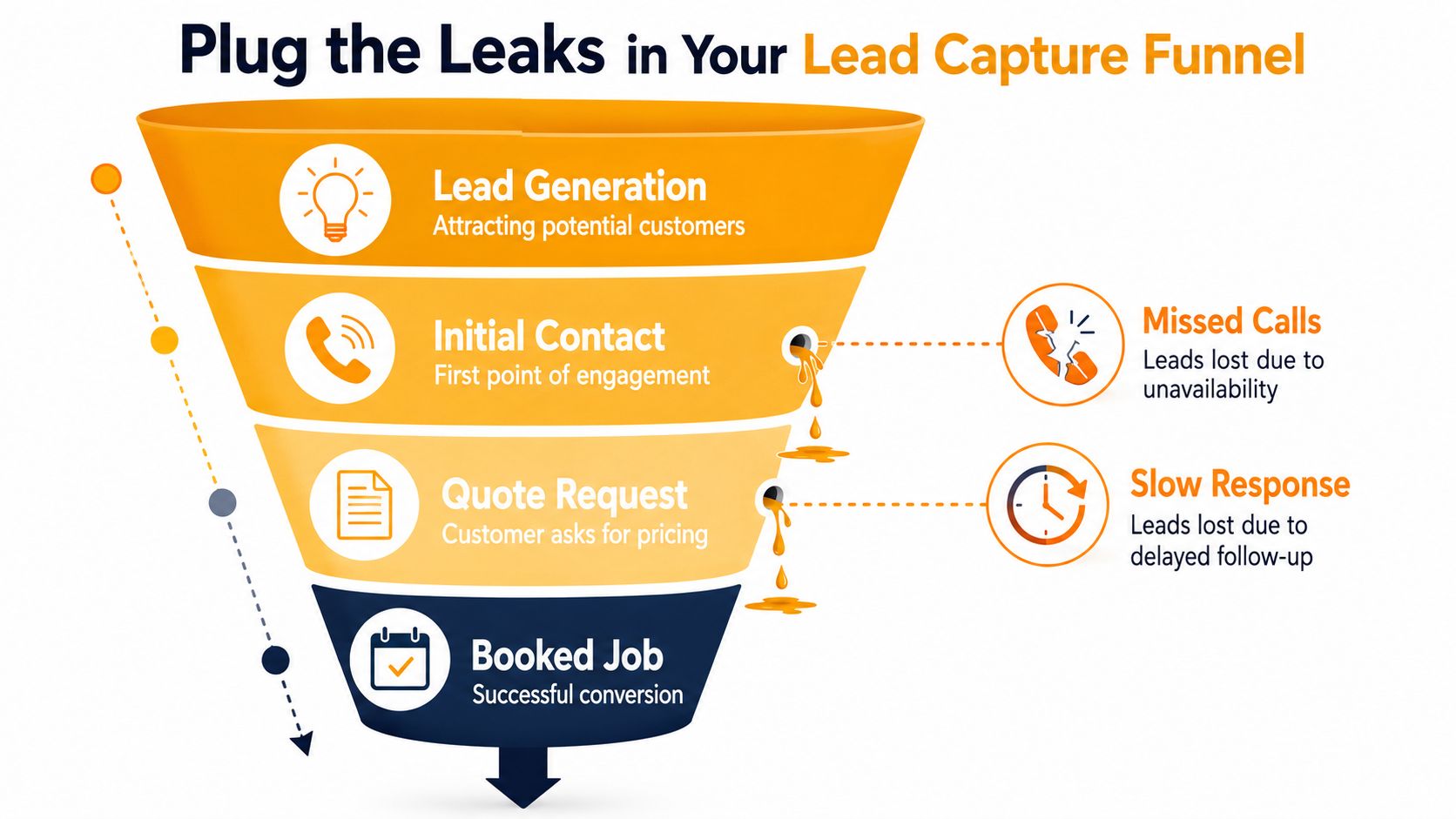
Your biggest revenue leak is usually boring. It's not your website. It's not your ad account. It's the calls and web leads your team doesn't handle fast enough.
A widely cited HBR/InsideSales study found that contacting a web lead within 5 minutes made a company 21 times more likely to qualify that lead than waiting 30 minutes, according to Built Right Digital's write-up for movers. In moving, that matters because intent fades fast. People don't submit one quote request and patiently wait. They keep dialing.
Audit where jobs are slipping away
Don't guess. Audit your front end for one week.
Look at every inbound call, web form, text, and after-hours inquiry. Then ask four blunt questions:
- Was it answered live or did it hit voicemail?
- Was a quote started immediately or pushed to later?
- Did someone follow up the same day if it wasn't booked on first contact?
- Was the lead qualified for service area, job type, and crew fit?
You'll usually find the same weak spots:
| Leak point | What it looks like | What it costs you |
|---|---|---|
| Missed daytime calls | Coordinator tied up, crews calling in, no backup | Warm leads move to competitors |
| After-hours gaps | Calls roll to voicemail nights and weekends | High-intent shoppers disappear |
| Slow web form response | Requests sit in inboxes | Intent drops before contact |
| Inconsistent intake | Different reps ask different questions | Bad quotes and weak close rates |
Practical rule: If a lead has to wait, assume you're now competing from behind.
For a clear example of what this front-end leak looks like in real moving operations, review what movers are switching to for front-end lead capture. The point isn't software first. The point is fixing the handoff between inquiry and quote.
Build a no-voicemail rule
A serious moving company needs a no-voicemail standard during business hours and a clear after-hours fallback. "We'll call them back" isn't a process. It's a hope strategy.
Set these rules immediately:
- Answer or return in minutes, not blocks of time. Don't let inbound quotes sit until the office catches up.
- Use a structured intake script. Origin, destination, move date, home size, stairs, long carry, packing, specialty items.
- Route overflow calls somewhere reliable. Peak-hour call spikes will break manual coverage.
- Review missed call logs daily. If nobody owns that report, nobody fixes it.
The companies that book more jobs aren't always generating more demand. They're losing fewer ready-to-book prospects.
Move Beyond Price with Accurate Quoting
A lot of movers think they lose jobs because they're too expensive. Usually that's not the core issue. They lose because the quote feels loose, rushed, or unreliable.
When a prospect hears a vague ballpark, they don't feel informed. They feel exposed. That pushes them to shop harder and compare you on price alone.

A vague estimate creates price shopping
Customers don't mind paying a fair rate for a mover who sounds organized. They hate surprises.
A trustworthy quote should clearly account for drivers of labor, time, and truck loading complexity. If your rep skips over stairs, elevator access, long carry distance, disassembly, shuttle needs, or bulky items, your quote isn't just weak. It's dangerous. It creates sticker shock on move day, charge disputes, and review problems later.
The fastest way to look cheap is to sound unsure.
A stronger approach is to explain your logic while you quote. Tell the customer what you're considering. That signals professionalism and shows you're pricing the actual move, not throwing out a number to get off the phone.
Standardize your quoting inputs
If three people in your office quote the same move three different ways, your sales process is broken. Fix that before you spend another dollar on marketing.
Use one quoting checklist across the company:
- Access details first such as stairs, elevator reservations, walk distance, and parking constraints.
- Inventory triggers next including appliances, safes, pianos, sectionals, glass, and fragile items.
- Service add-ons clearly like packing, supplies, storage coordination, or same-day delivery windows.
- Rate card rules consistently so minimums, travel time, hourly structure, and flat-rate logic are applied the same way every time.
Here's the standard you want. A customer should get the same pricing logic whether they call at noon on Tuesday or late Saturday afternoon.
If you want a model for tightening this up, accurate moving quotes over the phone lays out what a more consistent quoting workflow should capture. That's where better booking rate optimization starts. Not with lower prices, but with fewer surprises.
Use Strategic Pricing to Maximize Revenue
Booking more jobs only helps if those jobs make sense for your trucks, crews, and margin. A full schedule can still be a weak schedule if you're underpriced on premium dates and overcommitted on low-value work.
Good operators stop treating pricing like a static sheet and start treating it like capacity management.
Read your calendar like a revenue tool
Industry guidance highlighted in this video on dynamic pricing for movers advises owners to inspect the calendar monthly, raise prices when dates are already booking out weeks in advance, and lower them again if capacity opens up. That's how grown-up moving companies protect truck utilization and margin instead of reacting emotionally to every lead.
This matters most when your schedule gets tight. Prime Saturdays, end-of-month windows, and dense local routes shouldn't be priced the same as slower or harder-to-fill slots.
Use a simple decision lens:
| Calendar condition | Pricing move | Reason |
|---|---|---|
| Premium dates filling early | Raise rates | Protect high-demand capacity |
| Open pockets in slower periods | Lower selectively | Pull demand into unused capacity |
| Crew schedule strained | Get pickier | Avoid low-margin operational stress |
| Route fit is excellent | Quote confidently | Better logistics improve profitability |
Know which jobs to protect and which to chase
Not every inquiry deserves the same effort. Some jobs are perfect fits. Some are noise.
Push harder on jobs that match your service radius, crew strengths, and equipment setup. Be more selective when the job creates dispatch headaches, low ticket value, or ugly timing that blocks a better move.
A practical pricing review each month should answer these questions:
- Which dates are getting tight
- Which routes are easiest to service profitably
- Which job types create the most callbacks and disputes
- Where are you discounting out of habit instead of strategy
If your calendar is already tight and you're still quoting like you have empty trucks everywhere, you're buying revenue and giving away profit.
This is one of the cleanest ways to increase revenue without increasing chaos. Better pricing discipline doesn't mean fewer bookings. It means better bookings.
Build a Follow-Up Engine That Converts
Most moving companies lose the sale after the quote goes out. Not because the quote was terrible, but because nobody follows up with discipline.
The gap is operational. Public advice on booking more jobs talks nonstop about lead generation, but it gives far less attention to follow-up cadence and after-hours handling. Industry commentary has pointed out that letting a lead sit even 20 minutes can damage booking chances, as discussed in this video on moving lead response and after-hours gaps.
Use a simple follow-up sequence
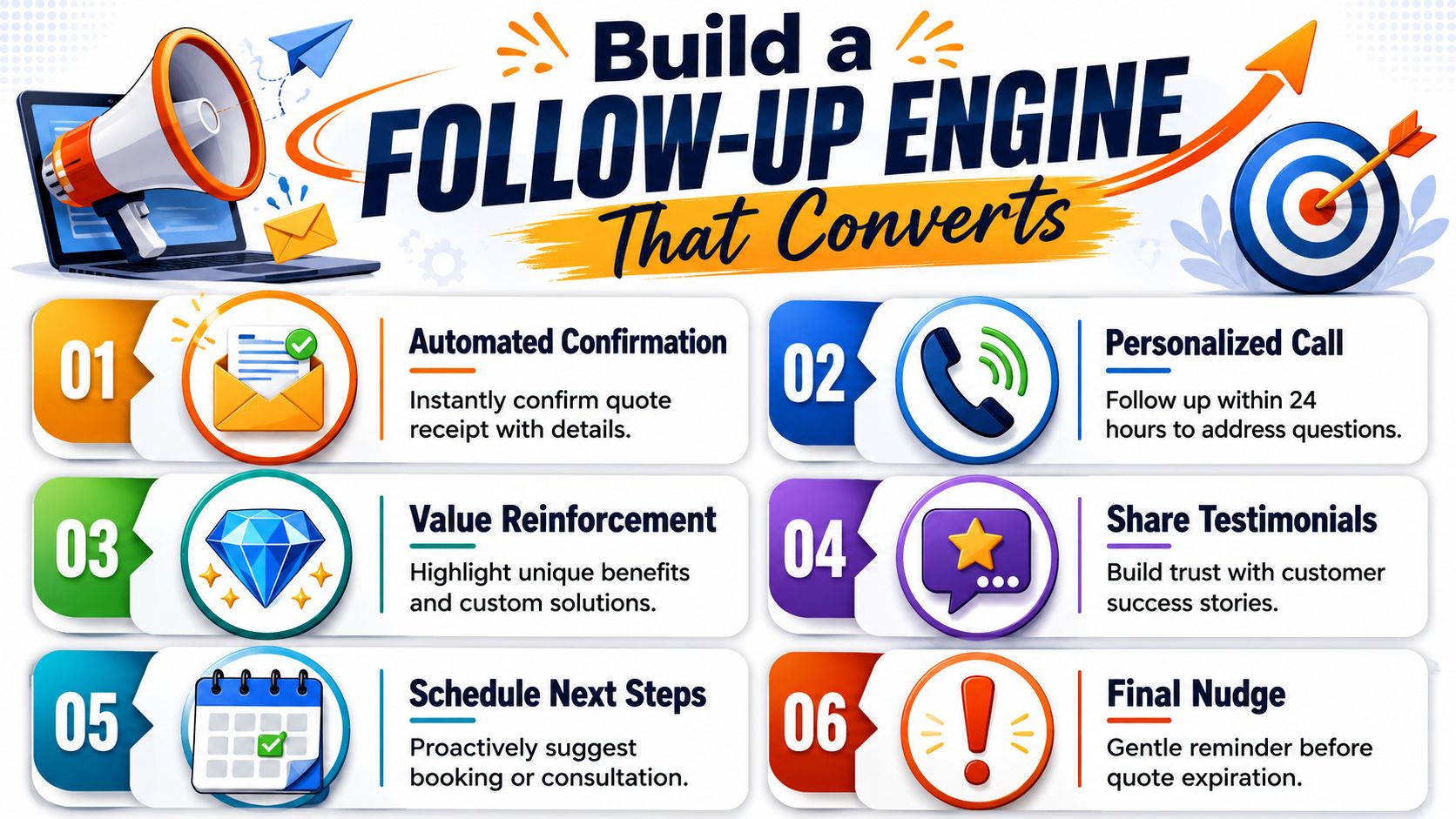
You don't need a fancy sales department. You need a repeatable sequence that every estimate enters automatically.
A good framework is the same basic principle behind RepurposeYourContent's follow-up playbook. Different industry, same truth. Timely, structured touches beat random check-ins.
Use this moving-specific cadence:
Immediate confirmation
Send the quote fast. Confirm move date, service details, and next step to book.Same-day text
Short message. Ask if they have questions about timing, access, or pricing.Next-day call
Call while the move is still fresh in their mind. Handle objections live.Value reminder
Email what makes your quote safer and cleaner. Trained crews, transparent charges, accurate scope, easier scheduling.Final nudge
Let them know premium dates don't stay open forever. Keep it professional, not pushy.
What to say in follow-up
Most reps either go soft or go awkward. They send "just checking in" messages that add no value.
Use follow-up to reduce uncertainty:
- Clarify the scope if they seemed unsure about inventory or packing.
- Reinforce trust by restating what's included and what isn't.
- Give a concrete next step such as reserving the date or reviewing final inventory.
- Make replying easy with a direct question, not an open loop.
"Are you still interested?" is weak. "Do you want me to hold the morning window for your move date?" moves the sale forward.
A CRM that only stores estimates won't fix this by itself. Somebody has to own the sequence, or automation has to run it for you. Otherwise your team sends a quote, gets busy, and leaves booked jobs sitting unclaimed.
Win Your Local Market with Trust and Visibility
Even if you tighten response time and follow-up, customers still compare options. That's normal. Storage providers and consumer moving guides commonly tell people to contact at least three different moving companies for quotes, which is why your reputation has to carry weight when you're in that comparison set, as reflected in Extra Space's guide to hiring movers.
Speed gets you into the race. Trust wins the tie-breaker.
Reviews win tie-breakers
Most local movers treat reviews like a branding task. They're wrong. Reviews are sales collateral.
When a prospect compares three bids, they're looking for reassurance that your company shows up on time, communicates well, and won't create a day-of-move mess. That's why your Google Business Profile, website testimonials, and recent review language matter so much.
Build a system, not a wish:
- Ask after successful moves when the customer is relieved and satisfied.
- Make it easy with one direct link and simple instructions.
- Coach the request so customers mention professionalism, communication, and care.
- Use reviews in sales by sending a few relevant ones with your quote follow-up.
Partnerships send better leads
The best leads often don't come from a cold Google search. They come from someone the customer already trusts.
Build referral relationships with:
| Partner type | Why it works | What to offer |
|---|---|---|
| Real estate agents | Constant flow of move-related conversations | Reliable scheduling and communication |
| Apartment managers | Frequent turns and building-specific needs | Easy booking process and COI readiness if needed |
| Storage facilities | Customers already in transition | Fast quote turnaround |
| Senior move organizers | High-trust, detail-sensitive clients | Patience, clear process, professionalism |
These leads usually arrive warmer, less chaotic, and with more context. That's a much better setup than fighting on price with strangers who found you in a search result and know nothing about your operation.
Install a 24/7 Booking Engine with Automation
Manual front-office processes break under volume. That's especially true in peak season, when moving demand is strongest from March through September, according to Rotate Digital's overview of moving demand seasonality. If you wait until the calendar is packed to fix intake, you're already late.
Automation stops being a nice add-on and becomes operating infrastructure.
Message taking is not job booking
A lot of movers think they've solved call handling because someone answers the phone. They haven't.
If the system only takes a message, collects a name, or sends an email to the office, the actual conversion work still waits on a human. That's exactly where jobs die. The customer wanted a quote, not a promise that someone will call tomorrow.
A real booking workflow needs to do more than answer:
- Capture the lead completely with move date, addresses, inventory cues, and access details
- Apply your pricing rules so the quote reflects your actual rate card and policies
- Handle after-hours demand when owners and coordinators are off the clock
- Push the job into your workflow so the booking doesn't live in a notebook, missed text, or voicemail box
Busy season exposes every weak process you tolerated in winter.
What a real booking engine should do
For moving companies, the standard should be simple. The system should help close jobs, not just log activity.
Look for a process that can:
- Answer every inbound inquiry immediately
- Qualify the lead against your service area and job fit
- Generate an accurate quote using your own rate card
- Offer booking while intent is still high
- Write the result into SmartMoving, Supermove, MoveitPro, or Google Calendar
- Trigger quote follow-up automatically if the customer doesn't book right away
That's the gap most generic tools miss. They capture a lead but don't quote it. They answer a call but don't close the job. They store the inquiry in software and hand work back to your already overloaded team.
If you want to see what this kind of workflow looks like in practice, a moving company appointment booking system should connect intake, quoting, and scheduling in one chain.
One option in this category is MoveJoy. It uses a moving company's own rate card to generate quotes on the call and can book jobs directly into systems like SmartMoving, Supermove, MoveitPro, or Google Calendar. That's a different category from a generic voice bot or traditional answering service because it handles the quoting layer that usually blocks conversion.
For owners who are serious about how to book more moving jobs, this is the operational shift that matters most. You don't need more dashboards. You need a booking engine that works when your office is busy, your crews are on the road, and customers are calling right now.
If you're tired of losing good jobs to missed calls, delayed quotes, and weak follow-up, take a hard look at your front-end process. Then see how MoveJoy fits if you want quoting, booking, and follow-up to happen automatically instead of depending on whoever happens to be free.