Accurate Moving Quotes Over the Phone: A Mover’s Guide

If you own a moving company with a few trucks, you already know the scene. The phone rings while you’re walking a crew through a load. A caller wants a price right now. You ask how many bedrooms, whether there are stairs, and if there are any heavy items. They say, “It’s just a normal move.” You give a number, hang up, and hope the job still makes sense when the truck arrives.
That routine feels efficient. It usually isn’t.
Phone quoting sits right at the intersection of sales, operations, and margin. When the process is loose, the quote is loose. When the quote is loose, one of two things happens. You underbid and give away profit, or you overbid and lose the job to a faster competitor. Accurate moving quotes over the phone don’t come from instinct alone. They come from a system that captures the right details, applies the right pricing logic, and confirms the quote in writing before the lead goes cold.
For small and mid-sized movers, that’s not a paperwork issue. It’s a revenue issue.
Why Your Phone Quotes Are Costing You More Than Just Time
A lot of owners think the phone quote problem is just about speed. It isn’t. Instead, the problem is that rushed quoting creates a leak at every stage of the job cycle. You lose leads when nobody answers. You lose bookings when the quote takes too long. You lose margin when key details never make it into the estimate.

The pressure is worst after hours and during busy season. Independent movers with 1 to 20 trucks lose $50K–$150K annually from unanswered after-hours calls, and a benchmark cited on United Van Lines’ moving quotes page says these operators convert only 15% of phone inquiries, compared with 45% for national movers with dedicated sales teams, while 60% of leads are lost after 5 PM.
That doesn’t surprise anybody who’s run a moving office. The owner is driving, dispatch is juggling crews, and calls hit in clusters. By the time someone calls back, the customer has already spoken to two or three other movers.
Fast quotes win attention, bad quotes lose trust
Customers shop moving companies quickly. They aren’t waiting around for a polished estimate next week. They want a number, they want clarity, and they want to know whether you’re organized enough to trust with their home.
A delayed quote is often treated the same as no quote at all.
The trap is obvious. To move fast, owners simplify. They quote by home size, skip the detailed inventory, and assume access is standard. That gets a number out the door, but it also creates downstream problems your crew has to absorb on move day.
What a rushed quote actually costs
A weak phone quote doesn’t just create customer friction. It creates internal friction too.
- Sales friction: The customer hears a vague range and keeps shopping.
- Dispatch friction: The office books a job without enough information to assign the right crew or truck.
- Margin friction: The crew arrives and finds stairs, a long carry, extra packing, or bulky items nobody priced.
- Review friction: The final bill feels different from the conversation, even when the extra charges are justified.
Owners often try to solve this by “training the phones better.” Training matters, but script quality alone won’t fix a broken process. You need a repeatable intake flow, consistent pricing rules, and a way to deliver the quote before the lead cools off.
The real shift
The companies that tighten up phone quoting stop treating it like a favor they do for callers. They treat it like a production system. Every question has a reason. Every answer changes labor, truck count, timing, or price. Every quote needs to be clear enough that operations can execute it without surprises.
That’s how accurate moving quotes over the phone become a growth tool instead of a gamble.
The Non-Negotiable Intake Questions for Accurate Quotes
Most inaccurate phone quotes come from one bad habit. The estimator asks for a shortcut summary instead of building the move piece by piece. “How big is the home?” is too broad. “Is it a pretty easy move?” is even worse.
A better call flow narrows the job in layers. Start with move basics. Then inventory. Then access. Then service level. If you skip a layer, you leave room for missed labor, missed materials, or missed time.
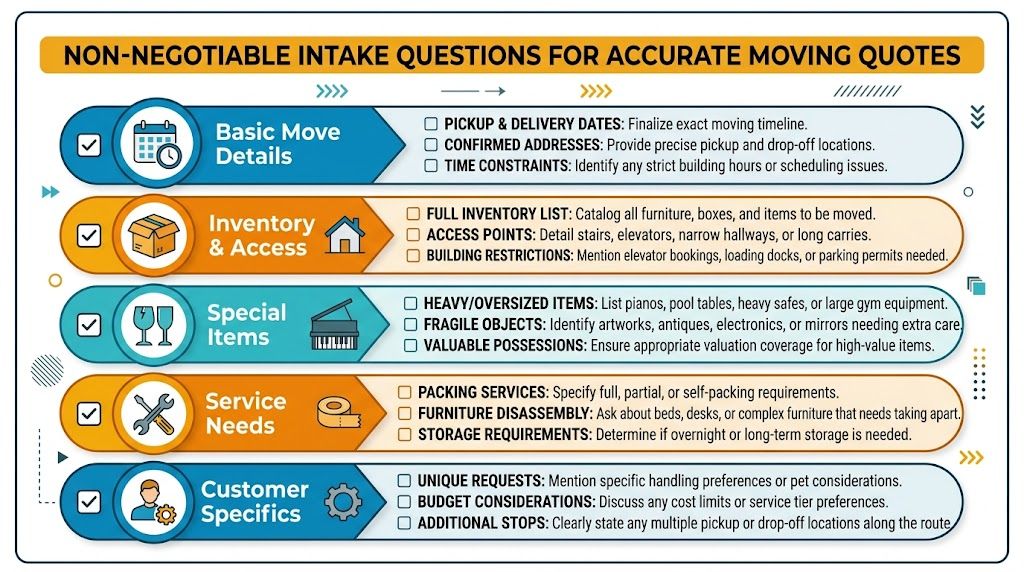
A Move.org analysis of online moving quote risks found that 52% of customers paid within $100 of their initial quote, but most variances happened because phone conversations failed to capture details like full inventories, stair access, elevators, and long carries. That’s the heart of the issue. The phone itself isn’t the problem. Incomplete intake is.
Key inventory details
Start with the origin and destination, but don’t stop at room count. Room count is a shortcut. Inventory is what prices the move.
Ask for:
- Major furniture by room: Beds, dressers, sofas, sectionals, dining tables, desks, bookcases, patio sets.
- Appliances included in the move: Refrigerators, washers, dryers, freezers, wine coolers.
- Storage areas: Garage, attic, basement, shed, off-site storage.
- Box volume: Not an exact count if they don’t know, but whether they’re lightly packed, fully packed, or still undecided.
- Anything staying behind: This keeps the inventory cleaner and prevents over-allocating labor.
A practical prompt works better than “Tell me everything you’re moving.”
Practical rule: Walk the customer room by room. People forget closets, patio furniture, garage shelving, and attic contents when you ask for a summary.
A good script sounds like this:
“Let’s go one room at a time so I can give you a cleaner number. In the living room, do you have a sofa, loveseat, recliner, TV stand, or bookcases? Then we’ll do bedrooms, kitchen, garage, and any storage areas.”
That approach lowers guesswork without making the call feel like an interrogation.
Critical access and logistics questions
Small movers lose margin in these scenarios. The furniture may be normal. The building usually isn’t.
Ask every caller:
- Are there stairs at pickup or delivery? If yes, how many flights?
- Is there an elevator? If yes, is it a service elevator and does it require a reservation?
- How far can the truck park from the entrance? You need to know whether it’s curbside, alley access, loading dock, or a long carry.
- Any narrow hallways, tight turns, or building restrictions?
- Any time windows or HOA rules?
- Any shuttle risk because the truck can’t get close?
This part of the intake often decides whether a quote is realistic. A second-floor apartment with straightforward truck access is one job. A second-floor walkup with a long hallway, limited parking, and an elevator reservation issue is another.
If you want a stronger front desk process, use a fixed checklist for every call. A simple reference like this guide on how to answer a call for moving leads can help standardize what your team asks and when they ask it.
Service level and special items
A lot of movers ask about pianos and safes, then stop there. That leaves money and labor planning on the table.
You also need to ask about:
- Packing help: Full pack, partial pack, fragile-only, or labor only.
- Disassembly and reassembly: Beds, desks, gym equipment, dining tables.
- Protection needs: Fragile art, mirrors, glass tops, antiques.
- Stops: Storage pickup, split delivery, or multiple addresses.
- Special pieces: Gun safes, treadmills, oversized sectionals, large aquariums, commercial equipment.
A natural script beats a rigid script
Owners sometimes resist scripts because they don’t want the call to sound robotic. Fair point. But there’s a difference between reading lines and following a sequence.
Use a conversational sequence:
- Confirm the move basics first. Date, zip codes, home type.
- Build inventory by area. Keep the customer moving mentally through the home.
- Pin down access. Access details reveal potential hidden labor.
- Clarify service level. Packing, assembly, storage, special handling.
- Repeat back the scope. This catches errors before pricing.
That last step matters. Repeat the job back in plain English before quoting. If the customer hears you summarize accurately, they’re more likely to trust the number.
The Quoting Logic Hourly vs Flat-Rate Pricing
A lot of quote problems don’t start with the intake. They start when the mover uses the wrong pricing model for the job.
Some owners default to hourly because it’s simpler. Others push flat-rate because customers like certainty. Both can work. Both can also create disputes if the pricing model doesn’t match the move profile.
The fix is to choose the model based on control. If the scope is still fluid, hourly often protects the business better. If the scope is well-defined and the route is stable, flat-rate can make the sale easier.
Hourly vs. Flat-Rate Quoting Decision Matrix
| Factor | Hourly Rate | Flat-Rate |
|---|---|---|
| Scope clarity | Better when inventory or access details may still shift | Better when the full scope is clearly documented |
| Local short-distance jobs | Usually a cleaner fit | Can work, but only with strong intake |
| Customer expectation | Best for callers who understand time-based billing | Best for callers who want a fixed number |
| Risk to mover | Lower risk when variables remain open | Higher risk if intake misses labor or access details |
| Sales advantage | Easier to explain for smaller jobs | Often easier to close when shoppers compare quotes |
| Operational discipline required | Strong crew time tracking | Strong estimating accuracy and scope control |
| Change orders | Simpler to handle | Must be clearly defined in advance |
When hourly pricing makes sense
Hourly pricing works best when the move is local and there are enough unknowns that locking a total would be risky. That usually includes smaller residential jobs, same-city relocations, and situations where the customer isn’t fully packed or can’t clearly confirm inventory.
Use hourly when:
- The inventory is still moving. The customer says they may add storage items or haven’t finished deciding.
- Packing status is uncertain. Loose packing creates delays that don’t belong inside a hard flat rate.
- Access details are incomplete. If nobody knows the truck distance, elevator rules, or building restrictions, hourly gives you room to protect labor.
- The customer is booking quickly. A local move can often be sold faster when the scope is clearly explained.
What matters is how you present it. Don’t say, “It’s hourly, so we’ll see what happens.” Say exactly what drives time and what can change it.
“For this type of local move, hourly is the fairest model because labor time depends on packing readiness, access, and how close we can get the truck. I’ll spell out the assumptions so you know what keeps the job on track.”
That language builds trust because it explains the logic, not just the price.
When flat-rate pricing makes sense
Flat-rate pricing works when the move has enough definition that you can commit to the scope with confidence. That often includes long-distance jobs, larger homes with documented inventory, and moves where certainty helps win the booking.
Flat-rate becomes stronger when you have:
- A detailed room-by-room inventory
- Confirmed access conditions at both ends
- A clear service scope
- Known timing and route conditions
Flat-rate doesn’t mean guess-and-hope. It means you price the full scope and define what’s included.
A lot of owners lose money here because they treat flat-rate as “all in” without boundaries. That’s not customer-friendly. That’s just vague. Every flat-rate quote should state the included inventory, services, addresses, and assumptions that support the price.
For teams trying to tighten this process, a structured resource on how to estimate moving costs can help operators line up scope, labor, and pricing method more consistently.
The communication side matters as much as the math
Customers don’t argue with pricing models as much as they argue with surprises. If you choose hourly, explain the clock. If you choose flat-rate, explain the scope.
Use these guardrails on every phone quote:
- State what’s included. Labor, truck, standard equipment, travel if applicable.
- State what can change. Added inventory, extra stops, packing not discussed, access conditions that differ from the call.
- Repeat the assumptions. “This quote assumes third-floor delivery with elevator access and reserved loading.”
- Send it in writing. Verbal clarity helps. Written clarity protects the job.
A strong quoting operation doesn’t just know how to price. It knows when each pricing model creates the least risk and the most trust.
Pricing the Details That Kill Your Margin
Most phone quotes don’t fall apart because the base move was priced badly. They fall apart because the extra labor was never priced at all.
Stairs, long carries, elevator delays, disassembly, packing, shuttle issues, and awkward specialty items are where margin disappears. If those details stay vague during intake, they become “surprise charges” in the customer’s mind and unpaid work in yours.
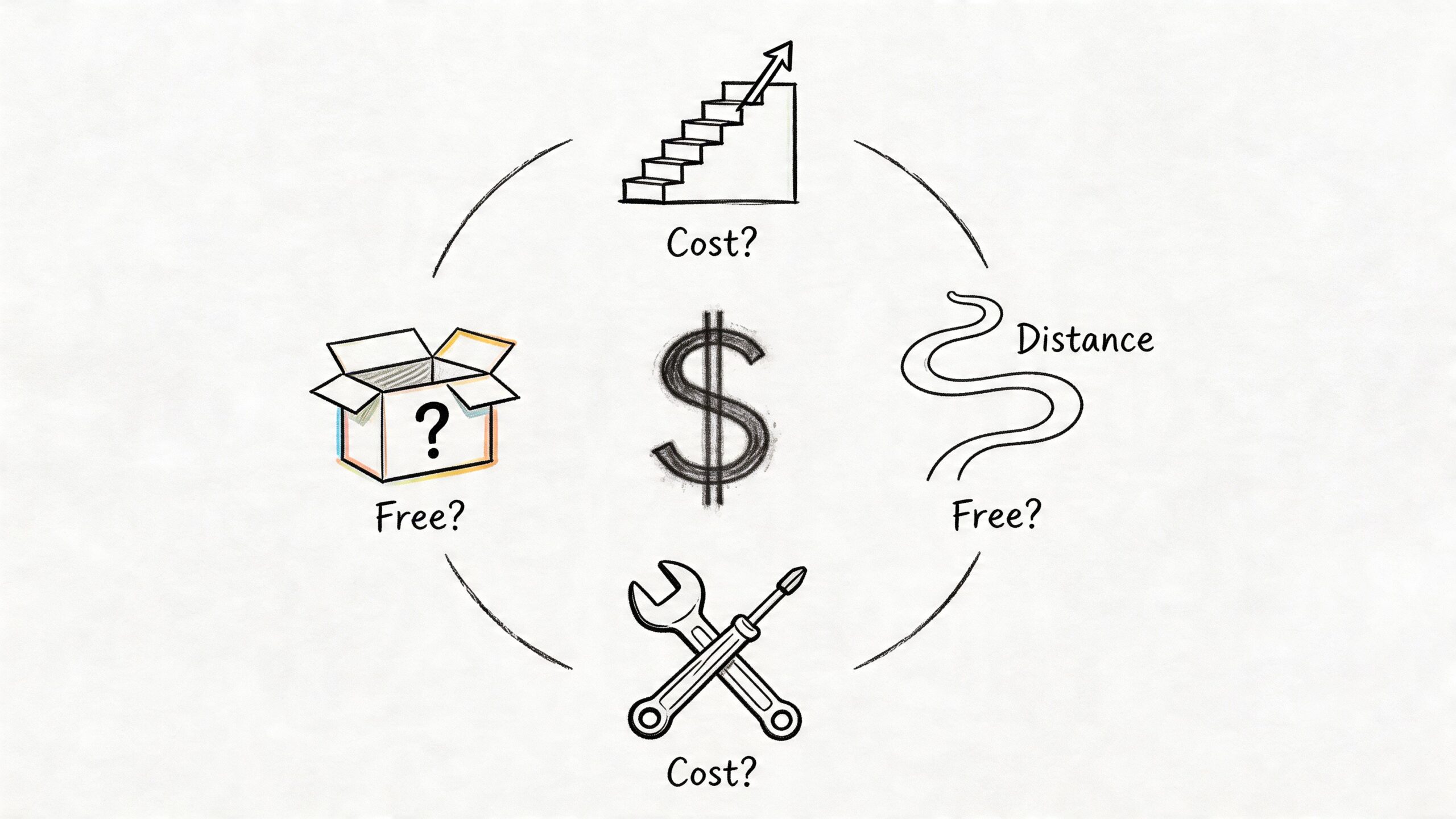
A complaint benchmark cited on LiteMovers’ phone estimate page says 35% of customer disputes and negative reviews stem from unmentioned or vaguely priced accessorial charges such as stairs, long carries, or shuttle services. That’s why these items need their own rules in your quoting system.
Build charge rules before the phone rings
If your estimator decides accessory pricing in the moment, the process will be inconsistent. One caller gets stair charges waived. Another gets a vague “we’ll figure it out on site.” That’s how trust and margin both erode.
Create written pricing rules for the items that most often distort labor:
- Stairs: Define when a stair charge applies and what counts as a flight.
- Long carries: Define the distance threshold and how the charge is applied.
- Elevator delays or reservations: Clarify who secures the reservation and what happens if loading access isn’t ready.
- Shuttle situations: Price this separately when a full-size truck can’t access the property.
- Assembly and disassembly: Decide which items are included and which require extra labor.
- Packing: Separate full-pack, partial-pack, and fragile-only service.
You don’t need a complicated spreadsheet to start. You need consistent rules your team can explain.
Quote the condition, not just the truck
One mistake I see often is pricing by truck and crew only. That works only when the homes are easy, the buildings are straightforward, and the customer is fully prepared. Real jobs aren’t that clean.
Price according to job conditions:
| Margin killer | What to confirm on the call | What to do operationally |
|---|---|---|
| Stairs | Number of flights at both ends | Add the stair rule to the written quote |
| Long carry | Where the truck can legally and practically park | Flag labor impact before booking |
| Elevator access | Reservation needed, service elevator available, time limits | Confirm with customer before dispatch |
| Assembly work | Which items need breakdown or setup | Assign the right crew tools and time |
| Packing | Whether items are already packed and what level of help is needed | Separate labor and materials clearly |
Present extra charges professionally
Accessory pricing only feels like nickel-and-diming when the mover introduces it late. When you present it early, it reads as competence.
Use language like this:
“To keep your quote accurate, I’m including the access conditions we discussed. That means the pricing reflects the stairs at pickup, the longer walk from the loading area, and the bed disassembly you asked us to handle.”
That sentence does two things. It protects your margin, and it signals that your company listened.
Keep the written quote aligned with the phone call
Every accessory you discuss should appear in writing. Not buried in a generic disclaimer. Listed in normal language the customer can understand.
A clean quote confirmation should show:
- Addresses and dates
- Inventory summary
- Service scope
- Access conditions
- Any conditional items that could affect final price
When operators tighten this part of the process, they don’t just reduce disputes. They make it easier for dispatch, crews, and customers to work from the same version of the job.
Common Phone Quoting Pitfalls and How to Fix Them
Most bad quotes don’t come from one giant mistake. They come from a handful of small ones that stack up. A missed question here, a rushed assumption there, and by move day the estimate no longer matches reality.
Manual phone quoting also puts a hard ceiling on consistency. On The Move’s discussion of over-the-phone quote issues cites SmartMoving data showing manual estimators average 20 minutes per quote with error rates above 15%, often leading to final bill variances of 20-30%.
Pitfall one, trusting the customer’s summary
“It’s just a small two-bedroom” is not an inventory. It’s a headline.
Customers usually aren’t trying to hide the scope. They just don’t think like estimators. They forget patio furniture, garage shelving, attic storage, and the treadmill that nobody has touched in a year.
Fix: Slow down and rebuild the move room by room. If a caller gives you a summary, treat that as the starting point, not the quote basis.
Pitfall two, letting the call drift
A lot of owners know what to ask, but they ask in a different order every time. That creates holes. One call covers stairs but misses packing. Another covers inventory but misses truck access.
Fix: Use one intake order for every single call.
A simple sequence works:
- Move date and addresses
- Inventory by room
- Access at both ends
- Special items and services
- Pricing model
- Written confirmation
That order keeps the quote anchored to operational reality.
Pitfall three, quoting before repeating the scope
If you quote immediately after gathering details, you’re assuming both sides heard the same thing. That’s risky.
Fix: Summarize the move back before giving the number.
“I’ve got a two-bedroom apartment, second-floor pickup with one flight of stairs, elevator at delivery, bed disassembly, and some garage items including shelving and tools. If that sounds right, I’ll price it from there.”
That recap often catches the missing detail that would have cost you money.
Pitfall four, failing to account for readiness
A move can look straightforward on paper and still run long because the customer isn’t packed, labels aren’t ready, or access hasn’t been coordinated.
Fix: Ask readiness questions directly.
- Are boxes fully packed and sealed?
- Do you need us to bring materials?
- Is the elevator reserved?
- Will someone be onsite and ready when the crew arrives?
These questions don’t just protect the estimate. They protect the schedule.
Pitfall five, no immediate written follow-up
A verbal quote with no confirmation tends to morph in the customer’s memory. By the next day, they remember the lowest number and none of the conditions.
Fix: Send the quote in writing right away. Include scope, assumptions, and next steps to book.
Pitfall six, too much estimator discretion
When one person applies travel one way, another rounds it differently, and a third waives access charges to “save the sale,” your front office stops acting like a system.
Fix: Turn pricing decisions into rules. The estimator should gather facts and apply the rate card, not invent policy on the fly.
Pitfall seven, trying to do it all while running the field
Owners answering quotes from the cab or the job site often believe they’re saving payroll. In reality, they’re splitting focus between operations and sales, and both suffer.
The answer isn’t just more hustle. It’s cleaner separation between intake, pricing logic, and booking. That’s what allows accurate moving quotes over the phone to scale instead of depending on whether the owner happens to be free.
The Automation Playbook How AI Delivers Perfect Quotes 24/7
If you own a moving company, you already know the pattern. You’re pricing jobs between dispatch problems, payroll questions, claim issues, and crews calling from the road. Then a good lead comes in at 7:40 p.m., nobody answers cleanly, and the customer books with the company that gave them a clear number first.
That is not a hustle problem. It is a systems problem.
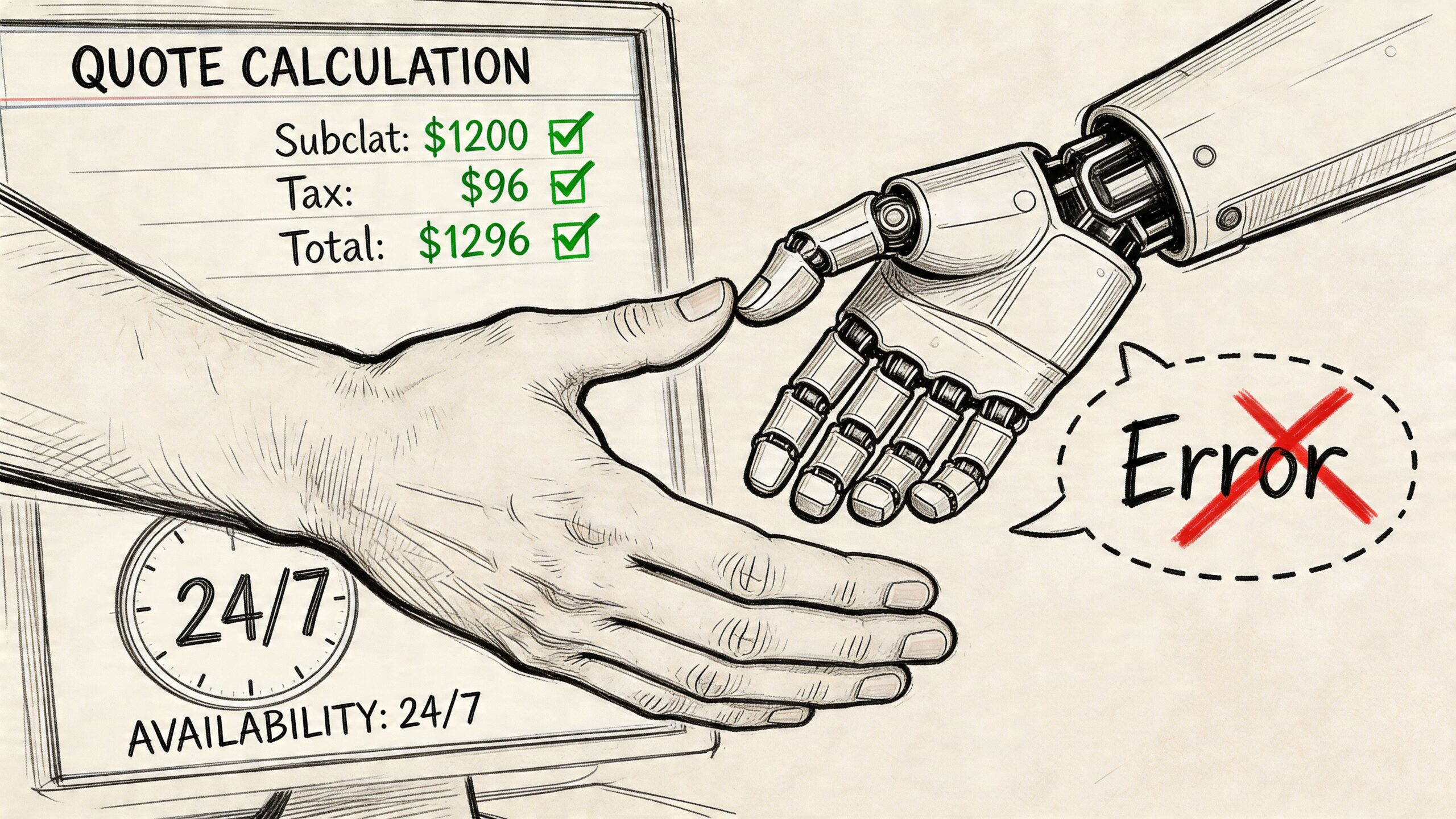
Automation earns its place when your quoting process is too important to depend on office availability. The goal is not to replace judgment. The goal is to capture the same intake, pricing logic, and follow-up steps every time, including after hours, on weekends, and during peak-season call spikes.
A working AI phone quoting system for movers should do more than answer the phone. It should run a full quoting workflow.
It should:
- Pick up immediately
- Guide the caller through move details in the right order
- Ask follow-up questions based on what the customer says
- Capture inventory, access limits, special items, and added services
- Apply your company’s pricing rules for hourly or flat-rate jobs
- Produce a quote during the call
- Send written confirmation
- Pass the job into your CRM or calendar so booking does not stall
That last step is where a lot of tools fall short. Message-taking software creates more admin work. Generic answering services create delays. A quote system has to move the job closer to booked revenue, not just leave a note for someone to call back tomorrow.
For movers comparing tools, the key test is fit. A general voice bot may sound polished, but if it cannot handle travel time, stair charges, long carries, packing labor, shuttle needs, or valuation options, your team is still cleaning up bad inputs later. Good software for estimating moving jobs connects call intake to the actual pricing logic movers use in the field.
MoveJoy is one example of that category. It collects job details during the call, applies the mover’s own rate card, and can push the result into systems like SmartMoving, Supermove, MoveitPro, or Google Calendar. That matters when the office is backed up and the owner is still expected to quote like a top rep while running operations.
Automation also forces a healthy discipline on the business. If your rules are inconsistent, the system will expose it fast. If your crew minimums, travel policy, packing charges, and access fees are clearly defined, the system will apply them the same way at 10 a.m. and 10 p.m.
That consistency protects margin.
Owners often start looking at AI because they are tired of missed calls. Fair enough. The bigger win is quote consistency, faster response time, and fewer judgment calls from stressed staff. The broader case for that approach is covered well in this piece on AI for small business marketing, especially the parts about using automation to improve speed and follow-through instead of adding more manual work.
The best phone quoting setup is simple to describe and hard to break. Define the rules once. Let the system ask, calculate, send, and log every quote the same way, every time.
Stop Guessing Start Systematizing
The companies that improve phone quoting don’t become more clever. They become more consistent.
They stop pricing from bedroom count alone. They stop leaving stairs and long carries to chance. They stop treating every caller differently depending on who answered the phone that day. Instead, they build a repeatable system for intake, pricing logic, written confirmation, and booking.
That shift matters because accurate moving quotes over the phone are really about operations discipline. The sale improves when the process improves.
If you’re working on the front end of your business, it also helps to think beyond ad spend and focus on cleaner inputs, cleaner follow-up, and cleaner decision-making. This short piece on data-driven marketing is a good reminder that better results usually come from better systems, not louder activity.
Manual improvements are worth making today. But if your company is still losing jobs because calls go unanswered or quotes stall when the office gets busy, the long-term fix is automation that can quote and book, not just answer.
If you’re tired of losing revenue between the first ring and the final booked job, take a look at MoveJoy. It gives moving companies a way to turn inbound calls into accurate quotes and booked jobs directly inside their CRM or calendar, even when nobody in the office is free.