Peak season exposes every weakness in a moving company’s front office.
You’re on a job, a crew lead is asking about access, dispatch is juggling tomorrow’s route, and a new customer calls for an estimate. It goes to voicemail. By the time you call back, they’ve already booked with the mover who answered first and gave them a usable quote.
That’s the core issue behind moving quote software. The problem isn’t the missed call by itself. The problem is the lost booked job that never had a chance to reach your calendar.
Most owners I talk to don’t need more software tabs. They need fewer moments where they are personally acting as the sales desk, estimator, and closer. If the business only moves when the owner answers the phone, the sales process breaks the second the owner steps onto a truck, walks into a survey, or goes home for dinner.
Fast response wins in local moving. Faster quoting wins even more. Customers don’t usually reward the mover with the nicest spreadsheet. They reward the mover who answers quickly, sounds organized, and gives a quote they can act on.
A lot of operators underestimate how expensive that gap is until they look at it closely. If you want a blunt breakdown of what missed calls indeed do to a small moving company, this write-up on the true cost of missing 4 calls per week lays out the business impact clearly.
Introduction The Cost of a Single Missed Call
A single missed call during busy season rarely stays a single missed call. It turns into a lead you never qualified, a quote you never delivered, and a job that lands on someone else’s board.
For a 1 to 20 truck operation, that happens in very ordinary moments. You’re walking a customer through a damage concern. You’re checking a tight staircase on-site. You’re driving between jobs. The phone rings, and the person calling wants what every moving customer wants right away: availability, confidence, and a price that makes sense.
What owners usually get wrong
Many movers think they have a phone problem. Most have a booking problem.
If a tool only captures the caller’s name and number, it hasn’t solved the hard part. It has created a follow-up task. Someone still has to call back, ask the same intake questions, build the quote, send it, chase it, and hope the customer hasn’t kept shopping.
Practical rule: If your system can’t turn an inbound lead into a real quote fast, you’re still depending on manual rescue work.
That’s why the winner in a lot of local markets isn’t the company with the slickest branding. It’s the company that responds first with something useful. A serious quote beats a polite voicemail every time.
Why this matters more now
The moving software category has become a serious operating investment, not a side tool. The global moving company software market was valued at USD 17.48 billion in 2026 and is projected to reach USD 38.11 billion by 2035, growing at a 9% CAGR, with about 70% of moving companies adopting cloud-based solutions to improve quoting and lead management, according to Business Research Insights’ moving company software market report.
That growth makes sense. Owners are done babysitting leads at night and rebuilding quotes from memory the next morning. They want a system that standardizes pricing, protects margins, and gets quotes out while the customer is still ready to buy.
What Is Moving Quote Software Really
Many people hear “moving quote software” and think of a website calculator. That’s too small a definition.
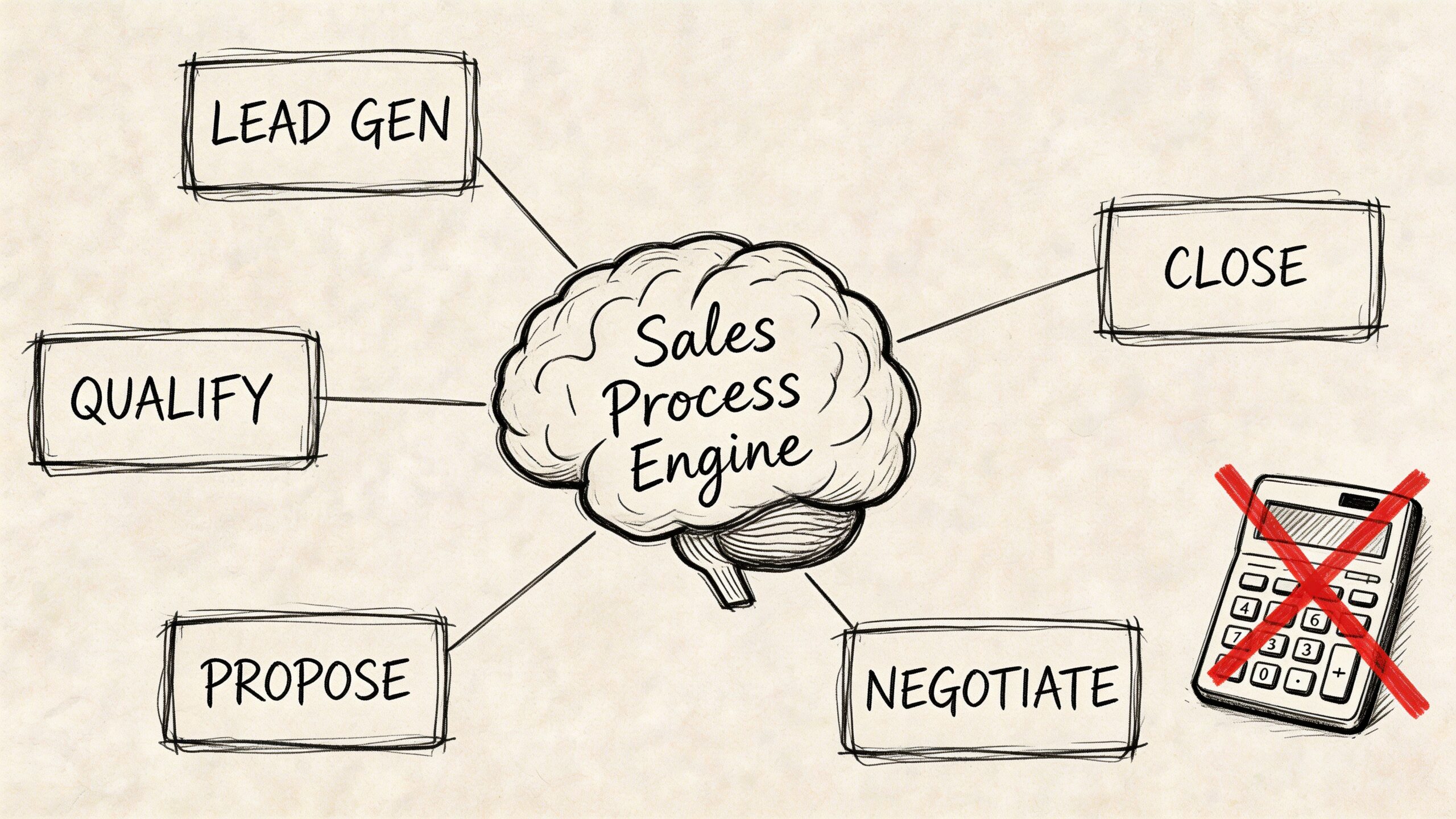
Effective moving quote software is your sales process engine. It takes your pricing rules, your service model, and your qualification steps, then applies them the same way every time a lead comes in.
It is not just an estimate form
A basic form collects information. A real quoting system evaluates it.
That means it can work from your hourly rates, flat-rate logic, truck minimums, travel time policies, packing add-ons, storage rules, and service-area specifics. It should produce a quote that matches how your office would price the job on a good day, not how someone guesses at it during a rushed callback.
Here’s the difference in plain terms:
| Tool type | What it does | What it does not solve |
|---|---|---|
| Simple web form | Captures lead details | Doesn’t create a trustworthy quote |
| Basic CRM intake | Stores prospect information | Doesn’t remove the quoting bottleneck |
| True moving quote software | Applies rate logic and generates a bookable estimate | Still needs good setup and integration to work well |
The primary job of the software
The software’s job is to remove the owner as the bottleneck.
When owners quote everything themselves, revenue is limited by attention span and availability. Jobs pile up in the inbox. Follow-ups happen late. Rates get applied inconsistently. Office staff start texting the owner for approval on every edge case.
That’s not scale. That’s dependency.
A moving company grows when pricing stops living in one person’s head.
Good moving quote software turns tribal knowledge into repeatable process. It gives dispatch, sales, and intake a shared ruleset. It also reduces the usual friction between “I got the lead” and “we booked the job.”
What mature operators look for
Owners who’ve been burned by generic tools usually stop asking, “Does it have quoting?” and start asking better questions:
- Can it handle my rate card?
- Can it quote the same way my office does?
- Can it produce something a customer can accept immediately?
- Can it feed the next step without retyping everything?
That’s the right lens. Moving quote software matters because it standardizes how revenue gets created. If it doesn’t do that, it’s just another place to store half-finished work.
The Quoting Logic That Wins Jobs
The mover who quotes faster wins more jobs. Not because every fast quote is perfect, but because customers buy from the company that removes uncertainty first.
In this business, speed only helps if the quote is credible. A fast bad quote creates callbacks, disputes, and unprofitable jobs. A fast accurate quote closes.
The variables that separate real systems from generic tools
Moving quotes break when software ignores how movers price work.
A customer doesn’t call and say, “Please provide one standard estimate.” They say they’re moving out of a second-floor walkup, the truck can’t park close, they need help with packing, and there’s a piano involved. Generic systems often start falling apart at this point.
A quoting engine that helps a mover has to account for things like:
- Pricing model choice: Hourly jobs and flat-rate jobs need different logic.
- Minimums and timing: Some companies price differently by day, distance, or booking window.
- Access conditions: Stairs, elevator limits, long carries, and shuttle situations affect labor and time.
- Special handling: Pianos, safes, fragile items, bulky assembly, and premium packing can’t be treated like standard furniture.
- Crew and equipment assumptions: The quote has to reflect the labor plan you’ll use.
Why instant detail beats vague speed
A vague “starting at” number may get attention, but it often pushes the substantive work to later. The customer still doesn’t know what they’ll pay. Your office still has to qualify the move properly. The lead still isn’t really closed.
What wins jobs is a quote that sounds like it came from someone who understands moving. It addresses the specifics the customer already knows matter. That gives the caller confidence that you’re not just trying to get them off the phone.
Customers don’t want a magic number. They want to feel that your company understood their move.
That’s why purpose-built quoting logic matters so much. The software should know that a two-bedroom walkup with a long carry is not just a “small move.” It should treat those conditions as cost drivers, not footnotes.
Accuracy protects margin, not just conversion
Owners sometimes frame quote accuracy as a sales issue. It’s also an operations issue.
A weak quote creates trouble later:
- The office promises one thing. The crew arrives expecting another.
- The customer argues at the truck. Your team starts the day on defense.
- Margin disappears. The job takes longer, requires more effort, and creates a bad review risk.
That’s why I tell movers to stop separating sales from operations. The quote is the first operational plan for the job. If that plan is wrong, the entire day starts wrong.
What works in practice
The best quoting process is usually simple from the customer’s side and strict behind the scenes.
That means:
- Ask fewer but better questions.
- Use your own rate card, not broad templates.
- Build clear rules for common edge cases.
- Treat booking as the goal, not “sending something over.”
If your team still says, “We’ll call you back after the owner reviews it,” your quote process is too fragile. The market moves faster than that. The movers who quote quickly and correctly don’t just look more professional. They take the job before the customer opens the next tab.
Human Answering Service vs Generic AI vs Moving Software
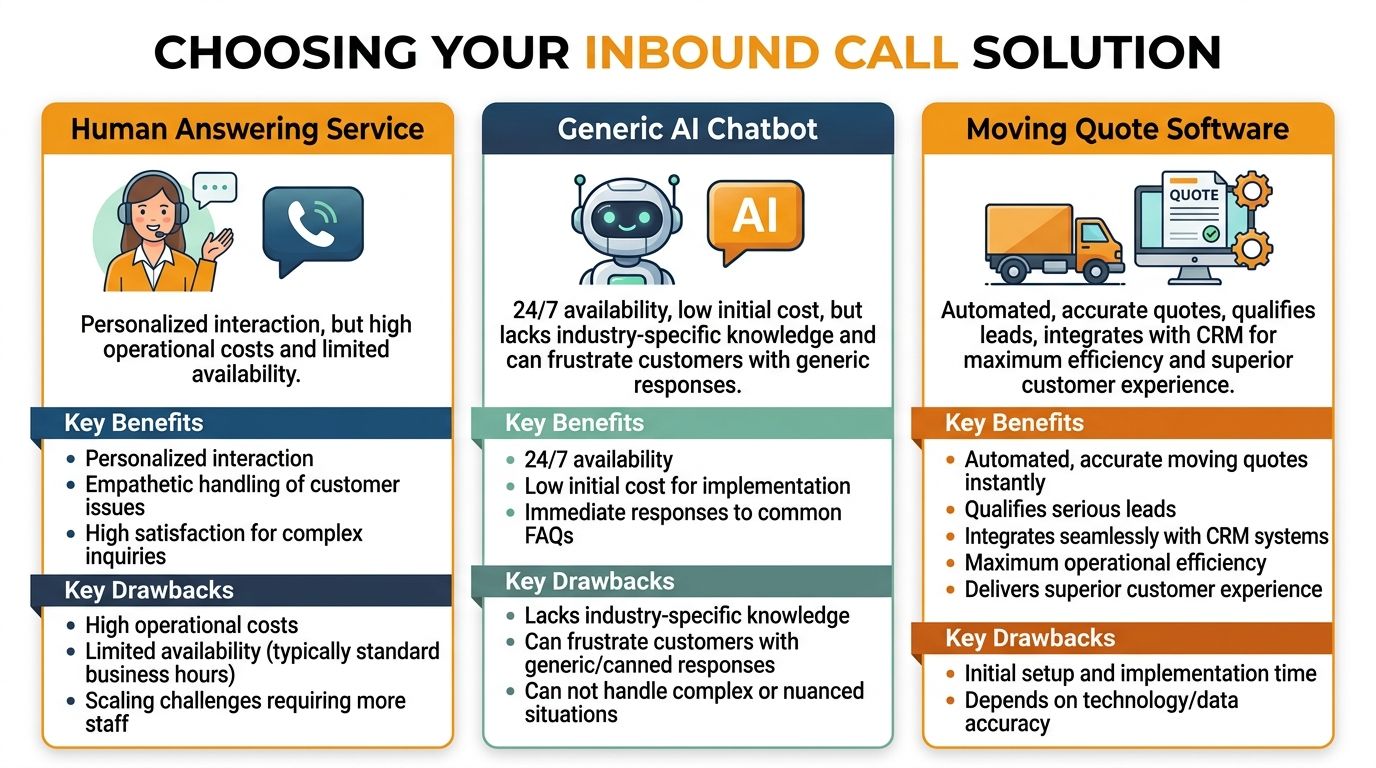
Most movers comparing options for inbound calls ask the wrong first question. They ask who can answer the phone. The better question is who can quote and book the job while the customer is still ready to move forward.
That difference changes everything.
Side by side comparison
| Option | Can it capture the lead | Can it generate an accurate moving quote | Can it book the job | Works after hours | Effect on owner workload |
|---|---|---|---|---|---|
| Human answering service | Yes | Usually no | Usually no | Yes, depending on service coverage | Still creates callback and manual quoting work |
| Generic AI voice tool | Yes | Often struggles with moving-specific logic | Sometimes captures intent, often not a true booking | Yes | Can reduce message-taking, but often adds cleanup |
| Purpose-built moving quote software | Yes | Yes, if configured to your rate card | Yes, when connected to your booking flow | Yes | Reduces intake, quoting, and follow-up burden |
Human answering services are polite, but limited
A human answering service can help if your current alternative is voicemail. That’s real improvement.
But most of these services are built to answer, reassure, and pass along a message. They are not trained on your stair policy, your travel fee logic, your flat-rate exceptions, or your calendar rules. So the lead still waits for someone on your side to do the hard part.
That creates a common problem. Owners feel better because calls got answered, but bookings don’t improve as much as expected because the service didn’t produce a quote or secure the job.
Generic AI sounds modern, but often misses the move-specific details
Generic AI voice tools can answer around the clock and handle basic conversation flow. For some businesses, that’s enough.
Moving is not one of those businesses.
A 2026 software comparison found that many top CRM platforms offer strong core features but still lack the native AI-powered tools needed for instant complex quoting, which is exactly the gap specialized quoting software fills. That distinction matters because the failure point usually isn’t whether a bot can say hello. It’s whether it can handle real pricing logic on a real move.
If a system can’t interpret moving-specific conditions well, it becomes a lead collector with a nicer voice.
Operational truth: Capturing a lead is not the same thing as closing a job.
That’s also why generic customer service automation often disappoints movers. It can work for appointment reminders or simple FAQs, but moving calls are qualification calls, pricing calls, and sales calls at the same time. If you want a broader view of where automation helps and where it falls short, this explanation of automated customer service is worth reading.
Purpose-built moving quote software closes the gap
Purpose-built moving quote software does the one thing the other options usually don’t. It applies moving-specific logic during the initial interaction and keeps the conversation moving toward a booked job.
That means the system can qualify the move, produce an estimate based on your own pricing structure, and push the result into the workflow you already use. It doesn’t stop at “we took a message.”
This is also where one category of tool stands apart from both answering services and generic bots. Some purpose-built systems can generate an accurate quote instantly through voice, SMS, or email without the owner getting involved. For example, MoveJoy is built to answer the inbound call, qualify the move, generate a quote using the company’s own rate card, and book directly into the CRM or calendar. That’s not message handling. That’s front-end revenue automation.
What works for small and mid-sized movers
If you run a small operation, the best setup is usually the one that removes handoffs.
Every handoff creates delay:
- Answering service to office
- Office to owner
- Owner to customer
- Customer back to office
- Office into CRM
That chain is where deals slow down and disappear.
A mover doesn’t need a front desk that sounds busy. A mover needs a system that converts the caller into a scheduled job with as little friction as possible. When owners evaluate inbound tools through that lens, the trade-offs become obvious fast.
Calculating the ROI of Automated Quoting
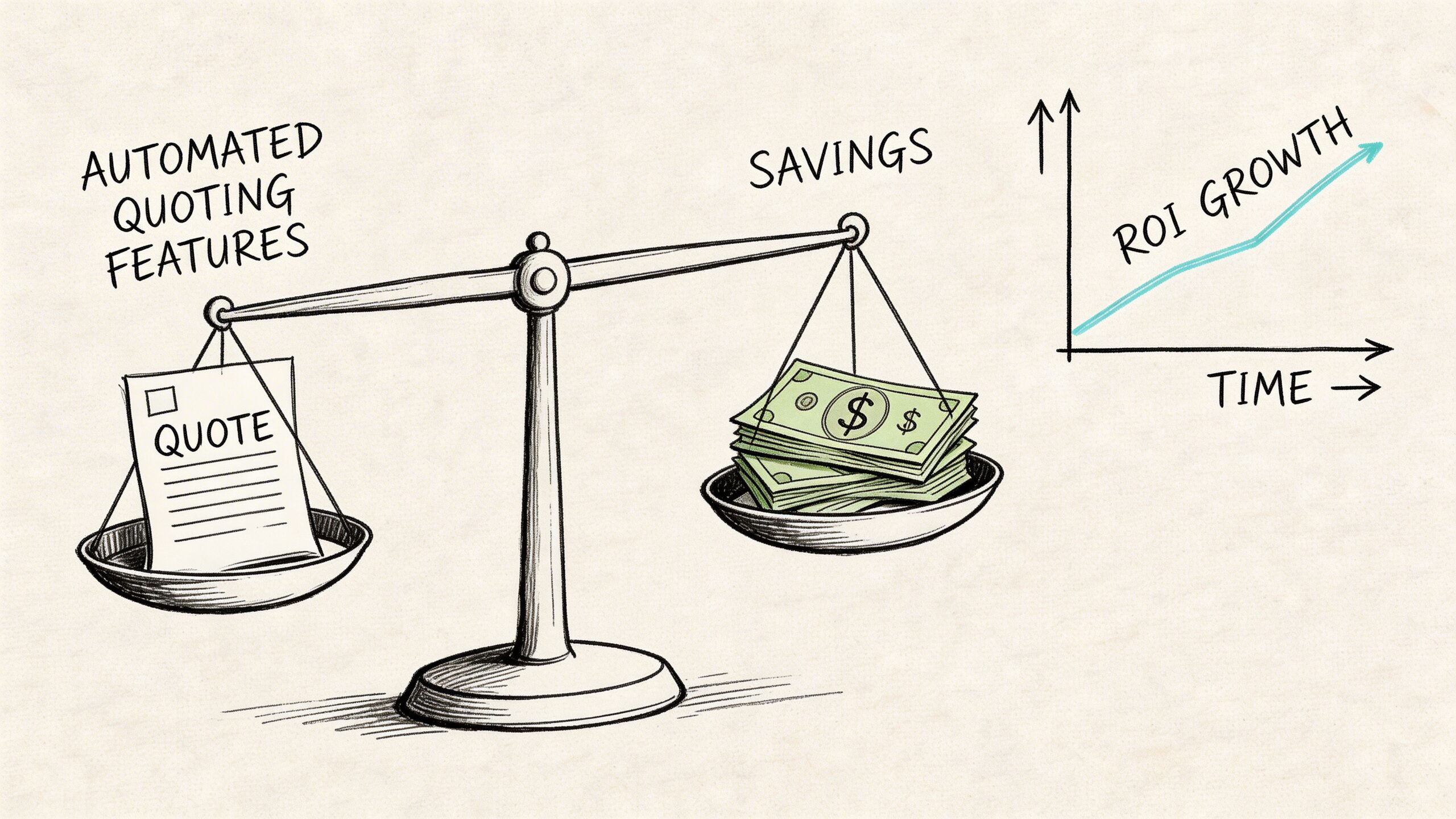
Owners often look at moving quote software as a monthly expense. The better way to look at it is by asking what revenue leaks stop once quoting becomes immediate and consistent.
The strongest ROI usually doesn’t come from one dramatic change. It comes from stacking small operational wins that happen every week.
The benchmark that should get your attention
Moving companies using specialized CRM and quoting software have reported major financial upside. Automated follow-ups and faster quoting can boost annual revenue by as much as $277,200 from improved lead conversion alone, and the software cost represents 0.4% of revenue for a $1.5M firm, according to this breakdown of CRM ROI for moving companies.
That matters because it reframes the decision. You’re not buying software to organize your office. You’re protecting conversion, speed, and pricing discipline.
Three places owners usually feel the payoff
After-hours leads
A lot of lost business happens when nobody is available to quote right now.
If your system can answer and quote when the office is closed, you stop starting every morning with stale leads. The practical win is simple. Instead of calling back a customer who already moved on, you begin the day with actual booked work or qualified follow-up.
Busy season volume
During heavy months, office teams don’t just get busier. They get slower under load.
Manual quoting creates backlog. Backlog creates delay. Delay creates shopping. Automated quoting gives you capacity without forcing every estimate through one person’s hands.
If your team gets buried in June, the issue usually isn’t lead volume. It’s how many manual steps each lead requires.
Owner time
This is the ROI owners often feel before they calculate it.
When the owner is no longer reviewing every quote, calling every missed lead, and fixing every intake error, they can focus on crew performance, route planning, claims prevention, and sales oversight. Those are higher-value tasks than repeating the same intake script all day.
A better way to evaluate the spend
Use this filter before you buy anything:
- How many leads currently wait for callback?
- How often does quoting depend on one person?
- How many jobs are slowed down by manual follow-up?
- How often does pricing inconsistency cause friction later?
If those problems are regular, your ROI isn’t theoretical. It’s already sitting in the gap between inquiry and booked job.
The movers who get the best return from automation usually aren’t doing anything flashy. They stop letting speed, memory, and office availability decide how much revenue they keep.
How Quoting Software Integrates With Your CRM
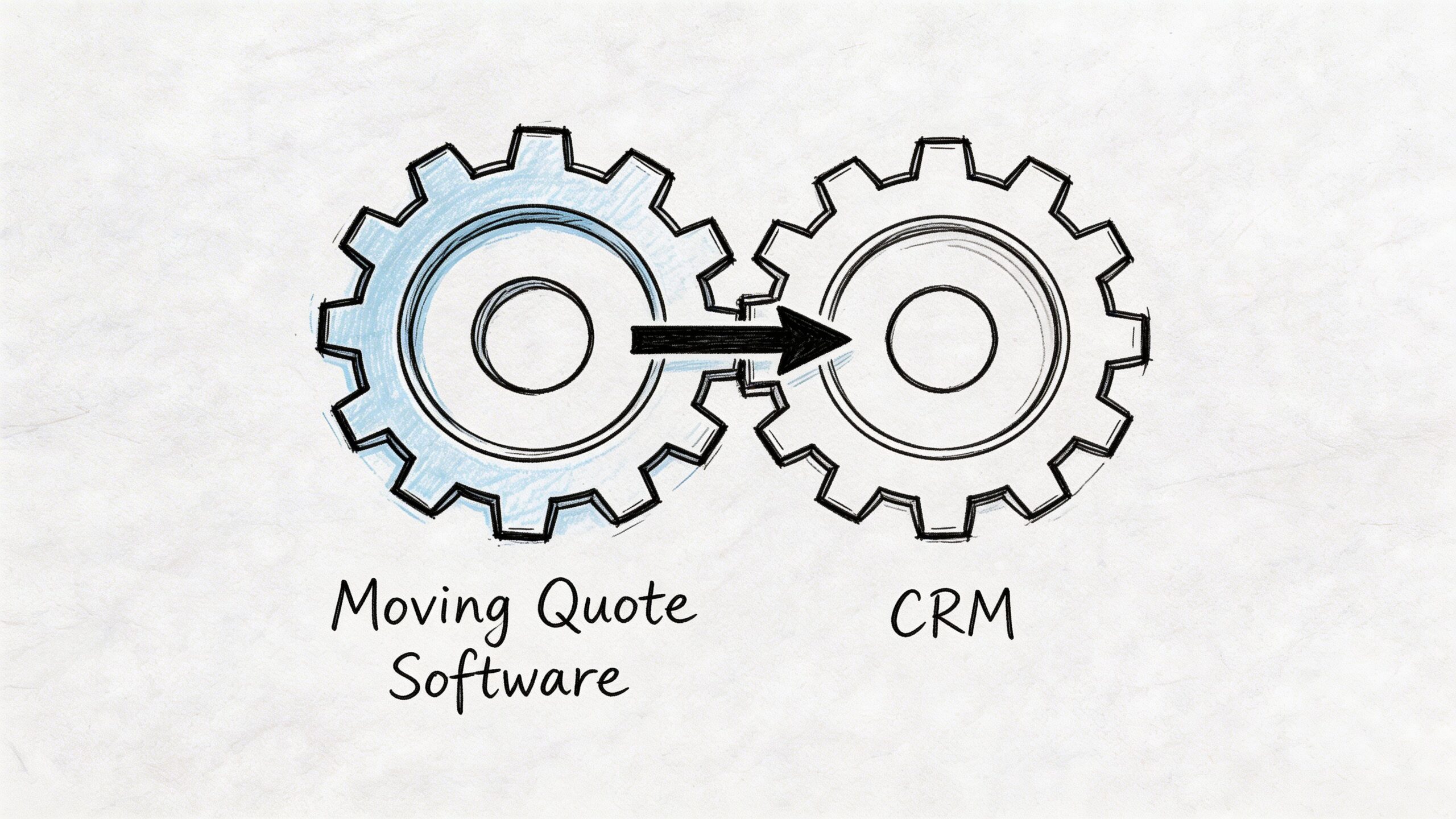
Most moving companies don’t need another separate system with its own login, its own process, and its own data cleanup. They need a front-end intake layer that feeds the CRM they already rely on.
That’s the essential role of moving quote software in a mature setup. It should sit in front of your CRM and make it more useful.
What clean integration looks like
In a strong workflow, the customer calls or messages, the system qualifies the move, applies your pricing logic, and creates the next record automatically in the CRM or calendar. Your office doesn’t have to re-enter names, addresses, inventory notes, price details, or booking data.
That matters because integration problems are expensive in subtle ways. Generic AI tools often fail on moving-specific details like “2-bedroom walkups” or “long carries,” which can lead to quote inaccuracies of 25% to 35%, according to Quick Move Tech’s discussion of moving estimate app limitations. Once bad intake enters the system, the CRM isn’t helping you. It’s just storing bad information faster.
The handoff that should disappear
These are the handoffs good integration removes:
- Manual retyping: Office staff shouldn’t have to rebuild the lead inside the CRM.
- Rate translation: The quote logic shouldn’t live outside the booking workflow.
- Calendar duplication: Booked jobs should land where dispatch can use them.
- Owner verification loops: Staff shouldn’t need approval on every non-standard inquiry.
For movers comparing systems across industries, it can help to look at how call-center teams think about workflow and customer records. This guide to the best CRM for call center is useful for understanding why routing, record quality, and handoff design matter so much, even though moving companies need more industry-specific quoting logic than a general call center.
Your CRM is not the problem
A lot of owners blame their CRM when the core issue is upstream.
The CRM usually handles scheduled jobs, customer records, and dispatch flow reasonably well. The weak spot is what happens before the record gets created. If the first interaction is slow, inaccurate, or incomplete, the CRM never gets a clean shot at doing its job.
That’s why the better approach is to connect front-end automation to the systems you already use. For a practical look at how that thinking applies across service businesses, this overview of a CRM for service business is a helpful reference.
The best integration is the one your team barely notices because the job is already in the right place.
When moving quote software is integrated well, intake stops being a side process. It becomes the front door to the same operational system your company already depends on.
A Buyer's Checklist for Moving Quote Software
Most demos look polished. That doesn’t tell you whether the software will survive a typical Saturday call from a customer with stairs, a tight move date, and incomplete information.
The right way to buy moving quote software is to force the vendor out of feature language and into operational detail.
Questions that reveal whether it can really quote
Ask these early:
- How does it handle my rate card? Don’t accept “fully customizable” as the whole answer. Ask how it applies hourly rates, flat-rate jobs, minimums, travel, and add-on services.
- What happens with stairs, long carries, elevators, and special items? If the answer stays generic, the quoting logic probably is too.
- Can it give a quote immediately, or does it just collect data for later review? That answer tells you whether you’re buying automation or just cleaner intake.
- Can the customer book from the quote right away? If not, you still have a handoff problem.
Questions that reveal whether it will fit your operation
These are just as important as pricing logic:
- Where does the booked job go? Ask whether it lands directly in the CRM or calendar your team already uses.
- How are rates updated? Busy-season changes, fuel adjustments, and policy changes should not require a support ticket every time.
- What does the office staff still need to do manually? Vendors usually reveal the truth here.
- How does it handle unclear calls? Real-world intake includes accents, background noise, partial answers, and customers who don’t know their full inventory yet.
If the vendor can’t show a messy real-world move flowing through the system, the clean demo doesn’t mean much.
What to ask for in the demo
Don’t ask for a polished tour. Ask for scenarios.
Have them walk through:
- A local hourly move with stairs
- A flat-rate move with specialty items
- A caller who wants a quote and books immediately
- A caller who isn’t ready to book and needs follow-up
That exposes whether the software supports an actual moving company or just sounds good in a sales presentation.
The final buying test
Before you sign anything, ask one blunt question:
Is this system helping me capture leads, or is it helping me book jobs?
That question cuts through almost every marketing claim in this category. For most movers, the right software is the one that gets quotes out fast, books cleanly, and removes owner involvement from routine sales work.
Overcoming Common Fears About Automation
Owners usually don’t resist automation because they’re old-school. They resist it because they’ve seen bad software create more cleanup than value.
That skepticism is healthy. It just needs to be aimed at the right concerns.
My customers want a real person
Sometimes they do. More often, they want a real answer.
If a caller can get availability, a usable quote, and a clear next step right away, most care more about speed and clarity than whether the first response came from a human. What frustrates customers is delay, confusion, and being told someone will call them back later.
A good automated process can still route edge cases to a person when needed. The mistake is assuming every call needs a human from the first second.
I’m worried it will misquote jobs
That fear is valid if the system is generic.
It’s less valid when the software is built around your rate card and moving-specific logic. Humans misquote too, especially when they’re rushed, distracted, or quoting from memory between jobs. Consistency is often the primary improvement automation brings.
This is the same reason operations teams in other industries adopt structured automation tools. If you want a simple non-moving example of how companies use systems to reduce manual oversight and repeated tasks, this overview of RMM Software for IT Infrastructure Automation is a useful parallel. Different industry, same lesson. Repeatable process beats constant human patchwork.
It’s too expensive for my company
Often, many small movers undercount the cost of doing nothing.
Industry data indicates that 70% of small U.S. movers miss up to 40% of their after-hours leads, representing a revenue leak often estimated between $50K and $150K annually, as described by WeMove.ai. When owners compare software cost against that kind of leakage, the conversation changes quickly.
The smarter comparison is not software cost versus zero. It’s software cost versus the value of calls you currently fail to turn into quotes and bookings.
Most small movers don’t have a technology budget problem. They have a revenue leak problem.
The better way to think about it
If automation only answers the phone, skepticism is fair. If it helps you quote accurately, follow up without delay, and reduce owner dependence, it becomes an operations decision.
Good automation doesn’t replace judgment. It removes repetitive front-end work so your team can spend time where human attention matters more. That’s the difference between adding gadgetry and building a company that can handle volume without chaos.
Conclusion Stop Answering Calls Start Booking Jobs
The core question isn’t whether your company answers enough calls. It’s whether your process turns inbound interest into booked work before the customer moves on.
That’s why moving quote software matters. The best systems don’t just collect lead information or make your office look organized. They apply your pricing logic quickly, handle the details that affect actual jobs, and move the customer toward a confirmed booking without forcing the owner to step in every time.
For small and mid-sized movers, that shift is bigger than it sounds. It means less manual quoting, fewer stale callbacks, cleaner CRM records, and more jobs won while the customer is still ready to decide. It also means your crews and managers can stay focused on operations instead of chasing every incoming estimate by hand.
If you’re evaluating tools this year, use one standard. Don’t ask whether the software can answer the phone. Ask whether it can help you book the job.
If you want to see what that looks like in practice, explore MoveJoy. It’s built for moving companies that want to stop leaking revenue between the first call and the booked job.