What Booking and Quoting Software Do Serious Moving Companies Use?
Serious moving companies have moved on. They aren't using basic answering services or wrestling with spreadsheets anymore. They run integrated, automated systems that plug a quoting engine right into their CRM, letting them give an accurate quote based on their specific rate card and book the job on the first call. This simple shift turns every single inquiry into a potential booking, day or night.
The Gap Between Answering Calls And Booking Jobs
Every moving company owner knows that gut-wrenching feeling of a missed call on a Saturday morning in May. That one unanswered ring isn't just a missed call. It's a $1,500 local move you just lost to the competitor who actually picked up the phone.
This is the daily reality for movers still relying on manual follow-ups or their own availability to grab leads. The money leaking out from missed calls, delayed callbacks, and wild guestimates is one of the biggest silent profit killers in our industry.
For years, the go-to solutions were either a human answering service or just letting calls hit voicemail. The problem is, neither of them solves what the modern moving customer actually wants: speed and a price they can trust.
Today's customers shop for movers fast. They expect an immediate answer and a reliable price. If you make them wait for a callback or give them a vague estimate, they will find someone else who won't.
This creates a huge gap between just answering a call and actually booking a job. An answering service can take a message, sure. A generic AI can grab a name and number. But neither can do the one thing that matters: generate an accurate quote using your company’s unique rates for labor, trucks, travel, and that awkward piano.
Why Capturing a Lead Isn't Enough
The smartest owners I talk to have all realized the real bottleneck isn't just answering the phone; it's the whole messy process from that first ring to a confirmed job on their calendar. This is exactly where the old-school methods fall flat.
- Human Answering Services: They're great at taking a message, but they can't quote. This creates a fatal delay. Your sales team has to call the lead back, but by then, the customer has probably already booked with the mover who gave them a price on the spot.
- Generic AI Voice Tools: These bots can answer 24/7, but they don't have the specific logic to understand moving. They get tripped up trying to price a 3-bedroom house with a long carry and a piano, leaving you with frustrated customers and garbage leads.
- Manual Voicemail & Callbacks: This is the most damaging approach, period. It gives a terrible first impression and forces you into a game of phone tag you’ll almost always lose, especially for jobs that come in after hours or when you're on-site during peak season.
The solution isn't just another piece of software. It’s about smart automation that closes that gap for good. The best booking and quoting software for movers is built to lock in the job on the first touchpoint. It gives an instant, accurate quote and schedules the move directly into your CRM, like SmartMoving or Supermove, turning a potential revenue leak into a confirmed, profitable job on the books.
Understanding The Four Tiers Of Quoting Solutions
If you’re trying to figure out the right booking and quoting software for your moving company, it’s easy to get overwhelmed. You've got everything from free spreadsheets to complex, all-in-one systems.
For a busy owner, the simplest way to cut through the noise is to see the options as a ladder. There are four rungs, or tiers, and each one represents a step up in how you handle leads, quote jobs, and ultimately, grow your business.
Let’s walk through them, from the ground floor up.
Tier 1: The DIY Stage (Spreadsheets And A Calculator)
This is where most of us start. You’ve got a custom Excel or Google Sheet, maybe just a notepad and a calculator. A customer calls, you frantically plug in the number of bedrooms, guess at the inventory, and hope the price your formula spits out is actually profitable.
The good news:
- It costs nothing. When you’re starting out and every dollar counts, free is a powerful word.
- You’re in control. You built it, so you know exactly how the sausage is made.
The bad news:
- It’s painfully slow. Building a quote this way can eat up 15-20 minutes. While you’re doing math, your competitor just took a credit card and booked the job.
- One typo can kill your profits. A single mistake in a cell can throw a quote off by hundreds of dollars, vaporizing your profit margin before the truck even leaves the yard.
- It looks amateur. Sending a basic PDF or a quote typed in an email doesn’t scream "professional." It tells the customer your operation might be just as clunky.
This works when you’re a one-truck show handling a few jobs a week. The second you try to scale, it becomes a massive bottleneck.
Tier 2: The Message Taker (Human Answering Services)
As more calls come in, the fear of missing one leads many owners to a human answering service. The goal is simple: stop sending leads to voicemail. The service answers 24/7, gets a name and number, and shoots you an email.
The good news:
- You never miss a call. Having a live person answer at 10 PM on a Saturday feels like a huge win.
- It sounds professional. A human voice is always better than a voicemail greeting.
The bad news:
- They can't quote. This is the critical failure. They can only take a message. This delay is a green light for motivated customers to call the next mover on their list.
- They don't close jobs. They capture a name, but you still have to do all the heavy lifting: calling back, quoting, following up, and trying to win back a lead that’s already gone cold.
- It’s expensive for what it is. You’re paying per call or per minute for what is essentially a glorified, human-powered voicemail.
This flowchart shows you exactly where this process breaks down. Capturing the lead is just step one.
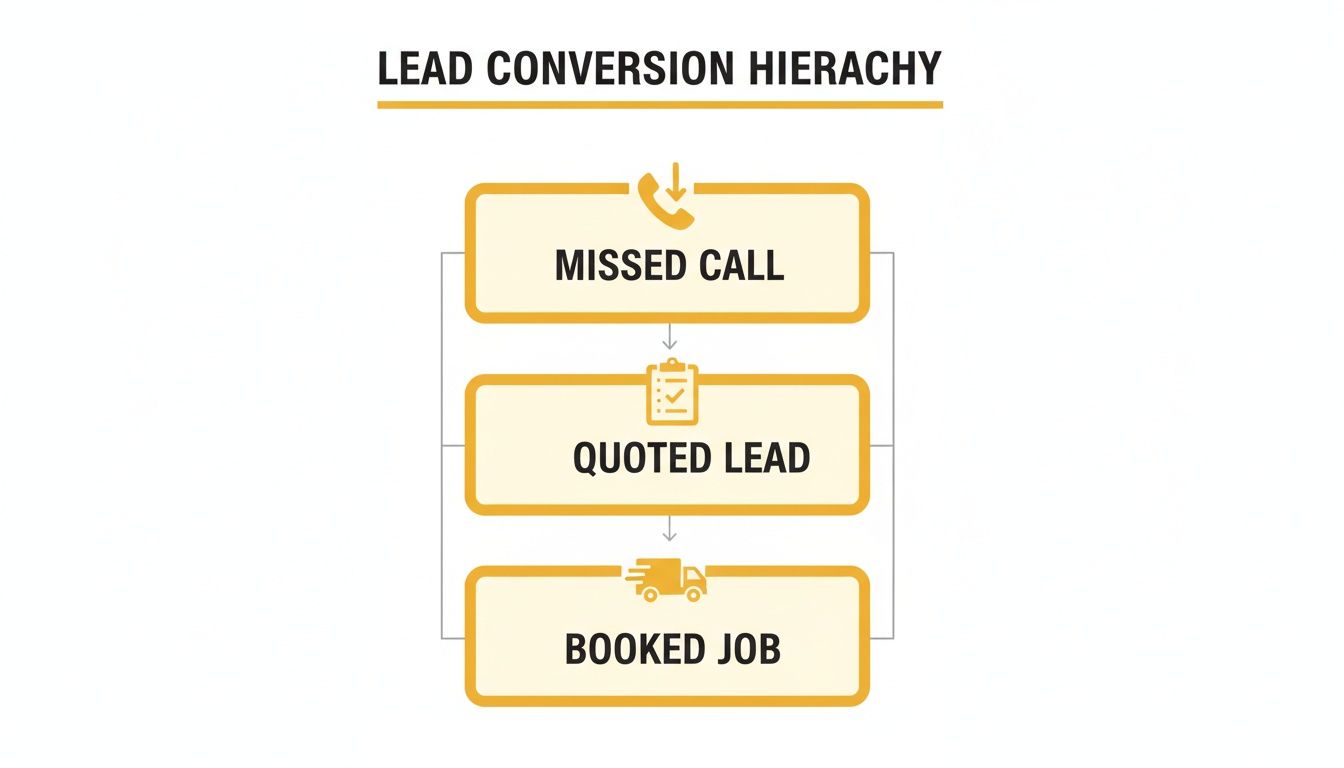
As you can see, the real money is made when you can instantly turn that first call into a quoted lead and a booked job. A message taker just can't do that.
Tier 3: The Command Center (CRMs With Quoting Modules)
This is where most "serious" moving companies live. They invest in an industry-specific CRM like SmartMoving, Supermove, or MoveitPro. These platforms are the backbone of your operation and come with built-in quoting tools that use your company’s rate card.
These systems are powerful because they tie everything together. The quote is linked to the customer file, the dispatch board, and the final bill, which cuts out a ton of double-entry.
But there’s a catch. The quoting itself is still 100% manual. Someone on your team has to be logged into the CRM to build and send that quote. That means you’re still not quoting the leads that call after 5 PM, on weekends, or when your office manager is on lunch. For a deeper dive, check out our guide on the best estimating software for moving companies.
Tier 4: The Automated Closer (AI-Powered Booking Engines)
This is the final step in the evolution. Tier 4 solutions plug the last, and biggest, leak in your revenue bucket: the inability to give an instant, accurate quote 24/7.
These tools are not a replacement for your CRM; they sit on top of it, acting as your front line.
When a customer calls—anytime, day or night—an AI system like MoveJoy answers. It asks the right questions, calculates a perfect quote based on your rates, and books the job directly into your CRM. No human needed. It doesn't just answer the phone; it closes the deal.
This is the fundamental difference between simply capturing a lead and actually driving revenue. Your CRM is fantastic for managing the job once it's on the books. An AI engine is what puts the job on the books in the first place, turning all those missed calls from nights and weekends into confirmed work waiting for you in the morning.
What Separates a Good Quoting Tool from a Great One?
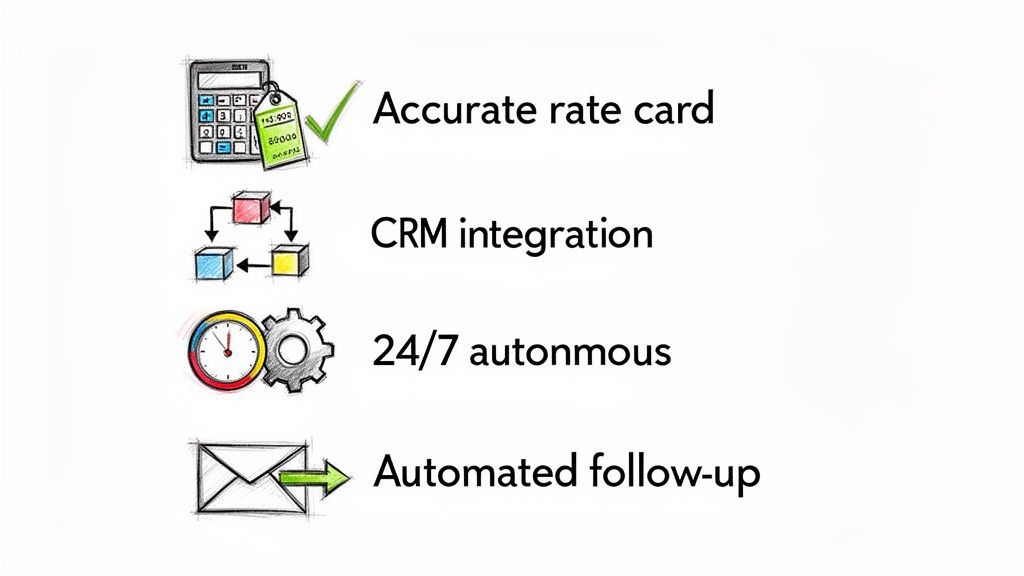
Knowing the different types of booking solutions is one thing. But what actually separates a decent tool from a genuine revenue engine for your business? It’s not about a long list of shiny features. It’s about having the right features that plug the biggest leaks in your sales process and fix your most expensive operational headaches.
When you're evaluating software, these are the non-negotiables.
Accurate Rate-Card Quoting
This is the absolute bedrock. If the tool can’t price a job using your company’s specific rate card, it’s worthless. Generic calculators that spit out "industry average" prices will either quote you so high you lose the job, or so low you lose your shirt.
Your quoting engine has to be smart enough to handle the real-world variables of a move, like:
- Hourly vs. Flat-Rate Pricing: It needs to know when to apply which model based on the job type or even customer preference.
- Stair and Long-Carry Fees: These can’t be an afterthought. The system must automatically add your fees for every flight of stairs or long walk from the truck.
- Specialty Items: Got a piano, a gun safe, or a marble statue? The software has to price it correctly, accounting for the extra crew and equipment needed.
- Travel and Fuel Surcharges: It must apply your travel time rates and fuel costs based on the actual mileage between locations.
Without this, you’re just guessing. And guessing is how you end up doing a five-hour job for three hours of pay.
Seamless Two-Way CRM Integration
Your quoting engine can't be a silo. It has to be the front door to your entire operation, which means it needs deep, two-way integration with the CRMs serious movers use, like SmartMoving, Supermove, and MoveitPro.
This means when a customer books a job at 10 PM, it doesn't just send you an email notification. It instantly creates a complete job file in your CRM, populates all the customer and inventory details, and puts the booking on your dispatch calendar.
This completely eliminates double-entry, prevents you from double-booking a truck, and makes sure your crew has the right info from day one. You can read more about how this kind of integrated system gives you a single source of truth in our guide on CRMs for service businesses.
True 24/7 Autonomous Operation
A lot of tools claim to be "24/7," but what they really mean is they’ll take a message after hours. That’s just a glorified answering machine. A modern booking engine offers full autonomy. It works without a human needing to step in.
Whether a potential customer calls at 2 PM on a Tuesday or 2 AM on a Sunday, the system must be able to:
- Answer the phone instantly.
- Ask the right questions to qualify the lead.
- Build a precise, binding quote on the spot.
- Offer the customer the chance to book right then and there with a credit card.
This is how you stop losing the 3-7 jobs every month that most movers miss because the call came in after 5 PM or on a weekend.
Automated Quote Follow-Up
Let's be real, not every customer books on the first call. They need to talk to their spouse, check their budget, or look at one more option. A top-tier system doesn't just let that hot lead go cold.
It should automatically trigger a sequence of follow-up texts and emails that do the work your sales team would do manually. These aren’t just spammy reminders. They’re professional touchpoints that reinforce why they should choose you, answer common questions, and give them a simple one-click link to finish booking when they're ready. No lead gets left behind.
The entire moving software market, which is projected to hit $3,500 million by 2033, is being driven by these kinds of smart, integrated features. As technology evolves—with North America leading the charge—tools that tie CRM-integrated quoting together with document management are becoming the new standard. For movers, this includes handling critical paperwork like the Bill of Lading, which is why a booking engine should be able to work with a specialized Bill of Lading parser to digitize that information seamlessly.
Why Generic AI And Human Answering Services Are a Waste of Money
When you're bleeding jobs from missed calls, almost any solution feels like progress. But here’s the hard truth: choosing the wrong tool is often worse—and more expensive—than doing nothing at all.
Many moving company owners I talk to have tried one of two things: a traditional human answering service or a generic AI voice tool. They almost always end up trading one big problem for a set of new, more frustrating ones.
These solutions fail because they don't understand the first thing about the moving business. The goal isn't just to answer the phone. The goal is to give a customer an accurate quote and book a profitable job, right then and there. Anything less is just a delay that sends customers straight to your competition.
The Problem With Human Answering Services
On the surface, a human answering service sounds perfect. You get a real person on the line 24/7, which feels professional. No more calls going to voicemail.
But their job is to take a message, not close a deal. For a mover, that’s where it all falls apart.
- They Can't Quote. Period. The agent has no idea what your rates are. They don't know the difference between a one-bedroom apartment and a four-bedroom house with a grand piano. All they can do is take a name and number and promise someone will call back.
- They Create a Deadly Delay. In this business, speed is everything. That callback delay, whether it's 10 minutes or 10 hours, is a golden opportunity for a motivated customer to call the next mover on their list and get a price on the spot.
- You Still Do All the Work. You're paying for the service, but your team still has to make the call, build the quote from scratch, and chase the lead. The answering service doesn't lighten your sales team's load; it just builds them a to-do list of leads that are getting colder by the minute.
Answering a call and taking a message is not the same as booking a job. By the time you call a lead back, they've likely already received a quote from another mover who could give them a price on the spot.
The Dangers Of Generic AI Voice Tools
Generic AI voice platforms are everywhere now, promising to handle your calls with a shiny, tech-forward feel. The keyword here is "generic." These bots were built for simple tasks, like booking a dentist appointment or routing support tickets—not for the complex, variable logic of a moving quote.
We talk more about the difference in our guide to AI-powered call handling services designed specifically for movers.
A generic AI will absolutely choke on real-world moving scenarios. Imagine a customer calls and says they’re in a "two-bedroom walkup."
- A generic bot hears: "two-bedroom apartment." It has no concept that "walkup" means multiple flights of stairs, which completely changes the labor hours and the price of the job.
- The result is a disastrously wrong quote. The bot might spit out a price of $600, thinking it's a standard ground-floor apartment move. But when your crew arrives and finds three flights of stairs, the real price is closer to $1,000.
Now you have two terrible choices: eat the $400 loss to honor the bad quote, or try to explain the price hike to a furious customer on moving day.
Either way, you’ve torched your reputation and probably lost that customer forever. These tools don't just fail to book jobs—they actively create chaos, financial risk, and angry customers by pretending to understand a business they were never built for. They capture a lead but can’t accurately quote or close it, leaving all the real work—and all the risk—on you.
Your Software Evaluation and Revenue Leak Checklist
Choosing the right software can feel like a massive decision. But it really starts with a simple, honest look at how you're operating right now.
Before you even glance at a demo or a pricing page, you need a clear picture of where your money is leaking out. This isn’t about feeling bad about what you’ve missed. It's about building a rock-solid business case for a solution that pays for itself, probably in the first month.
The Honest Lead Intake Audit
Grab a piece of paper and get real with yourself. For the last month, what are the actual numbers?
What percentage of your calls go to voicemail? Be conservative. If you know you miss a few calls every evening and on weekends, that number is easily 15-20% or more. Every one of those is a job you just handed to the next mover on the Google results page.
How long does a customer wait for a quote? Time it. From the second a customer calls or fills out a form, how many minutes—or hours—pass before they have a real price? If it’s more than five minutes, you’re losing to faster companies.
Can you give an accurate quote 24/7? If your office closes at 5 PM, the answer is a hard no. That means you're completely dark to the flood of people planning their move after work or on a Sunday afternoon.
How much time does your team spend building quotes? Add up the minutes. If your best salesperson spends 20 minutes on every quote and sends 10 a day, that’s over three hours of their time gone—payroll spent on manual data entry instead of closing deals or handling complex jobs.
If you looked at these questions and saw some uncomfortable truths, you're not alone. These are the exact operational headaches that push smart owners to find a better way.
To help you get a crystal-clear picture, we've put together a simple checklist. Use it to compare your current process side-by-side with what's possible with modern booking and quoting software. It’s a great way to spot the biggest opportunities for improvement.
Software Evaluation Checklist for Moving Company Owners
| Evaluation Question | Your Current Process | Ideal State (with Modern Software) |
|---|---|---|
| What happens when you miss a call? | Goes to voicemail; maybe we call back tomorrow. | Every call is answered instantly, 24/7. |
| How long does a quote take? | 15+ minutes of manual work per quote. | Instant, accurate quote provided on the call. |
| Can you book jobs after 5 PM? | No, office is closed. Leads wait until morning. | Yes, jobs are quoted and booked automatically. |
| How much time is spent on data entry? | Hours per day copying info into the CRM. | Zero. Two-way sync with the CRM is automatic. |
| How accurate are your quotes? | Depends on the salesperson; mistakes happen. | 100% consistent, based on your rate card. |
| How do you handle weekend leads? | We don't. We hope they leave a message. | Leads are captured and converted into jobs. |
| Do you know your booking rate? | It's a guess. | Tracked automatically with detailed analytics. |
This checklist isn't just about features; it's about plugging the holes where revenue is pouring out of your business every single day.
Connecting Problems to Real Solutions
Now, let's connect those dots. Your audit shows you the why. The right software provides the how.
Problem: High missed call rate.
- Solution: A system that works 24/7, answers every single call, and never sends a paying customer to voicemail.
Problem: Slow quote delivery.
- Solution: An engine that gives customers instant, accurate quotes right on the phone, satisfying their need for speed before they can call someone else.
Problem: Closed for business after hours.
- Solution: An AI-powered booking system that acts like your best salesperson, even when your office is dark. It doesn't just take a message; it quotes and closes the job.
Problem: Wasted staff time on manual quotes.
- Solution: Seamless two-way CRM integration that automates everything from the first call to the booked job in your system, freeing up your team for dispatch, operations, and customer service.
The data is clear: the most successful moving companies are using technology to solve these exact problems. Your self-audit is the first step to joining them.
Recent industry data shows a gap that’s getting wider. In the 2026 State of Moving Report, 55% of top-performing movers are using AI tools for booking and quoting, compared to just 42% of average performers. This isn't just a trend; it's the competitive advantage that separates companies that are scaling from those stuck leaking revenue. You can read the full report on mover technology trends to see what your competitors are doing.
From Cost Center to Revenue Engine: The ROI of Automated Booking
For years, moving company owners have treated the front office—the phones, the sales team, the entire quoting process—as a necessary evil. It's a line item on the profit and loss statement. A cost center.
But the smartest operators are flipping that script. With the right tech, your lead intake process stops being an expense and starts becoming your most profitable employee.
Let's cut through the noise. Here’s what it boils down to:
- Missed calls are lost jobs. Every time that phone rings and no one picks up, you’re handing money to a competitor. Simple as that.
- Speed-to-quote wins. The first moving company to deliver a professional, accurate quote is almost always the one that gets the job.
- Quoting accuracy builds trust. A precise, consistent price shows you’re a professional, not some guy with a truck winging it. It justifies your rates.
When you nail these three things, the return on an investment in automated booking isn’t just clear—it’s immediate. You stop paying people to take messages and start investing in a system that closes deals.
The Simple Math on ROI
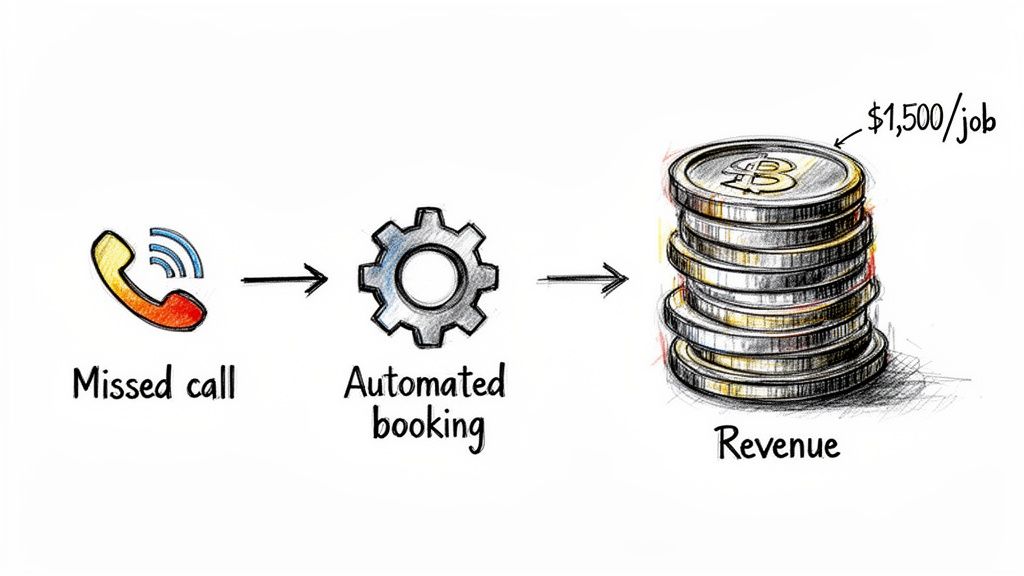
Let's do some quick, back-of-the-napkin math. Say your average local move is worth $1,500. Your office is closed on the weekends, and you know calls are coming in.
If an automated booking system grabs just one single job from a missed weekend call each month, that’s $1,500 in new revenue. That one booked job often pays for the technology for the entire year.
This isn’t some complicated financial model. It’s about plugging the biggest and most obvious leak in your revenue bucket. It's how you turn that cost center into a true revenue engine. There are all sorts of benefits of AI in automating pre-sales and customer support, but for movers, it all starts with capturing the leads you’re already paying for.
Your Next Move
The question is no longer if you should automate, but how you’re going to do it. The days of fighting with spreadsheets and losing jobs to a full voicemail box are over for anyone serious about growing their business.
Instead of just answering a call, a purpose-built AI booking engine like MoveJoy closes the job. It gives the customer an instant, accurate quote based on your rate card and books the move directly into your CRM.
If you’re tired of watching revenue slip through the cracks every single night and weekend, it’s time to see how automation can transform your front office.
Stop managing leads and start booking jobs. A single recovered move pays for the whole system. Every booking after that is pure profit, driving your company forward.
Your Questions, Answered
When you're thinking about a booking and quoting system, you have practical questions. You're not a tech person; you're a mover. You want to know what actually works in the real world. Here are the straight answers to the questions I hear most often.
How Long Does It Take To Set Up?
This is the best part. A purpose-built AI booking engine is surprisingly fast to get running—often in less than a day. It's built for owners, not IT guys.
You just give it your rate card. Your hourly rates, truck fees, travel charges, and what you charge for things like pianos or flights of stairs. The system uses that to build its quoting brain. After we connect it to your phone line and your CRM, like SmartMoving or Supermove, you're live. The goal isn't to start a long tech project; it's to start capturing the revenue you're missing, immediately.
Will It Sound Robotic and Scare Away My Customers?
This is a huge concern, and a fair one. We’ve all dealt with those terrible, robotic phone bots. But modern AI trained specifically for the moving industry is a completely different world.
A good AI booking engine is trained on thousands of real moving calls. It gets the slang, the accents, and the industry terms like "walkup" or "long carry." It responds exactly like one of your best, most experienced booking agents would.
The voice and script are also customized to match your company's brand. Every customer interaction feels authentic and reinforces the professional reputation you’ve spent years building.
Is This Only For Big Moving Companies?
Absolutely not. In fact, this kind of tech delivers the biggest punch for small to mid-sized moving companies running 1–20 trucks. The big national van lines already have giant sales teams working in shifts. It's the smaller operators who really feel the pain of every single missed call.
If you’re running a 3-truck operation, losing just one good job on a Friday night is a serious hit to your revenue. An automated system levels the playing field. It gives you the same 24/7 booking power as a major player, turning calls that used to go to voicemail into confirmed jobs on your calendar.
What's the Real Difference Between a CRM and an AI Booking Engine?
This is a great question. Think of it this way: a CRM like SmartMoving or MoveitPro is your command center for managing jobs you've already booked. It handles your dispatch, scheduling, and billing. But it needs a human logged in to actually create and send a quote.
An AI booking engine, on the other hand, is your automated front-end lead closer. It sits in front of your CRM, answering every single call 24/7 and giving customers an instant, accurate quote based on your rates.
Its only job is to turn phone calls into booked moves. Once it does, it feeds that job directly into your CRM. The AI engine gets you the job; your CRM helps you manage it.
Ready to stop losing jobs to voicemail and start turning every call into revenue? With MoveJoy, you can. It's the AI booking engine built specifically for movers, providing instant, accurate quotes from your rate card and booking jobs directly into your CRM, 24/7. See how it works.