
Most advice on cheap movers in New York is wrong for operators.
It says to avoid those leads because they waste time, haggle on every line item, and drag your team into quote wars you can’t win. That’s lazy thinking. For a moving company running multiple trucks, “cheap” isn’t automatically a low-value signal. It’s usually the front-end language customers use when they’re anxious about cost, timing, and getting burned by surprise charges.
If you run a 5 to 20 truck operation, the problem isn’t that these leads exist. It’s that most moving companies handle them poorly. They answer slowly, quote vaguely, skip building questions, and send out a number that falls apart the minute stairs, parking, or elevator restrictions show up. Then they blame the lead.
Why Cheap Movers New York Is a Goldmine Not a Headache
A lot of owners hear “cheap movers New York” and think bad lead, low close rate, too much friction. That misses the scale of the market. New York state drew 302,835 movers in 2023, up from 301,461 in 2022, according to ConsumerAffairs’ New York moving guide. That’s a huge stream of people entering a market where moving costs get compared hard.
Cheap is a market entry term
In New York City, local moves are commonly billed hourly, and a 2026 NYC cost guide cited by ConsumerAffairs says typical rates run $85 to $110 per mover per hour, with a 1-bedroom local move often landing around $800 to $1,100 in that guide’s ranges. When customers know moving is billed this way, shopping becomes normal behavior, not a red flag.

If you’re ignoring “cheap” searches, you’re not filtering out junk. You’re stepping away from a mainstream buying path. These callers may not say, “I’m looking for the mover with the cleanest estimating process and the best operational controls.” They say cheap because that’s the language of a stressed buyer trying to stay in control.
Why operators misread these leads
Owners usually get frustrated for three reasons:
- The office hears resistance early. The caller asks about rates before they explain the job.
- The estimator doesn’t get enough detail. Building access, carry distance, and scheduling constraints come out later.
- The quote gets treated like a placeholder. Then the final invoice climbs and everyone blames the customer.
Practical rule: A cheap lead isn’t asking you to be the lowest. They’re asking whether your number will hold up when the truck arrives.
That’s the opportunity. If your intake process qualifies quickly, explains what affects cost, and gives a quote that reflects the actual job, you can turn the lead category many movers hate into a reliable booking channel.
This matters even more for operators with several trucks on the road. Once volume increases, missed calls and slow callbacks become expensive. Price-sensitive shoppers move fast. They don’t wait around while your coordinator is buried in dispatch, payroll questions, and crew reshuffles. The mover who responds first with a credible estimate usually gets the next conversation.
The Anatomy of a Price-Shopping Lead
Most price shoppers in NYC aren’t obsessed with squeezing every last dollar out of the move. They’re trying to avoid getting trapped by a quote that starts low and finishes high.

Cheap usually means no surprises
That matters because New York moving jobs punish vague estimating. A long carry can show up if the truck can’t park within 75 feet of the entrance, and walk-up buildings can trigger stair or flight fees above the second floor, as outlined in this NYC moving cost guide from MoveAdvisor. Once customers learn those details from a bad experience, they stop chasing the lowest sticker price and start looking for price certainty.
The frustration owners feel is real. Cheap leads ask more questions, compare more quotes, and challenge assumptions. But that behavior can help you if your sales team knows how to frame the conversation.
What they’re often asking is:
| Customer question | What they really mean |
|---|---|
| "What's your hourly rate?" | "How bad can this get?" |
| "Is that your cheapest option?" | "Will you surprise me later?" |
| "Do you charge extra for stairs?" | "Have you done this kind of building before?" |
| "Can you send something in writing?" | "Can I trust your office?" |
What these callers are really testing
They're testing whether your company understands the move they have, not the move they wish they had.
Cheap shoppers become serious buyers when your team proves it understands the traps in their move before moving day.
That is why scripted rate-first selling usually fails in NYC. If your rep tosses out a low hourly number without asking about elevator windows, COI requirements, street parking, loading distance, or walk-up conditions, the caller doesn't feel reassured. They feel set up.
This isn't unique to movers either. Service businesses that depend on inbound calls see the same pattern. Shops in other local industries deal with callers who sound price-focused but are really trying to judge reliability, which is why resources like Phone Staffer for garage owners are useful outside the moving space too. The common lesson is simple. Intake quality shapes close rate.
For moving companies, the practical takeaway is to stop treating "cheap" as a personality type. Treat it as a buying stage. The customer wants a fast answer, a believable scope, and confidence that your final bill won't drift far from the conversation.
How to Quote Profitably for a Cheap NYC Move
The biggest mistake with cheap movers New York leads is trying to win with a skinny quote. That approach books the wrong jobs, creates crew conflict, and destroys margin when the job takes longer than expected.
Choose the pricing model that fits the job
In NYC, hourly pricing typically ranges from $100 to $200, with crew size and truck type affecting the number, according to this NYC pricing comparison. That same guidance notes hourly pricing often works better for tight urban jobs with stairs, elevators, and narrow access because the crew can work through real conditions without pretending the move is simpler than it is.
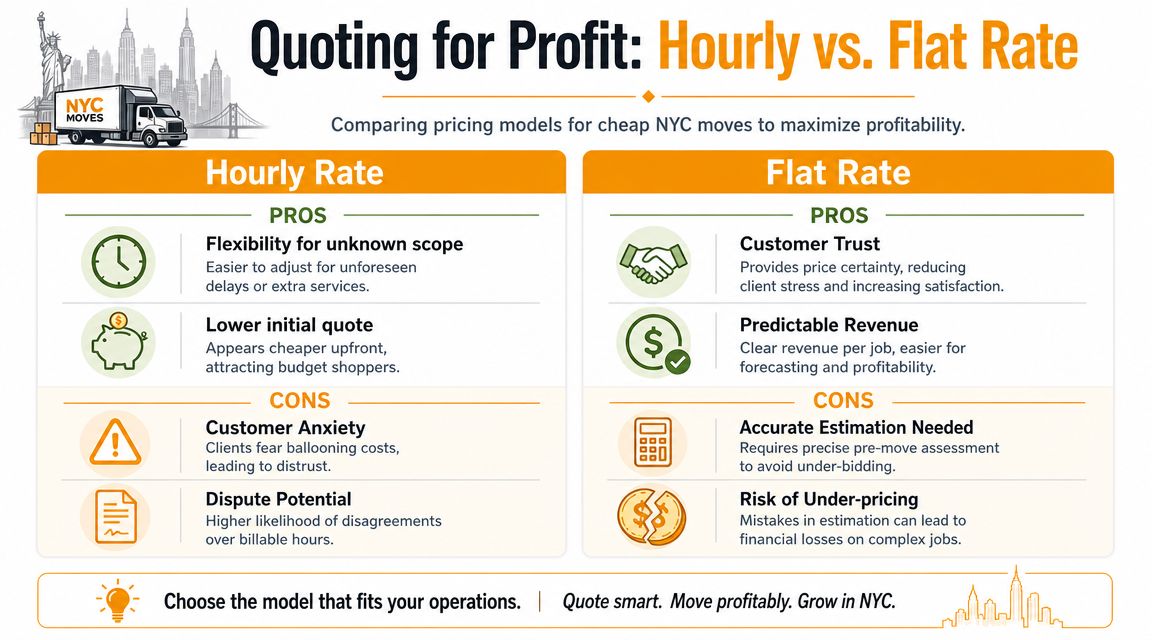
For moves over 100 miles or across state lines, NYC jobs are usually priced as a flat rate based on weight, distance, and extras like packing or crating. The same MoveAdvisor guide lists typical 1,000-mile estimates of $3,200 to $6,100 for a 1-bedroom and $4,100 to $8,500 for a 2-bedroom. That's a different sales conversation entirely. The customer isn't comparing stair delays by the hour. They're judging scope accuracy and total-job certainty.
A simple decision table helps:
| Move type | Usually works better | Why |
|---|---|---|
| Short local move with access headaches | Hourly | Scope changes on site |
| Longer local move with clean access and stable inventory | Either, depending on confidence | You may be able to lock a workable total |
| Interstate or over 100 miles | Flat rate | Weight, distance, and services drive the quote |
Build quotes that survive real-world conditions
A profitable quote for a price-sensitive NYC lead should do three things:
- Accurately reflect access. Ask about floor count, elevator reservation rules, parking distance, COI requirements, and whether the crew will face a long carry.
- Spell out add-ons before they happen. Cheap leads don't get upset because fees exist. They get upset when your office reveals them late.
- Give the customer a decision path. Offer options like labor-only packing help, partial self-pack, or a different service level if that fits your operation.
Field advice: If your sales team can't explain why a quote may change, the customer assumes the worst.
This is also where operators need discipline with rate cards. If your pricing logic lives in one estimator's head, your office can't scale. The companies that handle these leads well turn their pricing rules into a repeatable intake process, then make sure every coordinator follows it.
What works in the office
For small and mid-sized movers, the best quoting habits are boring. That's why they work.
Standardize the intake form
Don't let one rep ask ten questions and another ask three. Every quote should capture the same operational details.Use written estimate templates
If your current quotes are inconsistent, start with a structured moving company estimate template and tailor it to your rate card.Review underbid jobs weekly
Don't just look at booked revenue. Compare estimated scope to actual crew time and access conditions.Keep an eye on overhead pressure
If insurance, labor, or truck costs are shifting, your "cheap" strategy can go bad fast. Even broad planning resources like My Safety Manager's insurance rate predictions are useful as a budgeting check when you're deciding how aggressively to price.
Cheap leads become profitable when your quote is tighter than your competitors', not necessarily lower.
A Vetting Checklist to Separate Shoppers from Buyers
Some leads need a quote. Others need a reality check. Your office should know the difference within the first conversation.
The goal isn't to interrogate people. It's to find out whether the caller has enough intent, information, and timing to justify a serious estimate. If they do, move fast. If they don't, keep the door open without burning office time.
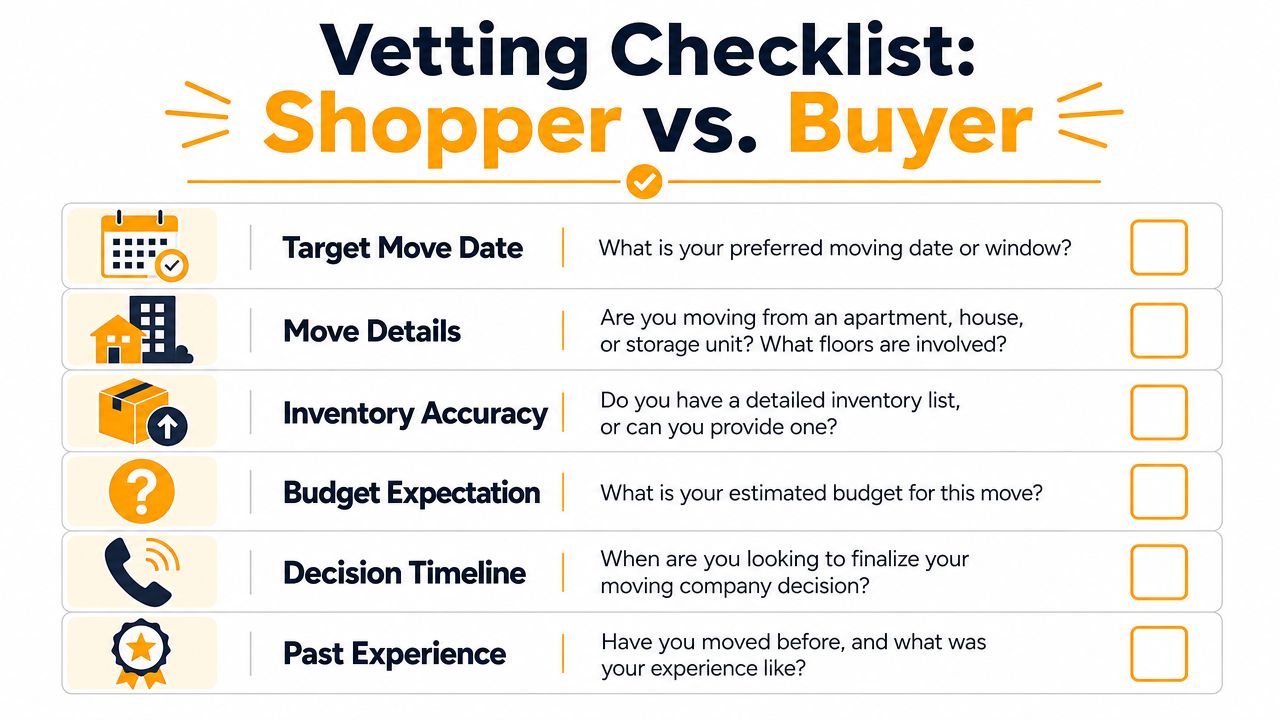
The six questions that save your sales team time
I like a short qualification flow that covers logistics, urgency, and buying readiness. If your team needs help building one, this guide on how to qualify leads is a practical starting point.
Use questions like these on every inbound call:
Move date
"What date are you targeting, and do you have flexibility?" This tells you whether the lead is actively booking or casually browsing.Building setup
"Are both locations apartments, houses, or storage units, and what floors are involved?" This surfaces the operational friction early.Inventory accuracy
"Do you already have a room-by-room list, or do you want help building one?" Serious buyers usually cooperate here.Budget expectations
"Have you set a budget range for this move?" You don't need an exact number. You need to know whether the customer expects a completely different service level.Decision timeline
"When do you want to choose your mover?" Someone deciding today gets different follow-up than someone gathering options for next month.Past moving experience
"Have you hired movers before?" That answer often reveals whether they're cost-sensitive because of a bad prior invoice.
How to score intent without sounding scripted
Don't turn this into a robotic checklist. Listen for buying signals.
High-intent leads usually do a few things:
- They answer specifics clearly. They know addresses, dates, or building details.
- They care about process. They ask what happens next, not just the starting rate.
- They want documentation. They ask for a written quote, confirmation, or availability window.
Lower-intent leads tend to stay vague. They want a number but resist giving scope. They may still book later, but they shouldn't consume the same effort as a ready buyer.
Fast qualification beats long persuasion. The first detailed and believable quote usually wins the serious shopper.
Many 5 to 20 truck operators lose easy jobs when the phone rings after hours, on weekends, or while dispatch is buried. Nobody captures the details properly. By the next morning, the lead has already talked to someone else who sounded more organized. That's not a marketing problem. That's an operations problem.
From Quote Sent to Job Booked The Follow-Up Formula
Sending a quote isn't a sales process. It's the start of one.
Too many moving companies work hard to answer the phone, gather inventory, and build an estimate, then go quiet. They assume the customer will call back if interested. That almost never works with price-sensitive leads because those customers are comparing speed, clarity, and confidence across several companies.
The mistake most moving companies make
The common sequence looks like this:
- Lead calls.
- Office gathers rough details.
- Quote gets emailed.
- Nobody follows up until the customer disappears.
That gap kills bookings. Not because the customer hated your price. Usually because another mover made the next step easier.
A better approach is to treat follow-up as part of quoting, not a separate admin task. Every quote should answer questions, reduce uncertainty, and guide the customer toward a decision.
A simple follow-up rhythm that closes more jobs
Keep the process straightforward and useful.
Right after the quote
Send the estimate promptly and restate the scope in plain English. Confirm what was included, what could change, and what you still need from the customer if anything is missing.
Next touchpoint
Reach out with one helpful clarification, not a generic "just checking in." Ask whether building restrictions, elevator reservations, or packing needs have changed.
Final nudge
Create a reason to act. That could be availability, scheduling coordination, or a request to confirm details so the quote stays accurate.
If your team needs a cleaner structure for those conversations, a simple follow-up call script can keep reps consistent without making them sound stiff.
The office that follows up with clarity usually beats the office that quoted first but disappeared.
Where automation changes the game
Operators should think carefully about workload. Most offices don't fail because they lack effort. They fail because too many small tasks pile up at once. Calls come in while dispatch is updating crews. Quotes need review. Leads sit in SmartMoving, Supermove, MoveitPro, or a shared inbox waiting for someone to send the next message.
The difference between capturing a lead and closing a job shows up here. Capturing means you got the name and number. Closing means the customer received a quote they understood, got timely follow-up, and had a clear way to book.
The companies that tighten this workflow usually do a few things well:
- They send quotes fast. Delay kills momentum.
- They tie follow-up to real operational details. The message reflects the move, not a canned template.
- They reduce handoff errors. Sales, dispatch, and scheduling all work from the same information.
If you want better booking rates from cheap movers New York traffic, don't obsess over lead volume first. Fix the handoff from inquiry to estimate to booked job.
Stop Competing on Price Start Competing on Trust
Winning cheap movers New York traffic doesn't mean becoming the lowest bidder in the borough. It means becoming the mover that sounds the most credible, asks the right questions, and sends the quote that feels safest to accept.
Trust wins the cheap search
Cheap leads book when customers believe three things:
- You understand their move
- Your quote reflects reality
- Your office won't disappear after sending it
That's why trust assets matter more than owners sometimes admit. Clear reviews, polished estimate documents, and visible proof points all reduce friction. Even a simple Testimonial trust badge tool can help your site and quote pages look more credible when a shopper is comparing several local movers fast.
The operational lesson is simple. Stop defending your price and start proving your process.
Build a system your team can actually run
For a growing moving company, this has to be systematic. One great salesperson can't carry the whole funnel forever. You need a repeatable intake flow, tighter quote logic, a qualification standard, and follow-up that happens even when the office is slammed.
If you build that, "cheap" stops being a headache category. It becomes one of the clearest opportunities in your pipeline.
The movers that win these jobs aren't always cheaper. They're faster, clearer, and more consistent.
If you're tired of missed calls, slow quote turnaround, and leads that go cold before your team can respond, take a look at MoveJoy. It helps moving companies turn inbound inquiries into accurate quotes and booked jobs using their own rate card, so the front end of the business doesn't leak revenue while your crews are out doing the work.