The Best Estimating Software for Moving Companies: A 2024 Guide

The best estimating software for a moving company isn't just a calculator. It’s the engine that turns missed calls into booked jobs, automates your quoting, and plugs right into your CRM. For owners running small to mid-sized moving companies (1–20 trucks), this means finding a tool that doesn't just spit out prices, but actively captures revenue you're currently losing—especially after hours or during the spring rush.
If you're still relying on spreadsheets or "gut feeling" pricing, you're leaving money on the table. In a competitive local market, the speed and accuracy of your quote often determine whether you win the business.
Why You Can't Afford to "Wing It" on Estimates Anymore
In the moving business, the difference between winning and losing a job is decided in minutes, not hours. If a potential customer has to wait for a callback, they're not waiting—they're calling your competitor. Relying on spreadsheets, scribbled notes, or inconsistent pricing is a direct path to lost revenue. The days of customers waiting around for a callback are long gone.
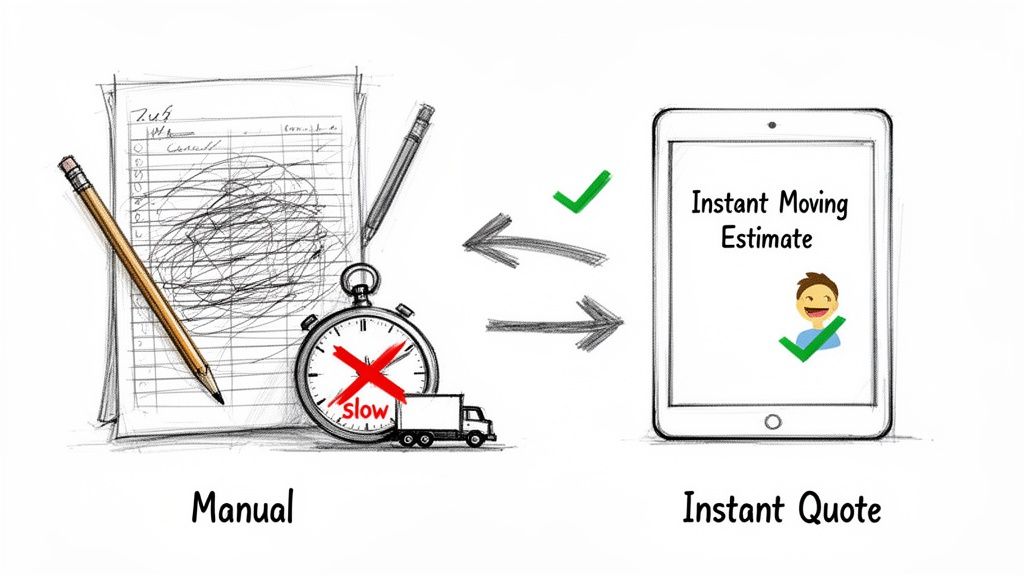
The Real Cost of Manual Quoting
Manual quoting is a direct line to lost profits. It's slow, inconsistent, and full of human error. Every minute a customer waits for you to crunch the numbers is another opportunity for them to find another mover.
Think about these all-too-common scenarios for a company running 1-20 trucks:
- Inaccurate Quotes: You forget to factor in the long carry from the truck to a third-floor apartment. You underestimate the drive time during rush hour. Each mistake eats directly into your profit margin, sometimes turning a good job into a money-loser.
- Operational Bottlenecks: The time your dispatcher or office manager spends punching numbers into a calculator and then re-typing that info into your schedule is time they aren't spending on crew management or customer follow-ups. It’s an administrative bottleneck that slows your whole operation down.
- Lost Customer Trust: A quote that comes in slow, looks unprofessional, or has to be "revised" makes customers nervous. A fast, detailed, and accurate estimate builds instant confidence and immediately sets you apart from the local competition.
The core issue isn't just getting the price right—it's about speed. The first mover to get a professional, accurate quote into the customer's hands usually wins the job. Period.
The Technology Gap Is Widening
The moving industry is getting smarter, and the performance gap between companies that use automation and those that don't is growing fast. A recent moving industry report found that the industry's average close rate is just 39%. For small and mid-sized movers, this means nearly two-thirds of all leads are lost—a huge amount of cash left on the table, especially during peak season.
The data is clear: companies still using manual methods are finding it harder to compete with operators who can deliver instant, accurate quotes through software. Estimating software isn't a "nice-to-have" anymore. It's the engine that drives your revenue. It's what turns a phone call into a booked job and an inquiry into profit.
Evaluating The Core Features of Great Estimating Software
Not all quoting tools are built the same. For a 1–20 truck operation, the difference between a “good enough” tool and the right one shows up on your bottom line in the form of more booked jobs and higher profit margins. To find that perfect fit, you have to look past the flashy dashboards and focus on four critical capabilities.
1. Quoting Logic and Accuracy
First and foremost, your software’s job is to protect your profits. A tool that can't price a job accurately is worse than a spreadsheet because it gives you a false sense of security. The quoting logic must be flexible enough to handle the messy reality of residential moving.
This means it absolutely must account for:
- Hourly vs. Flat-Rate Pricing: The system needs to support both models and let you decide which one makes sense for each job.
- Complex Accessorials: Can it add charges for a three-story walk-up, a long carry over 75 feet, or a shuttle truck for a tight downtown street? If it can't, you’re leaving money on the table with every single quote.
- Packing and Materials: The software should let you itemize packing services and material costs—from wardrobe boxes to bubble wrap—without pulling out a calculator.
The best software will also have tools for automatically factoring in operational costs, like using accurate mileage calculations to nail down travel time and fuel expenses. If your system can't handle these variables, you’ll either underbid and work for free, or overbid and watch the job go to a competitor.
2. Seamless CRM Integration
A quoting tool that doesn’t talk to your other systems just creates more work. Manual data entry is a huge operational bottleneck that leads to scheduling mistakes and lost customer details. Your estimating software has to be the front door to your entire operation, not a dead end.
The goal is a seamless "lead-to-booked-job" workflow. When a customer accepts a quote, it shouldn't just trigger an email notification—it should automatically create a booked job in your main system.
This is especially critical if you’re already invested in a moving CRM. Look for native, plug-and-play integrations with the platforms you already use, like:
Without that direct link, your team is stuck manually copying and pasting customer info, move details, and pricing. This completely defeats the purpose of automation and opens the door to human error. For more on what data points you should be capturing, our free moving company estimate template is a great place to start.
3. User Interface and Ease of Use
Your team is full of moving experts, not software engineers. If your sales manager or dispatcher can’t generate a quote in under two minutes, they’ll revert to their old habits. The user interface (UI) needs to be clean, intuitive, and built for speed.
A great UI isn't just about pretty colors; it's about efficiency. Can your staff find customer records in seconds? Is it easy to adjust move details on the fly? The software should feel like a helpful assistant, not another obstacle to work around.
4. Customization with Your Rate Card
Finally, and this is non-negotiable, the software must work for your business. It can’t force you into some generic, one-size-fits-all pricing model. You've spent years dialing in your rates, and your software must reflect them perfectly.
This ensures every single quote—whether it’s generated by your dispatcher or an automated AI system—is 100% accurate according to your specific business rules. This is what separates a simple calculator from a true revenue engine. When a solution can automate quotes on the very first call using your rates, it means every lead gets captured and quoted profitably, 24/7. This is the difference between simply answering a call and actually closing a job.
Core Feature Checklist for Estimating Software
This checklist helps you cut through sales pitches and focus on capabilities that directly impact your revenue and operations.
| Feature or Capability | Why It Matters for a 1–20 Truck Mover | Questions to Ask a Vendor |
|---|---|---|
| Custom Rate Card | Protects your unique pricing strategy. Ensures every quote is profitable. | Can I upload my exact rate card, or do I have to fit into your template? |
| CRM Integration | Eliminates manual data entry and creates a seamless lead-to-booking workflow. | Do you have a direct, native integration with SmartMoving, Supermove, or MoveitPro? |
| Accessorials Logic | Captures revenue from stairs, long carries, and shuttles that often make or break a job's profitability. | How does your system handle complex charges like a 4th-floor walkup with a 100-foot carry? |
| Automated Quoting (AI) | Answers calls 24/7, captures after-hours leads, and frees up your team from repetitive quoting. | Can your AI quote a job accurately using my rate card, and does it book the job for me? |
| User-Friendly Interface | High adoption from your team. If it's hard to use, they won't use it, and your investment is wasted. | Can you show me how to create a complete quote in under 2 minutes during a live demo? |
| Mileage & Travel Time | Ensures you’re not losing money on travel—a major hidden cost for every mover. | How do you calculate travel time and mileage? Is it integrated with a live map service? |
The 3 Main Types of Estimating Software for Movers
Picking the right estimating software isn't about finding the one with the longest feature list. It’s about finding the tool that solves your biggest headaches and plugs the most expensive leaks in your revenue pipeline. For an owner running a 1-20 truck operation, the needs are specific, and the stakes are high.
Let's break down the options into three main camps.
Category 1: All-in-One Moving CRMs
These are the powerful systems you’ve probably heard of: SmartMoving, Supermove, and MoveitPro. Think of them as the operating system for your entire moving company, handling everything from the first lead to the final invoice.
Who they’re for:
Growing companies, usually in the 6-20 truck range, who feel the pain of disconnected systems and need one central place to manage everything.
What they do well:
- Deep Integration: The estimate is built right into the CRM. When a customer says yes, that quote instantly becomes a booked job on your dispatch board. No double-entry, no mistakes.
- Total Business Management: They handle dispatch, payroll, claims, and storage billing, providing a unified dashboard for your whole operation.
Where they fall short:
- Cost and Complexity: These platforms are a serious investment and can be overkill for a smaller company with 1-5 trucks. The massive feature set also means a steep learning curve for your team.
- The Missed Call Blindspot: Here’s the critical flaw. CRMs are fantastic at managing the leads you capture. But they do absolutely nothing to help you capture them in the first place. If a call comes in at 8 PM or your lines are busy, that lead is gone forever. The CRM never even knew it existed.
Category 2: Standalone Quoting Tools and Calculators
This group includes simple, often web-based calculators and basic quoting tools. Their job is to do one thing: calculate a price for a move.
Who they’re for:
Newer, smaller operators (1-3 trucks) graduating from pen and paper who need something more professional but aren't ready for a full CRM.
What they do well:
- Simplicity and Low Cost: They’re usually cheap (sometimes free) and easy to use. You can be sending out professional-looking PDF estimates in minutes.
Where they fall short:
- The Integration Black Hole: This is the deal-breaker. These tools are completely disconnected from everything else. You still have to manually copy and paste every customer detail into your calendar and billing system, creating a recipe for errors and wasted time.
- Zero Automation: They are 100% manual. They can't answer a call, follow up on a quote, or book a job for you. It’s a step up from a spreadsheet, but it still requires a human to drive it every single time.
A key realization for moving company owners is the difference between a tool that can create a quote and a system that does create a quote automatically. The first one requires your time; the second one buys you time and captures revenue you would have otherwise missed.
Category 3: AI-Powered Call and Quoting Automation
This is a newer category, but it’s growing fast because it’s laser-focused on solving the single biggest source of lost revenue for movers: missed phone calls. These tools are built to sit at the front of your sales process to capture and convert leads. The clear trend in the industry is toward tools that not only price a job but also plug directly into your operational systems. As insights on the moving software market show, AI-driven automation is how movers are gaining a competitive edge.
Who they’re for:
Any moving company (from 3 to 20+ trucks) that knows they’re losing money to missed calls—especially after hours, on weekends, or during busy season. This is for the owner who can’t afford another full-time office person but can’t afford to keep sending leads to voicemail either.
What they do well:
- 24/7 Lead Capture and Instant Quoting: This is their superpower. An AI system answers every single call, asks the right questions, generates a precise quote based on your company's own rate card, and then books the job directly into your CRM like SmartMoving or Supermove. It closes the gap between capturing a lead and booking a job.
- Immediate Revenue Recovery: It turns a missed opportunity into a booked job. While your competitors let calls go to voicemail, your business is quoting and closing deals. It often pays for itself with just one or two recovered jobs a month.
Where they fall short:
- Focused Scope: These tools aren’t an all-in-one CRM. They are purpose-built for the top of the sales funnel—handling calls and quoting. They are designed to work with your existing management software, not replace it.
Our complete guide to the best moving company software goes even deeper, helping you match the right type of tool to where your business is right now. For many owners, the smartest play is to combine categories: use a powerful CRM to run your back-office and an AI tool like MoveJoy to ensure no lead ever gets missed.
Estimating Software Category Comparison
Choosing the right software comes down to identifying your biggest bottleneck. Are you struggling with internal disorganization, or are you losing customers before they even get a quote?
| Solution Type | Best For… | Key Strength | Primary Limitation |
|---|---|---|---|
| All-in-One Moving CRMs | Growing companies (6-20 trucks) needing to centralize operations. | End-to-end management from lead to payroll. | High cost and complexity; doesn't solve the missed call problem. |
| Standalone Quoting Tools | New or very small operators (1-3 trucks) needing a simple, professional quoting method. | Low cost and extreme simplicity. | No integration or automation, leading to manual data entry and errors. |
| AI Call & Quoting Automation | Any company (3-20+ trucks) losing revenue to missed calls and wanting to book more jobs. | 24/7 automated lead capture and booking that recovers lost revenue. | Focused on top-of-funnel revenue; designed to integrate with, not replace, a CRM. |
Ultimately, the best estimating "software" is the system that brings in the most booked jobs for the least amount of effort. For a growing number of movers, that means automating the part of the business where the most money is lost: the first phone call.
How AI Is Giving Movers a Competitive Edge on Quotes
Your CRM and estimating software have likely made your back office more efficient. But they all share the same expensive blind spot: they can’t answer the phone.
This means every call that rings after hours, on a weekend, or when your lines are busy is a lead you’re handing directly to a competitor who picks up. It’s a huge revenue leak that most owners accept as a cost of doing business. When you miss a call, you don't just miss a lead—you miss the job.
The Difference Between Capturing a Lead and Closing a Job
This isn’t about a generic AI receptionist that just takes a message. That’s no better than voicemail—it still forces the customer to wait, and speed is everything. The first company to give a caller a professional, accurate quote is the one that wins the job.
AI built specifically for the moving industry is different. It doesn’t just answer the phone; it’s trained to understand the language of your business. It knows the difference between a 2-bedroom apartment and a 4-bedroom house, what a “long carry” means for pricing, and how to quote a fourth-floor walk-up.
This is what allows it to do something no other tool can:
- Answer every call, 24/7, grabbing leads you would have completely missed.
- Generate a precise, accurate quote right on the call, using your company’s exact rate card.
- Book the job directly into your CRM (like SmartMoving or Supermove) or your calendar, closing the sale without anyone on your team lifting a finger.
This is the new competitive advantage. While your competition sleeps or is on another line, your business is actively quoting and booking profitable moves. One single move booked from what would have been a missed call often pays for the entire monthly cost of the service.
This flowchart helps visualize how to think about the right software based on what you’re trying to fix—whether it’s integrating systems, improving quote accuracy, or stopping the revenue leak from missed calls.
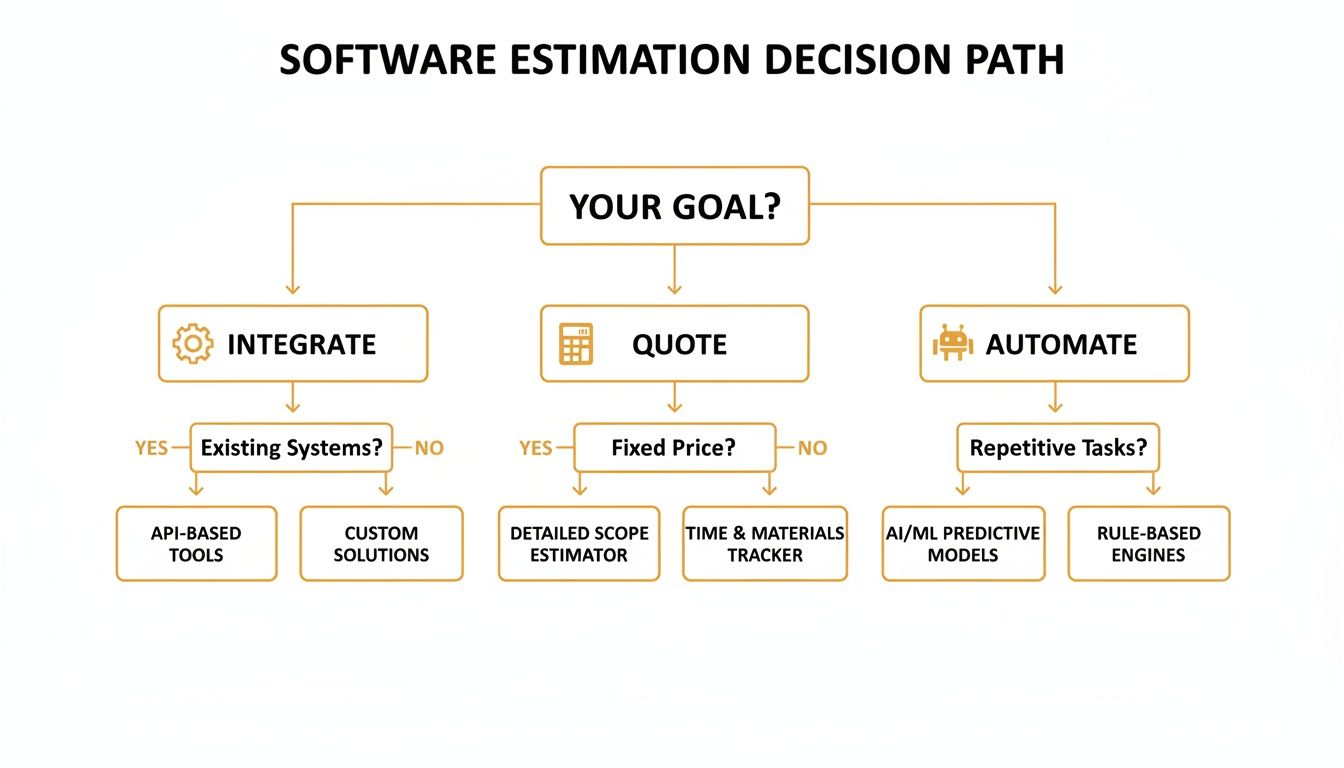
The takeaway is clear: if your main goal is to automate the process of capturing and closing leads you’re currently losing, AI-driven tools are the most direct path to revenue growth.
How AI Automation Actually Works for Movers
Picture this: it’s 9 PM on a Saturday. A hot lead calls your business line. Instead of hitting voicemail, they’re greeted by a professional AI that sounds completely natural. It walks them through the quoting process, asking for their addresses, home size, and details like stairs or heavy items.
Within minutes, it calculates a price based on your rates and sends the customer a formal quote via text and email. If they’re ready, it can even take a deposit and book the job right then. When your team arrives on Monday morning, that job is already on the schedule, with a deposit paid.
While these systems are fine-tuned for movers, they build on proven tech. As our industry adopts more technology, learning how other businesses use automation and artificial intelligence can offer valuable insight. This level of automation isn’t a fantasy; it’s a practical tool that owners of 1–20 truck operations are using right now to get ahead and turn unpredictable call volume into a reliable source of revenue.
Calculating the ROI of Your New Estimating Software
Investing in new software can feel like a big leap, but the best estimating software for moving companies isn't an expense—it's a revenue engine. The right system pays for itself, often in the first month, and then starts generating pure profit.
Let's skip the complicated spreadsheets and focus on the real-world math that matters to your bottom line.
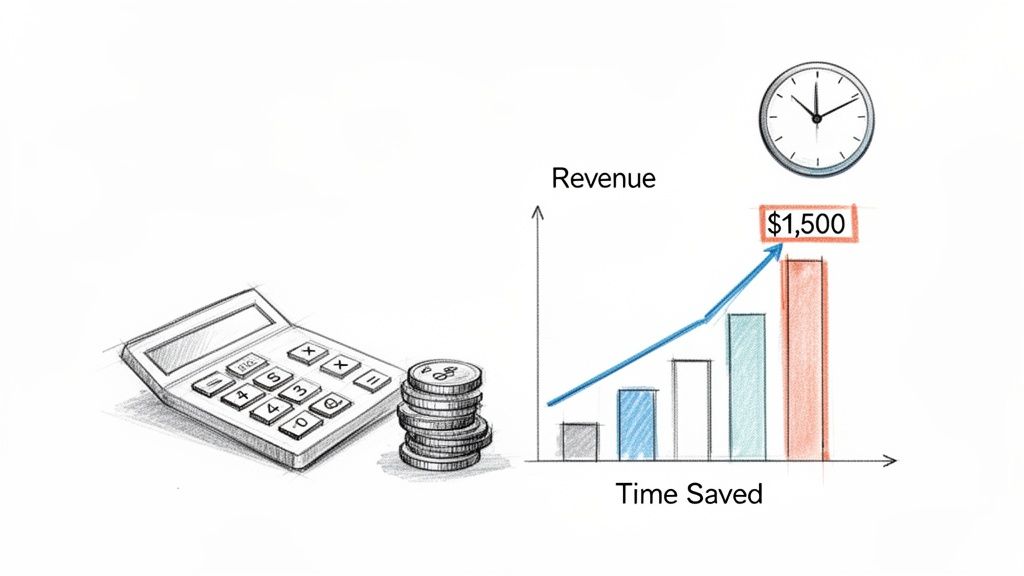
The market for moving company software is projected to hit $38.11 billion by 2035 as owners race to get more efficient. With nearly 70% of companies already on cloud-based tools, pen and paper just can't compete. You can see the full numbers in this complete moving software market analysis.
1. Revenue Recovered from Missed Calls
This is the fastest and most powerful way you'll see a return. Every moving company owner knows the pain of missed calls, especially after hours or during the spring rush. These aren't just missed calls; they're lost jobs.
Let’s use a conservative example for a 5-truck operation:
- Average Job Value: $1,500
- Missed Calls Booked by AI: Just 2 per month
By using a system that can quote and book jobs 24/7, you're not just answering the phone—you're closing deals while you sleep.
The Math: 2 booked jobs/month x $1,500/job = $3,000 in recovered revenue each month. For software that might cost a few hundred dollars, the ROI is immediate. A single booked job often covers the entire monthly cost.
2. Time Saved on Manual Admin Work
Your second ROI comes from clawing back the hours your office staff sinks into repetitive tasks. Manually building quotes, chasing leads, and re-typing job details into your CRM is a huge operational drag.
Consider the cost of those hours:
- Admin Hours Saved: Let's say automation saves just 10 hours per week on quoting and data entry.
- Hourly Rate of Staff: At a conservative $20/hour.
The Math: 10 hours/week x 4 weeks/month x $20/hour = $800 in saved labor costs per month.
Those 10 hours can now be spent on high-value activities that actually grow your business—like marketing, improving customer service, or managing crew performance.
3. Increased Booking Rates from Faster Responses
Finally, there’s the impact of speed. Customers shop fast. The first mover to provide a professional, accurate quote has a massive advantage. If you take hours to get back to someone, you've already lost.
Software that delivers instant quotes dramatically increases your booking rate. Even a small bump of 5% more closed leads from faster, more professional quotes can have a huge impact on your annual revenue.
When you add it all up—the recovered revenue, the saved labor, and a higher booking rate—the right software isn't a cost. It's one of the most profitable investments you can make. Plug your own numbers into this simple moving company ROI calculator to see the potential for your business.
Your Go-Live Game Plan: How to Choose and Implement
You've seen the options and run the numbers. Now it’s time to make a decision. The right software isn't about fancy features; it’s about fixing your single biggest—and most expensive—problem.
Follow these steps to choose a tool that fits your business.
Identify Your Biggest Revenue Leak: Before you book a demo, be honest. Where are you losing leads right now? How many calls go to voicemail after 5 PM or during busy season? Is it missed calls, slow follow-ups, or inaccurate quotes? Pinpointing that one thing will tell you exactly what you need a tool to do.
Define Your "Must-Haves": Go back to our feature checklist. What can you absolutely not live without? For most movers, it’s custom rate card support (so quotes are accurate) and a clean CRM integration with tools like SmartMoving, Supermove, or MoveitPro. Everything else is a bonus.
Book Demos and Ask Hard Questions: Based on your #1 problem, pick 2-3 vendors. If you’re losing thousands to after-hours calls, focus on AI automation tools. Get on a live demo and say, "Show me exactly how your system solves my problem with missed calls and books a job into my CRM." Don't let them give you a generic tour.
Ask About Onboarding and Support: A great tool is worthless if you can't get it running. Ask them straight up: "Who will set up my rate card? How long does it take to go live? What happens when I have a problem on a Saturday?" Good support isn't a feature; it's a lifeline.
Stop and ask yourself this one question: "What is the single biggest source of lost revenue in my business right now?" Your gut answer is the right one.
If that answer is "missed calls" or "not getting back to people fast enough," then your priority is clear. You have a gap between a customer wanting to give you money and your ability to take it. Your CRM is great for managing jobs you've booked. An answering service can take a message, but they can't quote or close the deal.
The real money is in closing that gap with a system that can capture a lead, provide an accurate quote using your rates, and book the job 24/7. That's how you stop bleeding cash on leads you already paid for and gain a salesperson who works around the clock.
Frequently Asked Questions from Moving Company Owners
Here are the most common questions moving company owners ask about estimating software, with the straight answers you need.
How much does this software actually cost?
The price varies based on what the software does for your business.
- All-in-One CRMs like SmartMoving or Supermove can run from a few hundred to over a thousand dollars a month, often based on your number of trucks.
- Standalone Quoting Tools are cheaper but lack the crucial CRM integrations, creating manual work.
- AI Automation Tools are typically priced between $149 and $499 per month. The entire point is for the tool to pay for itself by booking just one or two extra jobs you would have otherwise missed.
How hard is it to train my team?
The best modern platforms are designed for non-technical users. While large CRMs can have a steep learning curve, AI-powered automation tools are different. Most of the work is done during setup. Once your rate card is configured and the tool is connected to your CRM, it works in the background, answering calls and booking jobs without your team needing to do anything.
Will it work with my current CRM?
This is a deal-breaker question. The best estimating software for moving companies absolutely must have a direct, seamless integration with major industry CRMs like SmartMoving, Supermove, and MoveitPro. This connection is what ensures a job booked at 9 PM on a Saturday automatically shows up on your dispatch board Monday morning without any manual data entry.
What's the real difference between an AI tool and a human answering service?
It all boils down to one thing: booking the job.
An answering service is paid to take a message. They can't give a real quote because they don't know your rates. This creates a delay, and by the time you call back, your lead has likely booked with a competitor. A purpose-built AI for movers does more than answer the phone—it uses your company's rates to give a precise quote, books the job directly into your CRM, and closes the deal on the first call. It turns a lead into revenue, instantly.
Ready to stop losing revenue to missed calls and start booking more jobs, 24/7? MoveJoy is the AI-powered revenue engine built specifically for movers. It doesn't just answer your calls—it quotes and books jobs for you, turning missed opportunities into profit. See exactly how it works at https://getmovejoy.com.