AI for Moving Companies: A Guide to Booking More Jobs
If you run a 5 to 20 truck moving company, you already know the pattern. The office gets slammed when crews are loading, dispatch is juggling schedule changes, and the phone rings at the exact moment nobody can give a clean quote. A lead comes in after hours, on a Saturday, or during a lunch rush. Someone takes a message. Someone means to call back. The customer books with the mover who answered faster.
That’s why the conversation around AI for moving companies isn’t primarily about shiny tools or back-office experiments. It’s about fixing the front-end leak that costs operators bookings every week: missed calls, slow follow-up, weak qualification, and quotes that don’t get done while the customer is still ready to book.
Table of Contents
- The Real Problem AI Solves for Your Moving Company
- Key AI Use Cases That Directly Book Jobs
- Calculating the ROI of AI Automation for Your Business
- A Practical Guide to Implementing AI Automation
- How to Choose the Right AI Partner for Your Company
- Common Pitfalls and Real-World Success Stories
- Frequently Asked Questions from Moving Company Owners
The Real Problem AI Solves for Your Moving Company
The leak is between first contact and booked job
Most movers describe the problem as missed calls. That’s true, but it’s incomplete.
The bigger issue is the gap between answering the phone and closing the job. A lot of tools can capture a name and number. Very few can qualify the lead, understand moving details, calculate a usable quote, and help the customer commit while they’re still on the line.
That gap is expensive. Independent movers lose $50K to $150K annually from missed calls, and 40% of moving leads are lost due to delayed responses, according to Supermove’s analysis of AI tools for moving companies. For a busy operator, that shows up as unreturned calls, quote requests sitting in the CRM, and office staff trying to catch up after the customer has already moved on.
Practical rule: If your process can only “take a message,” it’s not protecting revenue.
Peak season makes this worse. From March through September, your team has less margin for delay. The customer calling for a local move usually isn’t building a spreadsheet and waiting three days. They’re comparing speed, confidence, and whether somebody can give them a price path that sounds credible.
Why generic tools fall short
Owners often get frustrated with generic automation. Basic voice bots often collect contact info but don’t understand moving-specific quoting logic. Human answering services sound helpful, but they usually stop at intake. Your CRM helps once the lead is inside the system, but it doesn’t solve first-touch conversion by itself.
Moving companies need front-office automation that understands things like stair charges, long carries, walkups, service areas, crew size, and whether the job should even be quoted on the first call. That’s different from generic small business automation. If you want a broader example of how operators are using automation in finance and admin, this piece on AI transforming small business bookkeeping is useful because it shows the same pattern: the best tools remove repetitive bottlenecks, not just add another dashboard.
Natural language handling matters here too, because callers don’t speak in neat form fields. They say things like “second-floor apartment, no elevator, short hallway, maybe a long carry depending on parking.” That’s why understanding natural language processing in customer conversations matters in a moving context. If the system can’t interpret how real customers talk, it can’t quote cleanly or route the lead correctly.
Key AI Use Cases That Directly Book Jobs
What actually changes on the front end
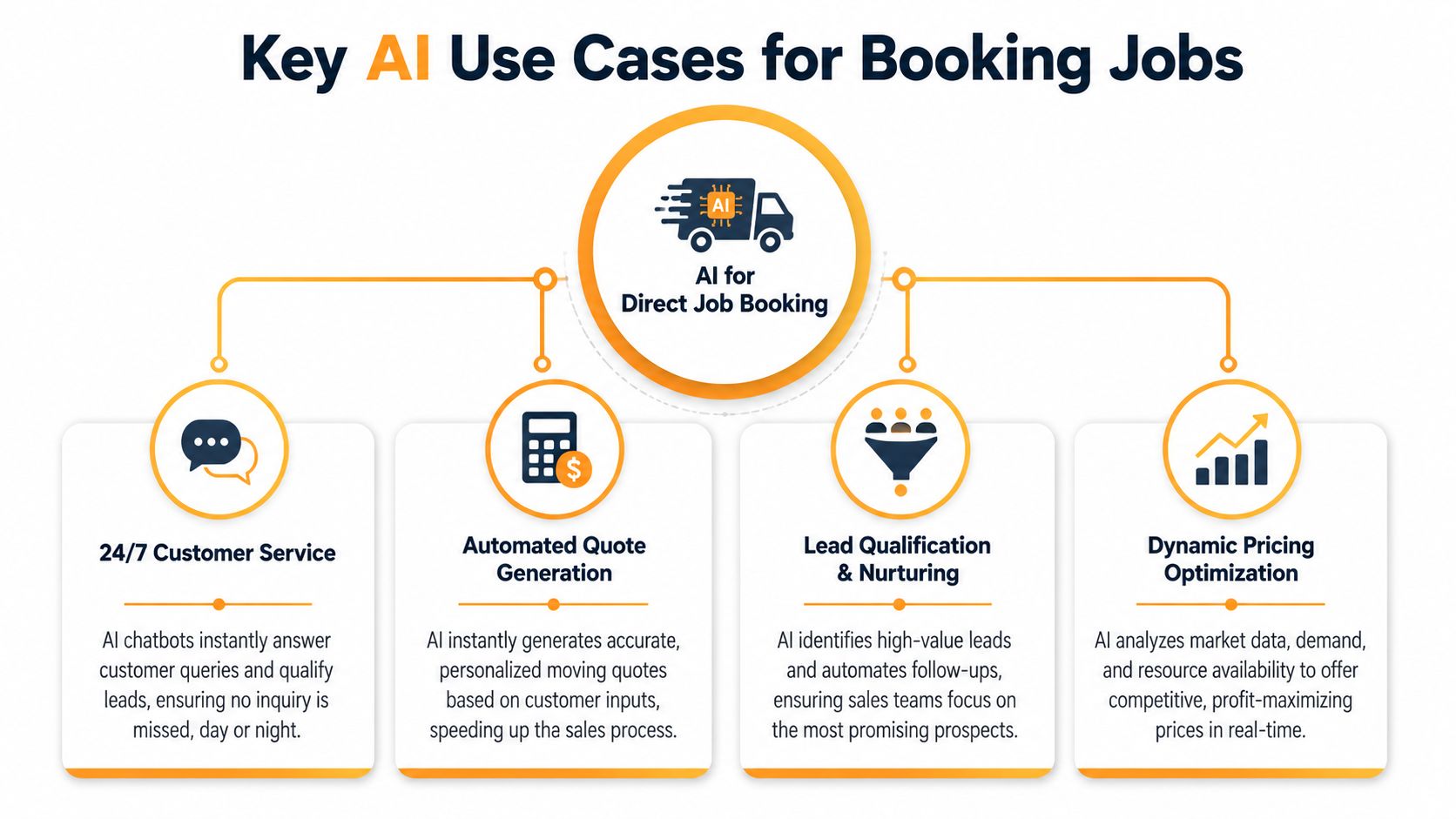
Good AI for moving companies should reduce office drag, not create it. The right use cases are simple to explain because they follow the path of a real incoming lead: answer, qualify, quote, book.
One of the clearest examples comes from AI-powered virtual surveys. They’ve cut survey and quoting time from over an hour to just a few minutes and let sales reps quote more than three times the number of customers by identifying furniture, calculating a cube sheet, and generating quotes from digital volume and weight analysis, as described by Yembo’s overview of AI in the moving industry.
The four use cases that matter most
1. 24 7 inbound call capture
Customers call when it’s convenient for them, not when your coordinator is free. After-hours and overflow coverage matters most when crews are on the road and the office is thin.
A strong setup should:
- Answer immediately: So the caller doesn’t bounce to the next mover.
- Handle common questions: Service area, timing, move type, and next steps.
- Keep the interaction moving: No long menus, no dead ends.
2. Lead qualification that filters junk from real jobs
Not every lead should hit your sales team the same way. The system should identify whether the caller is in your service area, whether it’s residential or commercial, and whether the move fits your operation.
That same logic matters for related services too. If you’re adding junk removal or labor-only jobs in slower periods, qualification needs to separate profitable add-on work from low-quality inquiries. On the operations side, many movers also think more carefully about route visibility and driver movement. If you’re reviewing fleet accountability, tools that track car’s movement history can help frame what good vehicle visibility looks like, even though quoting and booking are a separate front-office problem.
3. Quote generation using your own rate card
This is the dividing line between lead capture and revenue capture.
A useful system has to quote the way your company quotes. That means hourly versus flat-rate logic, minimums, travel time, stairs, long carries, packing, valuation, and calendar realities. If it can’t do that, it’s just a nicer message taker.
A moving company doesn’t win because it answered the call. It wins because it gave a quote the customer could act on.
There’s also a sales benefit beyond speed. Front-end automation can support prospecting and follow-up workflows, especially if you already think about AI for sales prospecting as a way to prioritize hot opportunities instead of letting every inquiry sit in the same queue.
4. Booking directly into your workflow
The final step is where a lot of systems still fail. A quote without booking options creates another delay. The lead gets sent for manual follow-up, and the office loses momentum.
What works better is direct booking into the tools your team already uses:
- SmartMoving workflows: So the office doesn’t re-enter job data later
- Supermove operations: So dispatch and sales stay aligned
- MoveitPro or calendar-based scheduling: So the customer leaves the call with a next step
That’s how AI for moving companies becomes practical. It doesn’t replace your team’s judgment. It removes repetitive intake work so your sales staff can focus on exceptions, high-value jobs, and customer issues that need a human.
Calculating the ROI of AI Automation for Your Business
Start with response speed and seasonality
Owners usually overcomplicate this calculation. You don’t need a giant model. Start with two facts that already affect your month.
Moving companies are closing 40% of leads on average in 2024, but 52% of operators fail to respond within critical timeframes, according to SmartMoving’s moving industry report takeaways. During the slower stretch from October through March, operators can see a 30% to 50% revenue drop, which makes every delayed lead more painful for a 5 to 20 truck business trying to keep trucks and crews productive, as noted in Move Right’s off-season revenue strategies for moving companies.
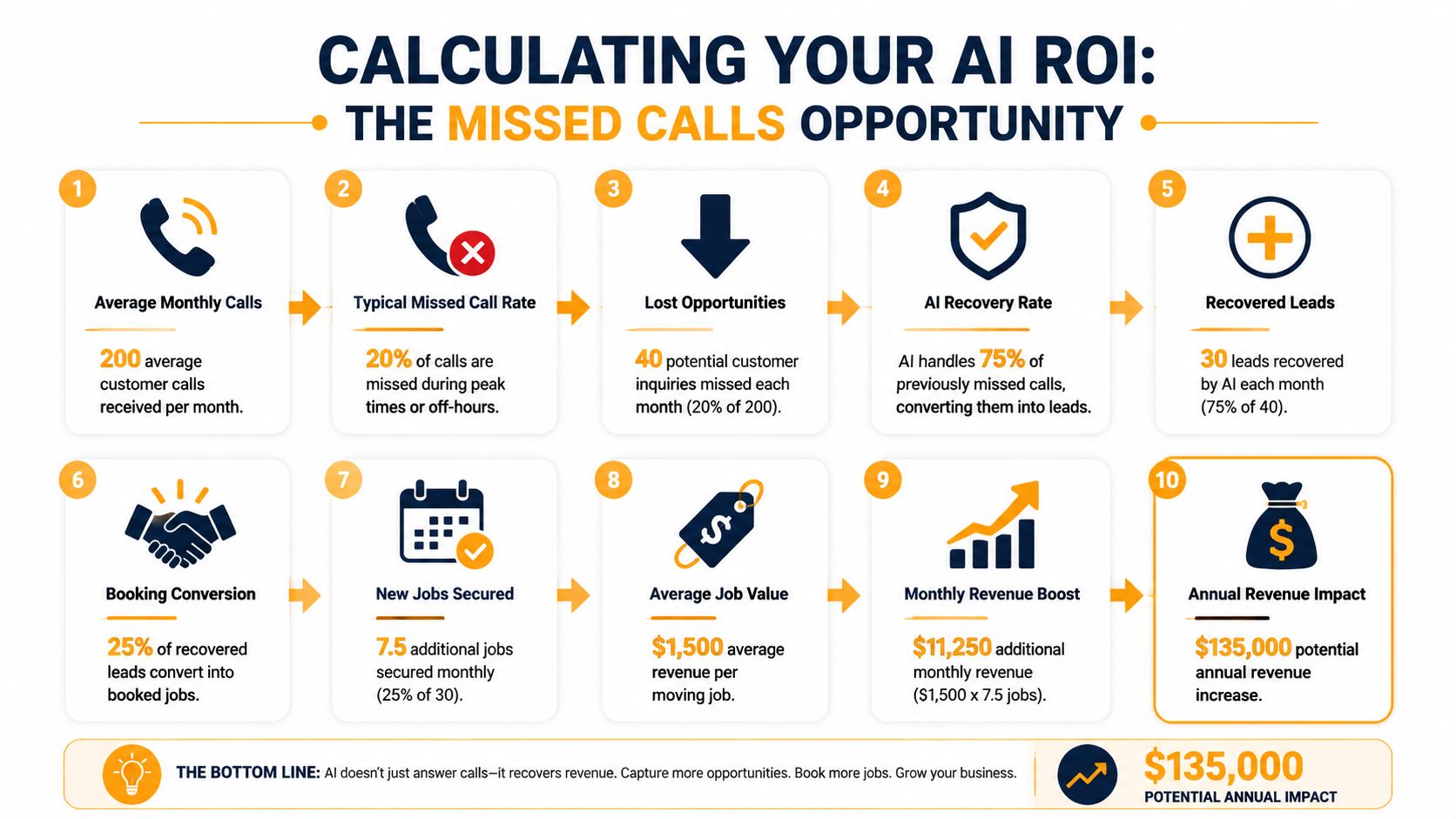
That means the ROI conversation is really a response-time conversation. If your team already has decent close rates on qualified leads, then improving speed on inbound opportunities can recover revenue you were already spending to acquire.
A simple way to measure the upside
Use a short internal audit. Don’t guess.
- Pull your call logs: Look at after-hours calls, missed calls, and overflow periods.
- Match them to booked jobs: Find out how many inquiries never received a timely response.
- Review your quoting queue: Check how long it takes from first contact to quote sent.
- Track seasonal patterns: Compare busy months with your October to March slowdown.
A small table helps:
| Area to review | What to look for |
|---|---|
| After-hours calls | Calls that went to voicemail and never turned into estimates |
| Midday overflow | Times when office staff were busy and leads waited |
| Quote turnaround | Jobs that sat too long before pricing went out |
| Follow-up gaps | Estimates sent without structured reminders |
Owner mindset: Don’t evaluate automation like overhead. Evaluate it like recovered dispatch capacity and recovered booking opportunities.
There’s a parallel on the fleet side. Shops adopt predictive maintenance because unplanned breakdowns cost more than prevention. If you want a plain-English overview, learn about PdM from Premier Fleet Repair. Front-office automation works the same way. It prevents avoidable revenue loss before it hits the schedule.
If you’re comparing options, it also helps to understand the cost of after-hours answering coverage versus systems that can move the lead toward a quote and booking instead of just passing a message to the morning shift.
A Practical Guide to Implementing AI Automation
Audit the leaks before you buy anything
The easiest way to waste money on software is to skip the process audit. Most moving companies don’t need more tools. They need one system that fixes the first few minutes of the customer journey.
Start by mapping your current lead flow from inbound call to booked job. Keep it simple. Who answers during business hours, who covers lunch, what happens after 5 p.m., where quote requests go, and who owns follow-up?
Then document the points where revenue slips:
- After-hours voicemails: Calls that wait until morning
- Crew-time conflicts: When the owner or dispatcher is on-site and can’t answer
- Slow quote assembly: Jobs that require callbacks because rate logic lives in one person’s head
- No-show follow-up: Estimates sent without reminders or booking prompts
You’ll usually find that one or two handoff points cause most of the damage.
Roll it out in a way your team can handle
Once the leaks are clear, build the quoting rules. This is the part operators often postpone, but it’s the foundation. Write down your actual logic for hourly jobs, flat-rate jobs, service areas, minimums, stairs, long carries, packing, and edge cases.
A practical rollout looks like this:
Phase one
Use automation for after-hours and overflow calls first. That keeps the test contained and lets your team compare booked outcomes against voicemail and callback workflows.
Phase two
Connect it to the systems you already use. For most movers, that means SmartMoving, Supermove, MoveitPro, or at minimum Google Calendar. The less re-entry your office staff has to do, the faster the team trusts the process.
Phase three
Add automated quote follow-up. A lot of jobs aren’t lost because the price was wrong. They’re lost because nobody followed up while the customer was still deciding.
Start where your office feels the most pain. Don’t automate everything on day one.
A few implementation rules help:
- Keep ownership clear: One person should own setup and rule review.
- Use real call scenarios: Test apartment moves, house moves, storage, and junk removal inquiries.
- Review bad fits early: Fix confusing questions and quoting edge cases before full rollout.
- Train the office on exceptions: Staff should know when to step in, not feel replaced.
That’s the difference between automation that “just works” and software that turns into another side project nobody maintains.
How to Choose the Right AI Partner for Your Company
Three categories of tools and what they really do
Most owners looking at AI for moving companies run into three options.
The first is the generic AI voice platform. It can answer calls, ask basic questions, and log a lead. That sounds useful until the caller asks about a walkup, a long carry, or whether the quote includes packing. Then the system gets vague, and vague doesn’t book jobs.
The second is the human answering service. It sounds more personal, but it usually stops at intake. The rep takes a message, maybe fills out a form, and your office still has to chase the lead later.
The third is a moving-specific automation platform built around qualification, quoting logic, and booking workflows. That’s the only category that addresses the front-end revenue gap instead of documenting it.
A quick comparison makes the difference clear:
| Option | Can answer calls | Can qualify by move type | Can quote using your rate card | Can book into workflow |
|---|---|---|---|---|
| Generic AI tool | Yes | Sometimes | Usually no | Sometimes |
| Human answering service | Yes | Limited | No | Rarely |
| Moving-specific platform | Yes | Yes | Yes | Yes |
Questions to ask before you sign
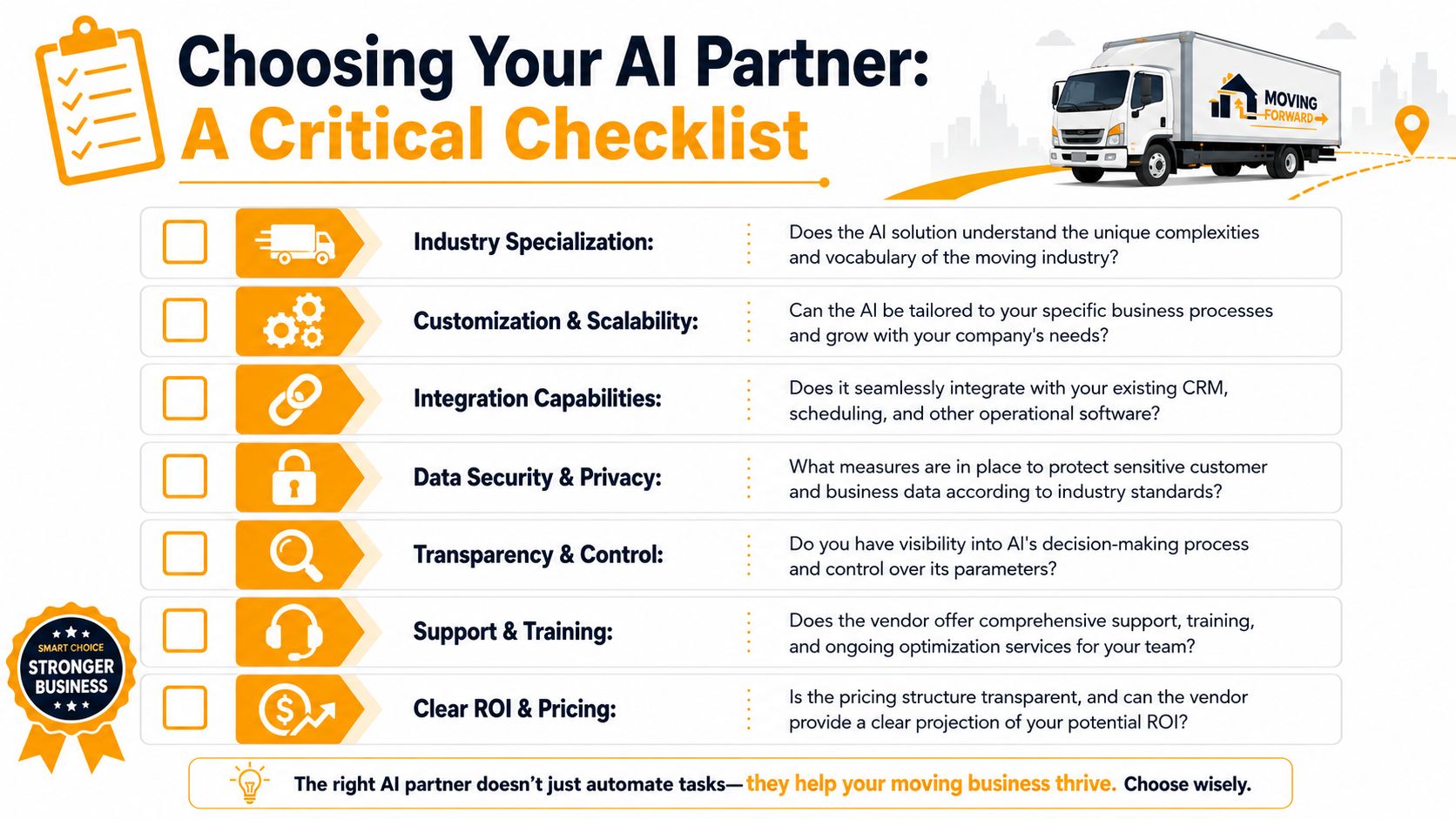
Don’t let the demo drive the decision. Use a checklist that reflects how your office works.
Ask these questions:
- Does it understand moving language: Can it handle stairs, walkups, long carries, valuation, and service-area limits?
- Can it use our actual rate card: Not a sample. Yours.
- Does it integrate cleanly: SmartMoving, Supermove, MoveitPro, or your calendar stack.
- Can it trigger follow-up: Quotes without reminders often go unaccepted.
- What control do we keep: You should be able to review rules, call outcomes, and exceptions.
- How does support work: Setup help matters because your team won’t have time for a long learning curve.
If the vendor mainly talks about answering calls, keep digging. The real question is whether it can help close the job.
A good partner should also be honest about limits. No system should pretend every call can be auto-booked. Some jobs need human review. The right product will know the difference and route those situations cleanly instead of forcing bad automation.
Common Pitfalls and Real-World Success Stories

Where movers get burned
The biggest mistake is buying generic automation and expecting moving-specific performance. When the tool can’t handle your quoting rules, one of two things happens. It gives a weak non-answer, or it gives a bad answer. Neither helps your brand.
Other common pitfalls show up fast:
- Unclear pricing logic: If your own team can’t document how quotes are built, automation will struggle too.
- No integration path: Staff ends up retyping lead details into the CRM and schedule.
- Poor exception handling: High-value or unusual jobs get trapped in a rigid script.
- No review process: Problems repeat because nobody listens to failed interactions.
Those issues don’t mean automation doesn’t work. They mean sloppy implementation doesn’t work.
What good implementation looks like
A better model is using AI where the business already has clear rules and measurable friction. The moving industry has good examples of that.
Texas-based 3 Men Movers implemented an AI distracted driver detection system that reached 91% accuracy, prevented 80% of distractions within the first three months, and contributed to a 4.5% reduction in the company’s accident rate, according to Business Insider’s report on 3 Men Movers and AI operations. That’s a safety use case, not a quoting one, but the lesson is the same. AI works when it solves a specific operational problem with clear inputs and a process around it.
For a typical 15-truck mover, the front-office version looks like this:
Before automation, the company misses overflow calls during dispatch rushes, callbacks pile up after 5 p.m., and quote follow-up depends on who remembered. Busy season feels chaotic even when demand is strong.
After implementing a focused intake and booking workflow, the office stops treating every lead like a manual project. Straightforward local jobs get handled faster. Staff spends more time on complex estimates, customer issues, and schedule management. The business doesn’t need perfect automation. It needs fewer preventable losses.
Good AI doesn’t remove your team from the process. It removes dead time, repetitive questions, and quote delays that never should’ve existed.
That’s the part owners should pay attention to. Not hype. Not features in a vacuum. Actual operational relief tied to cleaner execution.
Frequently Asked Questions from Moving Company Owners
Will customers hate talking to AI
Most customers won’t care what’s answering the phone if the experience is fast, clear, and useful. They care that somebody responds, understands their move, and gives them a next step.
The relevant comparison isn’t AI versus a perfect in-house salesperson. It’s AI versus voicemail, missed calls, and “we’ll call you back tomorrow.” For many movers, that’s where the bar is.
Is setup going to be a headache
It doesn’t have to be if you start with a narrow use case and clear pricing rules.
The hard part isn’t the technology. It’s documenting how your company already qualifies and quotes jobs. Once that’s written down, setup becomes much more manageable, especially if the platform connects to tools your office already uses such as SmartMoving, Supermove, MoveitPro, or Google Calendar.
Is this just one more tool to manage
It shouldn’t be.
If the system creates more dashboards, more admin, and more cleanup for your coordinator, it’s the wrong setup. Good automation should automatically handle repetitive front-end work in the background, then hand your team cleaner jobs, cleaner lead records, and fewer callback fires.
A simple test helps:
- If it only logs messages, it’s adding a handoff.
- If it helps qualify, quote, and book, it’s removing work.
- If your staff still has to rebuild every lead manually, it’s not true automation.
For most moving company owners, that’s the decision. You don’t need more software. You need a system that closes the gap between inquiry and booked job.
If you want to see what that looks like in practice, MoveJoy is built for the front-end revenue gap most movers are still dealing with. It helps moving companies capture inbound calls, qualify leads, generate accurate quotes using their own rate card, and book jobs directly into the workflow instead of just taking messages. If your team is losing bookings during peak hours, nights, or weekends, it’s worth taking a look at getmovejoy.com.