What Is Natural Language Processing? A Mover’s Guide to Winning More Jobs
Let's be honest, the term Natural Language Processing (NLP) sounds like something cooked up in a lab, not something that helps you book more moving jobs. But what it actually is? It's the technology that finally lets computers understand how real people—your customers—talk and write.
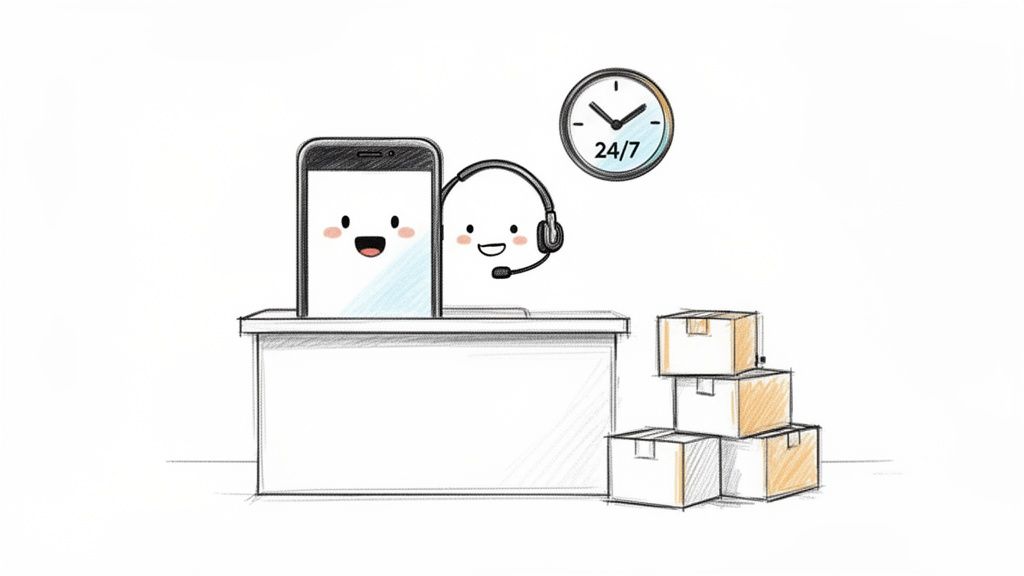
Think of it as teaching your phone system to do what a great sales manager does: listen, understand, and act. But this employee works 24/7, never misses a call during the spring rush, and never takes a coffee break.
From Missed Calls to Booked Jobs
As a moving company owner, you know that sound. The phone ringing is the sound of a potential job. But you also know the gut-punch feeling of seeing a list of missed calls at the end of a long day. Every single one of them is a customer who likely just booked with the competitor who answered first.
This isn't just a tech problem; it's a revenue problem. And understanding what NLP does is the first step to fixing it.
In the moving business, speed is everything. A customer looking for a quote is calling three or four other local movers. The first one to give a professional, helpful answer almost always wins. A few minutes of delay, and that high-value, 4-bedroom house move is gone for good.
The reality for a small moving company is brutal. Most businesses running 1–20 trucks lose 3–7 jobs every single month just because they can't get to the phone in time. That's not a small leak; that's thousands of dollars in revenue vanishing.
What NLP Actually Does For Your Moving Company
Forget the technical jargon. For your business, NLP is a practical tool that solves this exact problem. It's the engine that powers an automated system to:
- Answer every call instantly. No more sending paying customers to voicemail during your busy season or at 8 PM on a Saturday.
- Understand what a customer wants. An NLP system can tell the difference between a high-value lead asking for a quote on a "four-bedroom house" and someone just looking for "free boxes."
- Capture lead info without mistakes. It gets the name, phone number, email, and move details right every single time.
- Respond immediately. It can text a booking link or a quick quote while the customer is still on the line and ready to make a decision.
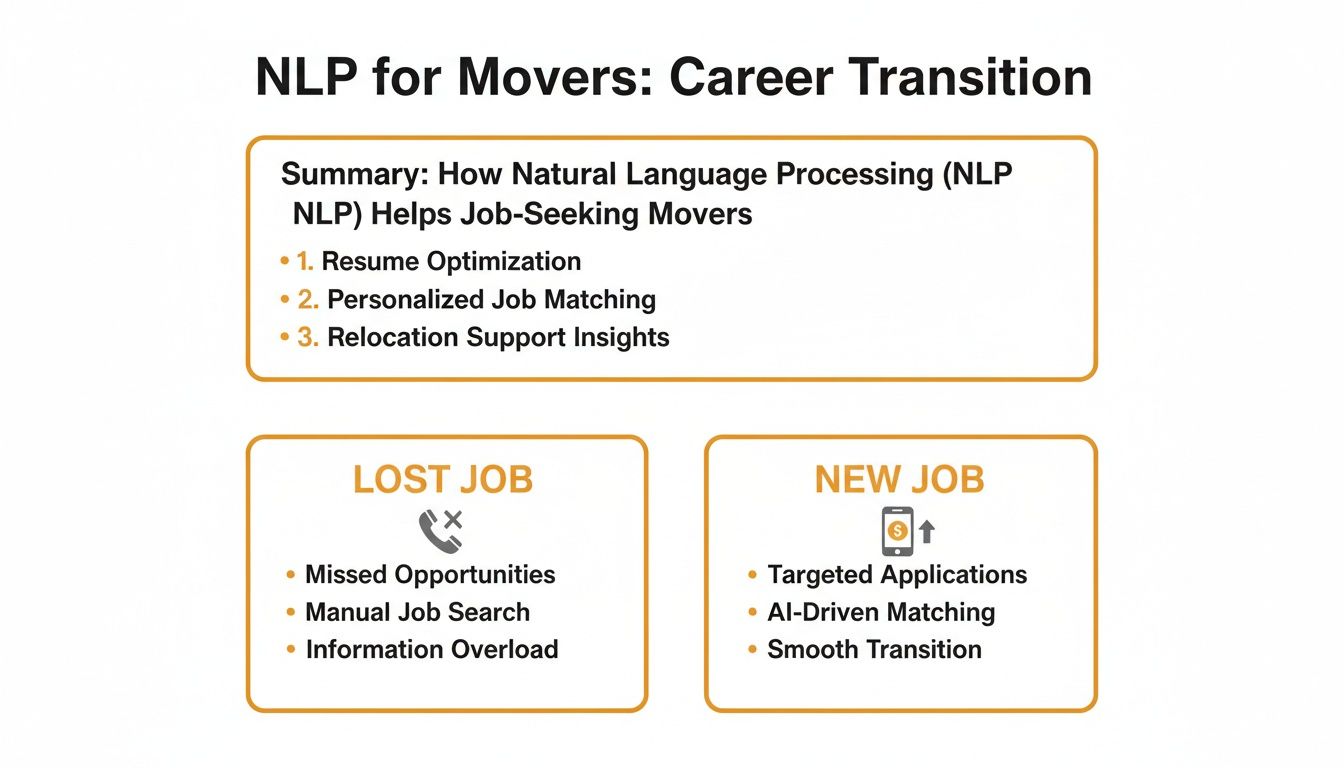
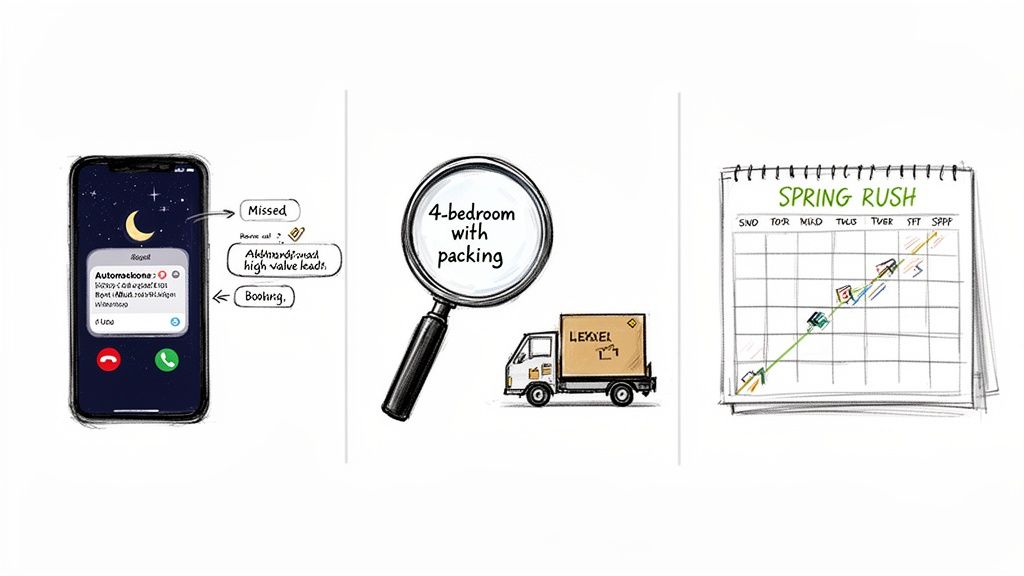
This visual says it all. A missed call is a lost job. An instantly answered call powered by NLP is a booked job. It’s that simple.
The real lightbulb moment here is that automation isn't about replacing your staff. It's about finally capturing all the leads you're currently paying for but failing to answer. This tech acts as your perfect AI receptionist, making sure no opportunity slips through the cracks.
Manual Call Handling vs. NLP-Powered Automation
Let's break down what this difference looks like day-to-day. For most moving companies, the "Manual Process" column is going to look painfully familiar.
| Operational Task | Manual Process (Your Current Reality) | NLP-Powered Automation (The Future) |
|---|---|---|
| New Lead Calls | Rings to office line. If busy, goes to voicemail. | Instantly answered, 24/7. |
| After-Hours Calls | Voicemail. You call back Monday, but they've already booked elsewhere. | Handled live. Quoted and booked on the spot. |
| Information Capture | Dispatcher scribbles notes while on another call. Mistakes happen. | All key details (name, number, move size) are captured accurately. |
| Quoting Process | You or a dispatcher have to stop what you're doing to run the numbers. | Instant, accurate quotes based on your company's rate card. |
| Booking Follow-Up | A manual email or text when you find a spare moment. | Automated text with a booking link sent immediately. |
The difference isn't just about convenience. The "NLP-Powered" column translates directly to more jobs booked, higher revenue, and less stress for you and your team.
Ultimately, by using this kind of technology, you’re not just buying software. You're buying back your time and locking down income that was previously walking out the door. To see this in action, it’s worth learning more about how a modern AI phone answering system is built specifically for the moving industry. It’s a shift that makes your business run smoother and gives you a serious leg up on the competition.
From Clunky Phone Trees to an AI Receptionist That Books Jobs
To really get why modern Natural Language Processing is such a big deal for your moving company, it helps to look at where this stuff came from. The road from those maddening, robotic phone menus to a smooth, conversational AI receptionist was a long one.
The dream of getting computers to understand us isn't new. The whole field of Natural Language Processing kicked off back in the 1950s. But for decades, the technology was clumsy and frustrating for a business owner.
The Problem With Old-School Phone Systems
You've dealt with the old technology firsthand. Think of every time you’ve called a big company and heard that familiar robot voice: "Press 1 for sales. Press 2 for support. Say 'operator'…" That’s a rule-based system, and it’s the clumsy ancestor of today’s AI.
These systems are completely rigid. They run on simple "if-then" logic.
- IF a caller says "Sales," THEN send them to the sales line.
- IF a caller says "Billing," THEN send them to the billing department.
The problem? Real people don't talk like that. A customer says, "Hi, I need a quote for my move," or "I got my bill and I think there's a mistake." A rule-based system hears that and just short-circuits. It can't handle slang, accents, background noise, or a customer who pauses for a second to think. This is why those old phone menus are so infuriating—they force you to talk like a computer, not a person. You can see why it fails in our article on the problems with a traditional telephone tree system.
The Big Shift: From Rigid Rules to Smart Learning
For decades, this was as good as automation got. It was too clunky and unreliable for the fast-paced world of a local moving company. A system that hangs up on a customer asking for a "quote for a 4-bedroom" just because it was only programmed to hear "get estimate" is worse than having no system at all. It actively drives business away.
The breakthrough came when developers stopped trying to write a rule for every single thing a person could possibly say. Instead, they started building systems that could learn from experience—a lot like a new dispatcher does.
Instead of being programmed with rigid commands, modern NLP models are trained on massive amounts of real-world conversations from the moving industry. They learn the patterns, context, and the million different ways people ask for the exact same thing.
This is the key difference. A modern AI receptionist doesn't need to be told that "get a price," "how much for a move," and "I need a quote" all mean the same thing. It learns this from context.
This shift from pre-programmed rules to flexible learning is what finally made automated assistants practical, reliable, and affordable enough for a moving business owner. It's the reason an AI can now handle a call from a stressed-out customer and sound just as capable as your best office manager.
How Modern AI Actually Understands Your Customers
So, how does an AI go from hearing a jumble of words to actually understanding that a caller represents a valuable job? The big shift is that it no longer listens word-by-word. It understands the entire request at once.
Think of it this way: older systems were like a rookie trying to read a complicated moving order one line at a time. They’d see “three,” then “bedroom,” then “house,” but couldn’t connect them. They lacked the context to realize it all described one big, valuable job.
Modern AI, on the other hand, processes the entire sentence at once. It immediately understands the relationships between all the words, just like an experienced ops manager would.
Seeing the Big Picture in a Single Glance
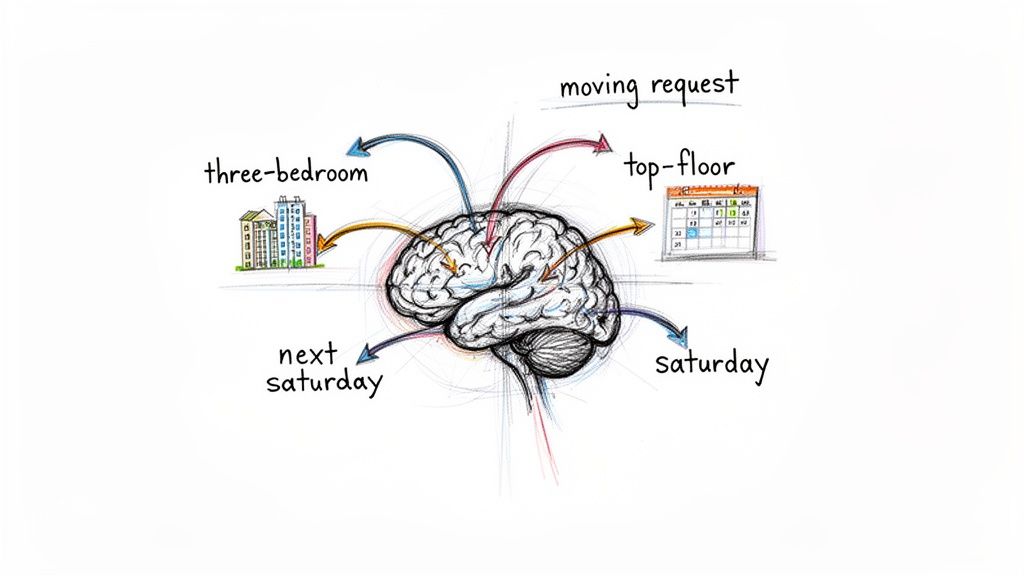
When a stressed-out customer calls and says, “Hi, I need a quote for a pack-and-move for my three-bedroom apartment on the top floor, maybe for next Saturday?” a modern AI doesn’t just hear a string of words. It instantly grasps the critical details:
- Service Type: Pack-and-move (a higher-value, full-service job)
- Scope: Three-bedroom apartment (a good-sized local move)
- Logistics: Top-floor (means more labor and time)
- Urgency: “Maybe next Saturday” (a specific booking window)
This is what separates a frustrating robot from a digital receptionist that actually helps book jobs. It can pick out the crucial details that determine a job’s value and complexity, just like an experienced dispatcher would.
The real breakthrough is that modern AI doesn't just match keywords; it understands intent. It knows the difference between "I need to buy boxes" and "I need you to pack my boxes," and it knows which one is the lead you want to talk to.
The “Transformer” Revolution
This massive step forward in AI’s ability to understand us happened pretty recently. The game changed with a new AI architecture called the "transformer," introduced back in 2017. This new design allowed AI to process whole sentences all at once, instead of one word at a time. This paved the way for powerful language models that can finally learn the patterns of how real people actually talk.
This technology is the engine behind systems that can handle real, messy human conversation. It’s the reason a customer with a thick accent or who uses slang can still get their needs met. First, the AI has to accurately turn their speech into text. Advanced tools like OpenAI Whisper have powerful translation and language identification features to process what customers are saying far more effectively.
Once the words are on paper, the transformer model gets to work understanding the meaning.
What This Means for Your Moving Business
This new level of understanding has a direct impact on your bottom line. It’s the difference between a system that just routes calls and one that actually closes deals for you.
Here’s how this advanced AI plays out in real-world scenarios:
- Instant Lead Qualification: The AI immediately recognizes a call about a "4-bedroom house move with storage" as a high-priority lead and can instantly text the caller a detailed quote form.
- Handling Any Phrasing: A customer might say, "I need to shift my stuff," "I'm looking to relocate," or "I want to book a move." The AI knows these all mean the same thing and responds correctly every single time.
- Capturing Critical Details: When a caller mentions they have "lots of fragile items," the AI can be trained to flag this and automatically add a note about "specialty packing" to the job file.
This ability to grasp the nuances of a customer's request is what gives you a true competitive edge. It ensures every single inbound call is handled with the speed and professionalism that wins jobs—especially during your busy season when you can't afford to let good leads slip through the cracks.
How NLP Solves Real Problems for Your Moving Company
All the theory is great, but let's talk about what actually matters: turning phone calls into booked jobs. How can this NLP technology actually solve the daily problems that cost your moving business real money? These aren't futuristic pipe dreams. They're practical fixes for the common bottlenecks that drain your revenue.
Scenario 1: The After-Hours High-Value Lead
It’s 9 PM on a Tuesday. A customer who just got off a late shift finds your company online. They call, ready to book a 4-bedroom house move with packing services—a job that could be worth thousands.
The Old Way: The call goes to voicemail. You see the missed call the next morning, but by then, it's too late. They already booked with a competitor who was available. You just lost a huge job while you were sleeping.
The NLP Way: An AI receptionist picks up immediately. It understands the caller is asking for a quote for a "4-bedroom house" and "full packing." It knows this is a high-value lead and instantly texts them a link to your booking form. The customer fills it out on the spot, and that job is on your calendar before your morning coffee.
Scenario 2: Filtering Out the Noise During the Day
The phone won't stop ringing. You finally duck off a job site to answer, hoping for a big move. Instead, you hear: "Hey, do you guys sell used boxes?" That’s time you'll never get back—time that could've been spent talking to a real customer.
The Old Way: You or your dispatcher are stuck fielding every single call, good or bad. You waste precious minutes on tire-kickers and box-seekers, while calls from people wanting to book an entire move go to voicemail.
The NLP Way: The AI receptionist instantly figures out what the caller wants. When it hears phrases like "buy boxes" or "sell used," it can give a standard, automated reply and never bother your team. It prioritizes calls asking for "quotes" or "booking a move," making sure you only spend your time on conversations that generate revenue.
This is a core function of intent detection. The AI doesn't just hear words; it understands what the caller wants. It acts like an intelligent gatekeeper for your phone lines, protecting your time and pushing real leads to the front.
Scenario 3: Surviving the Spring Moving Rush
It’s April, and the phones are on fire. You're facing a terrible choice: hire expensive, temporary office staff who you'll have to train, or just accept that you’re going to miss dozens of calls and lose thousands of dollars in revenue.
The Old Way: You’re in chaos mode. Missed calls are piling up, your customer service is slipping, and your team is completely fried. Every day feels like you’re lighting money on fire because you just don’t have enough capacity.
The NLP Way: The AI receptionist handles 100% of the calls, no matter how crazy it gets. It can have ten conversations at once, answering every single lead with the same speed and professionalism. It captures details, sends quotes, and books jobs right into your calendar. It's a scalable front office that grows with your seasonal demand—without the cost and headache of hiring.
Scenario 4: Reviving Cold Quotes Automatically
You sent out ten quotes last week. Only three booked. The other seven are just sitting there, getting colder by the minute. You know you should follow up, but you and your crew are swamped with the jobs you did book.
The Old Way: Follow-up is a nice idea, but it rarely happens consistently. Most of those un-booked quotes fall through the cracks. That’s a huge pile of potential revenue you’re just letting disappear.
The NLP Way: An automated follow-up system tracks every quote. If a customer hasn't booked within 24 or 48 hours, it automatically sends a friendly text: "Hi Sarah, just following up on the quote for your move. Do you have any questions I can answer?" That simple, timely nudge is often all it takes to jolt a dead lead back to life and turn it into a confirmed job.
Putting AI to Work Without Being a Tech Expert
All this talk about NLP, transformer models, and AI can sound overwhelming. Let's be honest, you're a moving company owner, not a software engineer. The good news? You don't have to be.
The best AI tools today aren't built for Silicon Valley coders. They're built for operators like you who are more focused on dispatching trucks than debugging code. The whole point is to give you a "plug-and-play" solution that solves your biggest operational headaches right out of the box.
What to Look For in a 'No-Tech' AI Solution
The goal here is simple: find a system that makes your life easier, not one that adds another complicated task to your plate. Evaluating a new AI tool should feel less like adopting software and more like hiring your most reliable employee. If you're just starting your search, you can explore AI solutions for your business.
Here are the non-negotiable features that prove a tool was built for a busy mover, not a techie:
- Easy, Fast Setup: You should be up and running in minutes, not weeks. The best systems require little more than connecting your phone number and tweaking a few settings.
- Seamless Calendar Integration: An AI receptionist is useless if it doesn't know your availability. It has to connect directly to your dispatch calendar (Google, etc.) to avoid double-bookings.
- Pre-Trained on the Moving Industry: A generic chatbot is a waste of your time. The system needs to already know the difference between a "studio apartment" and a "4-bedroom house with storage." It must understand that "pianos," "gun safes," and "COI" are critical details.
- Zero Upkeep: You don't have time to "train" a model or rewrite scripts. A great system is managed entirely by the provider, learning and improving on its own in the background so it "just works."
The bottom line is that the tool should handle the complex tech so you can focus on managing your crews and booking more jobs.
The most important question to ask is: "Was this built for a mover?" General-purpose AI tools require endless tweaking. A solution built specifically for the moving industry already knows your challenges and speaks your customers' language from day one.
Making Technology Feel Effortless
Think about the other tools you rely on. Your dispatch software, your GPS, your accounting program—you didn't have to build any of them. You chose solutions designed for your industry that solved a specific problem with minimal fuss.
AI and NLP should be exactly the same. The best platforms wrap this powerful technology in a simple package that any owner or dispatcher can use immediately. A dedicated AI receptionist for small business, for example, can be up and running without any technical overhead, creating a straight line from missed calls to booked jobs.
The ultimate test is simple: does it save you more time than it costs you to manage? A true "plug-and-play" solution starts capturing missed calls and booking jobs from the moment you turn it on. It proves its worth by putting more jobs on your calendar, not more tasks on your to-do list.
Your Questions About AI for Movers, Answered
Bringing on any new tech can feel like a big step. You have questions. As a moving company owner, you need to know that any new tool won't just work—it will actively help you book more jobs and take stress off your plate.
Let's tackle the most common questions movers have before they trust an AI with their phone lines.
Will an AI Receptionist Sound Like a Robot on the Phone?
This is the number one concern, and it’s a fair one. Your customers are stressed. The last thing they want is to argue with a clunky, robotic phone menu. We all hate those.
But the AI we’re talking about is a world away from the frustrating phone trees of the past. Today's systems are trained on thousands of real calls from the moving industry. They sound natural and can understand accents, background noise, and all the different ways a customer might ask for a quote.
Think "I need a price" versus "How much to move my stuff?" The AI gets it.
The goal isn't to fool your customer. It’s to give them an immediate, professional answer that captures their details and moves them one step closer to booking with you, not the competitor who answers next.
Is This Technology Affordable for a Small Moving Company?
As an owner-operator or someone running a small fleet, every dollar counts. The term "AI" sounds expensive. I get it. But you have to weigh it against the cost of doing nothing.
How much is one missed call worth? If it’s a 3-bedroom house move with packing, that’s easily a few thousand dollars in revenue that just went to your competitor.
The most practical way to think about the cost is this: if the system helps you book just one extra job per month that you would have otherwise missed, it almost always pays for itself. It stops being an expense and becomes a tool for recovering lost revenue.
When you stack that small monthly cost against the salary of a full-time hire or the hit-or-miss results of a generic answering service, it becomes one of the smartest, most cost-effective moves you can make to grow your bookings.
What Happens if a Customer Has a Really Unique Question?
Your business isn't cookie-cutter. What happens when a customer wants to move a grand piano and a hot tub? Or needs to coordinate a complex office move across state lines?
A good system knows its own limits. An AI isn't meant to handle every single unusual request, and the best ones are designed with an "escape hatch" for exactly these situations.
When a caller asks something the AI can't answer, it doesn't just hang up or frustrate them. Instead, it instantly pivots:
- Live Transfer: It can immediately try to connect the caller to you or your office manager.
- Schedule a Callback: It can say, "That's a great question. Let me have our moving coordinator call you back to discuss the details. What time works best for you?"
- Send a Smart Alert: It can text you the caller's info and their specific question, so you can personally follow up with all the context you need.
This way, no lead ever falls through the cracks. The AI handles the 90% of routine calls—quotes, availability, basic questions—so you can step in and use your expertise on the high-value, complex jobs that actually need your attention.
How Is This Different from a Standard Answering Service?
This is a critical difference. A traditional answering service is just a person taking a message. They’re basically a human voicemail box.
They take down a name and number, and you get an email an hour later. By the time you call back, that customer is long gone—they already booked with the company that actually answered the phone.
An AI receptionist is an active part of your sales process. The difference is automation and intelligence:
- Answering Service: Passively takes a message for you to handle later.
- AI Receptionist: Actively answers, qualifies the lead, collects all the job details, sends a quote, and can even book the job right into your calendar.
It’s the difference between a message-taker and a 24/7 booking agent that turns every call into revenue.
Ready to stop losing jobs to voicemail and see how automation can transform your front office? MoveJoy offers a powerful AI receptionist designed specifically for moving companies. Learn how MoveJoy can capture every lead and book more jobs for you.