
If you’re running a moving company with multiple trucks, you already know the pattern. The phone rings while dispatch is juggling crews, a sales rep rushes through a quote, the customer says they’re “just comparing options,” and the job either disappears or comes back on move day with details nobody priced correctly. That’s how profit leaks out of a moving business. Not in one dramatic mistake, but in a hundred rushed estimates, missed follow-ups, and underbilled jobs.
Accurate moving estimates aren’t just an admin task. They’re a revenue system. They protect margin, improve booking rates, reduce disputes, and give your team a process that still works when busy season hits from March through September. For operators in the 5–20 truck range, that shift matters because growth usually breaks the front office before it breaks the field.
The Foundation of an Accurate Estimate
Most bad quotes start with bad intake. You can’t price what you didn’t ask about. In moving, that’s the purest version of garbage in, garbage out.
The first discipline is simple. Treat every estimate as a data collection process before it’s a pricing exercise. A rushed room count and a move date won’t get you to a profitable quote.
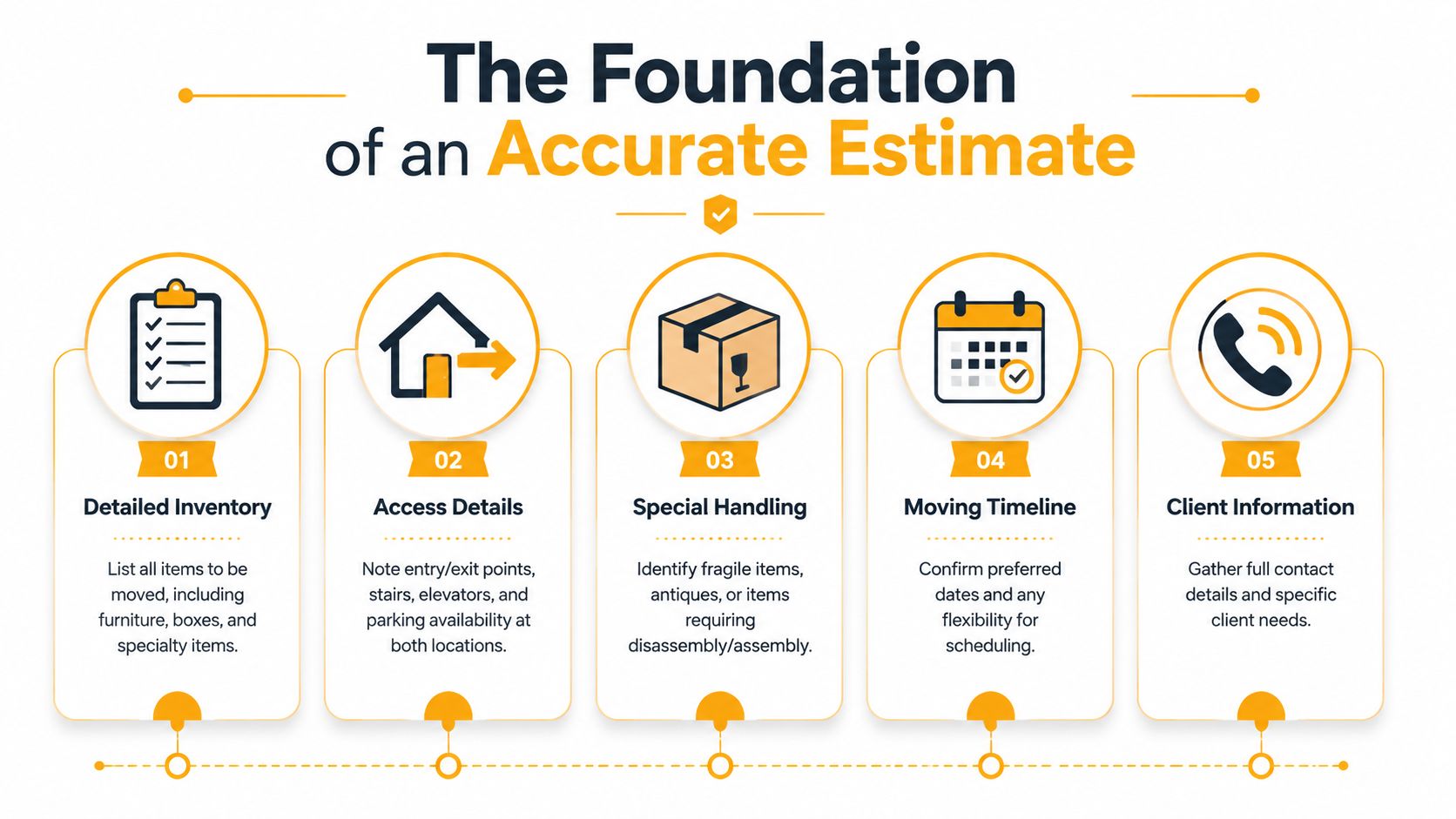
The two inputs that drive the whole quote
Every estimate rests on two pillars:
- Inventory
- Access
Inventory means a real room-by-room list. Not “standard two-bedroom.” Not “mostly boxes.” You need to know what’s in the primary bedroom, guest room, garage, patio, storage closet, and anything the customer forgot to mention until the truck is loaded.
Access means the practical path your crew and truck have to deal with at both ends. That includes stairs, elevators, parking restrictions, long carries, narrow driveways, apartment loading rules, building time windows, and whether the destination is a suburban driveway or a dense urban street.
Practical rule: If your estimator can’t picture how the crew gets from truck to front door at both locations, the estimate isn’t finished.
Producing an accurate estimate still eats time for most companies. Most movers spend an average of 20 minutes building each quote, while top performers cut that to less than 5 minutes by automating moving math, according to SmartMoving’s guidance on precise moving software. That time gap matters even more because the same source notes that operating costs for trailers, insurance, and labor have risen by up to 80% between 2020 and 2025.
A standardized intake checklist that your team can use today
If you want consistency across office staff, dispatchers, and sales reps, build one intake checklist and use it on every lead. Put it in your CRM, your call script, and your virtual survey process.
Use this structure:
- Customer details. Full name, best callback number, email, move date, and flexibility on timing.
- Origin and destination facts. House, apartment, condo, storage unit, floor level, elevator access, and parking situation.
- Room-by-room inventory. Large furniture, appliance count, mattresses, TVs, desks, outdoor items, garage contents, and expected box count.
- Special handling items. Safes, pianos, glass tops, antiques, artwork, heavy gym equipment, and items requiring disassembly.
- Service scope. Packing, unpacking, materials, junk removal, appliance prep, or storage coordination.
If you’re tightening your intake process, it helps to compare your fields against a dedicated moving company cost estimator workflow. The point isn’t the form itself. The point is that every lead should move through the same logic every time.
The Core Calculation From Inventory to Price
Once the intake is solid, the quote stops being guesswork and starts becoming math. Through this process, disciplined movers separate themselves from companies that price off instinct, then hope the crew can make it work.
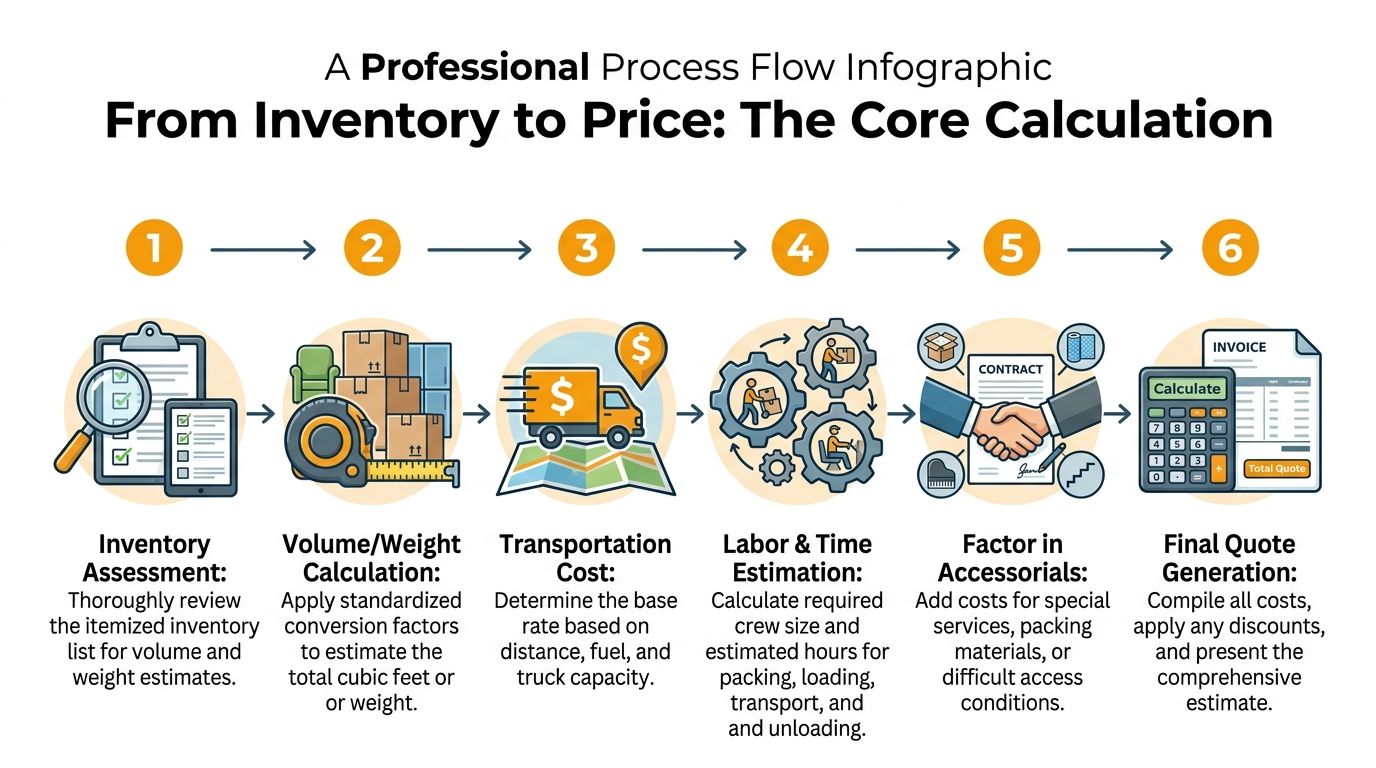
How pros turn inventory into a pricing baseline
The industry-standard method uses a density factor of 7 pounds per cubic foot, then estimates box count by dividing total weight by 100. A 6,000-pound inventory suggests about 60 boxes, based on the methodology explained in this moving estimate training example.
That matters because it gives you a repeatable baseline for pricing charts, crew planning, and truck allocation. It also forces your estimator to think in terms of load size, not vague home labels like “small three-bedroom.”
A clean calculation flow looks like this:
| Step | What you're calculating | Why it matters |
|---|---|---|
| Inventory | Total furniture and contents by room | Prevents missed items |
| Cube or volume | Space the shipment occupies | Helps size the load |
| Weight baseline | Uses the 7 lbs per cubic foot rule | Supports pricing logic |
| Box estimate | Weight divided by 100 | Helps labor and packing assumptions |
| Labor duration | Crew time for load, travel, unload | Protects margin |
| Final quote | Base charges plus service variables | Turns estimate into a bookable price |
This is also where packing materials need to be priced realistically. If your team offers packing, give customers a clear list of what’s included and what’s extra. A practical resource for explaining materials is this guide to boxes, wraps, and tapes, especially when customers underestimate what a full or partial pack requires.
The best estimators don’t round away uncertainty. They identify it, price it, and explain it before the move date.
For teams trying to standardize this workflow, a dedicated moving quote calculator for movers can help turn the same inventory logic into consistent outputs instead of rep-by-rep judgment calls.
Hourly versus flat-rate pricing
This decision isn’t philosophical. It’s operational.
Hourly pricing tends to work best when the move is local, access is straightforward, and the inventory is easy to verify. It gives flexibility, but it also creates anxiety for shoppers who worry the clock will run long.
Flat-rate or binding pricing works better when you’ve done enough intake to trust the scope. Customers usually respond well to price certainty because they can compare offers without wondering what the final bill will become.
A simple decision filter helps:
- Use hourly when access is simple and the job is variable.
- Use flat-rate when the inventory is well documented and surprises are unlikely.
- Avoid flat-rate when your team is still missing key details on access, specialty items, or service scope.
The mistake isn’t choosing one model over the other. The mistake is using the wrong model for the quality of information you have.
Mastering Surcharges and Access Variables
A quote can be right on inventory and still lose money. That usually happens in the driveway, the stairwell, or the loading dock.

Where good estimates usually break
A fourth-floor walk-up isn’t just “some stairs.” Street parking that forces a long carry isn’t just a minor inconvenience. Elevator wait time in a managed building can throw off the entire day’s schedule if the crew is stuck sharing freight access with other tenants.
That hidden cost is bigger than many operators realize. Unanticipated access conditions can cause final bills to be 15–25% higher than the quote, and 68% of moving complaints stem from access delays that weren’t included in the original estimate, according to FreightWaves on moving estimates and access variance.
Those are the jobs that create disputes even when your crew performs well. The customer thinks you changed the price. Your team thinks the customer left out critical details. Both sides end up frustrated because the estimate didn’t account for reality.
How to build a surcharge schedule customers can understand
You don’t want random add-ons showing up at dispatch. You want a published internal schedule tied to conditions your team can verify.
Build your access and surcharge logic around categories like these:
- Vertical access. Stairs, elevator dependency, walk-up conditions, and unusual floor access.
- Carry distance. Standard carry versus long carry from truck to entrance.
- Truck access. Shuttle risk, narrow roads, loading dock limits, gated communities, or street parking constraints.
- Labor complexity. Disassembly, reassembly, appliance handling, crating, or fragile-item prep.
- Building rules. COI requirements, reservation windows, elevator booking, and restricted move hours.
If the surcharge exists to cover real labor or real delay, put it in the estimate. If it only appears after the truck arrives, the customer hears it as a penalty.
A strong rate structure should live in one place, not in the heads of your senior estimators. That’s why many operators formalize it inside moving company rate card software, where stairs, long carries, specialty handling, and access conditions map to the same rules every time.
Delivering the Quote with Scripts and Templates
A technically correct estimate can still lose the job if the customer doesn’t understand it. Presentation isn’t fluff. It’s part of the sale.

Say the estimate type clearly
Customers shop fast, and plenty of them still can’t tell the difference between estimate formats. That confusion creates room for low-ball competitors and bad experiences. Moving scams reportedly grew 35% year over year since 2023, non-binding estimates can raise final bills by 20–40%, and only 28% of consumers confirm what type of quote they’re receiving, based on Capitol Moving’s review of estimate types and pricing risk.
That means your quote needs three things on the page and in the conversation:
- What type of estimate it is
- What is included
- What would trigger a change
If you leave any of those vague, you force the customer to compare you on price alone.
A lot of service industries deal with the same trust problem. When buyers don’t know how to compare proposals, they gravitate to the cheapest number. That’s why it’s useful to look at how other operators evaluate commercial cleaning proposals. The lesson carries over. Scope clarity often matters more than headline price.
A script that builds trust instead of resistance
Your estimator doesn’t need to sound slick. They need to sound precise.
Use language like this:
“Based on the inventory you confirmed and the access details at both locations, this is your quoted price. It includes the services listed here. If your inventory changes or building access changes before move day, we’ll review it with you in writing before anything is updated.”
That script works because it does three jobs at once. It confirms the customer participated in the inventory, it reinforces what’s included, and it tells them you won’t surprise them at the truck.
For a non-binding quote, tighten the wording:
- Lead with transparency. “This is an estimated range based on the information we reviewed together.”
- State the variable clearly. “If the inventory or access is different on move day, the final amount can change.”
- Close with a verification step. “We’ll confirm the details again before the move so there are no surprises.”
For a binding quote, keep it direct:
- Use fixed-price language. “This is a binding quote based on the inventory and services listed.”
- Point to the conditions. “If the scope stays the same, the price stays the same.”
- Make booking easy. “If you’re ready, we can lock in the date and send the confirmation now.”
The best quote templates read like a service agreement, not a mystery invoice. List inventory summary, addresses, access notes, included labor, exclusions, estimate type, and next step to book.
Quality Control and Performance Tracking
Most owners review revenue, payroll, and truck utilization. Fewer review estimate accuracy with the same discipline. That’s a mistake because quoting errors don’t stay in the sales department. They show up in crew overtime, customer disputes, and thin jobs.
A pre-send QA check that catches margin leaks
Before any quote goes out, run a quick quality check. It doesn’t need to be elaborate. It needs to be mandatory.
A solid pre-send review includes:
- Inventory match. Does the quote reflect the room-by-room list the customer approved?
- Access review. Were stairs, elevators, carry distance, and parking restrictions addressed?
- Service scope. Packing, materials, disassembly, storage, and specialty handling included where needed?
- Rate logic. Does the estimate align with your active rate card and service area rules?
- Customer details. Correct move date, addresses, phone, and email?
One missed field can turn a profitable job into a customer service problem.
The report every owner should review
The most useful report in your quoting operation is Estimate Versus Actual. It tells you whether your estimating process is honest, disciplined, and improving. According to Louis Massaro’s guidance on providing accurate moving estimates, final weight on non-binding moves should deviate by no more than 10% from the original estimate if the inventory is honest.
Track that report by estimator, job type, and branch or service area. You’re looking for patterns such as:
| Pattern | What it usually means |
|---|---|
| One estimator always comes in low | Training issue or low-balling |
| Urban jobs run over plan | Access variables not captured |
| Packing jobs exceed estimate | Materials or labor assumptions are weak |
| Certain lead sources dispute pricing more often | Intake quality is poor |
Review estimate accuracy the same way you review claims, callbacks, or damaged items. If you don’t inspect it, it won’t improve.
From Manual Quoting to Automated Booking
A manual process can work when call volume is light and one experienced person controls the pipeline. It starts to fail when the business grows, phones ring after hours, and office staff are split between dispatch, quote follow-up, and current customers.
Why manual quoting becomes a bottleneck
Moving companies miss a meaningful share of inbound calls during the workday, and after-hours loss is a separate problem. Movers miss between 20% and 35% of inbound calls during regular hours, and nearly 40% of small businesses lose sales because they miss customer calls after hours, according to OnCall Clerk’s overview of missed-call revenue loss. For moving operators, that’s not just a communications issue. It’s a booking issue, especially in peak season when shoppers call multiple companies in a short window.
The economics get sharper when you connect missed calls to conversion. Improving close rate from 39% to 50% produces a 28% revenue lift with zero new leads, based on Supermove’s analysis of mover conversion performance. That’s why the front end matters so much. More leads won’t fix a weak intake and quoting process.
If you want a customer-facing example of how buyers think about price before they ever speak to a rep, it’s useful to see how consumer tools calculate your moving costs. The takeaway isn’t that calculators replace estimators. It’s that customers expect speed, clarity, and a number they can understand quickly.
What automation should actually do
Owners don’t need more disconnected software. They need the quoting process to happen reliably when the office is busy, closed, or overloaded.
The right automation should:
- Capture the lead completely. Name, phone, move date, inventory, addresses, and access details.
- Apply your rate card. Not a generic script. Your logic, your surcharges, your service rules.
- Generate a real quote. Not “someone will call you back.” A bookable price.
- Trigger the next step. Put the job into SmartMoving, Supermove, MoveitPro, or Google Calendar.
- Follow up automatically. Because plenty of estimates die in the gap between sent and booked.
For growing local movers and even junk removal operators with similar phone and quoting pressure, that’s the operational shift that matters. The advantage isn’t just answering every call. The advantage is closing more of the jobs you already paid to generate.
If your team is still building quotes manually, chasing voicemails, and losing jobs in the handoff between intake and booking, it’s worth looking at MoveJoy. It helps moving companies turn inbound calls into accurate quotes and booked jobs using their own rate card and booking workflow, which is where revenue recovery is achieved.