Should a Moving Company Use an Answering Service
At 6:42 p.m., your office line rings. Your sales rep has gone home. Dispatch is still juggling tomorrow’s crews. The caller needs a quote for a move next week and wants to lock in a date tonight. The call rolls to voicemail, and in most moving businesses, that lead is gone before anyone listens to the message.
That’s the central question behind should a moving company use an answering service. It isn’t about sounding more professional. It’s about whether your front office can turn inbound demand into booked jobs when the team is busy, off the clock, or buried in peak-season volume.
Table of Contents
- Introduction to Missed Calls and Lost Revenue
- Overview of Call Handling Options
- Detailed Comparison of Human DIY and AI Approaches
- ROI Examples and Cost Analysis
- Integration and Quoting Accuracy Challenges
- Security Quality Tradeoffs and Business Fit
- Decision Checklist and Next Steps
Introduction to Missed Calls and Lost Revenue
Owners running 5 to 20 trucks know this pattern well. The phones don’t ring on a neat office schedule. Calls come in during lunch, while estimators are driving, after hours, and on weekends when customers finally have time to call around. If nobody answers, the marketing spend that generated that lead doesn’t matter anymore.
For movers, voicemail is especially expensive. One industry analysis says moving companies lose approximately 40% of potential leads because callers who encounter voicemail do not return (Boosted Movers). Another source puts the financial hit even more bluntly: each missed call can cost a moving company about $1,200 in lost potential revenue when average move value and conversion are factored in (Phone2.io on the true cost of missed calls).
That’s why I tell operators to stop treating missed calls as a customer service issue. It’s a revenue issue first. If you want a practical way to tighten up call tracking before you change anything else, this marketing agency advice on phone calls is useful because it pushes you to measure where calls are missed, not just how many came in. For movers trying to quantify leakage, a missed-call revenue breakdown like this one from MoveJoy’s guide to missed-call moving company revenue helps frame the problem in dollars instead of anecdotes.
Practical rule: If your crews are strong but your phones are inconsistent, growth stalls at the front desk, not in the field.
The pressure gets worse from March through September, when call volume rises and everyone on the team is already stretched. During that stretch, the company that answers first often gets the booking opportunity. A moving business doesn’t need more chaos in the office. It needs a system that catches demand when humans can’t.
Overview of Call Handling Options
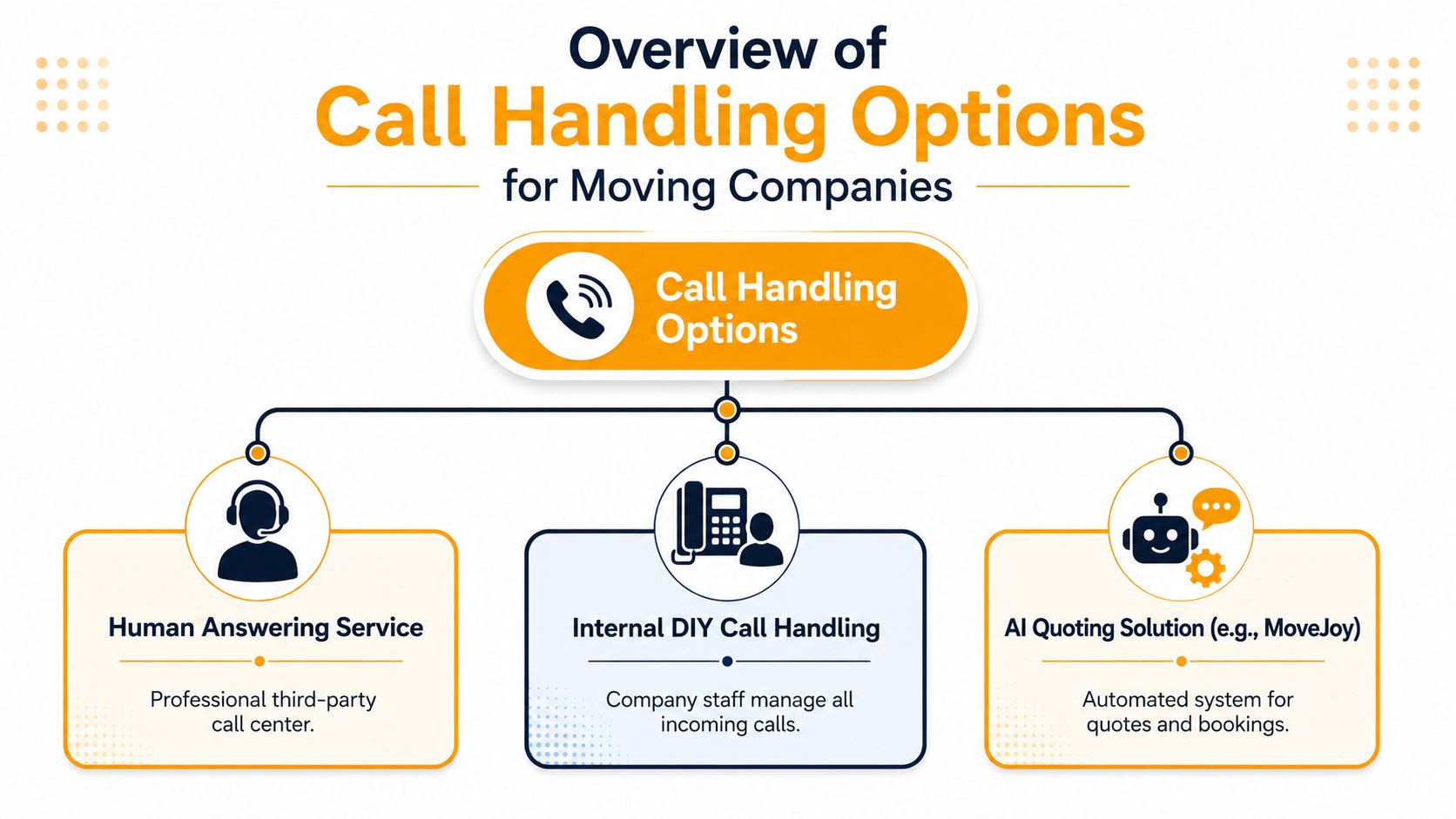
Most moving companies fall into one of three camps. They either handle calls in-house, outsource overflow to a human answering service, or use an automated system that can do more than take a message.
Three ways movers handle inbound calls
Internal DIY call handling means your office manager, dispatcher, sales rep, or owner answers the phones. This works when call volume is manageable and someone knowledgeable is reliably available. It usually breaks at the exact moment demand is strongest. The field is busy, dispatch is overloaded, and the phones stack up.
Human answering service means a third party picks up calls when your team can’t. The main advantage is simple coverage. That matters because moving companies lose approximately 40% of potential leads when callers reach voicemail (Boosted Movers). A live answer is better than dead air.
AI quoting solution means the system answers, qualifies the lead, follows your rate logic for simple jobs, and routes or books based on your rules. That’s a different category than a basic answering service because it aims to move the caller closer to a booked job instead of only documenting the inquiry. If you want a plain-language overview of that category, this page on call handling service options for movers is a useful reference.
What each option actually solves
Here’s the operational reality.
| Option | Best at | Weak spot | Good fit |
|---|---|---|---|
| Internal DIY | Handling nuanced questions when the right staff member is available | Inconsistent coverage, after-hours gaps, peak-season overload | Smaller teams with disciplined office coverage |
| Human answering service | Live pickup when your office can't answer | Usually limited on quoting, booking depth, and mover-specific context | Teams that need overflow coverage fast |
| Automated quoting system | Consistent intake, simple quote flow, and direct booking logic | Needs setup discipline, rate-card accuracy, and escalation rules | Movers who want to recover revenue, not just capture messages |
A lot of owners ask the wrong question. They compare who can “answer” the phone. The better question is who can advance the sale when a prospect calls after hours or during a rush.
A message taken at 8 p.m. is not the same as a booked move at 8 p.m.
That distinction matters because moving customers shop quickly. If your current setup relies on calling people back later, you’re asking the buyer to stay patient while a competitor is answering in real time.
Detailed Comparison of Human DIY and AI Approaches
The cleanest way to evaluate this is side by side. Not by vendor promises. By what happens when a caller asks, “Can you move a two-bedroom apartment next Saturday, and roughly what will it cost?”
Early comparison table
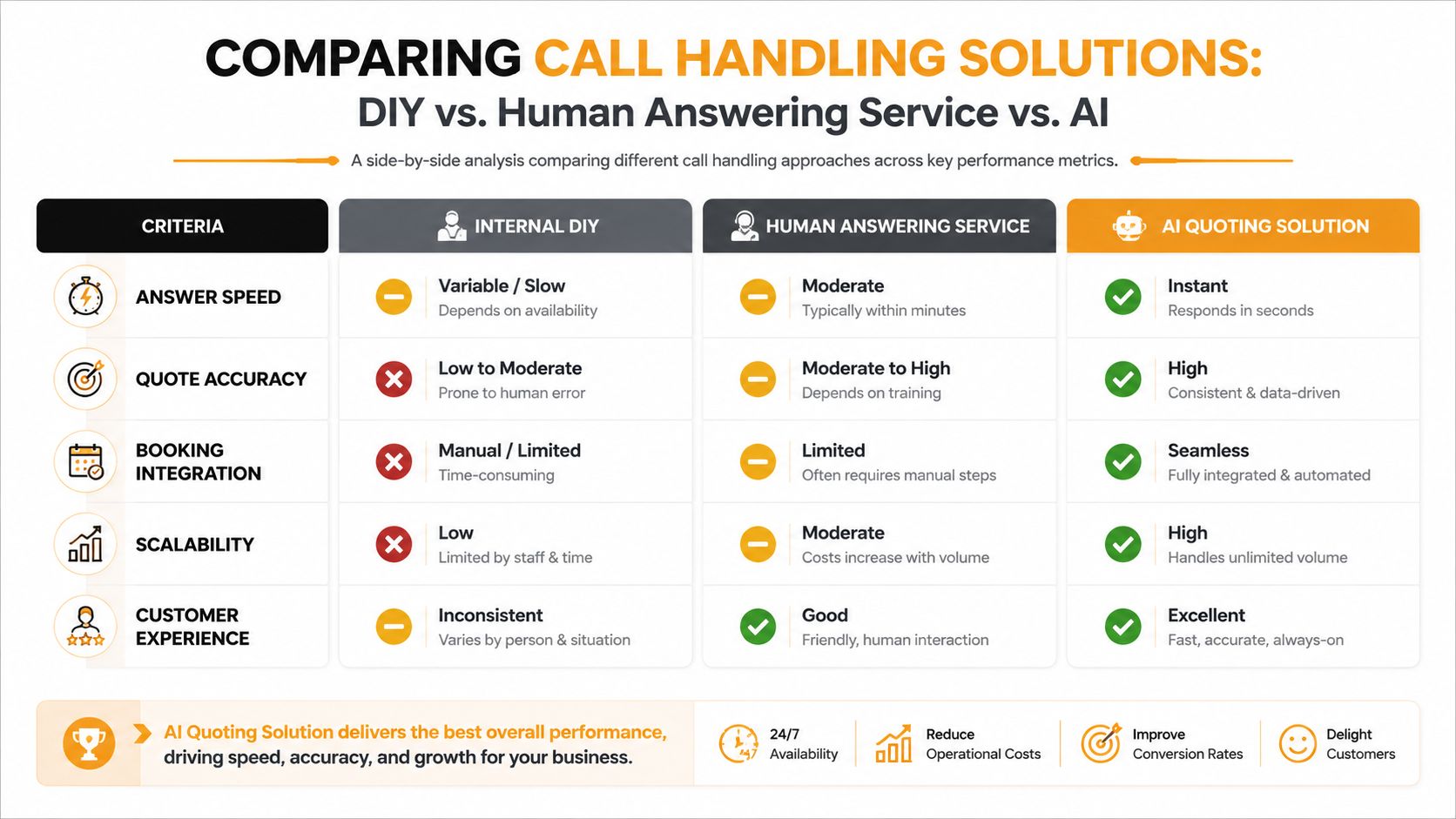
| Criteria | Internal DIY | Human Answering Service | Automated Quoting System |
|---|---|---|---|
| Availability | Limited by office hours and staffing | Better coverage, including overflow and after-hours | Always available if configured correctly |
| Answer speed | Varies by workload | Usually better than DIY | Usually immediate |
| Quote handling | Strong when experienced staff answers | Often limited to message taking or basic intake | Strong for simple jobs if built on your rate card |
| Booking integration | Depends on your team and CRM habits | Often partial or manual | Can be direct when connected to workflow tools |
| Peak-season scalability | Weakest of the three | Better, but can degrade under heavy volume | Strong if the rules and integrations are set correctly |
| Customer experience | Best when top staff answers, worst when nobody does | Professional but often generic | Consistent, but only if quoting boundaries are clear |
Where human services help and where they break
A professional answering service can absolutely improve a moving company’s front-end coverage. In fact, for movers, the benchmark should be a Call Answer Rate of 97% or higher, and missed calls cost about $1,200 per missed call on average (AgentZap moving company phone statistics). If your current setup isn’t close to that, outsourcing live pickup can plug a serious leak.
But live pickup alone doesn’t close jobs.
Most answering services are strongest at:
- Capturing contact details: Name, phone, service date, origin and destination.
- Following instructions: Routing urgent calls, taking messages, sending notifications.
- Providing coverage: Nights, weekends, lunch breaks, and overflow.
They usually struggle when the caller asks for anything more specific:
- Pricing nuance: Walkups, long carries, bulky-item handling, shuttle needs.
- Booking authority: Confirming a slot instead of “someone will call you back.”
- CRM discipline: Entering data cleanly into SmartMoving, Supermove, MoveitPro, or your calendar.
That gap matters more in moving than in a lot of service businesses because the caller usually wants progress on the first call, not an acknowledgment.
Why quoting changes the decision
This is the part most comparisons skip. The trade-off isn’t human versus machine. It’s message taking versus quote control.
The industry’s “Quote Diplomacy” gap is real. Effective automated systems must stop before improvising on price, use company rate-card data for simple moves, and route complex jobs back to your team instead of guessing (GetCallBook on moving company answering service design). That’s the right rule whether you use a staff member, a live service, or automation.
If a system can’t price accurately, it shouldn’t pretend it can.
That’s why the strongest workflow for many mid-sized movers isn’t a generic answering service and it isn’t bare-bones call capture. It’s a controlled quote-and-book process. One example is MoveJoy, which uses a mover’s own rate card to generate accurate quotes for qualifying jobs and books directly into systems like SmartMoving, Supermove, MoveitPro, or Google Calendar. That’s materially different from tools that only answer the phone and email over a lead.
For practical decision-making, use this lens:
- If calls are missed because nobody can answer, add coverage.
- If leads are answered but not booked, improve quoting and scheduling.
- If your team spends all day on repetitive intake, automate the front end and keep humans focused on exceptions.
ROI Examples and Cost Analysis
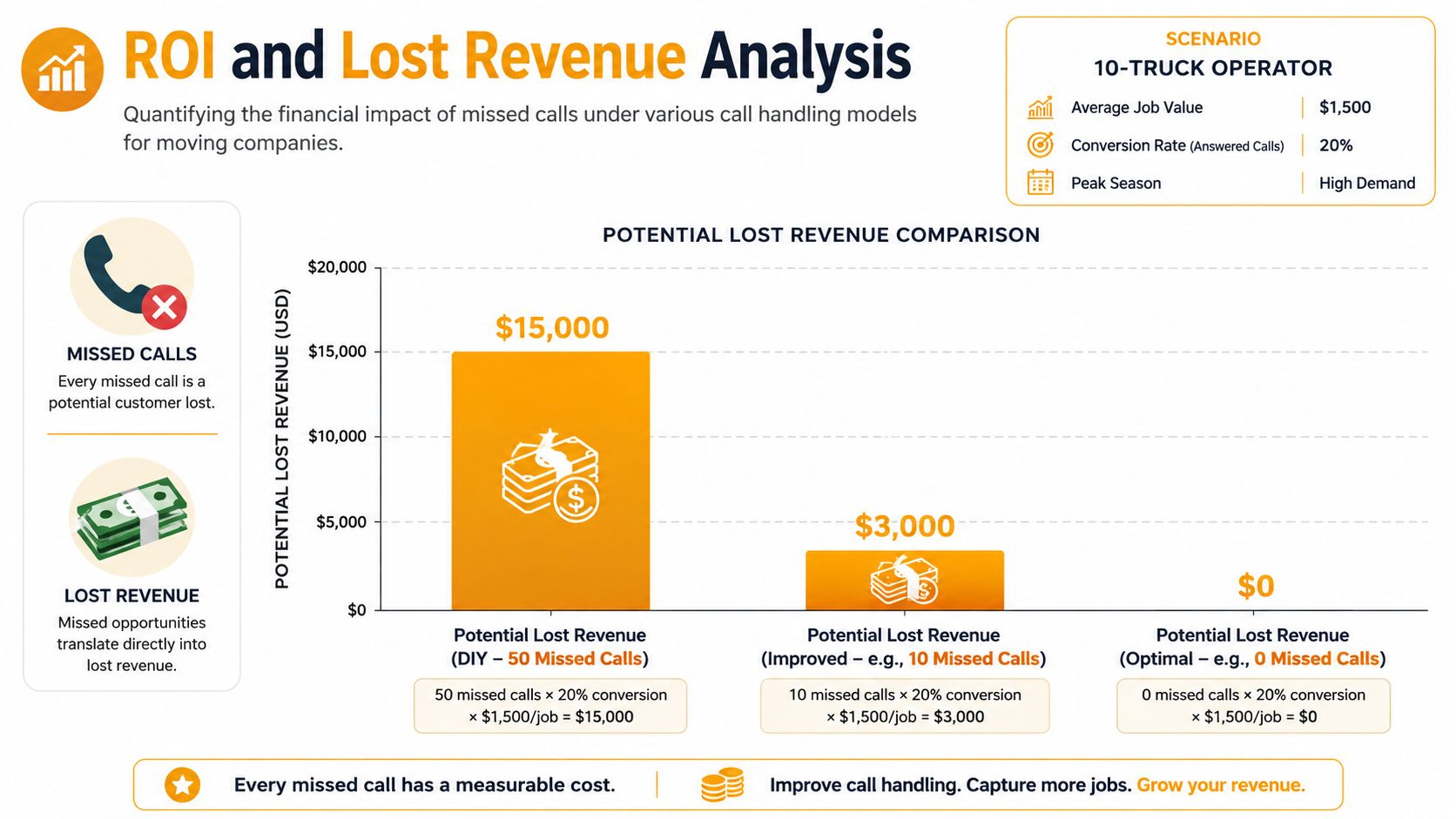
Owners usually underestimate the loss because they count missed calls, not missed bookings. Those are two different numbers.
How to calculate the leak
A simple moving-company formula already exists: Missed Calls Per Day × Working Days × Voicemail Hangup Rate × Close Rate × Average Job Value (OnCall Clerk on revenue lost from missed calls). You don’t need perfect data to start. You need honest data.
A separate moving-specific example makes the math concrete. When the average move is $2,000 and close rate is 25%, each missed call equals $500 in lost potential revenue, and a company missing 30 calls monthly loses $180,000 annually (GetStacked on missed calls costing movers).
That’s why the baseline benchmark for small business loss matters. Across industries, the average small business loses $126,000 per year to missed calls, and home service businesses lose $300 to $1,200 per missed call depending on the work type and transaction value (Phone2.io on the cost of missed calls). For movers, the economics usually sit toward the high end because jobs are valuable and time-sensitive.
What owners usually miss in the math
The obvious loss is the unanswered call. The less obvious loss is labor drag.
When your internal team handles every call manually, you also pay in:
- Interrupted dispatch work: Calls break scheduling focus.
- Slow quote turnaround: Leads wait while staff finish other tasks.
- Follow-up slippage: Estimates go out late, and momentum dies.
- Uneven after-hours coverage: Nights and weekends remain exposed.
This is why process automation matters beyond call answering. If you’re evaluating broader office efficiency, this piece on transforming business processes with AI is helpful because it frames automation as workflow relief, not gadget buying. In moving, that mindset is useful. The winning setup usually reduces repetitive intake and preserves staff time for exceptions, revisions, and high-value customers.
A lot of operators also compare solutions only by monthly service cost. That’s backwards. Start with recovered revenue, then compare cost. A practical reference point for that analysis is this guide on the cost of an answering service for moving companies, which helps frame whether your current spend is cheaper than your current leakage.
Key takeaway: A low monthly bill isn’t efficient if the system still lets booking-intent calls stall.
One more point matters during busy season. 78% of customers in the moving industry book with the first mover who answers their call (NextPhone on moving company answering service). So the ROI isn’t only from avoiding “lost” calls. It also comes from beating a competitor to a ready-to-book customer.
Integration and Quoting Accuracy Challenges
Buying coverage is easy. Wiring it into the way your office works is where projects succeed or fail.
What has to connect before automation helps
If you add any external call-handling layer, map the workflow first. For movers using SmartMoving, Supermove, MoveitPro, or even Google Calendar, the basic operational checklist is straightforward:
Define lead types
Separate simple local residential jobs from complex jobs. Local apartment move? That may be quotable on the call. Long-distance, commercial, piano, storage-heavy, or uncertain inventory? Route to a human estimator.Clean up your rate card
If your pricing rules live in three spreadsheets and one dispatcher’s memory, no answering process will stay consistent. Rate logic has to be documented before anyone or anything can quote from it.Decide booking authority
Determine which jobs can be booked instantly, which need estimate appointments, and which need manager approval.Set CRM fields and status rules
New lead, quoted, estimate scheduled, booked, follow-up needed. If these statuses aren’t standardized, your office will still lose leads after the call.
Where automated quoting goes wrong
The biggest mistake is letting a system improvise. In moving, quote accuracy depends on details generic tools often miss: stair carries, long carries, packing scope, time windows, travel charges, and minimums.
The best guidance on this is simple. The industry’s poorly defined Quote Diplomacy gap exists because effective AI must stop before improvising on price, use rate-card data for simple moves, and route complex jobs to your team (GetCallBook on the quoting gap for movers).
Use these guardrails:
- Auto-quote only standardized jobs: Local, well-defined, rate-card-supported moves.
- Escalate edge cases fast: Complex inventory, commercial work, specialty items, or unclear access conditions.
- Review transcripts and outcomes weekly: Bad assumptions show up quickly in real calls.
- Keep follow-up automated: If a caller doesn’t book on the spot, the estimate still needs prompt follow-up.
Bad quotes don’t just lose one job. They create distrust before your sales team ever gets a second chance.
If you ignore integration and rate discipline, a new system becomes another front-office patch. If you do it right, quoting, booking, and follow-up become one connected workflow instead of three separate tasks.
Security Quality Tradeoffs and Business Fit
Not every mover needs the same model. The right answer depends on your call volume, your office maturity, and how much quoting discipline you already have.
The quality benchmarks that matter
For moving-sector call handling, expert benchmarking says Average Speed to Answer should stay under 20 seconds and First-Call Resolution should land in the 70% to 80% range during high-volume periods (Contractor In Charge on answering service performance). Those are useful benchmarks because they reveal whether the caller got help quickly and whether the issue was resolved.
If your current provider answers fast but can’t resolve basic booking-intent calls, quality is still weak. If your internal staff gives excellent answers but only during office hours, coverage is still weak.
Which model fits which operator
DIY fits companies with strong office staffing, disciplined hours, and low after-hours exposure. It can work, but it depends on people being available when prospects call.
Human answering services fit teams that need immediate coverage without changing much else. This is often the right short-term move when voicemail is the main problem.
Automated quote-and-book workflows fit movers who already know the leak is happening before the estimate is even created. This tends to suit growth-minded operators with multiple crews in the field, recurring call surges, and pressure to standardize the front office.
Security and data handling still matter. Any provider touching customer details, inventory notes, addresses, and calendars needs clear controls, good recordkeeping, and a workflow you can audit. The less transparent the system, the harder it is to catch quote mistakes and booking errors before they cost you jobs.
Decision Checklist and Next Steps
The right decision gets clearer when you score your current setup against operational reality, not preference.
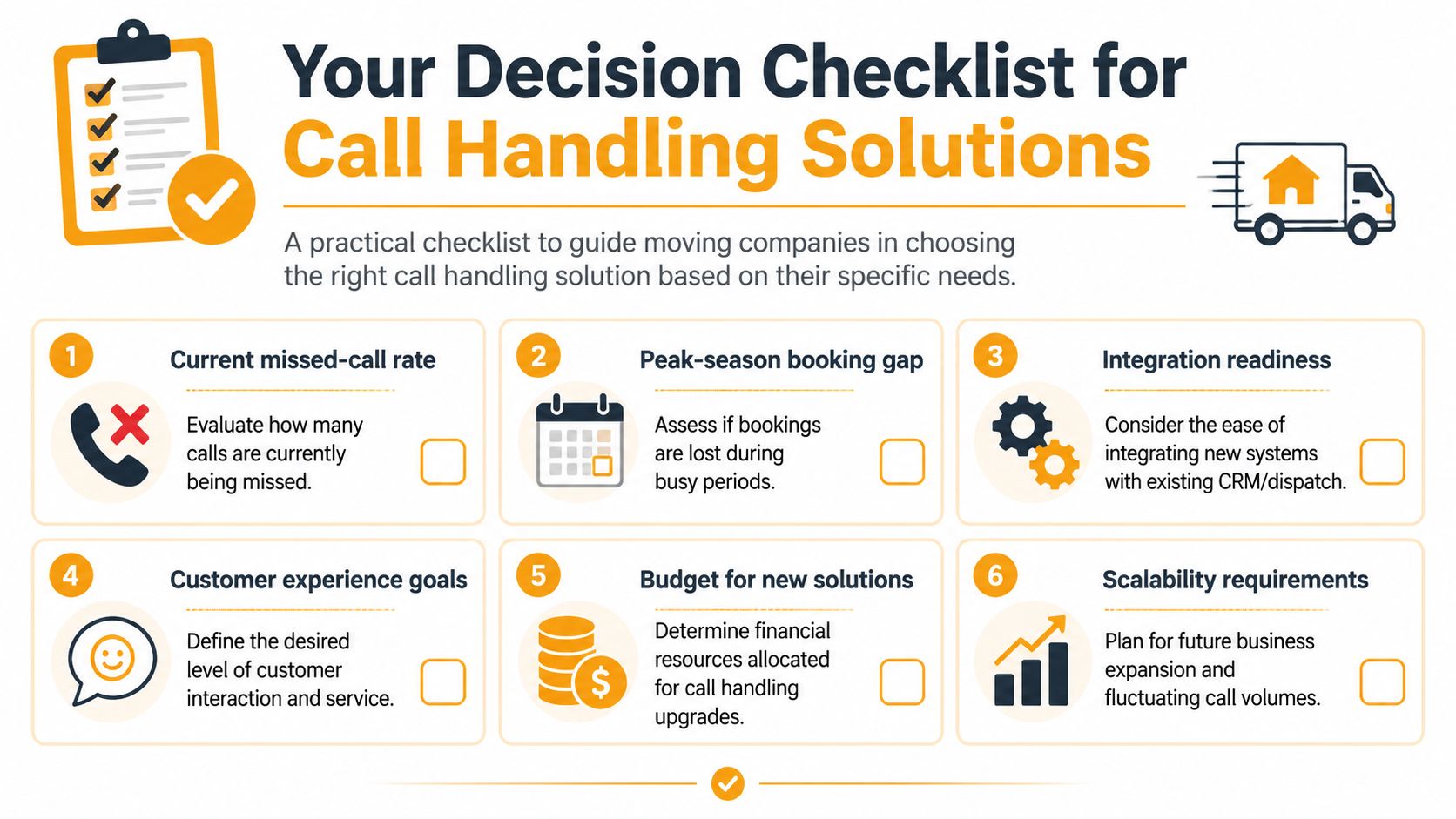
Use this checklist:
Current missed-call rate
Pull recent phone logs and identify when calls are being missed. Look for lunch gaps, evenings, weekends, and dispatch-heavy windows.Peak-season booking gap
Compare inbound demand with booked jobs during March through September. If calls rise but bookings don’t, the front end is bottlenecked.Integration readiness
Check whether your pricing rules, calendars, and CRM stages are clean enough to support a reliable workflow.Customer experience goals
Decide whether you need message taking, estimate scheduling, or real quoting and booking on the first call.Budget for new solutions
Compare monthly solution cost against the value of even one recovered job, not against what voicemail costs.Scalability requirements
Ask what happens when calls spike. If your process only works on a calm Tuesday, it isn’t built for busy season.
If you want the short answer to should a moving company use an answering service, it’s this: use one if your alternative is missed calls and voicemail. But don’t stop there. The true benefit comes when your call workflow can quote accurately, book cleanly, and keep leads moving without waiting for someone to call back tomorrow.
If your moving company is losing jobs between the first ring and the first quote, it’s worth looking at MoveJoy. The practical advantage isn’t just answering calls. It’s turning booking-intent calls into accurate quotes and scheduled jobs using your own rate card and existing workflow tools.