How Much Does an Answering Service Cost a Moving Company? (Hint: It’s the Wrong Question)
The monthly bill for an answering service can run from a few hundred to several thousand dollars, depending on your call volume and what you need it to do. But if you’re running a moving company, you're asking the wrong question.
The real question is: What’s it costing your moving company to NOT have one?
The True Cost of a Missed Call: A Lost Moving Job

Every time your phone rings and rolls to voicemail, you’re watching a job walk out the door and straight into your competitor's truck. A customer who’s ready to book isn’t going to wait around for a callback. They’re just going to dial the next mover on their Google search list.
That isn't just a missed call. It's lost revenue, pure and simple.
Let’s put some real numbers on this. Say you run a 5-truck moving company and your average local move is worth $1,500. If you miss just four calls a week during your busy season, that’s $6,000 in lost revenue. Every. Single. Week.
Over a three-month peak season, you could be leaving more than $70,000 on the table. That's the real cost we need to talk about.
Shifting from Expense to Investment
Thinking about it this way completely reframes the conversation. An answering service stops being another line item on your expense sheet and becomes a critical investment in protecting your revenue. It's your front-line defense against handing jobs over to the competition on a silver platter.
The cost of a traditional answering service can be a tough pill to swallow for a small moving business. I've seen movers get hit with bills of $10,000-$15,000 a year for basic human agents, and the service often gets worse right when you need it most—during peak hours. You can dig into a detailed breakdown of how these costs add up for service businesses to see why a modern approach is so critical.
The goal isn’t just to answer the phone—it’s to capture the opportunity. A reliable 24/7 call handling system ensures every single lead gets an immediate response, turning a potential loss into a booked job.
Ultimately, the cost of an answering service has to be weighed against the revenue it saves. As you can see from the math on missing just a few calls a week, capturing just one or two extra jobs a month can easily cover the cost.
Suddenly, it’s not a drain on your budget. It’s a powerful revenue generator.
Decoding Answering Service Pricing Models for Movers
Trying to make sense of answering service quotes can feel like staring at a puzzle designed to confuse you. To actually compare your options and find the best value for your moving business, you need to understand the three main ways these services charge.
Each model has its own hidden traps that can catch you off guard, especially when your busy season hits and the phones are ringing off the hook. Let's break down the common ones: pay-per-minute, pay-per-call, and flat-rate monthly fees.
Pay-Per-Minute Plans
This model bills you for the total time an agent is on the phone. At first glance, a low per-minute rate like $1.55 to $1.90 looks like a bargain.
Here’s the problem for a moving company: this can be the most dangerous option. A single detailed quote call with a new customer can easily stretch to 10 minutes. During a summer rush, just a handful of those longer calls will make your bill explode, basically penalizing you for giving good customer service. You're paying more because you were thorough.
Pay-Per-Call Plans
With this setup, you’re paying a fixed fee for every single call they answer, no matter how long it lasts. This gives you a bit more predictability than per-minute billing, which is great for budgeting.
But the catch is in the fine print: what counts as a "call"? Many services will hit you with the full fee for wrong numbers, relentless spam calls, or even a 5-second hang-up. You can easily end up paying for dozens of calls that had zero chance of becoming a booked job.
Flat-Rate Monthly Fee Plans
A flat-rate plan gives you a set bucket of minutes or calls for one fixed price each month. For a moving company with seasonal call volume, this is often the most predictable model. You know exactly what your bill will be, which makes planning a lot easier.
The main drawback here is overage fees. If you blow past your monthly allowance during a seasonal spike, you'll get slapped with a premium for every extra minute or call. These fees are designed to be painful and can wipe out any savings you thought you were getting. This structure forces you to guess your future call volume, which is almost impossible to get right in the moving industry.
To get a better handle on these structures, the article Call Center Outsourcing Costs Explained: Pricing, Models, and Hidden Fees is a great resource. And if you want to see how these fees hit your bottom line as a mover, our guide on understanding call center costs has some practical insights.
Answering Service Pricing Models Compared
To make it even clearer, here’s a quick breakdown of how these models stack up for a small to mid-sized moving business.
| Pricing Model | How It Works | Best For Movers Who… | Potential Downside for Movers |
|---|---|---|---|
| Pay-Per-Minute | Billed for every minute an agent is on the phone. | Have very short, predictable call lengths (rare for movers). | Costs skyrocket with detailed quote calls, penalizing thorough service. |
| Pay-Per-Call | A flat fee for every answered call, regardless of duration. | Want predictable costs and handle a mix of short and long calls. | You pay for every single call, including spam, wrong numbers, and hang-ups. |
| Flat-Rate Monthly | A fixed monthly fee for a set number of minutes or calls. | Need budget certainty and have somewhat consistent call volume. | Expensive overage fees punish you for being successful during your busy season. |
Ultimately, the "best" model depends on your specific call patterns. But for most moving companies, the downsides of per-minute and per-call billing often outweigh the benefits, while traditional flat-rate plans require you to have a crystal ball to predict your call volume.
The Hidden Fees That Will Blow Up Your Monthly Bill
Let's be honest: the price you see on an answering service’s website is almost never what you actually pay. It’s a classic bait-and-switch. They lure you in with a low base rate, then pile on charges for the exact features you need to run your moving company.
If you don’t know what to look for, you’re in for a nasty surprise when that first bill arrives. Many moving company owners get shocked when they realize things they considered standard are actually premium add-ons. We're not talking about luxury features here; we're talking about the basic tools required to capture and book jobs.
Common Charges That Drive Up Your Bill
The biggest offender? After-hours and weekend coverage. Your customers don't stop needing quotes just because it's 5 PM on a Friday. In fact, that’s often when they have time to call. Not having 24/7 coverage is like closing your doors during prime time, but paying for it can jack up your monthly bill significantly.
But it doesn't stop there. Here are other "add-ons" that should be standard:
- Appointment Scheduling: You don't just want someone to take a message. You need them to get a customer on your calendar. That capability almost always costs extra.
- Custom Scripting: A generic script is useless for a mover. Your agents need to ask specific qualifying questions about home size, inventory, and tricky access points. That requires custom scripting, which comes with a fee.
- CRM Integration: Pushing lead info straight into your system—whether it’s SmartMoving or Supermove—seems like a no-brainer. But it’s often treated as a premium integration that adds to your bill.
- Holiday Premiums: Expect to pay a much higher rate for calls answered on holidays, which is ironically when many families are making their moving plans.
The real cost of a missed call for a service business can be anywhere from $200-$500. And if the experience is bad? 53% of customers will cut back on spending with that company.
The True Cost of "Service"
The financial hit from a bad call experience is huge. Research shows that making a customer wait satisfactorily makes them 2.6 times more likely to buy from you. That stat alone shows just how much immediate, effective communication is worth. You can dig into more of these numbers on LiveAgent's blog to see how call performance shapes customer behavior.
Ultimately, these hidden fees create a frustrating paradox. You get penalized for being busy and charged more for the very features that help you book more work. This nickel-and-dime approach makes it impossible to budget effectively and leaves you feeling like you're paying more for less.
The alternative is to find a solution with transparent, flat-rate pricing. One that includes these critical features from the start, so you can grow your business without watching your costs spiral out of control.
How to Calculate Answering Service ROI for Your Moving Company

Is an answering service just another line item on your P&L, or is it an engine for growth? The only way to know for sure is to run the numbers. Calculating your potential Return on Investment (ROI) isn't complex financial wizardry; it's how you make a decision based on data, not just a gut feeling.
This simple calculation can completely reframe the conversation. It shifts from "how much does this cost?" to "how much more revenue could this bring in?"
Let's walk through a real-world scenario for a 5-truck moving company to see how this plays out.
Step 1: Get Your Baseline Numbers
First, pull together a few key metrics for your moving business. The more honest you are with these numbers, the clearer the picture will be.
- Average Revenue Per Job: What's a typical move worth to you? Let's say it's $1,500.
- Estimated Missed Calls Per Week: Be realistic. How many calls go to voicemail when your dispatcher is on another line or after hours? A conservative guess for a small operation might be 4 calls per week.
- Estimated Booking Rate: Of the calls you do answer, what percentage actually turn into booked jobs? A solid rate is around 25%.
- Estimated Answering Service Cost: What’s the monthly price tag for the service you're looking at? We'll use $400 per month as our example.
Step 2: Calculate Your Lost Revenue
Now, let's figure out what those missed calls are really costing you each month. It’s almost always higher than you think.
First, find your total missed calls per month:
4 missed calls/week x 4 weeks = 16 missed calls per month
Next, let's translate that into lost jobs. If you book 25% of the calls you answer, it's safe to assume you'd book a similar percentage of the ones you're missing.
16 missed calls x 25% booking rate = 4 lost jobs per month
Finally, let's put a dollar amount on that:
4 lost jobs x $1,500/job = $6,000 in lost revenue per month
That's right. In this scenario, your company is leaving $6,000 on the table every single month just from a handful of missed calls. This is the number that puts the cost of an answering service into perspective.
Step 3: Figure Out Your Potential ROI
Once you know the lost revenue, calculating the ROI is easy. You’re just comparing the potential gain to the cost of the service.
- Potential Revenue Gain: $6,000 per month
- Service Cost: $400 per month
- Net Profit: $6,000 (Gain) – $400 (Cost) = $5,600
The formula for ROI is simple: (Net Profit / Cost of Investment) x 100
So, for our example:
( $5,600 / $400 ) x 100 = 1,400% ROI
Think about that. Even if the service only helps you capture one single extra job per month, the math still works. A $1,500 job more than pays for the $400 cost, leaving you with a net gain of $1,100.
This isn't fuzzy math; it’s a clear demonstration that a reliable call-handling solution isn't a cost center. It's a powerful tool for growing your revenue. One booked job pays for the cost of the automation.
The Modern Alternative: AI Call Automation for Movers
Let's be honest. The old way of handling calls—paying by the minute for a human agent who doesn't know the difference between a long carry and a certificate of insurance—is broken. For a moving company trying to grow today, the real competitive advantage isn't just answering the phone; it's automating the entire booking process.
AI receptionists aren't some sci-fi concept anymore. They’re practical, affordable tools built to solve the two biggest problems in this business: missed calls and slow follow-up.
Think about it. What if you had a receptionist who worked 24/7, never took a lunch break, and could handle a dozen calls at once during your summer rush? That's what a good AI system does. It doesn't just take a message. It qualifies the lead, gives them an accurate quote based on your rates, and books the job right into your calendar. Day or night.
This isn't about replacing your dispatcher. It’s about freeing them from the constant grind of inbound calls so they can focus on managing crews and complex logistics. You completely remove the operational bottleneck and ensure every dollar you spend on marketing has a chance to turn into a booked job.
How AI Actually Helps Your Moving Operations
At its core, an AI receptionist is designed to handle the critical, revenue-generating tasks that happen before your crew ever shows up.
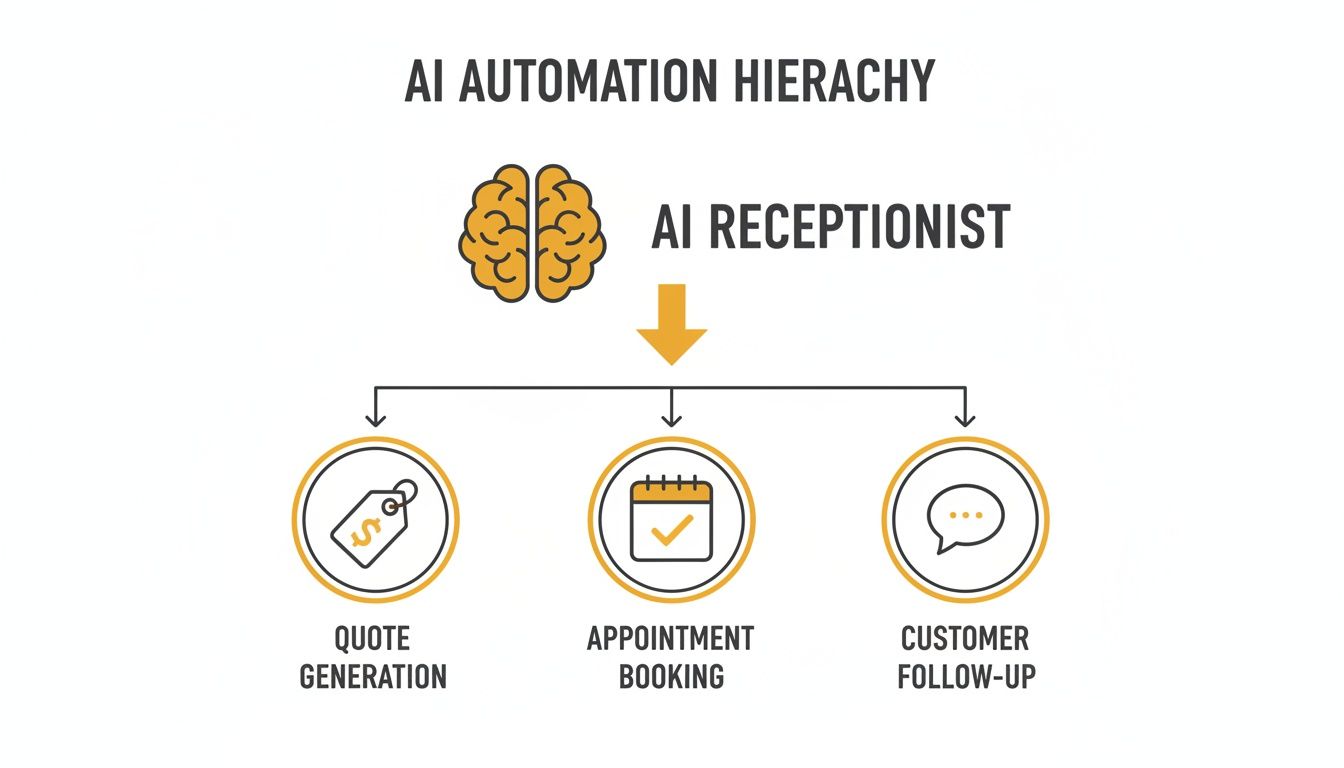
This setup means every caller gets the same perfect, consistent experience, from the first question to the final booking confirmation—without anyone on your team having to lift a finger.
Unlike old-school answering services that punish you with higher bills as your call volume goes up, a modern AI solution like MoveJoy runs on a flat-rate model. You get all the benefits of a hyper-efficient front office for a predictable monthly cost. This model is built to scale with you, not against you. You can handle the August peak season without sweating overage fees or watching your service quality tank.
By automating repetitive tasks like quoting and scheduling, your team gets to focus on what they're best at: running great moves and dealing with complex customer situations.
But the biggest advantage here is speed.
When a customer calls for a moving quote, they aren't just calling you. They're calling two or three of your competitors, too. An AI receptionist answers instantly, gives them the info they need on the spot, and can lock in the booking before a competitor even has a chance to call them back from voicemail. Faster responses equal higher booking rates.
This speed-to-lead is what gives you a real edge in a crowded local market. It turns your phone line from a point of stress into a reliable engine for new jobs. We're not just talking about a lower cost of answering service; we're talking about a much, much higher return on every call.
Comparing Costs: Human Answering Service vs. AI Automation

When you lay the numbers side-by-side, the financial gap between a traditional answering service and a modern AI solution is impossible to ignore. It’s about predictable costs versus unpredictable expenses that punish you for being busy.
Think about it this way: a traditional service bills you per minute, usually somewhere between $1.55 to $1.90 per minute. That means a single 10-minute call to quote a job can cost you almost $20. During your summer rush, those costs stack up fast.
AI solutions flip that model on its head. They typically operate on a flat monthly fee. You can handle an unlimited number of calls without ever worrying that your bill is going to skyrocket just because your marketing is working.
Cost and Feature Showdown: Traditional Service vs. AI Automation
The real story isn't just the price tag, but what you actually get for your money. Traditional services are great at taking messages, but anything beyond that—like booking a job or integrating with your CRM—is usually a pricey add-on. An AI receptionist, on the other hand, often includes these tools right out of the box. It stops being a simple message-taker and becomes a machine for generating revenue.
When you're trying to figure out the most effective way to manage calls, looking at options like AI-powered voicemail-to-text apps can show just how different the cost and efficiency are compared to a live human service.
Let's break down how they really compare for a moving company.
| Feature | Traditional Answering Service | AI-Powered Automation |
|---|---|---|
| Pricing Model | Per-minute or per-call, with overage fees | Flat monthly subscription |
| Cost Predictability | Low; bills fluctuate with call volume | High; budget with confidence |
| Scalability | Limited; service quality can drop during peaks | Unlimited; handles any call volume instantly |
| 24/7 Availability | Standard, but often at a premium cost | Included at no extra charge |
| Booking & Quoting | Basic message taking; scheduling is an add-on | Fully automated quoting and booking |
| Automated Follow-up | Not available | Built-in to nurture leads and win jobs |
Ultimately, choosing an answering service is less about the sticker price and more about the total value you get back. For a deeper look at what modern systems can do, our guide on the AI receptionist for small business explains how automation can seriously drive up your efficiency.
AI delivers more powerful, revenue-focused features for a predictable, flat fee. It’s about ending the financial surprises for good and investing in a tool that helps you grow.
Your Questions, Answered
You've got questions about how this all works. Here are the straight answers I give moving company owners when they ask about cost, value, and getting started.
How Much Should a Small Mover Budget for an Answering Service?
For a traditional, human-powered answering service, a small moving company can expect to pay anywhere from $200 a month for a bare-bones, low-call-volume plan to well over $1,500 during your busy season for 24/7 coverage with appointment setting.
The real danger here isn't the base fee; it's the per-minute charges and overage fees. Those are the silent killers that can take a predictable bill and turn it into a nasty surprise, especially when you're having a great month with lots of quote calls. Modern AI automation, in contrast, typically offers a predictable flat rate that doesn't penalize you for growth.
Are Flat-Rate Answering Services Better for Movers?
For most movers, yes—absolutely. The moving business has peaks and valleys. One week is quiet, the next is a madhouse. Per-minute plans might look cheap on paper, but a few long quote calls can blow your budget out of the water.
A flat-rate model, especially one powered by AI automation, brings predictability. You know exactly what you’ll pay each month, whether you get 50 calls or 500. This lets you handle unlimited inquiries without punishing you for being successful.
The real win is predictability. A flat-rate service means one booked job pays for the entire month, without the risk of runaway costs just because you’re having a successful week.
Can an AI Answering Service Actually Book Moving Jobs?
Yes, and this is where the game changes. A modern AI receptionist isn't just a glorified answering machine. It’s designed to be an extension of your operations team.
It connects directly to your calendar, checks your real-time availability, quotes jobs based on your specific rates, and books confirmed appointments right onto your schedule. A customer can call at 10 PM on a Friday, get their questions handled, and be booked for next Tuesday without a single person on your team lifting a finger. You literally make money in your sleep.
Stop losing jobs to voicemail. MoveJoy answers every call 24/7, provides instant quotes, and books jobs directly into your calendar, turning missed opportunities into revenue. See how much you could be making at https://getmovejoy.com.