
Most moving companies don’t have a lead problem first. They have a conversion problem.
The pattern is familiar. The phones ring hard during busy hours. A few calls hit voicemail because the coordinator is helping walk-in customers or dispatch is putting out fires. Web forms come in after hours and sit until morning. Quotes go out late, or not at all. Then the owner says the business needs more leads and starts shopping for ads.
That’s backwards.
For most 5 to 20 truck operators, moving company lead generation only works when the front end can answer fast, qualify properly, quote cleanly, and book before the prospect keeps calling down the list. Lead flow and lead handling are the same system. If one side is weak, the other side gets expensive fast.
Laying the Foundation Define Your Most Profitable Jobs
A lot of movers say they want more local leads, more long-distance leads, or more packing jobs. That’s too broad. If you don’t know which jobs produce your healthiest margins, your marketing will attract volume without improving profit.
Start with jobs you already know make money
Pull the last few months of completed jobs from SmartMoving, Supermove, MoveitPro, or a spreadsheet if that’s what you’re using. Don’t start with demographics. Start with job economics.
Review jobs by:
- Home size and inventory. A three-bedroom house with a straightforward load can be very different from a small apartment with elevator restrictions and multiple long carries.
- Zip code and drive pattern. Some service areas look good on paper but create deadhead time, parking issues, and crew inefficiency.
- Add-on services. Packing, unpacking, storage, and specialty items often separate average tickets from better jobs.
- Move type. Local labor-only, full-service local, intrastate, and long-distance all stress your operation differently.
- Season and crew fit. Some jobs are profitable in shoulder season and a headache in peak season.
A general marketing framework like these services lead generation strategies is useful, but movers need to apply it through a job-profit lens, not a generic “get more inquiries” lens.
Practical rule: If a lead source sends jobs your crews dislike, your claims rise, or your close rate stays weak after quoting, it isn’t a good lead source no matter how busy it makes the phones.
Build a simple profitable job profile
You don’t need a fancy BI tool. Build one sheet with five columns:
| Job factor | What to review | Why it matters |
|---|---|---|
| Revenue | Final billed amount | Shows top-line value |
| Labor load | Crew size and time | Reveals strain on schedule |
| Add-ons | Packing, storage, materials | Highlights margin boosters |
| Friction | Stairs, shuttle, long carry, delay | Exposes jobs that look good but drag ops |
| Outcome | Review quality, claim issues, referral potential | Connects profitability to reputation |
Then write one or two ideal job profiles. For example, that may be suburban family moves within your core service radius, with packing added and enough lead time to schedule properly. Or it may be apartment moves in dense urban zones if your crews and pricing model handle that well.
Once you've done this, your lead generation gets sharper fast. Your SEO targets the right service areas. Your ads stop chasing cheap clicks. Your office qualifies leads against work you want to do. That's how you break out of the revenue plateau without just buying more noise.
Dominate Your Service Area with Local SEO
For most independent movers, local SEO is still the most effective channel because the customer is already searching with intent. The defensible workflow is to combine local-intent SEO, Google Business Profile optimization, and rapid multi-channel follow-up, while avoiding the mistake of treating lead generation as traffic only, as noted in this moving company lead generation guide.
The checklist below is worth implementing line by line.
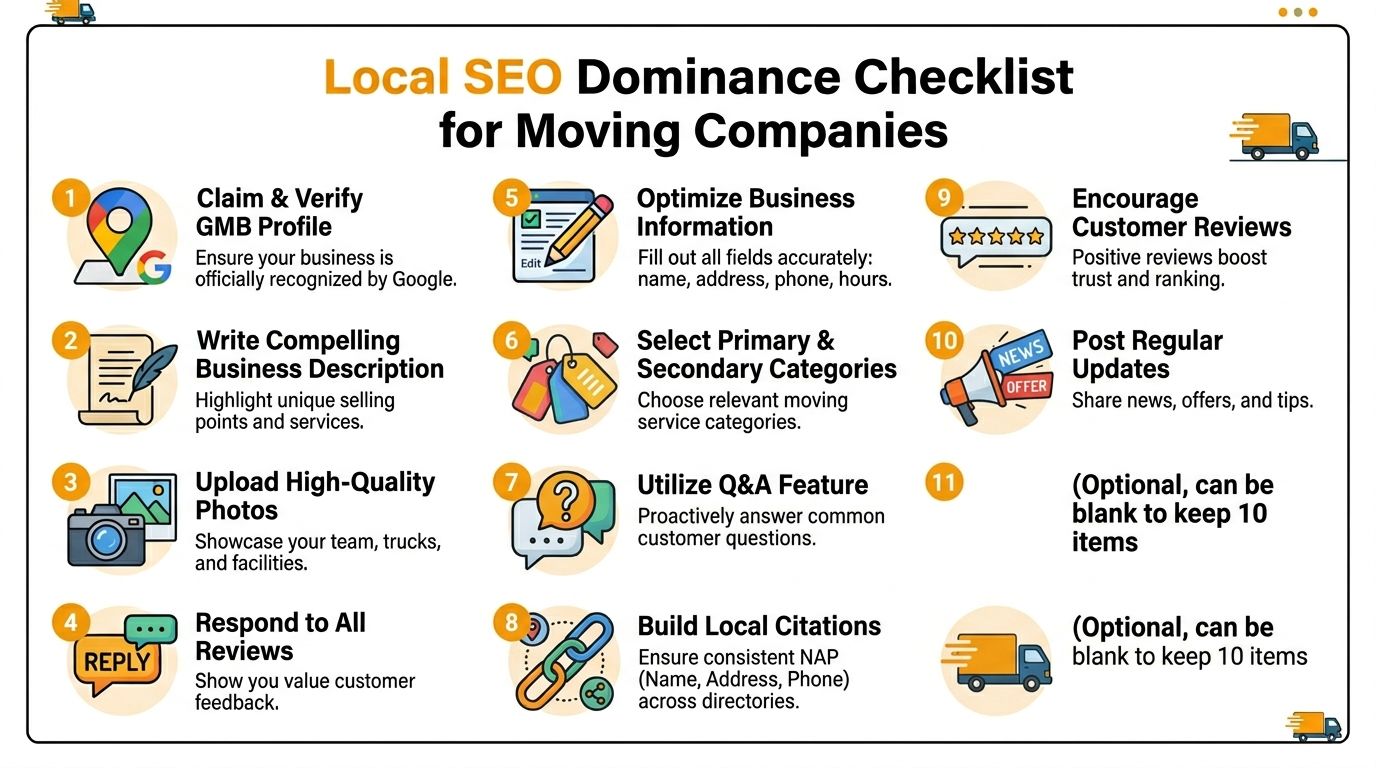
Get your Google Business Profile tight
Your Google Business Profile does more work than most mover websites. If it's incomplete, inconsistent, or stale, you're giving away calls to companies with weaker operations but better local visibility.
Handle the basics first:
- Claim and verify the profile. Sounds obvious, but plenty of movers still have duplicate or half-managed listings.
- Pick categories carefully. Use the primary category that best matches your core service, then add relevant secondary categories.
- Fill every field. Service areas, hours, phone number, website, and business description all need to be current.
- Upload real photos. Trucks, crews, warehouse, packing work, and branded uniforms outperform generic stock visuals.
- Ask for reviews continuously. Don't ask in batches once a quarter. Build the ask into your closeout process.
- Respond to every review. Prospects read the response as much as the review itself.
A strong GBP also supports the kind of local visibility discussed in MoveJoy's guide to marketing for moving company growth, especially when the listing is tied to fast intake and strong quote handling.
Clean up citations and service pages
A mover can rank poorly even with a decent website if the business details are inconsistent across directories. Your name, address, and phone number need to match everywhere they appear.
Check these items:
- Directory consistency. Yelp, Angi, Apple Maps, Bing Places, and industry listings should all match your core business info.
- Service-area pages. Build pages around real search intent such as city plus service type. Keep them specific, not spun.
- Quote-intent content. Publish pages that answer the questions buyers ask before they call, especially around moving timelines, packing, storage, and pricing process.
- Mobile usability. If the form is hard to complete on a phone, local SEO traffic won't convert.
The ranking win matters. The booking win matters more. Local SEO only pays when the office handles the inquiry quickly after it comes in.
Spend Smarter with Paid Advertising
A 10-truck mover turns ads on Monday, gets a spike in calls by Wednesday, and still ends the week blaming Google for poor lead quality. I see that pattern a lot. The problem is usually simpler. The campaign is too broad, the office is not set up to qualify quickly, or the quote path is too slow to convert paid traffic into booked jobs.
Paid ads should buy demand that is already close to booking. They should not be asked to fix weak intake, vague service positioning, or slow estimating. If those problems are still in the system, more budget just makes the leaks more expensive.

Start where booking intent is highest
For most 5 to 20 truck operators, paid acquisition works best in a clear order:
| Channel | Why start or wait | Best use case |
|---|---|---|
| Local Services Ads | High-intent calls, simpler setup, strong fit for local demand | Core service-area leads |
| Google Search Ads | Strong once keyword control, routing, and quote handling are in place | City plus service searches |
| Social ads | Usually weaker cold intent, stronger as follow-up traffic | Remarketing and niche audiences |
Google notes that ad relevance, expected clickthrough rate, and landing page experience all affect performance in Search campaigns, not just bid level, in its guide to how Google Ads auction and Quality Score work. For movers, that matters because a generic campaign structure usually drives up cost before it improves booked jobs.
Start with the narrowest version of what already sells well. If local residential moves in three zip codes are your cleanest jobs, build around that first. Do not start with every service, every suburb, and every keyword variation you can think of.
If you're comparing vendors, marketplaces, and paid channels, review how different moving lead sources for moving companies perform and judge them on booked revenue, fallout rate, and margin, not raw lead count.
Set campaigns up to protect office time
Bad paid traffic does not just waste ad spend. It clogs the phones, slows down good prospects, and creates the false impression that marketing is the problem.
Watch for these failure points:
- Broad match drift. Loose targeting pulls in searches for truck rental, jobs, boxes, and DIY help.
- Missing negative keywords. Every irrelevant call burns budget and receptionist time.
- Mixed-intent landing pages. Residential local, commercial, long-distance, and labor-only leads need different pages and different offers.
- No after-hours plan. If calls come in at 7:30 p.m. and nobody can capture inventory or schedule a survey, competitors get the job.
- Budget increases before close-rate review. More leads only help if your booked-job rate holds up.
The operators who win with paid ads usually look boring from the outside. Tight radius. Tight keyword list. Clear service pages. Fast callbacks. Good filters. That is what makes the math work.
Measure paid traffic the way an owner should
Cost per lead is useful, but it is not the number that keeps a moving company healthy. Two channels can generate leads at the same price and produce very different outcomes once no-shows, bad-fit jobs, and low-margin moves show up.
Track paid performance through the full chain:
- Lead to contact rate
- Contact to survey or quote rate
- Quote to booked-job rate
- Average revenue per booked job
- Gross margin by lead source
That is how you identify the underlying problem. Sometimes the ad account needs work. Sometimes the office is taking 25 minutes to return a missed call, and the campaign is doing its job just fine.
Paid ads work when operations can absorb demand without letting good leads sit. Buy intent carefully, route it fast, and measure booked jobs instead of lead volume.
Build a High-Quality Referral and Partnership Engine
The highest-quality moving leads usually come from trust, not from a click. In Supermove's survey of movers, 68.6% of companies said word-of-mouth produces the highest-quality leads, with referrals ranking second, according to Supermove's 2025 moving industry survey. That's a strong signal for operators who keep chasing more ad volume while underusing the goodwill they've already earned.
Turn good operations into repeatable referrals
Most movers think referrals are something that "just happens" if the crews do a good job. That's only half true. Service quality creates the opportunity. Process captures it.
Build the referral ask into your workflow:
- At job completion. The crew leader flags happy customers before the truck leaves.
- During final payment or closeout. Office staff sends the review link and a short thank-you.
- A few days later. Ask for a referral while the move is still fresh.
- For repeat-friendly customers. Follow up with property managers, seniors transition coordinators, and storage users who may refer again.
Keep the ask simple. Don't write a paragraph. Ask for the review, then ask whether they know anyone moving soon.
Choose partners who already touch move-ready customers
The best partners already work with people who are in transition. Realtors are obvious, but they aren't the whole picture.
Focus on:
- Property managers who deal with move-ins, move-outs, turnovers, and tenant issues.
- Storage facilities that hear from customers who need labor, transport, or short-term holding.
- Mortgage brokers and loan officers who see relocation timing before many movers do.
- Senior move managers and downsizing specialists where service and trust matter more than price alone.
A good partnership isn't just "send me leads." It works better when you help the partner look organized and responsive to their client. Fast scheduling, clean communication, and accurate estimates matter more than awkward commission talk in a lot of markets.
One more point. If your office drops calls, sends late estimates, or creates scheduling confusion, referral partners stop referring. Referral marketing is still operations.
Plug the Leaks in Your Lead Capture Workflow
A common revenue stall looks like this. The phone rings while the crew is loading. Three web leads come in after 5 p.m. An office admin calls one back the next morning, sends one estimate late, and forgets the third because nobody owns it. Traffic was not the problem. Intake was.
That is why growing movers should audit capture and follow-up before raising ad spend. More leads only make the leaks more expensive. If your team misses calls, collects weak information, or sends quotes too slowly, marketing starts feeding a broken booking process.
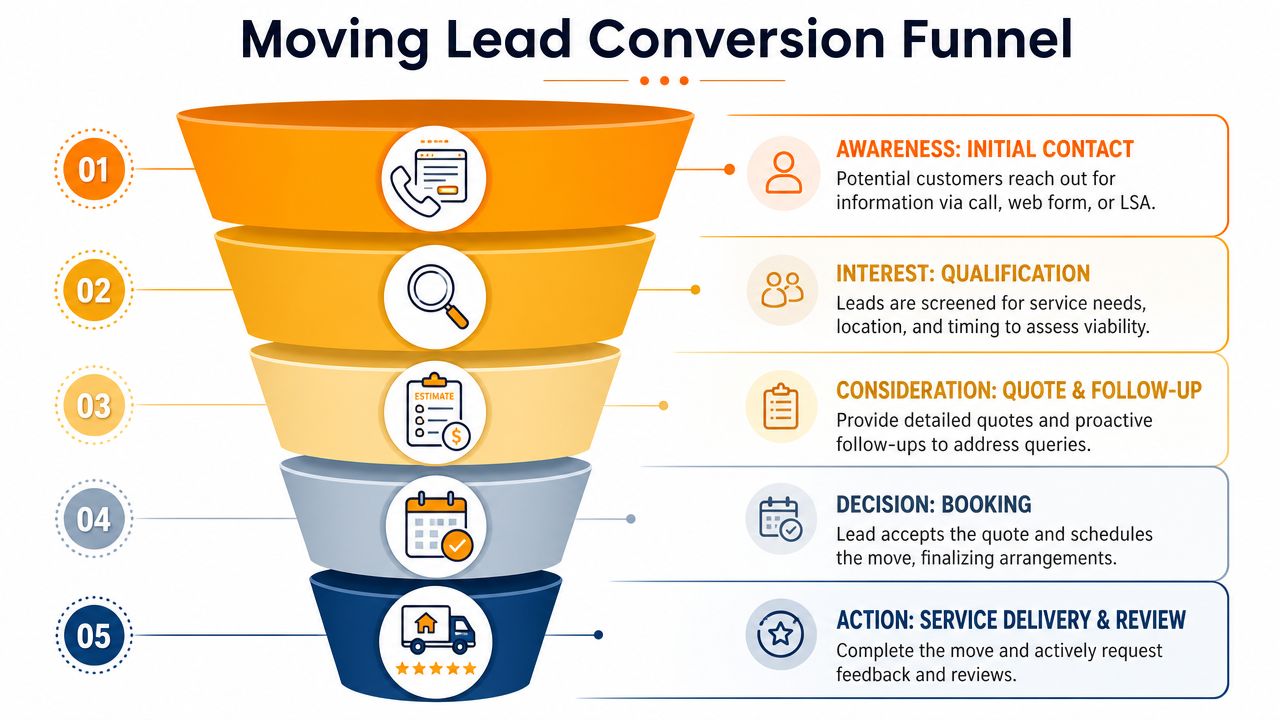
Map the funnel from inquiry to booked job
A moving lead usually passes through five moments:
- Initial contact by phone, web form, Local Services Ads, or chat.
- Qualification around move date, origin, destination, inventory, access issues, and service fit.
- Quote delivery with enough detail to create confidence.
- Follow-up if the customer does not book immediately.
- Booking and confirmation into the schedule or CRM.
Audit each stage using real leads from the last seven days. Pull missed-call logs. Read partial form submissions. Check the time gap between inquiry and estimate. Listen to recorded calls. Review whether coordinators are collecting the details your estimator or sales rep needs to price the job cleanly.
The goal is simple. Find the exact step where good demand turns into dead air.
Fix the handoff points that kill close rate
In 5 to 20 truck operations, close-rate problems usually come from handoffs, not from a lack of lead volume.
A few patterns show up over and over:
- Missed calls during dispatch and morning rushes. The lead is ready to talk now. If that call hits voicemail, another mover often gets the booking window.
- Forms that create friction. Too many required fields, weak mobile design, and confusing error messages cut submission rates. If your web team needs a reference, these form accessibility and validation techniques are a practical place to start.
- Slow quote turnaround. A same-day quote has a different win rate than a next-day quote in this business, especially for local moves and end-of-month demand.
- No follow-up sequence. One call and one email is not a system. It is a hope-based process.
- No clear owner. If intake, estimating, and scheduling all assume someone else is handling the lead, nobody is.
If your office is still quoting manually from scattered notes, tighten the workflow before you buy more clicks. A structured process for automated moving estimates helps capture the right job details faster and keeps quote delivery from depending on who is available at that moment.
Use this quick audit table:
| Leak point | What it looks like | Fix |
|---|---|---|
| Phone goes unanswered | Calls hit voicemail or ring out | Route overflow and after-hours calls |
| Form drop-off | Visitors start but do not submit | Shorten fields and improve mobile UX |
| Quote delay | Inquiry comes in, estimate goes out late | Standardize qualification and pricing steps |
| Weak follow-up | One call or one email, then silence | Use scheduled call, text, and email follow-up |
| No tracking | You cannot tell which leads booked | Tie lead source to booked job outcome |
One more hard truth. If your office captures inquiries but cannot qualify them, quote them, and follow up on a schedule, you do not have a lead generation issue. You have a conversion leak that is draining booked revenue.
Use Automation to Quote and Close Jobs 24/7
A lead comes in at 8:17 p.m. The customer wants a local move this Saturday, has two flights of stairs, and is calling the next two movers on Google if nobody can quote tonight. If your process stops at "we'll call you tomorrow," you did not lose that job to marketing. You lost it to speed and coverage.
Automation fixes that problem only if it handles real estimating work, not just message taking.
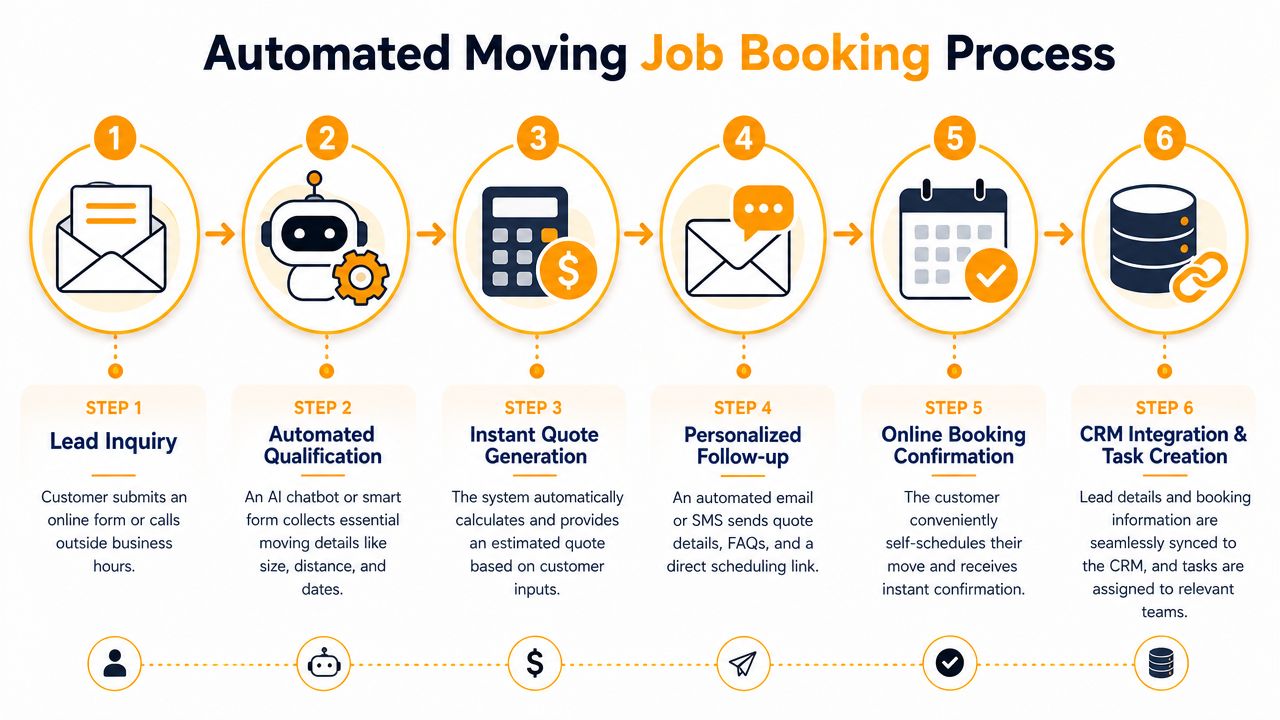
Compare the real options
Owners usually look at four ways to cover nights, weekends, and call spikes. The difference is not whether someone answers. The difference is whether the customer gets qualified, priced, and pushed toward a booking without waiting for your estimator to log back in.
| Option | What it handles | Where it falls short |
|---|---|---|
| Voicemail | Captures a message | No qualification, no quote, no booking path |
| Human answering service | Answers live and takes details | Usually cannot apply your crew minimums, travel charges, or scheduling rules |
| Generic automation tool | Collects basic information | Often misses moving-specific logic such as stairs, long carry, packing, or storage |
| Purpose-built moving automation | Qualifies, quotes, and books | Needs clean pricing rules, calendar controls, and clear exceptions |
The trade-off is straightforward. The more generic the tool, the more cleanup your office staff does later. The closer the system is to your actual estimating workflow, the more booked revenue it can protect after hours.
What an automated workflow should actually handle
For a 5 to 20 truck company, useful automation needs to cover the parts of the sales process that usually stall after the first inquiry:
- Qualify the move by date, zip codes, home size, access, add-on services, and urgency
- Apply your pricing rules including minimums, hourly logic, travel time, packing, and specialty items
- Give the customer a next step immediately with a quote, a range, or a scheduled survey when the job needs review
- Book into your operating system such as SmartMoving, Supermove, MoveitPro, or Google Calendar
- Trigger follow-up automatically by text and email when the customer does not commit on the first touch
- Route exceptions to staff for jobs that fall outside your quoting rules
A good setup also needs boundaries. You should not let automation auto-book every job. Large interstate moves, fragile-item-heavy jobs, and requests with unclear inventory often need human review. Good automation speeds up straightforward jobs and flags the risky ones before they turn into underpriced work.
One example is automated moving estimates, where inbound calls can be answered, qualified, priced from the mover's own rate card, and placed into the calendar or CRM. That is a different tool category than a chatbot that collects a name, phone number, and preferred move date.
I usually recommend owners start with one lane first. Local moves inside your core service area, with standard inventory and clear pricing rules, are the easiest place to automate profitably. Get that lane working, review the booked-job quality, then expand.
If you want a simpler framework for judging whether the system is paying off, this guide on how to boost your marketing returns is a useful reference. The actual test is simple. Fewer missed opportunities, faster quote delivery, and more booked jobs from the leads you already paid to generate.
Track What Matters Most Your Cost Per Booked Job
A 10-truck mover can spend $6,000 on ads in a month, feel busy, and still finish the month disappointed. The phone rang. Quote requests came in. The calendar never filled the way it should have. In almost every case, the problem is measurement. The owner is tracking lead volume instead of booked jobs by source.
Lead count is an activity metric. Cost per booked job is the number that protects margin.
A cheap lead source can burn hours at the front desk, clog your quote pipeline, and produce price shoppers who never commit. A more expensive channel can send fewer inquiries, but those customers book faster, take packing, and fit your crew schedule better. If both channels sit in the report as "20 leads," the budget decision gets made on bad information.
Measure every channel all the way to the calendar
Track each source at three levels:
- Inquiry volume to confirm the channel is producing opportunities
- Qualified opportunity rate to see whether the leads match your service area, job type, and pricing
- Booked job outcome to see whether the channel is producing real revenue
That third number matters most. Owners who plateau usually know their cost per lead. Stronger operators know what it costs to book one good local move from Google Ads, Local Services Ads, SEO, and referral partners. They also know which channels send jobs that turn into claims, discounts, or unprofitable long days.
If you want a broader framework for tying marketing spend back to revenue, this guide on how to boost your marketing returns is a useful reference.
Use a weekly scoreboard you will actually maintain
Skip the complicated dashboard. A simple weekly sheet is enough if your team updates it consistently.
Track these fields:
| Channel | Leads | Qualified | Booked | Notes |
|---|---|---|---|---|
| Google Business Profile | ||||
| SEO service pages | ||||
| Local Services Ads | ||||
| Google Ads | ||||
| Realtor referrals | ||||
| Property manager referrals | ||||
| Storage partners |
Then add one more number in your own version. Cost per booked job.
That gives you a practical operating view. If Google Ads produced 18 leads, 9 qualified opportunities, and 3 booked jobs, you can judge the channel properly. If realtor referrals only sent 4 leads but booked 3 premium jobs inside your preferred zip codes, that source may deserve more attention than the ad campaign with higher volume.
Keep source tracking tight or the report becomes useless
Ask every caller and form lead how they heard about your company. Log it the same day in the CRM, dispatch software, or even a shared sheet if that is what the office uses right now.
Do not accept vague labels like "Google." That answer should get cleaned up into Google Business Profile, organic search, Local Services Ads, or Google Ads whenever possible. Those channels behave differently, and combining them hides what is working.
There is also a trade-off here. Perfect attribution is hard, especially when a customer sees you in more than one place. That is fine. The goal is not a flawless analytics setup. The goal is better budget decisions than the mover down the street who is still guessing.
The companies that improve fastest ask a sharper question: which channels produce booked jobs that fit our rates, service area, and crew capacity?
If your company is getting inquiries but losing jobs to missed calls, slow quoting, or weak after-hours coverage, MoveJoy is worth a look. It's built for movers that need more than lead capture. It handles inbound calls, qualifies the move, generates quotes using your rate card, and books directly into your workflow so more inquiries turn into actual jobs.