Moving Company Marketing Strategy: Book More Jobs in 2026
You're probably in a familiar spot. You finally put real money into marketing, or at least real time. You cleaned up the website, turned on Google Ads, asked for more reviews, maybe even hired someone to help with SEO. Calls start coming in, but they don't always come when someone is free to answer. They come while your estimator is on another line, while dispatch is handling tomorrow's route, while crews are loading, and after hours when nobody wants to pick up a sales call.
That's why most moving company marketing strategy conversations miss the underlying problem. The issue usually isn't only lead volume. It's what happens after the lead shows intent. A moving prospect doesn't want to wait half a day for a callback and then another day for a quote. They want confidence, speed, and a clear next step. If your front office can't deliver that, your marketing spend turns into a leak.
The operators who grow steadily usually understand one thing early. Marketing and operations are the same system. If you drive demand but don't capture and convert it, you haven't built a growth engine. You've built a busier version of the same bottleneck.
Table of Contents
- Your Marketing Is Working But Are You Answering The Phone
- The Foundation Before You Spend A Dollar
- Dominate Your Local Market with Google
- Run Paid Ads That Actually Generate Revenue
- Build Your Referral and Off-Season Content Engine
- Fix the Leaky Bucket Where All Your Marketing Leads Go
- From Marketing Strategy to Booked Revenue
Your Marketing Is Working But Are You Answering The Phone
A lot of movers assume the fix for inconsistent revenue is more traffic. More ads. More SEO. More leads. Sometimes that's true. Often it isn't.
Blue Corona points out that most mover marketing articles focus on SEO, Google Ads, reviews, and social content, but rarely deal with the business impact of answering faster. It also notes that marketing performance is often limited by intake speed and call handling, not traffic volume alone, and that some movers may get better ROI by fixing response speed before increasing ad spend, as explained in Blue Corona's moving company marketing guide.
Speed is the real first impression
In moving, the first company to respond with confidence often wins the job. Not always the cheapest. Not always the oldest company. The one that makes the customer feel like the move is already getting handled.
That's especially true for local residential work. People call during lunch, between meetings, after arguing with a landlord, or right after their closing date changes. They're not browsing casually. They're trying to solve a problem now.
Practical rule: If your phone rings and the customer can't get a clear next step quickly, your marketing didn't fail. Your intake process did.
That changes how you should think about a moving company marketing strategy. The question isn't only how to get more inquiries. The question is whether your business can reliably turn that inquiry into a quote, a follow-up, and a booking window before the customer moves on.
What a missed call really means
A missed call isn't just a missed conversation. It can be a paid click, a referral you didn't honor well, or a high-intent prospect who was ready to compare two movers and book the first one that sounded organized.
Common failure points look like this:
- Calls hit voicemail during jobs: Owners and sales staff are stretched thin, especially during busy months.
- After-hours leads sit overnight: By morning, the prospect may already have two other quotes.
- Callbacks happen without context: The customer has to repeat everything, which lowers trust immediately.
- Quotes take too long: The customer doesn't remember who was helpful. They remember who was fast.
If your current process depends on someone being available at exactly the right moment, it's fragile. That's why operators trying to tighten intake should review practical phone handling standards, including scripts and first-response habits, in this guide on how moving companies should answer a call.
The Foundation Before You Spend A Dollar
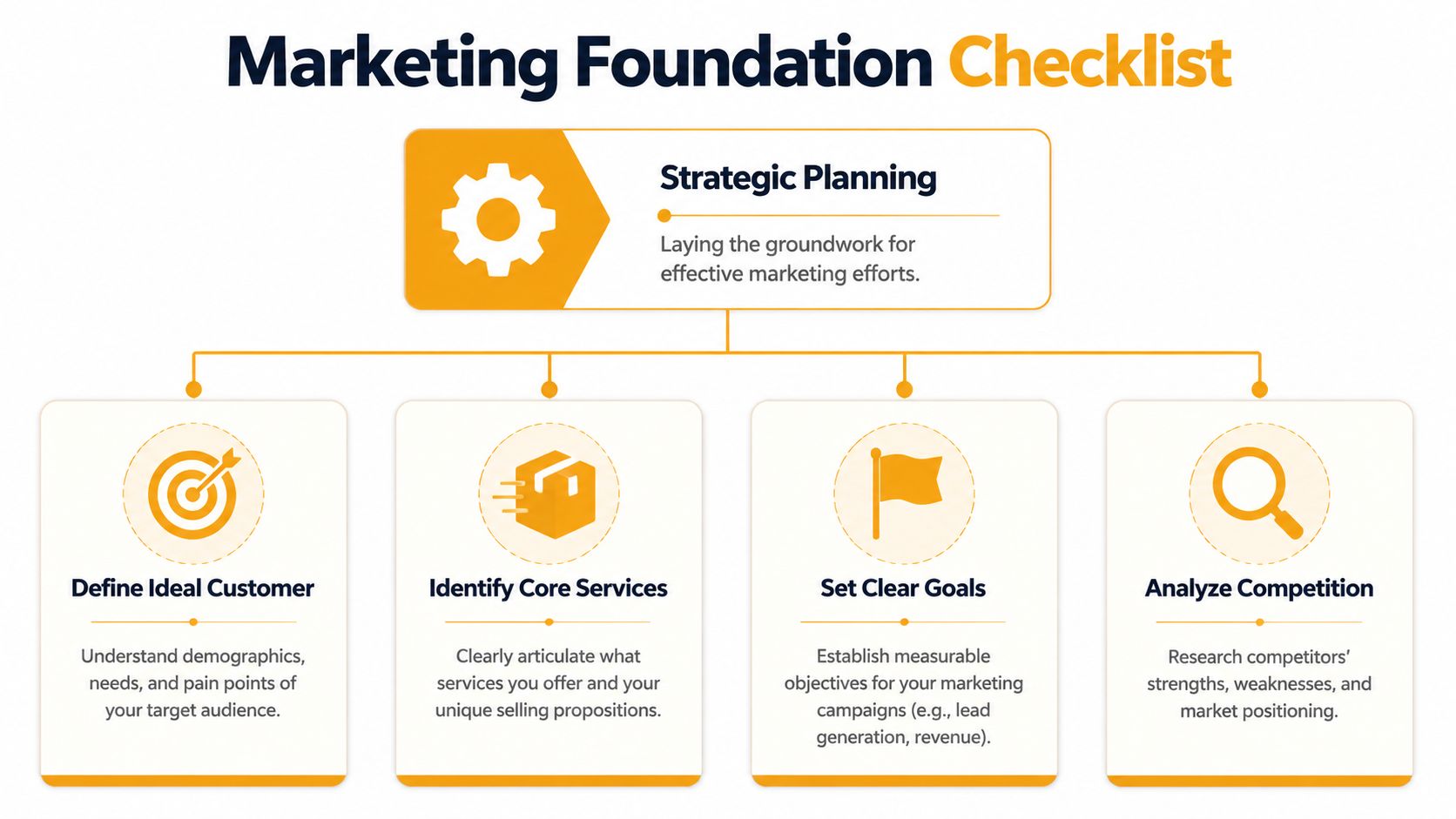
Before you buy traffic, define what a good lead is. A lot of moving companies burn budget because they market to “anyone moving” instead of targeting the jobs that fit their trucks, crews, pricing model, and calendar.
According to SmartMoving, 40% of movers plan to improve their marketing efforts, which shows the competitive bar is already high and more operators are investing in discoverability, reviews, and paid lead capture, as noted in SmartMoving's marketing strategy article. If other movers in your market are getting more intentional, winging it is expensive.
Know which jobs you actually want
Not every booked move is a good move. Some jobs create dispatch headaches, drag down crew efficiency, or eat margin through underquoting and surprises on site.
Build your strategy around your best-fit work:
| Job type | Usually worth prioritizing | Usually worth filtering carefully |
|---|---|---|
| Local residential | Suburban homes, organized move dates, clear inventory | Last-minute small jobs with unclear scope |
| Apartment moves | Buildings with elevator access and predictable logistics | Walk-ups with parking issues and vague details |
| Add-on services | Packing, unpacking, storage coordination | Custom requests that interrupt route efficiency |
| Commercial | Repeatable small office moves if your team handles them well | Complex work outside your crew's experience |
A practical filter helps your whole team. Dispatch knows what to hold space for. Sales knows what to qualify harder. Marketing knows what neighborhoods and service pages deserve attention.
Set goals that connect to booked work
Bad goals sound like this: get more website traffic, rank higher, run more ads.
Useful goals sound like this:
- Improve booking rate on inbound leads: That forces you to inspect quoting speed, phone coverage, and follow-up.
- Raise average job quality: That pushes better targeting by neighborhood, service type, and season.
- Fill weak spots in the schedule: Midweek and off-peak gaps deserve their own campaigns.
- Increase profitable add-ons: Packing and related services can lift revenue without adding a second truck.
Your marketing plan should match your capacity map. If Tuesdays are light and Saturdays are full, don't buy traffic the same way for both.
A strong foundation also means being honest about seasonality. Many movers overspend in peak months when demand is already active, then go quiet when they should be creating winter offers, referral outreach, and nurture campaigns. Good strategy doesn't chase volume blindly. It sends demand to the parts of the calendar where your operation can handle it profitably.
Dominate Your Local Market with Google
For most local movers, Google is the first screening tool customers use before they ever call. They check your reviews, photos, service area, and whether your business looks active or neglected. Your Google Business Profile isn't a side task. It's your digital curb appeal.
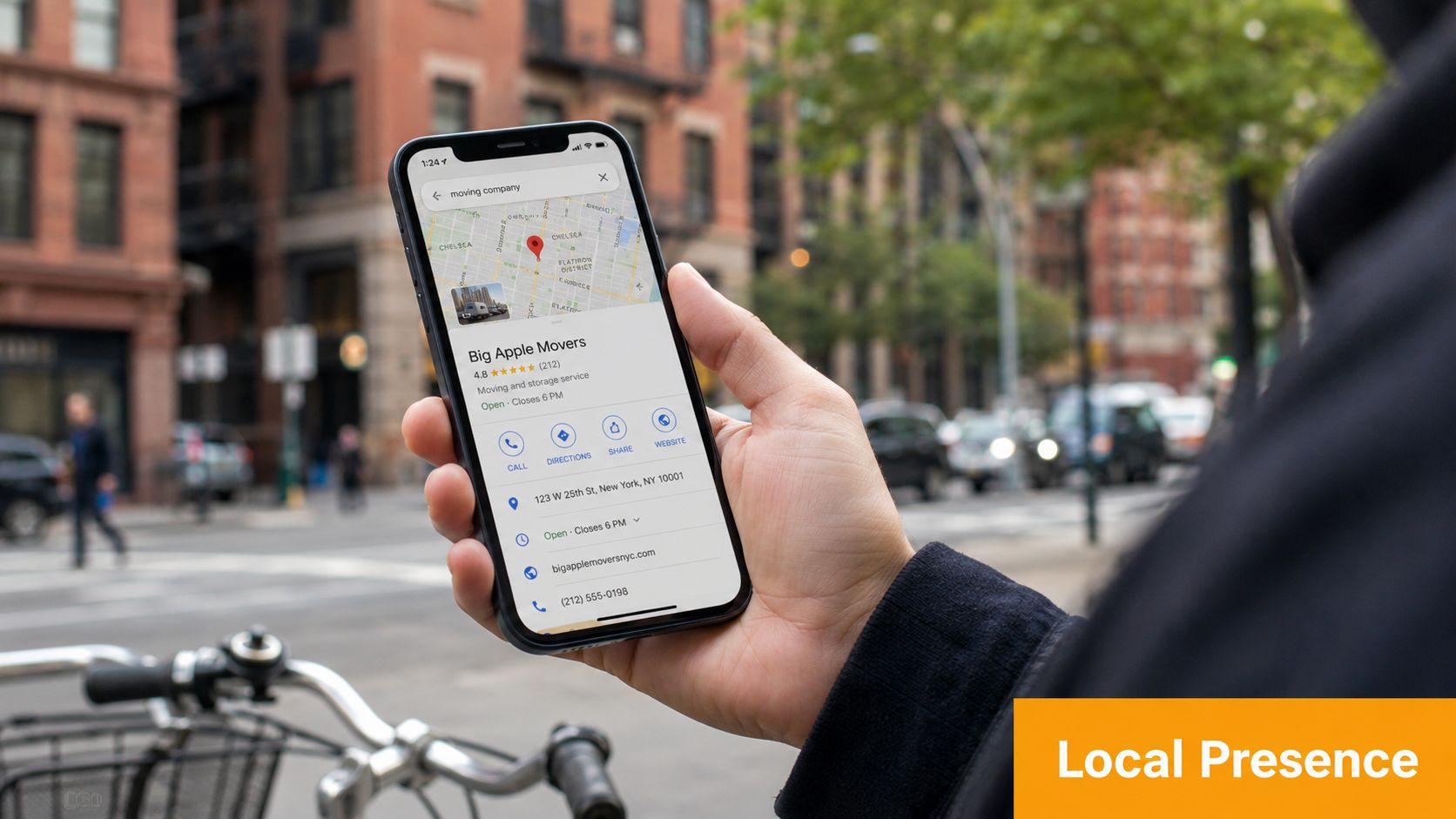
Treat your Google profile like a storefront
If your profile has old photos, sparse service info, or unanswered reviews, customers notice. They may not say it out loud, but they read it as disorganization.
Start with the basics:
- Use real photos: Trucks, crews, uniforms, wrapped equipment, and actual move-day scenes beat stock images every time.
- List services clearly: Local moving, packing, labor-only help, apartment moves, office moves. Don't make people guess.
- Keep hours accurate: Especially if your office and phone coverage differ after hours.
- Use the Q&A section: Put common pre-sale questions there so the customer gets reassurance before calling.
If you want a practical reference for tightening the profile itself, UFO Performance Marketing's GMB guide is a useful walkthrough for local business operators.
Reviews and local trust signals
Reviews matter because moving is a trust purchase. Customers are inviting strangers into their home, turning over fragile items, and hoping the crew shows up on time. They want evidence that your company is competent and calm under pressure.
A simple review process works better than a sporadic one:
- Ask right after a successful move when the customer is relieved and grateful.
- Make the request part of your closeout workflow, not an optional favor.
- Mention specifics. Customers leave better reviews when they remember the crew leader, the careful handling, or the smooth finish.
- Respond to every review. Good reviews show appreciation. Negative reviews show professionalism.
A stale profile tells customers you might be slow. An active profile tells them you're in the market every day.
Don't stop at Google. Keep your business name, phone, and service details consistent across local directories and partner sites. Citation consistency won't rescue a weak operation, but messy listings create unnecessary doubt. In local search, trust compounds through small signals.
Run Paid Ads That Actually Generate Revenue
Paid ads work for movers when the campaign matches the way people buy. Most local moving prospects aren't doing broad research for weeks. They're searching with intent, comparing a few options, and looking for someone who can take control fast.
Supermove's guidance for movers emphasizes a technically strong paid-search setup built around tight geographies, separating buying-intent keywords from research-intent keywords, and measuring conversion rate and job value instead of clicks, as described in Supermove's moving company marketing strategies.
Build campaigns around service area reality
A moving company with a constrained service area shouldn't run broad campaigns like a national brand. That's how budgets get chewed up by traffic that was never bookable.
Focus on three filters:
- Geography first: Target ZIP codes, neighborhoods, and towns you can serve profitably.
- Intent second: Bid on phrases that show the customer wants a mover, not just general advice.
- Offer third: Match the ad to the landing page and the phone script so the customer gets continuity.
A simple keyword split helps:
| Keyword type | Better for movers | Usually weaker for direct booking |
|---|---|---|
| Buying intent | “movers near me,” “moving company quote,” local move estimate terms | |
| Research intent | “how to pack boxes,” “moving checklist,” broad educational queries |
Research keywords can have value in content strategy. They're often weaker for direct ad spend if your goal is booked jobs now.
Track booked jobs not cheap clicks
A lot of owners get misled by ad reports. Click volume looks healthy. Cost per click seems manageable. Calls come in. But the schedule doesn't improve enough because nobody measured what happened after the lead entered the business.
Look at these metrics instead:
- Qualified calls by campaign
- Quotes delivered
- Booked jobs
- Job value by source
- Lead quality by geography
If you're still thinking mostly in click metrics, this breakdown of how to calculate cost per lead for moving companies is a good place to sharpen your measurement. Then take the extra step and tie it to cost per booked job, which is the number that shows you if a campaign deserves more budget.
Paid search can become reliable. But it only becomes reliable when ad targeting, intake speed, quoting, and follow-up work together. Otherwise, you're paying premium prices to feed the same front-office bottleneck.
Build Your Referral and Off-Season Content Engine
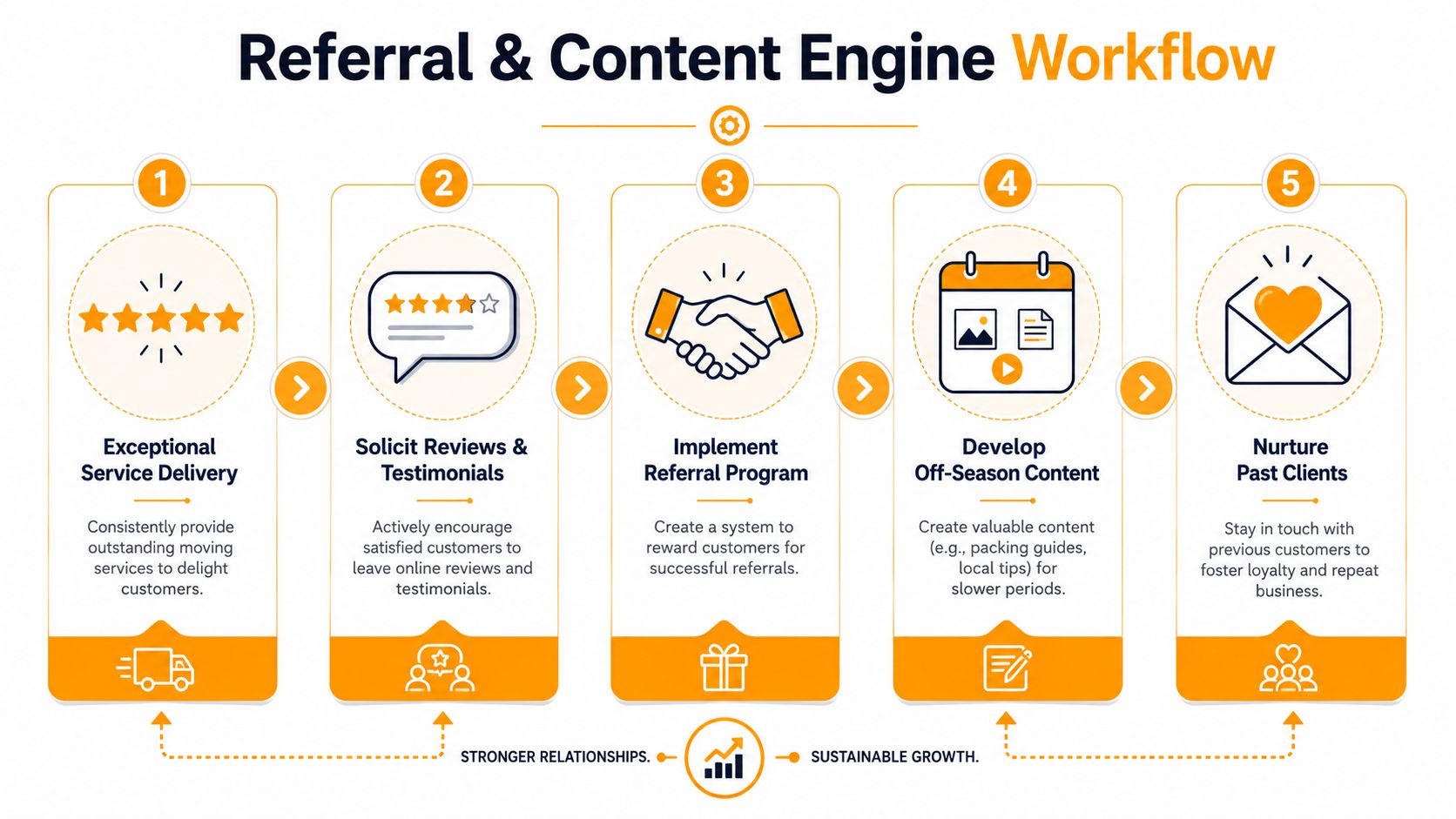
The best marketing systems for movers don't rely on one channel. They stack trust. Referrals bring warm intent. Content reinforces credibility. Community visibility keeps your name circulating when someone suddenly needs a mover.
Nextdoor recommends using slower seasons for early-bird booking discounts, packing-only services, and community-driven campaigns to help fill winter or midweek capacity, as outlined in Nextdoor's marketing advice for movers. That's a smart reminder that marketing shouldn't only chase peak-season volume. It should smooth utilization.
Turn referral partners into repeat lead sources
Most movers say they want more referrals. Fewer build a system for them.
Strong partners usually include:
- Real estate agents: They hear about move timing before most vendors do.
- Apartment and property managers: They can refer tenants constantly if your team is reliable.
- Storage operators: They interact with people in transition every day.
- Past clients: They know exactly how your crews work.
The mistake is making outreach too generic. Don't just drop off business cards. Give partners something useful to share with their clients.
Examples:
- A short pre-move checklist branded with your company
- A page explaining how to prepare for elevator reservations
- A winter-move planning guide they can email to buyers or tenants
- A clear contact workflow so they know who to send leads to
If you want a practical referral mindset for movers, this guide on how moving companies can earn referrals is worth reviewing with whoever owns sales and local partnerships.
Use slower periods to smooth capacity
Off-season content doesn't need to be fancy. It needs to answer the problems customers and partners have.
Good off-peak content topics include:
- Winter move prep: Weather, timing, access, and protection of floors and furniture.
- Packing-only offers: Useful for customers not ready to commit to a full-service move.
- Midweek booking incentives: Helpful when weekends are full and weekdays are soft.
- Neighborhood moving tips: Content that helps a relocating family feel local faster.
The point of off-season marketing isn't to discount your way into bad jobs. It's to keep trucks, crews, and cash flow steadier.
Think of referrals and content as one engine. The content gives partners a reason to remember you. The partnerships give the content a distribution path. Together they create trust before the customer ever speaks with your office.
Fix the Leaky Bucket Where All Your Marketing Leads Go
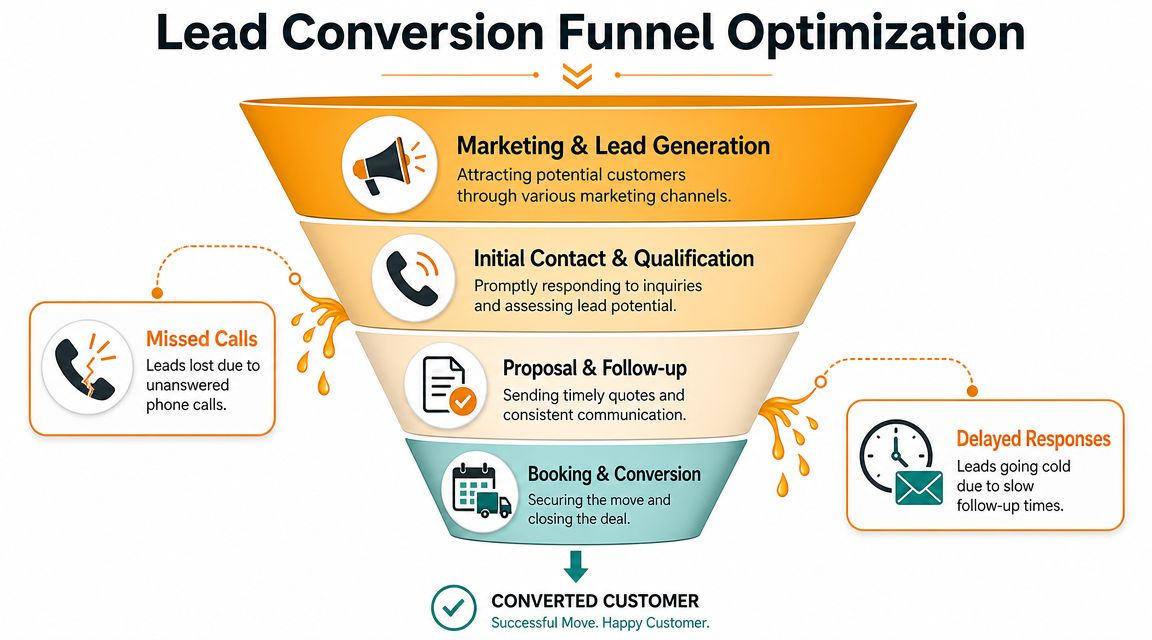
By the time a lead calls your office, most of the marketing work is already done. They found you, screened you, and decided you were worth contacting. That's why the highest-impact fix in many moving businesses sits at the bottom of the funnel, not the top.
The broader market isn't getting easier. The global moving services market is projected to grow from USD 81.73 billion in 2023 to USD 147.7 billion by 2033, at a 6.10% CAGR, according to Market.us's moving services market report. More demand attracts more competition. When that happens, every missed call hands a live opportunity to another mover.
Most lead loss happens after the click
Owners often inspect ad copy, landing pages, and rankings first. Those matter. But the bigger leak is usually simpler.
A prospect calls.
Nobody answers.
They submit a form.
Nobody follows up promptly.
They ask for a quote.
It takes too long or comes back vague.
That sequence kills more revenue than most operators realize. Not because the marketing was poor, but because the handoff from inquiry to quote was too slow and too manual.
Here's where leads commonly leak:
- Unanswered inbound calls
- After-hours inquiries with no immediate response
- Quotes delayed by manual data gathering
- Inconsistent pricing between team members
- No structured follow-up after the estimate
The handoff from inquiry to booked move
The strongest moving companies treat quoting like a sales operation, not an administrative task. They know that the customer is judging two things at once: price and certainty.
Fast quoting only helps when it's accurate. A rushed but sloppy estimate creates a different kind of loss later.
That's why “someone called them back” isn't enough. A stronger standard is required:
| Stage | Weak process | Strong process |
|---|---|---|
| Initial contact | Voicemail or delayed callback | Immediate response with qualification |
| Quote creation | Manual, inconsistent, delayed | Structured, fast, tied to real pricing rules |
| Follow-up | Ad hoc reminders | Scheduled, persistent, professional |
| Booking | Separate handoff and extra friction | Clear next step and easy confirmation |
Automation transforms from a nice-to-have into a revenue protection tool. If your team can't consistently answer, qualify, quote, and follow up across busy hours, evenings, and weekends, your moving company marketing strategy will always underperform its potential. You don't need more software for the sake of it. You need fewer gaps between inquiry and booked job.
From Marketing Strategy to Booked Revenue
A strong moving company marketing strategy is really a coordination strategy. Google visibility, paid search, referrals, reviews, and local content all matter. But none of them matter enough if your business can't convert demand quickly and consistently.
The scoreboard that actually matters
Most operators look at leads first because leads are easy to count. Revenue comes from a tighter chain:
- The right customer finds you.
- They contact you.
- You respond immediately.
- You give a clear and credible quote.
- You follow up until the customer books or declines.
That's why your main scoreboard should include booked jobs, job value, lead source quality, and conversion by channel. If one source produces lots of inquiries but weak bookings, it may not deserve more budget. If another source books cleaner, more profitable work, feed it.
For a useful outside perspective on building systems that move prospects through defined stages, AI SDR framework strategies from Drast AI are worth reading. The context is different, but the process discipline applies. Structured response beats improvisation.
Build a system your team can run
As a company grows from a handful of trucks to a larger local fleet, the owner can't stay at the center of every sales interaction. That's where many movers stall. The marketing starts working, but the front office stays owner-dependent.
The better path is simple:
- tighten local visibility
- run disciplined ad campaigns
- systemize referrals
- create off-season demand offers
- remove intake and quoting delays
When those pieces work together, marketing stops being unpredictable. It becomes a repeatable path to booked revenue.
If you're tired of paying for leads your team can't answer, quote, and book fast enough, MoveJoy is worth a look. It's built for moving companies that want more than call coverage. It helps capture inbound demand, generate accurate quotes using your own rate card, and book jobs directly into tools like SmartMoving, Supermove, MoveitPro, or Google Calendar so more of your marketing turns into revenue.