
Phoenix movers don’t have a demand problem. They have a conversion problem.
That’s the key shift in the moving market Phoenix AZ operators are facing in 2026. The metro is still huge. The Phoenix–Mesa–Chandler area had 4,845,832 residents in the 2020 Census and ranks as the 11th-largest U.S. metro. Arizona also ranked high in post-2020 population growth. But the housing environment no longer looks like a frenzy. In Phoenix, homes sold over the last three months ending May 2026 took about 51 days to sell and received 2 offers on average. That changes how customers shop, how fast they commit, and how your office needs to respond.
For a moving company owner, this isn’t bad news. It’s a market signal. When buyers and sellers have more time, they compare movers more carefully. Quote quality matters more. Follow-up matters more. The company that answers first still has an advantage, but now the company that quotes clearly, follows up consistently, and books cleanly has the bigger one.
The New Phoenix Moving Market Landscape
Phoenix homes sold in roughly 51 days and received about two offers on average in the three months ending May 2026. For moving companies, that matters more than another generic population-growth headline. It signals a market that still produces demand, but no longer forces customers into rushed decisions.
Phoenix remains a large, structurally attractive metro for movers, as noted earlier. The change is in customer timing. During the recent hyper-growth cycle, many households booked quickly because the housing transaction itself moved quickly. In a more balanced market, buyers and sellers have more time to compare providers, question line items, and wait for a second or third quote before committing.

Growth is still real but the buying cycle changed
This shift changes what wins business.
In a faster market, decent availability and a fair price could carry weak intake habits. In Phoenix today, independent movers are more likely to lose jobs because of slow response times, unclear scope notes, and estimates that feel incomplete. The lead did not disappear. It went to the company that replied first with a quote the customer could trust.
That is an operational issue, not just a marketing issue. A larger service area and steady inbound demand help only if the office converts interest into scheduled surveys, accurate estimates, and signed jobs. Owners who want more return from advertising should connect lead generation with a tighter moving company marketing strategy for local growth, because quote speed and quote quality now shape close rates as much as visibility does.
What this means for movers running 5 to 20 trucks
For operators in the 5 to 20 truck range, the pressure point is usually the front office. Crews often have capacity on paper, but revenue slips earlier in the funnel. Calls roll to voicemail. Web forms wait too long for a response. Inventory details stay vague until move day, which weakens both conversion and margin.
Three implications stand out:
- Lead quality matters more than raw volume: A smaller number of serious, well-qualified leads can outperform a high-volume campaign that fills the pipeline with price shoppers.
- Booking cycles are longer: Some households will research over several days instead of booking on the first call, which makes disciplined follow-up more profitable.
- Accuracy supports conversion: Customers comparing multiple movers notice missing fees, unclear assumptions, and generic estimates. A precise quote builds confidence before your truck ever leaves the yard.
The practical takeaway is straightforward. Phoenix still offers plenty of opportunity, but the easy-win period has cooled. Companies that answer quickly, define scope clearly, and follow up on a schedule are better positioned to turn a balanced market into a margin advantage.
Mapping Opportunity Phoenix Moving Hotspots
The smartest way to read the moving market Phoenix AZ isn’t by asking where people live. It’s by asking what kind of move each submarket tends to produce.
Phoenix no longer behaves like one uniform service area. Different parts of the Valley create different job sizes, access constraints, customer expectations, and quoting risks. The companies that map this correctly don’t just market better. They deploy trucks better and protect crew productivity.

Urban turnover and apartment logistics
In the denser parts of Phoenix, movers often face a different operating model than in the suburban ring. Think apartment-heavy zones, tighter access, elevators, loading restrictions, reserved dock issues, and customers who need fast scheduling clarity. These jobs can look small on paper but become operationally expensive if intake misses building details.
The broader market backdrop supports this more deliberate customer behavior. A 2026 Phoenix trend report noted that inventory was up 15% to 20% year over year and homes were sitting about 60 to 65 days on market, signaling a more balanced market where customers have more time to plan and compare movers. In practice, that means apartment and condo leads may arrive earlier in the decision cycle, with more back-and-forth before booking.
For office staff, that changes the first-call script. You need building questions early, not after the estimate goes out.
Suburban family moves and premium service zones
Family moves in outer and established suburban areas usually produce larger job scope, more furniture, more packing discussion, and more schedule sensitivity around school calendars and closing dates. These leads often justify a more consultative sales process because the revenue per booked job can be higher and the service expectations are broader.
Luxury-oriented areas create a separate category. These customers typically care less about a bargain-style estimate and more about confidence, protection, punctuality, and whether your team sounds prepared for higher-value households. The mistake many independents make is using the same intake style for a small apartment transfer and a complex household relocation.
A useful way to structure area targeting is this:
| Submarket type | Common move pattern | Main operational risk | Best office response |
|---|---|---|---|
| Urban core | Apartment churn, short lead-time jobs | Access surprises | Ask building questions immediately |
| Family suburbs | Full-house local relocations | Underestimating scope | Use detailed inventory intake |
| Premium neighborhoods | High-touch relocations | Trust failure | Lead with professionalism and clarity |
If you're building campaigns around these local patterns, tighten your moving company lead generation approach by neighborhood and move type, not just broad citywide keywords. That gives your team a better chance of attracting the right jobs instead of just more inquiries.
Mastering Your Pricing and Quoting Strategy
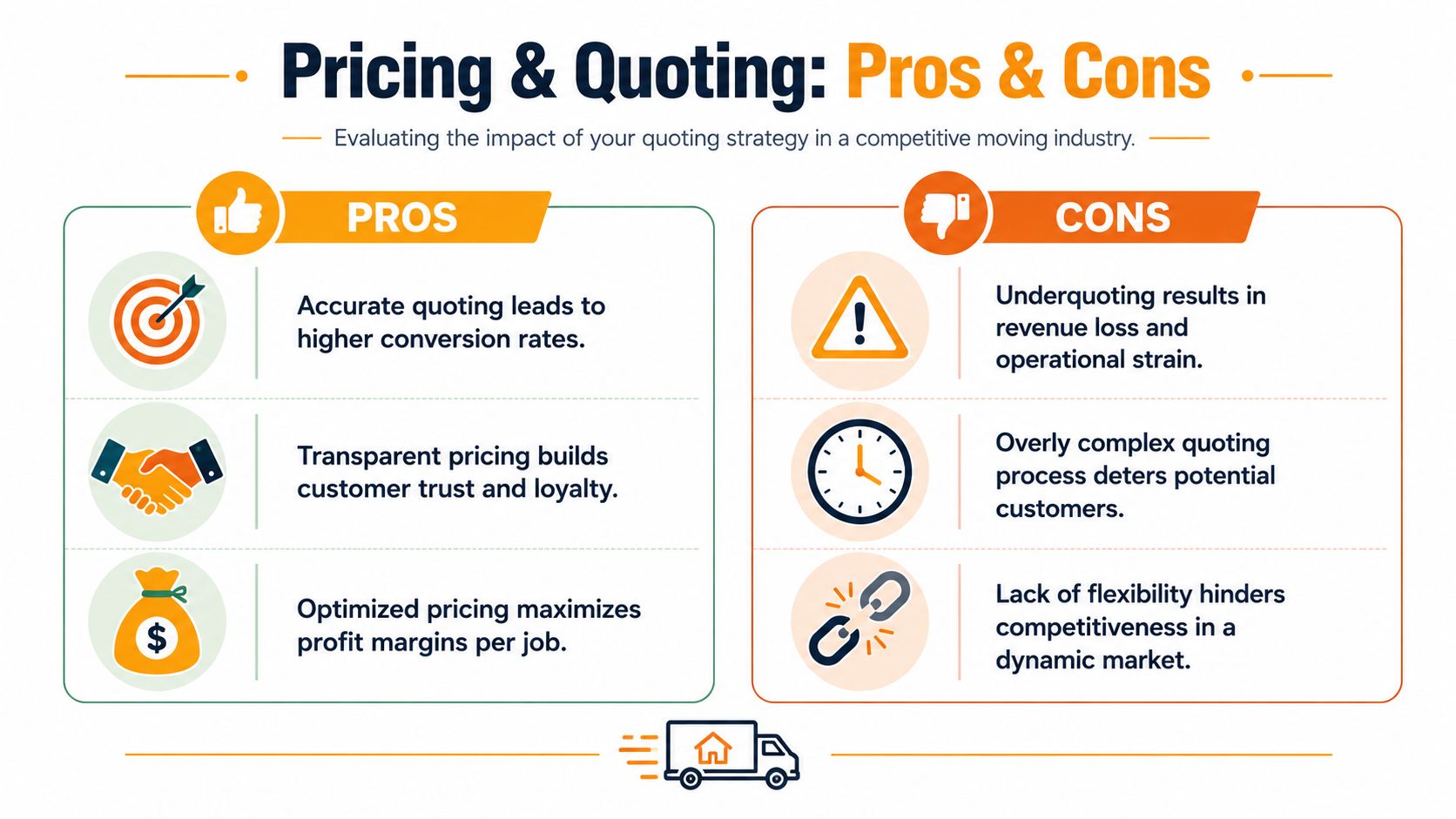
In a market where customers have more time to compare, pricing is no longer just a sales tool. It's a filtering tool, a margin tool, and an operations tool.
Phoenix operators feel this pressure from both sides. Customers are less rushed than they were during the most frantic phase of the housing cycle, but your own costs haven't relaxed in the same way. If your quoting process still depends on gut feel, a rushed phone note, or one estimator interpreting scope differently from another, you're leaving margin exposed on every busy week.
Why margin discipline matters more now
Facility economics are part of the story, even for residential movers who don't think of themselves as warehouse-heavy operators. Phoenix is a major logistics market, and that affects the cost base around yards, storage, dispatch space, and short-term staging. Lincoln Property Company reports that Phoenix is the sixth-largest industrial market in the U.S., with average direct asking rent reaching $12.89 per square foot per year NNN in Q1 2026. If your depot or storage costs rise while your quote process stays sloppy, profit leaks fast.
Underquoting doesn't just hurt the P&L. It creates downstream service problems. Crews get squeezed. Dispatch starts reshuffling. Customers feel the friction. A bad estimate often becomes a bad review before it becomes a bad month.
A mover doesn't protect margin by charging blindly. A mover protects margin by scoping correctly.
When hourly pricing works and when flat rate wins
There's no universal winner between hourly and flat-rate pricing. What matters is matching the model to the move type and to the quality of your intake.
Hourly pricing usually fits jobs where scope is uncertain, access is variable, or customers may change details as move day approaches. It can also work well when your office is disciplined about explaining what affects time on site.
Flat-rate pricing works better when your intake process is strong enough to capture inventory, distance, stairs, elevators, long carries, packing needs, and special handling before the quote goes out. In a comparison-heavy market, many customers prefer the certainty of a well-built flat rate.
Use a simple decision rule:
- Choose hourly when access variables are still unclear.
- Choose flat rate when your scope detail is strong and your production model is predictable.
- Avoid hybrid confusion unless your office can explain every charge clearly and consistently.
If you want a better framework for building those rules, this guide on how to price a moving job is worth reviewing with your estimator and sales manager together.
A practical quoting checklist for Phoenix operators
Many quoting errors come from missing one of a few recurring variables. Standardize those variables before you try to quote faster.
- Inventory depth: Don't settle for “2-bedroom move.” Ask what needs to be moved.
- Access reality: Stairs, elevators, gate codes, truck parking, and walking distance change labor time.
- Service mix: Packing, disassembly, protection, and storage need separate handling in the estimate.
- Scheduling certainty: Flexible-date customers may convert differently than fixed closing-date customers.
- Crew fit: Match quote assumptions to the crew model you'll really send, not the ideal one.
A professional quote should feel consistent no matter who answers the phone. That consistency becomes a competitive advantage when buyers are comparing three or four movers who all sound similar at first contact.
Identifying High-Value Customer Segments
Phoenix produces plenty of leads. That doesn't mean every lead deserves the same response sequence, the same callback priority, or the same sales effort.
Independent movers often waste prime office time on low-intent shoppers while high-intent callers slip to voicemail or wait too long for a real estimate. In a more balanced market, segmentation gets more valuable because customers are sorting providers more carefully.
Not all Phoenix leads are worth the same effort
Start with the simplest distinction. A direct inbound caller who asks informed questions and wants a real quote is usually more valuable than someone filling out multiple comparison forms and responding only with “What's your lowest price?” That doesn't mean price shoppers never book. It means your process should recognize intent early.
Common Phoenix segments include:
- Urban renters and apartment movers: Often schedule-sensitive, usually focused on speed, access logistics, and total out-the-door clarity.
- Family households: More likely to need detailed scoping, packing discussion, and reassurance about crew professionalism.
- Affluent household relocations: Less tolerant of sloppy intake, more likely to judge you on trust signals and process quality.
- Time-compressed local moves: Often triggered by closing shifts, lease deadlines, or internal household changes. These leads value responsiveness first.
A small but important operational truth follows from that. Missing a call from a high-intent family move can cost far more than losing a low-quality web lead. The revenue difference isn't just in ticket size. It's in conversion probability.
How higher-value segments usually behave
Higher-value segments usually leave clues during the first interaction. They ask about timing, protection, logistics, certificates, storage, and how your process works. Low-intent leads tend to anchor immediately on price and stay vague on scope.
Your team should triage based on behavior, not guesswork. A simple qualification approach works:
| Signal on first contact | Likely meaning | Best next step |
|---|---|---|
| Specific move details | Higher intent | Quote quickly and confirm next action |
| Vague scope, price-only questions | Comparison shopping | Give clear range and structured follow-up |
| Complex household questions | Higher margin potential | Route to strongest estimator |
| After-hours inbound call | Often urgent or high-convenience intent | Respond immediately or lose position |
Owner's lens: A missed call isn't an admin failure. It's often a lost shot at one of your best jobs.
That's why front-office discipline matters so much in the current Phoenix environment. You don't need every lead. You need to capture and convert the right ones with less delay and less inconsistency.
Actionable Tactics to Capture More Phoenix Bookings
Phoenix demand has not disappeared. The sales cycle has changed. In a market that has cooled from peak urgency, independent movers win more jobs by reducing response time, tightening quote accuracy, and following up with discipline over a longer decision window.
That shift matters operationally. In a hyper-growth phase, many consumers booked quickly because inventory was tight and timelines were compressed. In a more balanced market, prospects compare more providers, ask more detailed questions, and revisit quotes before they commit. For movers, that means lead volume and booked revenue are no longer tightly linked. Conversion process now carries more weight.
Build a follow-up system for a longer booking cycle
A single estimate sent once is rarely enough. Prospects who are not ready to book on the first call are not low quality by default. Many are still deciding between dates, comparing service levels, or waiting for a housing or lease trigger to clear.
Treat follow-up as revenue recovery, not admin work.
A practical sequence looks like this:
- Send the quote the same day. Speed matters because the first complete estimate often becomes the comparison baseline.
- State the next action clearly. Tell the customer how to approve, revise inventory, or confirm the move date.
- Schedule follow-up touches. Use a defined cadence instead of relying on memory or inbox flags.
- Reconfirm scope before assigning labor. Longer booking cycles increase the odds that dates, access conditions, or item counts change.
The operational benefit is straightforward. Faster quote delivery improves close rates. Better scope control reduces day-of-move surprises, underpriced jobs, and crew downtime caused by bad assumptions.
Reduce handoff failure between intake and dispatch
Many booking losses happen after a lead is captured but before a clear owner is assigned. That problem gets worse during busy weeks, when office staff are quoting, dispatching, answering inbound calls, and solving field issues at the same time.
Use a tighter intake process before peak strain hits:
- Separate sales and dispatch responsibilities where possible. Quoting quality drops when one coordinator is also managing crew changes and route problems.
- Use prebuilt estimate templates by move type. Apartment relocations, large suburban homes, storage transfers, and last-minute local moves need different assumptions.
- Set after-hours coverage rules. Evening and weekend inquiries often come from high-intent shoppers with active deadlines.
- Track ownership on every open estimate. Each lead should have a named owner, next action, and current status in SmartMoving, Supermove, MoveitPro, or a tightly managed calendar workflow.
The gap that hurts movers most isn't between marketing and operations. It's between capturing a lead and booking the job.
Match local visibility to how Phoenix customers choose movers
Search behavior is fragmented at the neighborhood and move-type level. A downtown condo move, a Scottsdale upsell move with packing, and a Gilbert family relocation do not start with the same query or the same buying criteria. Broad visibility helps generate inquiries. Specific visibility improves fit and conversion.
That is why local pages, service-specific landing pages, and accurate Google Business content matter more in a balanced market. They pre-qualify the customer before the phone rings. Owners investing in SEO or paid search should spend time understanding local search intent, because the highest-converting searches usually signal immediate logistical need, not general research.
A useful operating checklist:
- Answer fast. Response time affects whether you make the shortlist.
- Quote cleanly. Clear scope, pricing structure, and booking terms reduce hesitation.
- Follow up on schedule. Open estimates are pipeline, not clutter.
- Route the best leads to the best estimators. High-value jobs justify stronger sales coverage.
- Close every loop. Mark each inquiry as booked, lost, or deferred so your team can measure real conversion leaks.
None of these tactics are flashy. They improve the part of the funnel that Phoenix movers can still control, even after the market shifted from fast growth to a more measured pace.
Conclusion Your Competitive Edge in the Valley
The Phoenix moving market still offers real opportunity, but the easy-growth version of the story is outdated. Scale and population momentum still support demand. What changed is the customer decision process. People have more time, more options, and more reason to compare.
That shifts the competitive battle away from simple availability. The stronger advantage now sits in the front office. Can your team answer consistently? Can it quote accurately? Can it follow up without dropping leads? Can it turn a phone inquiry into a booked job before the customer moves on?
For operators with multiple crews, this matters even more. A weak intake process wastes marketing spend, creates schedule volatility, and puts unnecessary pressure on field teams. A strong intake process improves job mix, protects margin, and helps you fill the calendar with better work instead of just more work.
There's also a broader visibility lesson here. If you're investing in content, maps, and local rankings, it helps to study proven local organic growth strategies that connect neighborhood search demand with service pages and conversion paths. Visibility gets the call. Operations win the job.
Phoenix doesn't require a radically different moving company. It requires a more disciplined one. The operators who win this market won't necessarily be the cheapest, and they won't always be the biggest. They'll be the ones who respond faster, scope better, and let fewer opportunities leak out of the pipeline.
If you want a system that helps your company turn more inbound calls into booked jobs, not just answered calls, take a look at MoveJoy. It's built for moving companies that want accurate quoting, cleaner booking workflows, and less revenue lost between the first ring and the confirmed job.