Most moving companies don't have a pricing problem. They have a pricing process problem.
A lead calls after hours and asks for a quote on a three-bedroom move. One estimator says one number. The owner says another. The dispatcher forgets the stair charge. Nobody asks about the long carry. You either lose the job because your quote feels too high, or you win it and watch the margin disappear on move day.
That's why learning how to price a moving job isn't just about rates. It's about building a repeatable system that gives the same answer every time, protects profit, and helps your office close work faster. When I look at companies that stay stuck at a few trucks, inconsistent quoting is usually somewhere in the middle of the mess. When I look at companies that grow cleanly, they treat pricing like an operating system.
The Foundation of Every Profitable Moving Quote
A profitable quote starts when you stop treating a move like a generic service call.
There is no "standard" three-bedroom move. One house has wide drive access, no stairs, and clean packing. Another has a tight urban street, a basement full of heavy furniture, and a third-floor delivery with no elevator. If those jobs get the same quote logic, one of them is going to hurt you.
Every quote needs four building blocks
At the minimum, your pricing process should account for:
- Inventory: What is being moved. Furniture count matters more than vague room count.
- Distance: Local and long-distance jobs carry different labor and travel implications.
- Labor: Crew size and expected hours drive the core of the price.
- Access: Stairs, long carries, parking restrictions, elevators, and building rules decide whether a job stays profitable.
The key is to treat each one as a cost driver, not as a side note. That's how you get away from gut-feel pricing.
Revenue starts before the truck rolls
Owners often focus on truck utilization and payroll, but pricing also has to support sales efficiency. If your quote takes too long to build, leads keep shopping. If it's inconsistent, your team loses confidence. If it's too loose, you book work that looks busy on the calendar but doesn't create real profit.
That also ties into what you're spending to acquire the lead in the first place. If you want to tighten that side of the business, this guide on customer acquisition cost is worth reviewing alongside your quoting workflow. A bad estimate doesn't just reduce margin. It wastes the marketing dollars that brought the phone call in.
Practical rule: If your team can't explain exactly why a quote is priced the way it is, the process isn't ready to scale.
A strong quoting system also gives you a cleaner handoff from sales to operations. The office knows what was promised. The crew knows what they're walking into. The customer hears the same logic from first call to final invoice.
If you need a more detailed framework for turning job details into a consistent estimate, this breakdown of moving cost estimation methods is a useful companion to your internal pricing process.
Deconstructing the Core Variables of Any Moving Job
Good pricing gets easier when every inbound lead is broken into the same operational parts. That removes guesswork and makes your quotes easier to train, audit, and improve.

Inventory tells you what the job really is
Room count is a shortcut. Inventory is the truth.
A two-bedroom move can be light and clean, or packed with oversized sectionals, appliances, exercise equipment, and storage overflow. For fixed-price quoting especially, you need a room-by-room list or photos that let you identify bulky items and anything that slows production.
The point isn't paperwork. The point is labor accuracy. Specialty pieces change time, crew requirements, and truck space. If your estimator hears "just normal furniture," you're already exposed.
Labor is the engine of local pricing
For local jobs, labor usually does the heavy lifting in the estimate. Professional movers for local jobs typically charge $25 to $50 per hour per mover, with teams of 2 to 4 workers resulting in total hourly costs from $150 to $600 for a standard 3-hour move, excluding added expenses. That model is standard for local moves under 50 miles, and the same source notes that a studio apartment may take 3 to 5 hours with 2 movers, while a three-bedroom house often takes 7 to 10 hours with 4 movers (FreshBooks moving estimate guide).
That matters because many owners still quote off square footage or instinct. Time is what payroll follows. Time is what truck scheduling follows. If you understate labor, you don't just miss on price. You create downstream scheduling problems all week.
The most expensive estimate mistake isn't losing a job. It's booking a job at a price that blocks a truck and crew for less than they're worth.
Distance changes the structure of the quote
Distance isn't only mileage. It changes the pricing model.
For short local jobs, hourly pricing often makes sense because time is the biggest unknown. For moves with more travel, you need to decide whether travel time, mileage, fuel, and destination constraints should sit inside a flat quote or be separated as line items. The operational question is simple: what part of this move is predictable enough to price with confidence?
That same logic applies to overhead. If your rates feel competitive but your bank account says otherwise, your office is probably confusing direct job cost with total business cost. A practical place to tighten that is this guide on how to calculate overhead costs for profit, especially when you're building or revising your rate card.
Accessorials decide whether the quote survives move day
Small operators lose money without realizing it.
Accessorials include stairs, long carries, elevators, shuttle situations, tight parking, building reservation requirements, and restricted loading windows. These aren't edge cases. They're part of the work, and if you don't price them up front, crews absorb the pain while the office wonders why jobs run long.
Use a checklist on every call. Ask where the truck can park. Ask how many flights. Ask whether there's an elevator and whether it's reserved. Ask how far the front door is from legal parking. A quote that ignores access is incomplete.
Hourly and flat-rate serve different jobs
Here's the practical split:
| Pricing model | Best fit | Main strength | Main risk |
|---|---|---|---|
| Hourly | Smaller local jobs, uncertain scope, changing customer plans | Protects you from time overruns | Customer may worry about final cost |
| Flat-rate | Well-surveyed full-house moves, more predictable scope | Gives customer certainty | You carry the risk if the survey is weak |
Owners get into trouble when they choose the model based on what sounds better in sales, instead of what fits the job. The right system lets you do both, but only when the underlying quote details are solid.
Hourly Rates vs Flat-Rate Pricing Which to Use and When
Pricing model choice affects sales, operations, and dispute risk. It isn't a cosmetic decision.

When hourly pricing works best
Hourly pricing is usually the safer choice for local jobs where the scope can move around a bit. It protects you from the customer who says they're "mostly packed" and then shows you a garage full of last-minute boxes.
A common hourly local pricing method is based on crew size: $170 to $180 per hour for a 2-person crew, $230 per hour for a 3-person crew, and $280 per hour for a 4-person crew on moves under 100 miles. That same pricing guidance also notes overtime at 1.5x after 8 hours, and says this comes up in about 25% of jobs during the March to September peak season (Got2Move pricing methodology).
That structure works because it matches how local operations run. More crew means more payroll, faster production, and a different truck-day value.
Use hourly pricing when
- The inventory is incomplete: The customer is still packing, donating, or deciding what goes.
- Access is uncertain: You don't yet know how ugly the carry, stairs, or loading setup will be.
- The job is small to mid-sized: Customers often accept hourly more easily on local apartment and smaller home moves.
- You want scope creep protection: Added items and delays are less likely to turn the job into a loser.
When flat-rate pricing works best
Flat-rate works when your survey is strong and the job is stable. Customers like the certainty, and sales teams often close faster when they can explain a clear number with clear assumptions.
The mistake is giving flat-rate quotes off a quick phone call with no real inventory discipline. That turns your estimate into a bet. Sometimes you win. Over time, the house wins.
A better approach is to use flat-rate when you have enough detail to trust your production plan. That often means a detailed inventory, photos, or an in-person survey depending on the job.
A flat-rate quote is only as good as the survey behind it.
Use flat-rate pricing when
- The scope is stable. Full-house moves with well-documented contents fit this model.
- The customer needs budget certainty. Some prospects won't book without a firm cap.
- You have a disciplined estimator. Flat-rate exposes every weak assumption.
- The move includes multiple extras. A single bundled quote can be easier to sell than several moving parts.
Build your rate card before you choose the model
Too many movers decide hourly versus flat-rate before they know their own numbers. Do it the other way around.
Start with your actual labor cost by crew size. Add truck cost, fuel, materials, and overhead allocation. Then decide which jobs are predictable enough to cap and which should stay time-based. The quote format should reflect the job. It shouldn't hide uncertainty.
A practical internal rate card should include:
- Crew-based hourly rates: Separate rates for 2-man, 3-man, and 4-man crews
- Minimums: Your floor for short jobs
- Overtime rules: Clear language for work that runs long
- Travel rules: When travel time or mileage applies
- Add-ons: Packing, materials, stairs, long carry, and specialty items
- Change-order policy: What happens when scope changes after booking
What customers hear versus what owners need
Customers hear "hourly" and think risk. Owners hear "flat-rate" and think close rate. Both reactions are incomplete.
Hourly can be the more honest option when the move has too many unknowns. Flat-rate can be the better experience when the scope is documented and stable. The true skill is matching the model to the level of certainty you have.
If your team keeps forcing one model onto every lead, that's usually a sign the pricing process is underbuilt. Mature moving companies don't argue hourly versus flat-rate in the abstract. They choose based on survey quality, job type, and operational risk.
How to Build a Rate Card That Guarantees Profit
If your company has three different people quoting three different ways, you don't have a pricing strategy. You have improvisation.
The rate card fixes that. It gives the office one source of truth, makes training easier, and keeps your margins from changing based on who's answering the phone.
Don't copy competitors blindly
A lot of movers set prices by calling around, checking websites, and trying to land in the middle. That's dangerous. Competitive pricing matters, but copying market rates without knowing your own break-even point is how companies stay busy and broke.
A more reliable method starts with fixed and variable cost. One example formula for true break-even pricing is $18,000 in monthly fixed costs divided by 40 jobs = $450 per job, then $600 in variable costs, which creates a $1,050 break-even. With a 20% margin, the target price becomes $1,260. The same pricing guidance also warns that many movers fail to adjust this logic for seasonal surges, even when volume rises and costs rise with it (Elromco guide to profitable moving rates).
That is the part many owners skip. They know what they charge. They don't know what a booked day needs to produce.
Do this instead of pricing from memory
Build the card from the bottom up:
List fixed monthly costs
Truck payments, insurance, rent, software, admin payroll, phones, and other office expenses.Calculate variable job costs
Labor, fuel, materials, and other job-specific spending.Set your target margin
Decide what level of profit the job needs to contribute after direct and fixed cost are covered.Convert it into quoting rules
Turn your math into simple rates the office can apply consistently.Review it before and after peak season
Your spring and fall review matters because labor pressure, fuel, and scheduling strain don't stay flat all year.
Sample Moving Company Rate Card Structure
| Service / Charge | Unit | Rate | Notes |
|---|---|---|---|
| Local move 2-person crew | Per hour | Company rate | Use for smaller local jobs |
| Local move 3-person crew | Per hour | Company rate | Common for 2BR to 3BR jobs |
| Local move 4-person crew | Per hour | Company rate | Use when speed or size justifies extra labor |
| Minimum charge | Per job | Company minimum | Prevent short jobs from underperforming |
| Travel charge | Per job or per hour | Company rate | Define when it applies |
| Packing labor | Per hour or per job | Company rate | Separate from move labor if needed |
| Packing materials | Per job | Company rate | Standardize common supply packages |
| Stair charge | Per flight | Company rate | Apply consistently at origin and destination |
| Long carry | Per foot after threshold | Company rate | Define the distance threshold in writing |
| Specialty item handling | Per item | Company rate | Piano, safe, gym equipment, appliances |
| Overtime | Per hour | Company overtime rule | Match labor reality and crew policy |
That table doesn't need to be complicated. It needs to be usable.
Don't keep your rate card trapped in one person's head
Often, a lot of owner-led companies stall out. The owner knows the right price instinctively, but nobody else can replicate it. Then every quote needs approval, every busy afternoon creates delay, and every missed call becomes a missed chance to book.
Put the rate card where dispatch, sales, and management can all use it. If you're coordinating crews and quote flow across multiple trucks, it also helps to connect pricing discipline with scheduling discipline. Tools built for moving crew scheduling and dispatch visibility make that handoff cleaner because the office isn't quoting in one system and planning labor somewhere else.
Owner check: If a new office employee can't follow your rate card and produce a consistent estimate, the card is still too vague.
The rule most movers resist
Don't leave add-ons negotiable unless you intentionally want them negotiable.
When stair charges, long carries, packing labor, and specialty handling are applied inconsistently, customers notice and staff members create their own habits. That's where margin leaks start. A good rate card doesn't just price the move. It defines the conditions that trigger each charge, so the team applies the same logic every time.
Critical Pricing Mistakes That Cost Movers Thousands
Most pricing losses don't come from one disaster. They come from repeated small misses.
A missed stair charge here. An underestimated long carry there. A vague phone estimate that turns into an argument on move day. Over a season, those mistakes chew through profit faster than most owners realize.

Mistake one: treating access like a minor detail
Access problems are pricing problems.
Industry pricing guidance says movers should add 20% to 50% surcharges for obstacles like stairs, with stair fees around $50 to $100 per flight, or long carries over 75 feet at $1.50 per foot. The same analysis warns that underquoting these accessorials can erode 30% to 40% of a job's potential profit margin (Move and Store pricing guidance).
If your office asks only for origin and destination addresses, you're missing the part that determines production time.
Don't do this:
Give a quick quote before confirming stairs, carry distance, parking, and elevator constraints.
Do this instead:
Use a mandatory access checklist on every estimate, even for repeat referral jobs.
Mistake two: giving soft ballparks that nobody can enforce
"Probably around X" sounds harmless. It creates trouble.
Customers hear the low end. Your crew walks into the actual job. Then the office has to explain why the final number moved. Even when you're right operationally, you still lose trust because the original quote felt casual.
Use ranges only when the assumptions are explicit. Better yet, document what would change the price.
Mistake three: relying on memory instead of process
Small operators often quote from experience alone. That works until the phone starts ringing harder, the owner isn't available, or a new office staffer steps in.
The business problem isn't lack of knowledge. It's inconsistency. Every manual shortcut makes your pricing harder to train, harder to audit, and harder to improve.
Why automation matters here
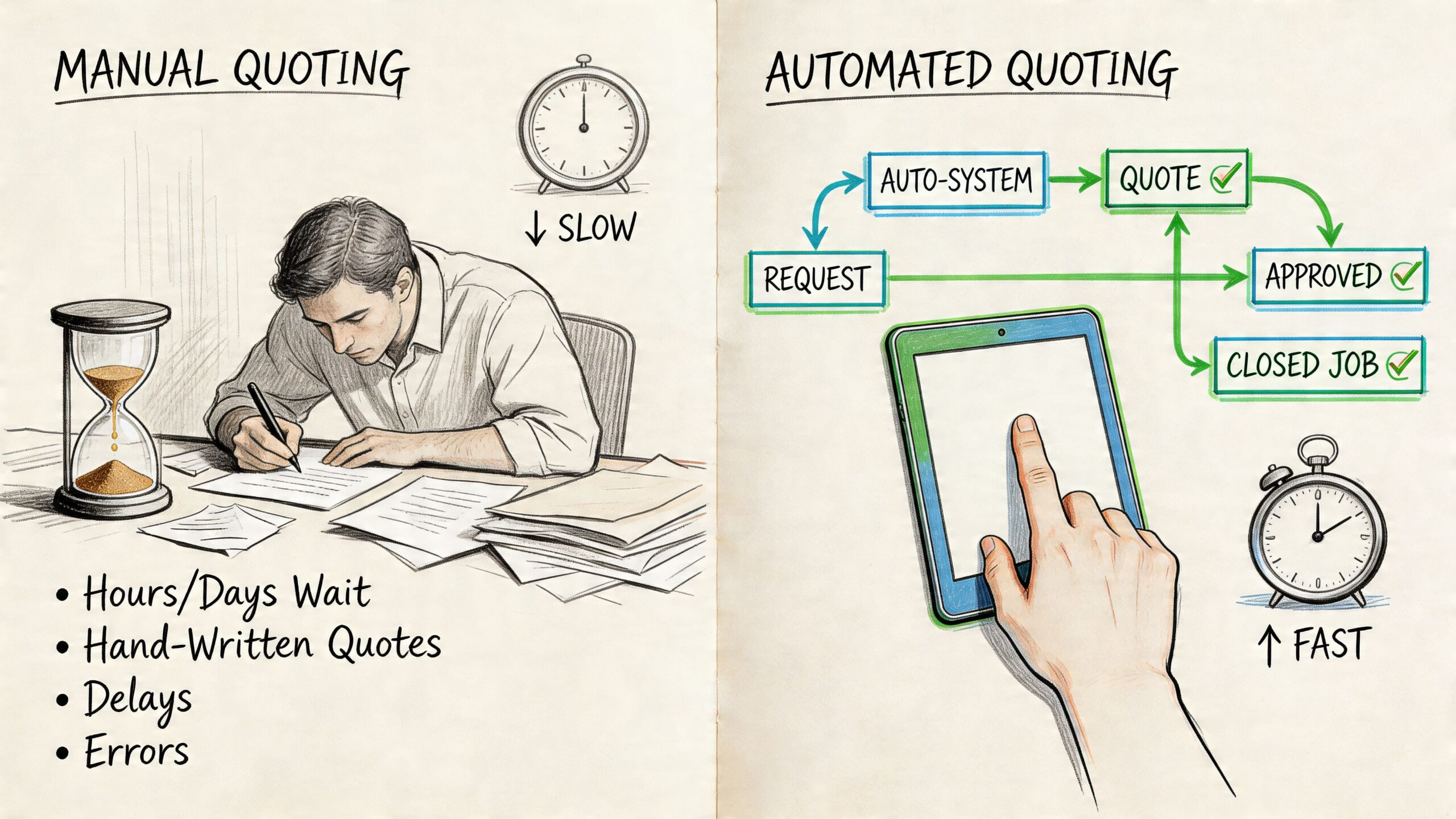
Manual quoting creates a bottleneck at the exact moment speed matters most. Customers shopping local movers don't wait around while your team checks a notebook, calls the owner, or promises to call back later. They move on.
Automation helps because it forces consistency. The same inventory questions get asked. The same access rules get applied. The same rate card logic gets used whether the call comes in at noon or late evening.
Fast quotes aren't enough. Accurate fast quotes are what protect margin and win bookings.
That matters even more when the office is stretched. Crews are out. Dispatch is handling changes. Somebody misses a call or sends a delayed follow-up. That's where revenue slips out of the business. The true cost isn't only the missed lead. It's the lack of a system that could have priced and closed it cleanly without depending on one person being available.
Automating Your Quoting to Close More Jobs
A strong rate card solves the math. It doesn't solve the workflow.
The main operational problem shows up when leads come in outside office hours, while dispatch is buried, or when the person who usually quotes is unavailable. That's when even a solid pricing strategy breaks down. The issue isn't whether you know how to price a moving job. It's whether your business can apply that logic every single time.
Where manual quoting breaks
Most owners can quote well. Most offices can quote reasonably well. But manual quoting fails under volume, interruptions, and after-hours demand.
That gap matters because pricing guides still leave phone-based quoting underdeveloped for small movers. Research focused on this problem notes that small movers are losing $50K to $150K annually from missed or poorly quoted calls, and that newer voice systems trained on moving terms like "2-bedroom walkup" and "stair charges" can recover 20% to 40% of these missed bookings by giving instant, accurate quotes (GoLoadUp analysis of phone-based quoting gaps).
Those numbers line up with what operators already feel in the field. The phone rings when nobody can answer properly. A message gets taken, but no quote gets delivered. Or worse, someone gives a rushed estimate that ignores the actual rate card.
What useful automation should actually do
A lot of tools capture leads. That's not the same as closing jobs.
If you're evaluating quoting automation for a moving business, the bar should be practical:
- It should use your exact rate card
- It should ask the right moving-specific questions
- It should understand terms your customers use
- It should hand the job into your workflow without rekeying
- It should work when the office is closed
That's the distinction many movers miss. A generic call tool may collect name, phone, and move date. A human answering service may take a message. Your CRM may store the estimate after someone creates it. None of those steps, by themselves, produce a priced job.
The operational gain is consistency
When quoting gets automated correctly, your business gets more than speed.
You get cleaner estimates because the same intake logic runs every time. You get fewer hand-typed errors because the rules sit inside the system. You get tighter scheduling because the quote can move directly into the tools your office already uses. And you give customers an answer while they're still in buying mode.
That matters for growing companies in the 1 to 20 truck range because scale creates decision fatigue. The more calls you take, the more dangerous inconsistency becomes.
The office doesn't need another place to store leads. It needs a way to turn inbound demand into booked work without adding more manual steps.
One practical option for applying your rate card automatically
A purpose-built quoting system provides a better solution than a generic call tool. MoveJoy's Quote Engine applies the company's exact rate card during the call, handles moving-specific inputs like walkups and access charges, and can book directly into systems such as SmartMoving, Supermove, MoveitPro, or Google Calendar. If you're comparing workflows, that's closer to a front-end revenue system than a message-taking tool. The same idea also shows up in software built around moving company estimate workflows, where the goal is to reduce human quoting error instead of just logging inquiries.
That doesn't replace judgment. It standardizes it.
What to automate first
If you're not ready to overhaul your whole quoting process, start with the parts that leak the most revenue:
After-hours inbound calls
These are the easiest to lose and the hardest to recover manually.Initial inventory intake
Standardized questions immediately improve quote quality.Accessorial capture
Stairs, carries, elevators, and specialty items should never rely on memory.Rate card application
If your team still calculates quotes manually, consistency breaks down.Booking handoff
The estimate should move into dispatch or CRM workflows without duplicate data entry.
The companies that get this right don't just answer more calls. They close more of the calls they're already paying to generate.
Stop Guessing and Start Growing Your Moving Business
Profitable pricing comes from discipline, not instinct.
When you break every move into inventory, labor, distance, and access, your estimates get tighter. When you choose the right pricing model for the job, your close rate and margins stop fighting each other. When you build a real rate card, your whole team starts quoting with the same logic instead of relying on memory.
That is how small moving companies grow without chaos. The office gets faster. Crews get better information. Customers get clearer expectations. The calendar fills with work that makes money.
The final step is making sure your system works even when your people are busy. Manual quoting always hits a ceiling. Calls come in at the wrong time, details get missed, and profitable jobs slip away because nobody applied the rate card quickly enough.
If you want a moving company that scales cleanly, pricing has to become a process your business can repeat all day, every day.
If you want to stop losing jobs to inconsistent quotes and missed calls, take a look at MoveJoy. It's built for moving companies that want to apply their own rate card automatically, quote accurately on the call, and turn more inbound leads into booked jobs.