Moving Company Peak Season Preparation: 2026 Playbook

If you run a moving company with 5 to 20 trucks, you already know the feeling. The calendar still says spring, but the phones are starting to stack up, dispatch is getting tighter, and last year’s weak spots are showing up in your head before they hit the schedule. One crew lead is solid, another is shaky. One truck is fine, another has “we’ll deal with it later” written all over it. The problem isn’t demand. The problem is whether your operation can absorb demand without turning your best revenue window into a daily scramble.
That’s where most moving company peak season preparation breaks down. Owners think in checklists, but peak season punishes companies that don’t turn those checklists into timing, systems, and capacity decisions. The busiest months reward operators who prepare early, quote fast, staff with a buffer, and protect the schedule from bad-fit jobs and soft bookings.
The revenue stakes are real. Independent moving companies with 5–20 trucks lose between $50,000 and $150,000 annually from missed calls during peak season (March–September), which is the primary revenue pain point for 70% of small moving operators, according to Network Leads on seasonal moving company operations. If you want a broader look at the pressure window itself, this breakdown of the busiest time of the year for movers is worth a read.
Table of Contents
- The Inevitable Storm Is Coming Are You Ready
- Your 90-Day Pre-Season Preparation Timeline
- Build Your Peak Season Crew and Fleet
- Optimize Your Pricing and Quoting for Profit
- Stop Leaking Revenue from Missed Calls and Slow Quotes
- Contingency Planning and Your Post-Season Review
The Inevitable Storm Is Coming Are You Ready
Peak season’s arrival is rarely subtle. It starts with a few more quote requests than normal, then a packed Friday, then a Saturday where dispatch is juggling reschedules, late arrivals, and a customer who wants a revised estimate while your office is already underwater. By the time most owners admit the rush is here, they’re reacting instead of managing.
What separates a strong operator from a stressed one isn’t toughness. It’s preparation that shows up in daily decisions. Strong companies know which jobs fit their lanes, which crews can carry premium bookings, how much capacity they have, and where the front office starts to choke.
Practical rule: Peak season doesn’t expose new problems. It magnifies the ones you ignored in winter.
A lot of owners focus on trucks and labor first, and that’s fair. But the pressure usually shows up sooner in intake and scheduling. Calls come in while you’re walking a job, while dispatch is handling a late truck, or after hours when nobody’s at the desk. A lead that should’ve become a booked move turns into voicemail, a sticky note, or a callback that happens too late.
That’s why moving company peak season preparation has to start before the first heavy week. If your systems only work when the office is calm, they won’t hold when crews are maxed out and customers are shopping fast. The operators who stay sane aren’t always the biggest. They’re the ones who tighten the machine before demand forces their hand.
Your 90-Day Pre-Season Preparation Timeline
Peak season is won long before your first fully booked week. If you wait until the phones are hot to hire, repair, train, and tighten quoting, you’re already behind. The companies that handle spring and summer well start early and build in phases.

Successful moving companies proactively hire seasonal staff 3–4 months before peak season begins, starting in December or January for the March–September peak, and analyze prior year data to forecast demand, reducing operational bottlenecks in dispatch and quoting, as noted by Rack USA on peak season logistics preparation.
January and February lock the plan
January and February are for decision-making, not optimism. Pull last year’s calendar, booked jobs, lost jobs, cancellations, callback gaps, and overtime pain points. Look at where your office slowed down, which move sizes were most profitable, and which dates created stress without margin.
Use those months to make a written operating plan with three pieces:
- Capacity assumptions: Decide how many crews you can run reliably, not ideally.
- Hiring targets: Set recruiting goals for movers, drivers, dispatch support, and sales coverage.
- Rate card cleanup: Tighten rules for travel time, stairs, long carries, shuttles, minimums, and deposit collection.
This is also the right window to review anything that could create compliance headaches once trucks are moving hard. If you want a timely checkpoint on inspection pressure and roadside enforcement timing, the DOT compliance event information from My Safety Manager is useful context when you’re planning spring fleet readiness.
March and April build operating capacity
March and April are about turning the plan into muscle. Recruiting needs to be active, not passive. Orientation needs a calendar. Training needs an owner, not vague accountability. Fleet maintenance should already be booked with clear deadlines.
A lot of operators make the mistake of mixing planning with execution here. Don’t. By March, you should be scheduling interviews, confirming uniforms and equipment, updating estimate templates, and pressure-testing your dispatch process against real volume.
A simple March-April priority stack looks like this:
- Fill the bench first: Get commitments from returning seasonal workers before you gamble on strangers.
- Train on customer-facing basics: Movers need to understand arrival windows, walkthrough etiquette, and how to surface scope changes cleanly.
- Clean up office handoffs: Sales, dispatch, and crew leads should all work from the same job notes.
- Tighten vehicle availability: Every truck should have a clear maintenance status and backup plan.
If you need a rule for timing, use this one. If a task affects labor, trucks, or quote accuracy, it shouldn’t still be unsettled by late spring.
May and June pressure-test execution
By May and June, demand starts exposing weak links. This is the moment to test your system, not admire the plan. Run through what happens when a caller wants a same-week quote, a Saturday move needs confirmation, or a truck is pulled out for repair.
Use these weeks to audit the basics:
| Area | What to verify |
|---|---|
| Phone coverage | Every inbound lead gets handled quickly during business hours, after hours, and on weekends |
| Quote consistency | Your team applies the same logic for stairs, carries, access, and minimums |
| Calendar discipline | Premium slots are protected and lower-quality jobs don't crowd them out |
| Crew communication | Job notes are complete before wheels roll |
Owners who treat May like “business as usual” usually spend June putting out fires. Owners who stress-test in May usually spend June closing better jobs.
Build Your Peak Season Crew and Fleet
Friday at 4:30 p.m., two Saturday crews are full, a driver calls out, and the spare truck has a brake issue you already knew about but never took off the board. Peak season breakdowns usually start days earlier. They show up in recruiting gaps, weak crew pairings, sloppy equipment checks, and no real backup capacity.
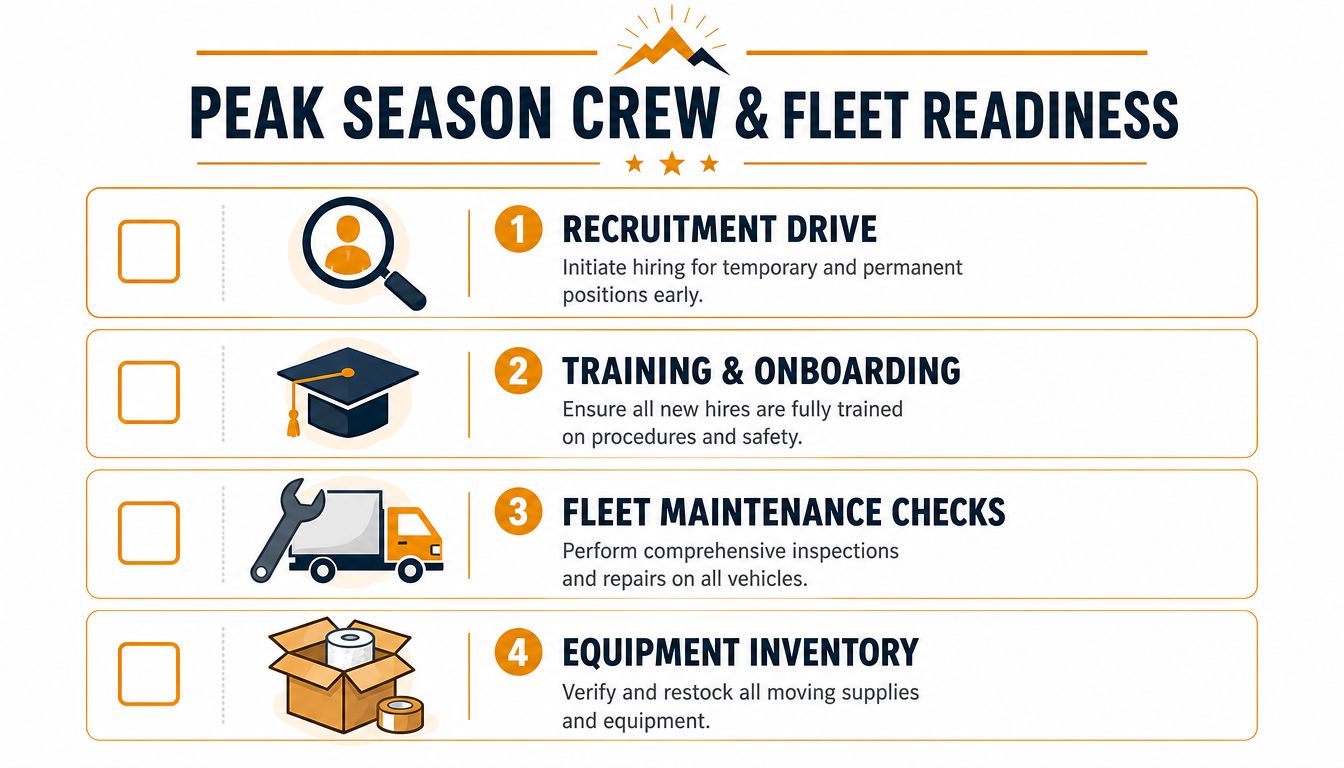
Build labor capacity by tier, not by headcount
A lot of owners count bodies. That approach fails in June.
Count usable crews instead. A roster of 24 names means very little if only 14 can pack well, 10 can drive, 6 can lead, and 3 can handle a high-stress long carry without slowing the whole day down. Peak season staffing works better when you sort labor into tiers before the calendar fills: crew leads, dependable movers, trainees, and emergency bench.
Rehires sit at the top of that list for a reason. They know your paperwork, your service standards, and how your foremen run jobs. They also hit productivity faster. New hires still matter, but they need structure or they will cost you margin through callbacks, claims, and blown arrival windows.
Use a staffing plan like this:
- Lock in rehires first: Call proven seasonal workers before you post open roles.
- Hire against crew templates: Build crews on purpose, such as one lead, one steady second, one newer helper, instead of filling shifts randomly.
- Assign a real bench: Keep extra labor available for weekends, month-end dates, and same-week reschedules.
- Cross-train for dispatch flexibility: At minimum, know who can drive, who can pack, and who can lead without supervision.
The timing matters. By the time peak demand is obvious, the best seasonal workers are already committed somewhere else.
Train for the job you sell, not the job you hope shows up
Training should protect production and customer experience at the same time. If a mover can carry furniture but cannot handle a change-order conversation, your office still ends up eating the problem.
I trained crews on four things before giving them busy-season volume: home protection, inventory discipline, communication with the customer, and when to call the office before making a promise on site. That cut down on underbilled labor, claim exposure, and those ugly afternoon calls where the customer says, “Your guys told me it was included.”
Pairing matters too. Two inexperienced movers on the same truck create delays that never show on the schedule until the second job starts late. Put new people with stable leads. Keep your fastest crews on the jobs with the tightest margins or the highest review risk.
Treat fleet readiness like capacity planning
A truck that is technically operable is not the same as a truck you should book six days a week.
Before peak season, every unit needs a status that dispatch can trust: ready, limited use, backup only, or out of service. That sounds basic, but it changes how you sell the calendar. If dispatch thinks you have 12 trucks and maintenance knows only 10 are dependable, sales will overbook capacity and operations will spend the next month digging out.
The pre-season inspection list should cover more than fluids and tires. Check lift gates, ramps, door seals, backup cameras, interior lighting, cargo floors, tie-down points, and every piece of equipment that rides with the truck. Missing dollies and bad straps create just as much schedule damage as mechanical issues.
For a stronger system around utilization, maintenance intervals, and truck assignment rules, review these fleet management best practices for moving companies.
Protect the business when you add capacity
Peak season often pushes owners to add rentals, subcontract work, or owner-operator support. That can help, but only if the paperwork and coverage match the way the truck is being used. A quick review of trucking insurance for owner-operators is smart if any part of your summer plan depends on outside equipment or contractor relationships.
Do that review before the first claim, not after it.
Run a readiness board the whole team can see
The easiest way to lose control is to keep all of this in separate notebooks, text threads, and one manager’s memory. Put crew and fleet readiness on one visible board, whether that lives in software or on a wall in the office.
Track these items by owner and deadline:
- Crew roles assigned: Lead, driver, helper, packer, and backup coverage are all confirmed.
- Training status complete: Every seasonal hire has finished orientation and ride-alongs.
- Truck status updated: Each vehicle is marked ready, limited, backup only, or out of service.
- Equipment loaded and counted: Blankets, straps, dollies, tools, floor protection, and consumables are in the right trucks.
- Failure plans documented: You know who gets called if a lead quits, a truck goes down, or a job runs long into the next dispatch window.
That is the difference between having more resources and having more usable capacity. During peak season, usable capacity is what protects revenue and your sanity.
Optimize Your Pricing and Quoting for Profit
Peak season doesn’t just increase volume. It changes the value of your calendar. A Tuesday opening in the middle of the month isn’t worth the same thing as a Saturday at month-end. If you price them like they’re equal, you’ll stay busy and still leave margin on the table.

Peak season pricing has to reflect actual demand
Moving services cost 20–35% more on weekends and national holidays compared to mid-week moves, according to Maxwell Relocations on peak season moving costs. That should shape how you build your pricing logic, minimums, and slot protection.
Most operators already know weekends are hotter. The mistake is acting like the sales team should “feel it out” on each call. That creates inconsistency, weak margins, and a lot of avoidable negotiation. Put the rules in writing.
Use a pricing model that matches demand:
| Booking type | Better pricing approach |
|---|---|
| Mid-week, mid-month | Standard minimums and cleaner schedule-fill strategy |
| Weekend and holiday slots | Premium rates that reflect harder-to-replace capacity |
| End-of-month dates | Tighter minimums and stricter screening for job fit |
| Complex access jobs | Clear quote logic for stairs, carries, shuttles, and access constraints |
If your estimators need a framework for structuring those decisions, this guide on how to price a moving job is a useful reference point.
Deposits separate serious customers from fragile bookings
Peak season punishes weak commitment. The same Maxwell Relocations guidance notes that requiring 20–30% deposits on all bookings can increase booking conversion by 28% and significantly reduce last-minute cancellations. That’s not just a finance policy. It’s a schedule protection policy.
A deposit does three things at once. It filters out shoppers who aren’t ready. It gives your office a cleaner signal about who’s serious. It protects high-demand dates from getting blocked by customers who vanish when it’s time to confirm.
The best peak season schedule isn’t the fullest one. It’s the one with the fewest low-commitment jobs sitting in premium slots.
You don’t need complicated pricing science here. You need consistency, written rules, and estimators who know when to hold the line.
Stop Leaking Revenue from Missed Calls and Slow Quotes
Most moving companies don’t lose peak season revenue because they can’t do the work. They lose it at the front door. The lead comes in while the owner is on a truck, while the coordinator is buried, or after hours when nobody’s free to quote. By the time someone calls back, the customer has already moved on.

The old intake model breaks first
This is the least discussed part of moving company peak season preparation, and it should be one of the first things you audit. Consumer-facing content usually focuses on how customers should prepare for a move. It rarely looks at how movers lose jobs operationally when phones spike.
That blind spot matters. Independent studies cited by Get Moving Muscle on common questions customers ask movers note that 1–20-truck moving companies lose $50K–$150K annually from missed calls during peak hours, nights, and weekends. If your company serves residential leads, those are often the exact moments when customers are researching, calling around, and ready to book.
Slow quotes create a second leak. Customers don’t just want a callback. They want clarity on scope, timing, and price. If your process takes a message but can’t move the lead toward a real estimate, you’re still behind.
A side-by-side look at intake options
A lot of operators treat every phone solution like it does the same job. It doesn’t.
| Intake approach | What it handles well | Where it fails during peak season |
|---|---|---|
| Voicemail and callbacks | Cheap and familiar | Leads cool off, callbacks lag, quote momentum disappears |
| Traditional live answering | Basic coverage when staff is busy | Message taking isn't the same as quoting or booking |
| Purpose-built automation | Handles volume consistently and keeps intake moving | Only works if it understands moving logic and your rate rules |
Many teams confuse lead capture with conversion. Capturing the name and number is better than missing the call. But it still leaves the hardest part untouched. Can the system identify job details, apply your rate card, handle common move variables, and move the customer toward a booking?
If you're working on call handling and front-end sales process at the same time, this article on strategies for sales growth from One Call is a useful outside perspective on tightening response flow and reducing lost opportunities.
What a better front end actually does
For movers, the win isn't just “answer every call.” The win is getting the lead through the messy middle. That means collecting move details, applying quoting logic, handling common accessorial issues, and placing the job into the workflow your team already uses.
The strongest setups do a few things well:
- Quote with your rules: They use your own rate card and service logic, not generic scripts.
- Book into real systems: They can place jobs into SmartMoving, Supermove, MoveitPro, or Google Calendar without creating a second admin task.
- Follow up automatically: Unbooked estimates don't vanish because someone forgot to call back.
- Scale when volume jumps: The process holds up on nights, weekends, and heavy call days.
Fast response matters. Accurate quoting matters more. A quick but sloppy estimate creates just as many problems as a missed call.
That's the front-office shift more moving companies need to make. Don't build for message taking. Build for booked jobs.
Contingency Planning and Your Post-Season Review
Saturday in June, 8:10 a.m. One truck won't start, a lead calls in sick, and the second job on the board has a fourth-floor walk-up your estimator did not catch. Peak season does not test whether your plan exists. It tests whether your dispatcher can use it in under five minutes.
Contingency planning works best when it is built into daily operations, not kept in a binder nobody opens. The goal is simple: protect the day's best revenue, keep crews productive, and get in front of customer communication before the office starts taking angry calls.
Your in-season fire drill playbook
Keep the response rules short enough that ops, dispatch, and crew leads can follow them under pressure.
- Truck issue: Decide within minutes whether the job gets a backup truck, a truck swap, or a revised arrival window. Call the customer before they call you.
- Crew shortage: Move your strongest lead onto the hardest or highest-value job first. Then spread your remaining labor across lower-risk work.
- Scope surprise: Give crews a clear escalation path for long carries, stairs, shuttle needs, elevators, and packing overflow. If field conditions break the quoted plan, the office needs that update fast.
- Schedule overload: Protect the jobs that fit your margin, route, and crew strength. Push out weak-fit work before one bad decision wrecks the full board.
The hard part is not writing these rules. The hard part is using them early enough.
Owners get in trouble when they run the schedule too hot for too long. Once you are stacked wall to wall, one breakdown turns into three late arrivals, two reschedules, and a refund conversation you did not need. Weekly capacity reviews prevent that. As noted earlier from Elromco's peak-season guidance, the operators who stay in control track capacity before the week breaks, not after.
I learned this the expensive way. At 5 trucks, you can save a bad day with hustle. At 20 trucks, hustle is not a system. You need preset thresholds for overtime, backup equipment, overflow labor, and the point where sales stops forcing extra work onto the board.
What to review when the season ends
Do the review while the pain is still fresh. Waiting until winter turns clean observations into vague opinions.
The post-season review should produce decisions, not a slide deck. Start with the places where margin got thinner or the office got louder.
| Review area | Questions worth answering |
|---|---|
| Lead handling | Where did calls get missed, delayed, or mishandled? Which hours exposed coverage gaps? |
| Quote quality | Which jobs were underquoted, overcomplicated, or poorly screened at intake? |
| Schedule health | Which dates, crews, or truck assignments caused the most reschedules, callbacks, and write-offs? |
| Hiring outcomes | Which hires stayed, which washed out, and which crew leads are ready for more responsibility next season? |
| Profit mix | Which job types, dates, and service areas produced the cleanest margin with the least operational drag? |
One more rule. Review the exceptions, not just the averages.
Averages hide the damage. The month may look fine while Saturdays were chaos, one estimator underpriced every long-carry apartment move, or one service area kept producing late jobs and weak margins. Break the season down by day of week, lead source, estimator, crew lead, truck, and job type. That is where next year's improvements come from.
Then make the changes while your team still remembers why they matter. Update the rate card. Tighten intake questions. Save your best seasonal workers first. Mark the dates that broke dispatch. Rewrite the overflow rules. Good operators turn one season's mistakes into next season's capacity plan.
If your team is tired of losing jobs between the first ring and the final quote, take a look at MoveJoy. It helps moving companies recover revenue by generating accurate quotes from your own rate card, booking jobs into the tools you already use, and keeping leads from slipping through the cracks when volume spikes.