Moving Company Expenses a Guide to Profitability

The month looked good on paper. Trucks stayed busy, crews kept moving, estimates were flowing out, and revenue should’ve felt healthy. Then the owner opened the accounts, saw the margin, and realized the business had been working hard without keeping much of what it earned.
That gap is where moving company expenses do their real damage. A job can look profitable at the quote stage and still bleed once labor runs long, fuel climbs, packing materials get overused, or a missed call turns into an unbooked estimate. According to a 2025 survey of 1,000 moving customers, the average full-service move costs $3,020, with local moves averaging $1,489 and long-distance moves averaging $3,129 in the same dataset, which shows how much revenue sits inside every booking, and how easily unmanaged expenses can erode it (This Old House moving survey).
For operators running 5 to 20 trucks, that’s not just an accounting issue. It’s a control issue. The owners who stay profitable know exactly which costs belong to each job, which ones are fixed, and which hidden leaks are stealing booked revenue from the front office.
If you’re operating in a state like New Jersey, insurance deserves special attention because one weak policy decision can wipe out months of work. A practical starting point is a resource like comprehensive New Jersey business insurance from Liberty Insurance Associates, especially if you’re comparing liability, cargo, and vehicle coverage against the actual risks your crews face every day.
Table of Contents
- Introduction Where Is All the Profit Going
- Core Operating Expenses The Cost of Every Job
- Essential Overhead and Compliance Costs
- Growth Expenses Fueling Your Sales Engine
- The Hidden Expenses Actively Leaking Your Profits
- Smart Budgeting and Cost-Saving Strategies
- Conclusion From Managing Costs to Driving Profit
Introduction Where Is All the Profit Going
A mover can have a full calendar and still feel cash-poor. The trucks are rolling, the phones are busy, and the schedule looks healthy, but the margin shrinks when no one separates the expenses that create revenue from the expenses that only keep the operation alive.
The job looks profitable until the invoice clears
The first trap is putting every cost in the same bucket. Crew labor, truck fuel, packing supplies, insurance, ads, software, and missed calls affect the business in different ways, and they behave differently when volume changes. A job that was quoted tightly can still underperform if the move needed extra stairs, a longer carry, or more labor than forecasted.
That is why owners should think in terms of job-level profitability, not just monthly sales. The key question is not, “Did we book work?” It is, “Did we keep enough of what we booked?”
Practical rule: if a cost changes when the job changes, track it at the job level instead of burying it in a general expense line.
The revenue opportunity is real. A customer survey from This Old House moving survey puts the average full-service move at $3,020, with local moves averaging $1,489. Every booking carries meaningful revenue, but only if the operation protects it from labor creep, rework, and preventable leakage.
A shortfall often starts before the truck leaves the yard. Missed calls, slow quote follow-up, and weak dispatch coordination all create hidden costs because the job never gets a clean start. Tools that tighten scheduling, crew communication, and call handling can protect margin before the first box gets loaded. A practical starting point is comprehensive New Jersey business insurance, because one claim, one delay, or one uncovered incident can erase the profit from several good jobs.
Why a busy month can still feel tight
Growing moving companies rarely struggle because demand disappears. They struggle because no one sees where demand turns into profit. A missed follow-up, an underquoted stair carry, or a truck idle window can each cut into the same job in different ways, and each one leaves less cash at the end of the month.
The better model is to treat the expense sheet like a control panel. Each line should answer a direct question. Is this cost needed to complete the move, needed to stay in business, or tied to growth? Once that split is clear, pricing, hiring, and automation decisions get easier because you can see which leaks are operational and which ones are strategic.
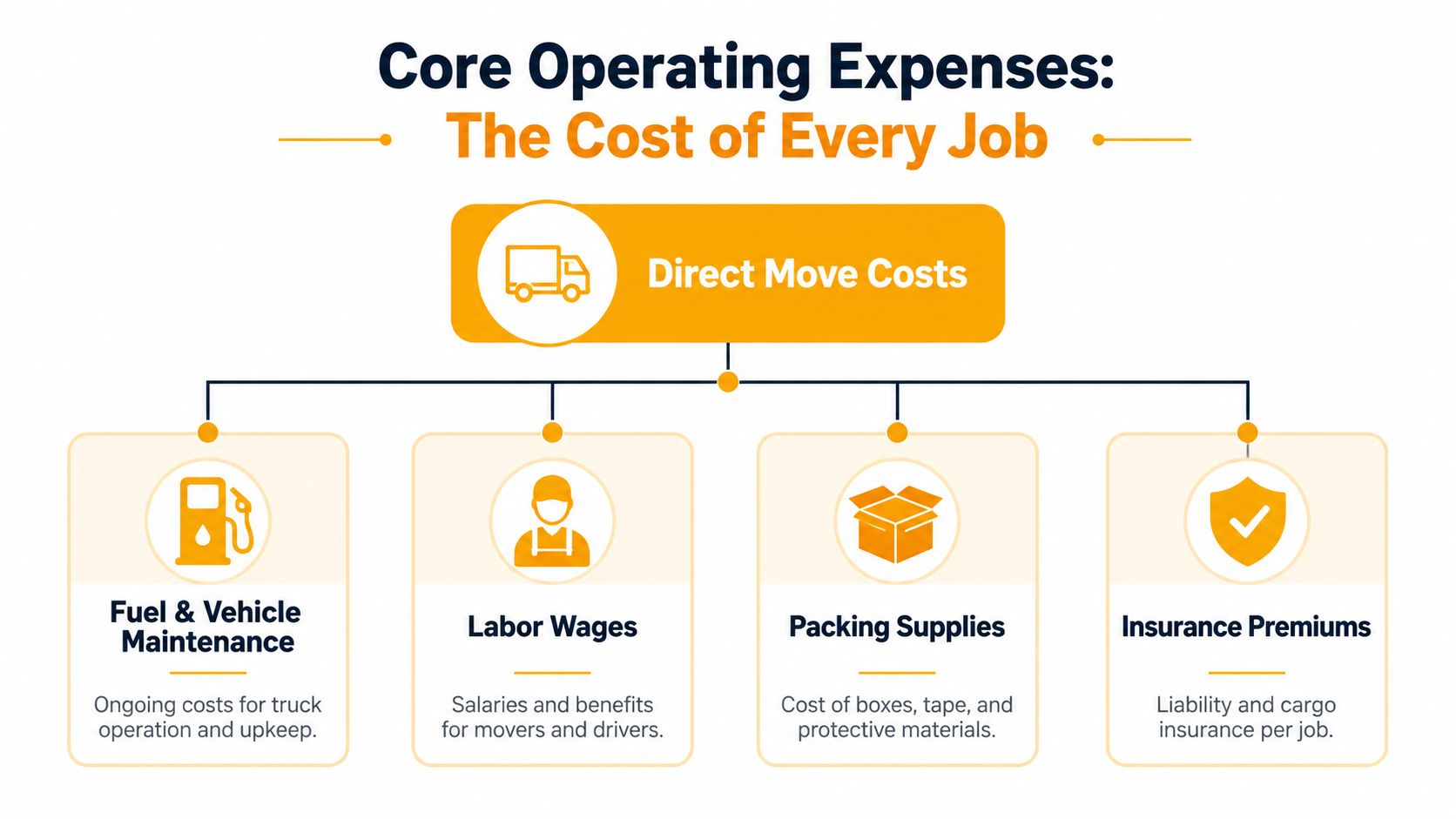
Core Operating Expenses The Cost of Every Job
A move can look profitable on paper and still bleed cash on the floor. The crew is on time, the truck is loaded, the customer is happy, then fuel, labor, supplies, and route mistakes eat into the margin before the day is done. These moving company expenses need to be tracked by job, because the cost profile changes with every service type, every driveway, and every extra stop.
Labor, fuel, and the parts of a move you can’t wish away
Local residential work usually starts with labor. Professional movers often charge by the hour, and many companies set a minimum so the crew, truck, and office time are covered even on short jobs (NerdWallet). That structure makes every delay expensive. A late customer, a tight stairwell, or poor parking can turn an otherwise clean estimate into a job that barely clears margin.
Long-distance jobs follow a different pricing model, and that changes how owners should think about cost control. Weight, mileage, dispatch timing, and crew coordination all affect the final number, so inaccurate inventories and sloppy scheduling can distort the quote before the truck leaves the lot. The moving company that gets this right protects revenue by matching the estimate to the actual work, not the hoped-for version of the job.
How to keep direct costs from drifting
Direct costs stay under control when the office builds the job correctly before dispatch. That means matching the crew to the work, capturing the access details that change labor time, and separating add-on services from the base move so the estimate reflects what gets billed.
- Crew size: Send the crew that fits the job, not the largest team sitting idle.
- Access notes: Record stairs, long carries, elevators, and parking limits before the truck rolls.
- Add-on labor: Price packing, disassembly, and bulky-item handling separately from basic transport.
- Fuel exposure: Estimate route length and truck use before the quote goes out.
- Maintenance timing: Fix wear issues before they turn into breakdowns, missed jobs, and rebooking headaches.
Vehicle control matters just as much as pricing control. These fleet management best practices for moving companies connect truck condition to crew uptime, and that connection shows up in the schedule fast. If a truck is unreliable, the office starts spending time on reroutes, callbacks, and apology calls instead of booking more work.
A truck that misses a day does not just create repair expense. It also disrupts dispatch, pushes jobs around, and forces the office to scramble for reroutes and callbacks.
The point is simple. Core operating expenses are not just costs to trim, they are levers that affect speed, close rates, and the amount of work a team can complete. Automation helps here because it reduces missed calls, tightens scheduling, and keeps the office from losing revenue to preventable drift before the first box gets loaded.
Essential Overhead and Compliance Costs
Overhead is different from operating cost because it doesn’t show up only when a truck leaves the lot. These are the expenses that keep the company legal, insurable, and ready to sell work at a professional level.
The non-negotiables behind a functioning moving business
Insurance is the first place owners get tempted to cut too far, and it’s usually the worst place to save money. Liability, cargo, auto, and workers’ comp all protect different failure points, and if one is missing or underbuilt, one bad claim can erase the gains from several good months. The right policy mix also supports credibility with customers, shippers, and commercial partners.
Licensing, permits, and compliance also belong here. If you’re running household-goods work under federal protections, the quoting process itself has to be disciplined. The FMCSA requires a written estimate on every shipment transported, and that estimate must include all charges, including transportation, accessorial, and advance charges, with binding estimates allowed under the rule (FMCSA Subpart D).
That’s a big operational point. Informal pricing isn’t just sloppy, it can create legal and customer-service problems.
Equipment beyond the truck still costs real money
The business also needs dollies, pads, straps, hand tools, and replacement gear. These items are easy to ignore because each one is small, but they’re part of the actual cost of showing up prepared. A crew that’s missing the right equipment works slower, risks damage, and makes the office eat the consequences later.
For a practical accounting angle, the ultimate guide to trucking industry accounting software is helpful because it reinforces the difference between fixed overhead and variable job cost. That distinction matters when you’re trying to figure out your breakeven point and set pricing that doesn’t undercut your own operation.
A good way to think about overhead is this. If the expense exists before the first call of the day, it’s probably overhead. If it rises because the job got bigger, it belongs somewhere else in the model.
Growth Expenses Fueling Your Sales Engine
Not every expense is a drag on profit. Some costs are really revenue tools, and if they’re measured well, they can produce more booked work than they consume. That’s where a lot of moving companies either grow intelligently or waste money chasing activity instead of conversions.
Marketing and sales should be measured against booked jobs
Paid ads, SEO, lead vendors, and booking staff all sit on the growth side of the ledger. The mistake is treating them like unavoidable overhead instead of investments that should be judged by the jobs they produce. If a channel brings in calls but doesn’t produce booked work, it’s not a growth engine. It’s noise.
MoveJoy publishes guidance for moving companies on marketing budgets and cost per lead, including a suggested $25 to $50 per day range and 5% to 10% of target annual revenue for marketing. That’s useful because it forces owners to think in terms of lead economics, not just ad spend. Its cost per lead framework is especially relevant for owners comparing traffic sources, booking quality, and follow-up efficiency.

Software only pays off if it closes the loop
A CRM should reduce friction between lead intake, dispatch, and booking. If it only stores jobs that were already sold, it’s not doing enough. The same is true for payment tools and follow-up systems, they need to shorten the path from inquiry to scheduled move.
The best budget question is not, “How much does this tool cost?” It’s, “How many calls, estimates, or bookings does this tool help us recover?” A system that captures a lead, quotes accurately using the company’s own rate card, and books the job directly into a CRM or calendar can belong in this category because it turns front-end demand into a measurable revenue event.
The cheapest software is the one that gets used. The most expensive one is the subscription nobody logs into after the first busy week.
For operators comparing tools, think in workflows, not features. Does it reduce missed calls? Does it help with fast quoting? Does it hand the office a booked job instead of a voicemail? If the answer is no, it’s not a growth expense. It’s just another line item.
The Hidden Expenses Actively Leaking Your Profits
The most expensive costs are often the ones that never show up clearly on the P&L. Missed calls, slow follow-up, and bad quotes don’t look dramatic in accounting software, but they erode revenue while the trucks are still moving.
Missed calls are a revenue problem, not a phone problem
A voicemail during peak season is often a lost booking. The customer is already shopping, and if another mover answers, quotes, and confirms first, the job is gone before your office gets back to the line. That’s why missed-call recovery matters so much in moving, especially for operators juggling crews, dispatch, and field issues at the same time.
The hidden cost gets worse when calls happen after hours or during lunch rushes. A company can think it’s “busy” while the actual result is a pile of unbooked estimates. The front office needs a way to capture those leads in real time, not just return them later.
Quoting delays and weak follow-up bleed margin
There’s another quiet leak. If the quote takes too long, the customer shops elsewhere. If it’s too vague, the customer pushes back. Industry guidance notes that unexpected expenses can add hundreds or thousands of dollars beyond a base estimate, and the cheapest quote is often not the lowest final price because some companies recover margin through add-ons (SmartMoving).
That’s where quoting accuracy becomes a profit tool, not a sales nice-to-have. A fast, clear quote keeps the customer from drifting to a competitor, and a transparent estimate reduces the odds of disputes later. For one-shot services like moving, speed and clarity often beat polishing the perfect spreadsheet.
If your team takes a great call but can’t turn it into a booked job, you’re paying for lead intake without getting paid for conversion.
The practical fix is simple. Track every unbooked estimate, every missed callback, and every job that stalled because the quote took too long. Those are not soft issues. They’re lost revenue hiding behind busy days.
Smart Budgeting and Cost-Saving Strategies
Good budgeting in a moving company is less about squeezing every expense and more about putting each dollar where it makes the biggest difference. The strongest operators don’t just cut costs, they move spending toward the areas that reduce friction, protect margins, and improve booking consistency.
Budget by function, not by habit
Summer pricing pressure is real. Industry sources say summer premiums of 10% to 15% are standard, and broader relocation budgets can run 20% to 30% higher from May through September, with major-market relocations costing 20% to 40% more than smaller markets (Elromco). That means peak-season planning can’t be copied from the off-season playbook.
| Moving Company Expense Benchmarks | Benchmark Range (% of Revenue) |
|---|---|
| Labor and crew costs | 35% to 50% |
| Fuel and vehicle costs | 5% to 10% |
| Marketing and sales | 5% to 10% |
| Insurance and compliance | 3% to 8% |
| Software and office overhead | 4% to 8% |
These are budgeting guardrails, not universal rules. The point is to catch drift early, before one category starts eating the others.
Put savings into operations that remove waste
A few practical moves make a real difference:
- Route planning: Use route optimization to reduce dead time and unnecessary fuel burn.
- Maintenance discipline: Service trucks before they fail, especially before the busy season.
- Supply control: Buy packing materials in bulk where possible, and track shrinkage.
- Policy review: Shop insurance annually so coverage stays aligned with actual fleet size and risk.
- Front-office automation: Use systems that answer, quote, and book around the clock so missed calls don't become lost jobs.
For cash flow planning, improving cash flow with financial planning is a useful external reference because it reinforces the value of forecasting instead of reacting. That mindset is critical for movers, since labor and demand swing sharply with the calendar.
Automation is a major cost saver that replaces repetitive office work with a consistent intake process. If a system can capture the call, generate an accurate quote using your own rate card, and book the job into SmartMoving, Supermove, MoveitPro, or Google Calendar, it turns a leak into a process.
Conclusion From Managing Costs to Driving Profit
Profit in a moving company usually doesn't disappear in one big mistake. It leaks out in small pieces, a weak quote here, a missed call there, a truck that sat too long, or a repair that should've been caught earlier. Once those leaks are visible, the business gets easier to control.
The best operators treat moving company expenses as levers, not just bills. They protect core job costs, keep overhead clean, measure growth spend against booked jobs, and pay attention to the hidden losses that never show up as one obvious line item. That's how a busy company stays profitable instead of just staying busy.
For owners running 5 to 20 trucks, the biggest shift is usually front-office discipline. If your team can answer, qualify, quote, and book without losing the lead in the process, the business gets stronger without adding more chaos. That's also where automation starts to make sense, not as a tech trend, but as a way to recover revenue and reduce preventable friction.
The companies that win don't just move faster. They know where every dollar goes, and they build systems that keep more of it.
A CTA for MoveJoy.