
When your phone rings during peak season, it’s not just a call—it’s a potential job worth thousands. For a moving company with a small crew, every single missed call means that revenue is likely walking right out the door and straight to a competitor who was ready to answer.
This is the daily reality for moving company owners trying to juggle on-site jobs, dispatching, and sales all at once.
Why Moving Companies Can’t Afford Missed Calls

As an owner or operator, you know the phone is your business's lifeline. When a potential customer calls for a quote, they’re ready to book. If they hit your voicemail, they almost never wait for a callback. They just call the next mover on their list. The company that responds fastest wins the job.
This problem gets ten times worse during the busy spring and summer months when call volume spikes.
This operational bottleneck is why so many moving company owners start looking into companies that outsource call centers. The need to scale up quickly without overwhelming your existing team is a huge driver behind the growth of the call center outsourcing market. Globally, this market was valued at around USD 102.59 billion and is projected to keep climbing, which just shows how common this headache is for local businesses. You can dig into the numbers yourself over at Precedence Research.
The True Cost of a Single Missed Call
It’s easy to underestimate the financial damage here. A single missed call isn’t just a lost opportunity; it's a direct hit to your bottom line. Most movers lose 3-7 jobs per month this way.
Let's break it down with some simple math for a local mover:
- Average Job Value: A standard local move can bring in about $1,500.
- Missed Calls Per Week: During peak season, missing just three calls a week is a conservative estimate for a busy crew.
- Lost Revenue: That’s potentially $4,500 in lost revenue. Every. Single. Week.
This calculation doesn't even touch on the lifetime value of that customer—the person who might have hired you again or referred friends and family. The issue is crystal clear: relying solely on your in-house team to catch every call is a risky way to grow your moving business.
Scaling for the Seasonal Rush
Hiring a full-time receptionist seems like the obvious fix, but it opens up a new set of challenges for a small to mid-sized moving company. The cost of a salary, benefits, and training is significant, especially when call volume plummets in the slower fall and winter months. You end up paying someone to sit around.
This operational headache is exactly what makes outsourcing such an attractive idea. The goal isn't just to answer more calls. It’s about building a scalable system that captures every lead, gives a professional first impression, and ensures you’re not leaving money on the table—whether you're out on a job or it's 10 PM on a Saturday.
Evaluating Traditional Call Center Outsourcing
Handing your phone lines over to someone else seems like the easiest fix for missed calls. The promise is tempting: 24/7 coverage that lets you and your crew focus on getting furniture from point A to point B without interruption.
The biggest immediate win is availability. A customer calling at 10 PM on a Friday gets a live person, not your voicemail. Right there, you’re already ahead of the competitor that closed up shop at five.
But for a local moving company, where knowing the difference between a studio apartment and a three-bedroom house is everything, the traditional call center model has some serious landmines.
The Problem with Generic Scripts
The biggest issue with most outsourced call centers is that they’re built on generic, one-size-fits-all scripts. The person answering your phone likely handles calls for dozens of different businesses—plumbers, dog walkers, e-commerce stores, you name it.
They don’t know what a “long carry” is. They won’t think to ask about stairs, parking access, or specialty items like a piano that requires special handling. This lack of industry knowledge leads directly to frustrated customers and, even worse, wildly inaccurate quotes you have to fix later.
Key Takeaway: When the person answering your phone can't handle basic, move-specific questions, your company looks unprofessional. It instantly kills the trust a customer needs to feel before they let your crew into their home.
The Hidden Costs and Contract Traps
That monthly fee for an answering service might look simple on the surface, but the contracts are often loaded with hidden fees that can bite you during your busy season. It’s absolutely critical to read the fine print.
Look out for these common gotchas:
- Per-Minute Billing: You could be paying for every single second an agent is on the phone, including hold times. Those minutes add up faster than you’d think.
- Holiday Surcharges: Expect to pay a premium for coverage on holidays—which, ironically, are often some of the busiest moving days.
- Setup and Scripting Fees: Many providers will charge you extra just to create or tweak your call scripts.
- Overage Charges: If your call volume spikes during peak season (as it always does), you could get slammed with hefty penalties for going over your monthly minute limit.
These little expenses can turn an "affordable" solution into a major budget headache. To get a better handle on this, you can learn more about the different types of business telephone answering services and how they structure their pricing.
You Lose Control of Your Brand
At the end of the day, every single phone call is a direct reflection of your moving company. An unmotivated, poorly trained agent reading from a script can do more damage than just missing the call in the first place.
A clumsy interaction or a wrong answer can lose you the job on the spot. Worse, it could earn you a nasty one-star review online.
When you hand over your phones, you're betting that a stranger will care about your business as much as you do. For a local moving company built on word-of-mouth and trust, that’s a massive gamble. This loss of control is a major reason so many movers are looking at more modern, automated alternatives that guarantee every call is handled with consistency and accuracy.
Comparing Call Handling Solutions for Moving Companies
So, what are the real options for a moving business owner? Here's a quick look at the key differences between traditional call centers, virtual receptionists, and modern AI assistants.
| Feature | Traditional Call Center | Virtual Receptionist | AI Assistant |
|---|---|---|---|
| Industry Knowledge | Generic; low to none | Can be trained, but knowledge is limited | Trained specifically on moving industry terminology |
| Availability | 24/7/365 | Typically business hours or extended hours | 24/7/365 |
| Cost Structure | Per-minute, high setup fees, overages | Per-minute or monthly fee, often with limits | Flat monthly fee based on usage tiers |
| Quote Accuracy | Cannot provide quotes; takes messages | Cannot provide quotes; takes messages | Provides accurate quotes based on your rate card |
| Booking Ability | No; forwards leads for callback | No; forwards leads for callback | Yes; books jobs directly into your CRM or calendar |
| Consistency | Varies greatly between agents | Varies by individual receptionist | 100% consistent on every call |
| Scalability | Limited; can get overwhelmed during peak season | Limited; can only handle one call at a time | Infinitely scalable; handles unlimited calls |
As you can see, while traditional services offer the promise of 24/7 coverage, they fall short on the things that actually matter for a moving company: industry-specific knowledge, accurate quoting, and direct booking. Modern AI-powered solutions are built to solve these exact problems, ensuring you capture every lead without sacrificing quality or control.
How to Choose the Right Outsourcing Partner
Picking an outsourcing partner is a high-stakes bet. You’re not just hiring someone to answer phones; you’re handing over your company’s front door to a stranger. Get it wrong, and you can trash your reputation faster than a single bad review. Get it right, and it feels like you’ve cloned your best office manager.
The trick is asking sharp questions that cut right through the sales pitch. A generic call center might promise you the moon, but if they don’t understand the moving industry, they’ll create more problems than they solve. Your vetting process has to be specific to the real world of a local mover.
Key Criteria for Vetting a Partner
Before you even think about signing a contract, run every potential partner through this checklist. A solid “yes” to these questions isn't a bonus—it's the bare minimum.
- Do they actually know the moving business? Ask for case studies or references from other moving companies. An agent who understands what "cubic feet," "long carry," and "access issues" mean is infinitely more valuable than someone just reading from a generic script.
- Is their pricing crystal clear? Demand a flat-rate pricing model. Run away from partners who bill by the minute or surprise you with hidden fees for setup, script changes, or handling more calls during your busy season.
- What do their Service Level Agreements (SLAs) actually guarantee? The SLA is your proof. It needs to spell out key metrics like average answer speed (aim for under 10 seconds) and call abandonment rate. This is what holds them accountable.
- How are they protecting your customer data? They’ll be handling sensitive information every day. Make sure they have rock-solid security protocols to protect your clients' names, addresses, and phone numbers.
This decision tree gives you a simple way to think about whether outsourcing even fits what you need right now, especially if 24/7 coverage is the main goal.
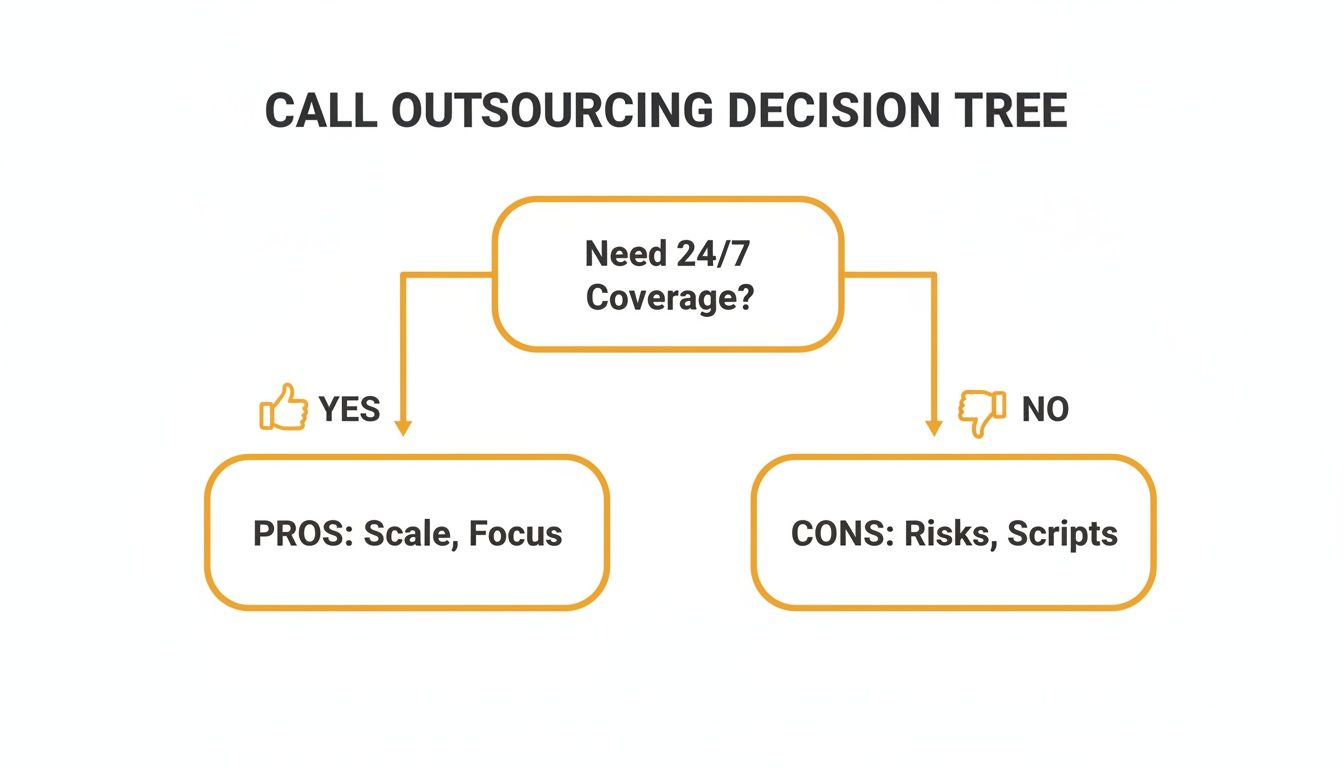
As the visual shows, the core trade-off is pretty clear: traditional outsourcing gives you scale but at the cost of control over the customer experience and the risk of sounding generic.
Integration and Technology Capabilities
Whatever solution you choose, it shouldn't create more admin work for you. The most critical question to ask is whether the partner's tech can plug into the systems you already use, like your CRM or booking calendar. The goal here is seamless call-to-calendar integration and automated lead capture, not just taking a message you have to deal with later.
Crucial Insight: The best partners don't just answer your calls—they automate the entire lead capture and booking process. If a potential vendor can't automatically schedule a quote or drop a new lead right into your CRM, you’re only solving half the problem.
This decision is a big one, and it pays to do your homework. Digging into resources on choosing the right customer service outsourcing partner can give you a broader perspective.
At the end of the day, the right partner for a moving company is one that respects your brand, gets how you operate, and uses technology to make your life easier, not more complicated.
The Modern Alternative: AI Answering Services
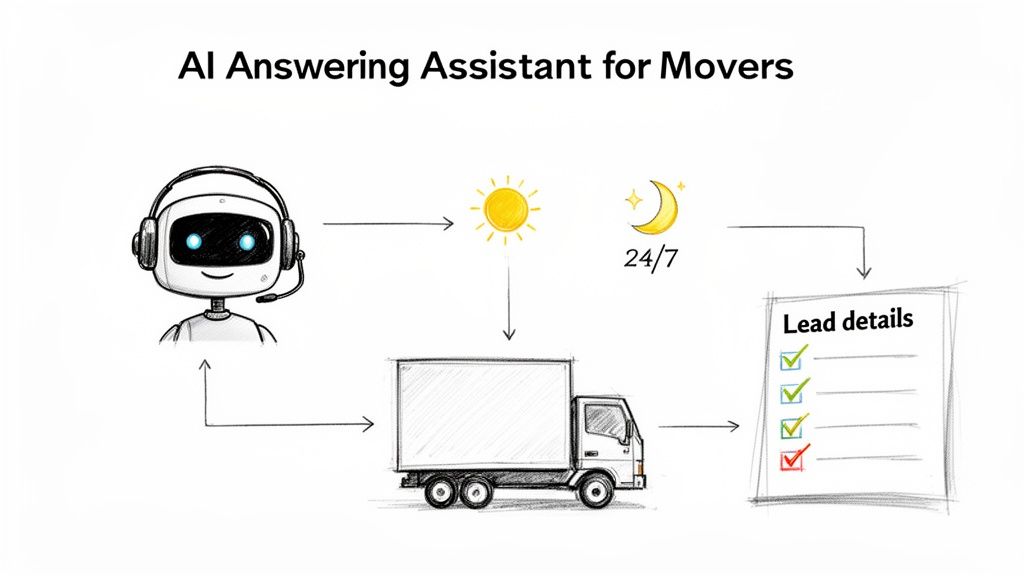
What if you could guarantee every single call gets answered instantly, 24/7, by a receptionist that already knows your business inside and out? I’m not talking about hiring more people or paying for a pricey call center that just takes messages. I’m talking about a smarter way to handle your phones, built specifically for moving companies.
For years, the problems with outsourcing have forced owners to look for something better. That something is here, and it's an AI answering service.
Forget all the tech jargon. Just think of it as your best office manager, cloned, and ready to work 24/7. It gives you the always-on reliability of a huge call center, but with the deep industry knowledge of someone who actually gets the moving business.
How It Works for a Mover
Here’s where it gets powerful for a local mover. A live agent at a traditional call center is just reading from a generic script. They don't know the difference between a "long carry" and a "COI." An AI receptionist, on the other hand, is trained specifically on the language and logistics of moving.
It can answer calls, qualify leads by asking the right questions, and even book jobs for you automatically. For the customer, it’s a seamless, professional experience.
The whole process is dead simple:
- It Answers Instantly: A customer calls, and the AI picks up immediately. No ringing, no hold music, and definitely no voicemail. When a customer is calling three other movers, that speed is everything.
- It Qualifies the Lead Intelligently: The AI asks the right questions, just like a seasoned booking agent would. It gathers all the critical details—move size, addresses, special items, and access issues.
- It Captures Info Perfectly: Every detail is recorded with perfect accuracy. This completely eliminates the human error that happens when a distracted call center agent is trying to juggle three things at once.
This isn't about replacing your team. It's about giving them a superpower—flawlessly handling the repetitive front-end work so your people can focus on running the actual moves.
The Key Difference: A traditional call center’s only job is to take a message. An AI assistant's job is to capture the lead, provide a quote, and book the job directly into your calendar.
Practical Benefits You Can See Immediately
For a moving business with 1-20 trucks, the impact is direct and easy to measure. It solves the exact problems that make owners consider outsourcing in the first place, but without any of the usual headaches.
- Never Miss a Lead Again: With 24/7 call answering, you capture every single opportunity. It doesn't matter if it comes in during a big job, late at night, or on a holiday weekend.
- Stop Losing Track of Follow-ups: The system can trigger automated quote follow-ups via text or email. No more potential jobs slipping through the cracks because your team got slammed.
- Book Jobs Without Lifting a Finger: The AI plugs right into your calendar. It knows when you’re free and can book a profitable job in an open slot, sending confirmations to both you and the customer.
This gives you the power of a massive outsourcing partner while keeping the quality and control you'd only get from your best in-house employee. One booked job often pays for the entire cost of the automation for a month.
To see exactly how this works, you can explore the specifics of an AI phone answering system designed for movers. It turns your phone from a constant interruption into a machine that generates revenue automatically.
Your Action Plan for Capturing More Bookings

When it comes down to it, booking more moving jobs is all about two things: speed and professionalism. The mover who answers the phone first and gives a confident, accurate quote is almost always the one who wins the business.
Sticking with traditional call center companies often means giving up the control and quality you need to make that happen. It's time to stop just answering calls and start strategically capturing every single lead.
Your 3-Step Audit
Let's get a real-world picture of what's happening in your moving business right now. This quick audit will show you exactly how much money you might be leaving on the table.
- Track Your Missed Calls: For one full week, keep a simple log of every call that hits your voicemail, both during and after hours. You’ll probably be shocked at the final number.
- Calculate the Lost Revenue: Now, multiply that number by your average job value. Let's say it's $1,500. If you missed just four calls, that’s $6,000 in potential revenue that just vanished.
- Evaluate Your Response Time: How long does it really take your team to follow up on a web form or a voicemail? If it's more than five minutes, your odds of booking that job drop off a cliff.
Final Takeaway: Your phone system should be your biggest asset, not a liability that bleeds cash. Automation isn't some complex, big-corporation tool anymore. It’s now a dead-simple way for local movers to reclaim lost income, deliver a far better customer experience, and get a real leg up on the competition. Automation is becoming a competitive advantage.
Your Questions, Answered
Let's cut through the noise. Here are straight answers to the questions I hear most often from moving company owners.
Do I Really Need 24/7 Answering?
Here's the hard truth: if you miss calls after 5 PM or on a Saturday, you are bleeding money. Your customers don't shop for movers on your schedule; they do it when they have a free moment. That's usually at night, after they've put the kids to bed, or on a weekend when they're planning their week.
Offering 24/7 availability isn't just a "nice-to-have" customer service perk. It's a direct line to revenue that your competitors, the ones who do pick up, are happily taking from you.
Can an AI Actually Book One of My Moving Jobs?
Yes, and it’s a world away from those clunky, robotic phone trees you're thinking of. A modern AI receptionist built for the moving industry does way more than just take a message.
It’s trained to ask the right qualifying questions—move size, addresses, special items like pianos or safes, access issues like stairs. Then, it uses your rate card to give the customer an accurate quote and books the job right into an open slot on your calendar. All without you or your team lifting a finger.
Is a Traditional Call Center My Only Option?
Absolutely not. In fact, for most moving companies, it's a terrible option. While a traditional call center gives you a live human on the phone, that person knows absolutely nothing about your business. They can't quote a job, they don't understand moving lingo, and they definitely can't close a deal. They're just an expensive message-taker.
The modern alternatives, like a purpose-built AI receptionist, give you the 24/7 coverage of a call center but with the knowledge and booking power of your best dispatcher.
Look, for most small to mid-sized moving companies, the goal isn't just to answer the phone—it's to book the job. An AI assistant is built to do exactly that. A traditional call center is just built to take a message, leaving you to play phone tag while the customer books with someone else.
How Much Am I Really Losing From Missed Calls?
It's way more than you think. I've talked to dozens of owners, and a conservative estimate is that most movers lose 3–7 jobs every single month just from calls rolling to voicemail.
Let's do the math. If your average move is worth $1,500, that’s a minimum of $4,500 in lost revenue hitting the floor each month. This is exactly why a solution that guarantees every call gets answered often pays for itself with the very first job it books.
Stop letting your hard-earned revenue slip through the cracks. MoveJoy is a 24/7 AI Receptionist that answers every call, qualifies every lead, and books jobs directly into your calendar. You never have to miss a booking again.
See exactly how it works at https://getmovejoy.com.