
If your office is still building invoices from handwritten notes, text messages from the crew, and whatever the estimator remembers from the original call, you’re leaking money at the very end of the job. The customer thinks they booked one thing. Your crew delivered something slightly different. Then the invoice shows up with charges the customer wasn’t expecting. That’s where payment slows down, reviews get ugly, and your team wastes time defending work you already completed.
A good moving company invoice template fixes part of that problem. A disciplined process fixes the rest. The invoice isn’t just a payment request. It’s the final record of the quote, the work performed, and every approved change in between.
Your Professional Moving Company Invoice Template
A professional moving company invoice template should give you a place for every charge you might need to defend later. Generic service invoices don’t do that well. They usually assume one fixed price, one date, and one description field. That doesn’t match how moving jobs are billed.

Why a moving invoice needs its own structure
Moving charges are often variable, not fixed, so the invoice typically separates labor, travel, mileage, supplies, and surcharges. Intuit’s 2026 guidance says the invoice should include the issue date and service dates such as pickup and delivery. It also says local jobs should show crew hours and hourly rates, while interstate jobs should show shipment weight, total miles, and a rate per pound or per mile, which is why a moving-specific template matters in the first place (Intuit moving company invoice template guidance).
That structure protects your revenue in two ways. First, it keeps your office from forgetting billable items. Second, it shows the customer exactly how the final amount was built.
If you want to standardize the rest of your paperwork around the same idea, it’s worth reviewing these business documentation templates. Most moving companies don’t have an invoicing problem alone. They have a document consistency problem from quote to work order to final bill.
Practical rule: If a charge can come up on move day, your template needs a dedicated place for it before the job ever starts.
What to include before you send it
A solid template can live in Word, Google Docs, PDF, or inside your invoicing software. The format matters less than the field structure. At minimum, your template should have room for:
- Company identity: Legal business name, contact details, and branding so the customer knows the invoice is official.
- Customer and job details: Customer name, service address, destination, and any job reference tied to the original estimate.
- Service timing: Invoice date, pickup date, delivery date, or the service window used on the move.
- Charge sections: Labor, travel time, mileage, materials, storage, and accessorial charges.
- Payment details: Amount due, due date, accepted payment methods, and notes about deposits or balances.
What doesn’t work is cramming everything into one line that says “Moving services rendered.” That may feel faster in the office, but it’s slower once the customer calls asking what changed.
Use a template that’s editable and easy for dispatch, sales, and accounting to follow the same way every time. The best invoice is the one your team can complete correctly even during busy season, when calls are stacked up and crews are still on the road.
The Anatomy of an Invoice That Prevents Disputes
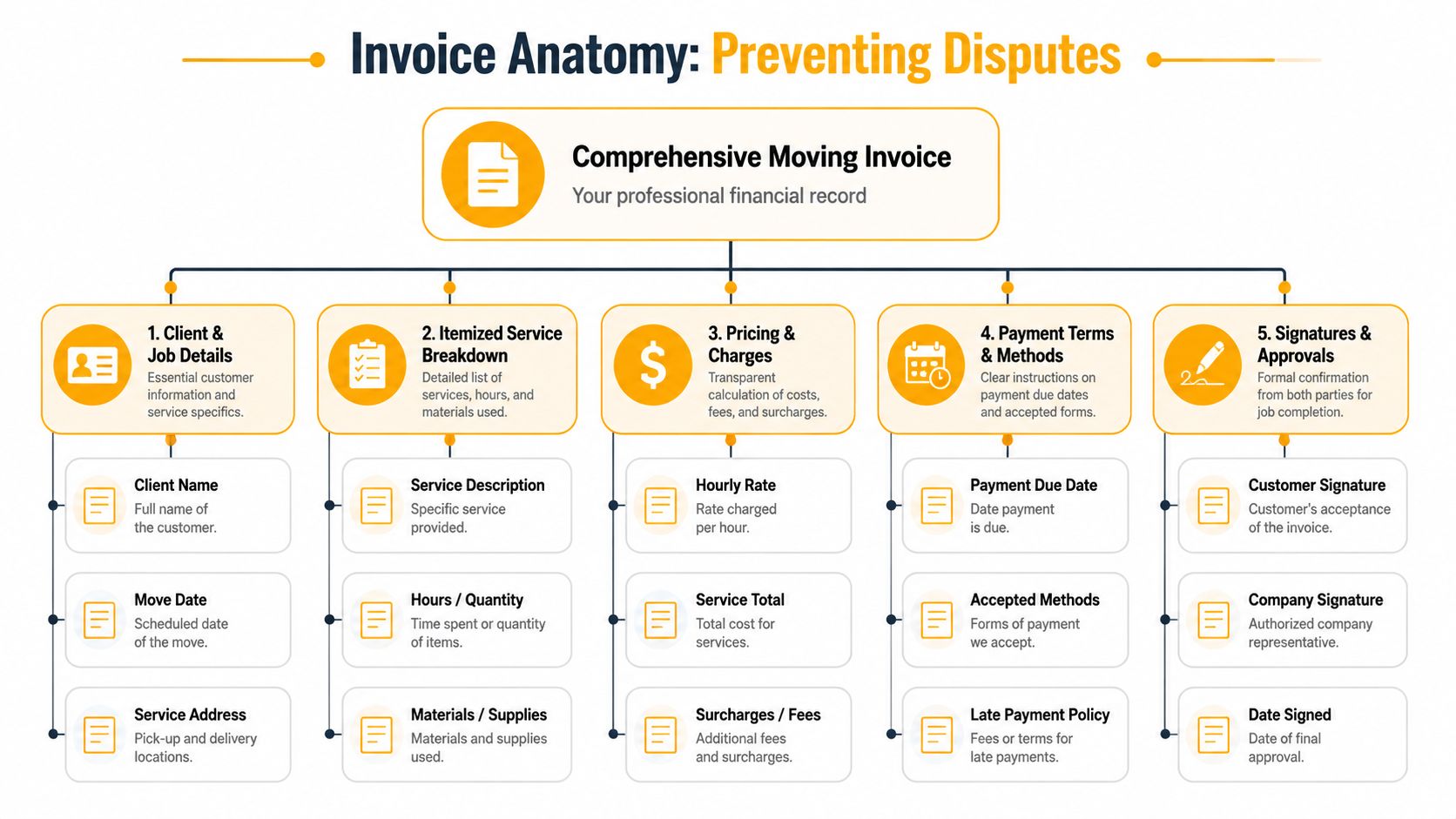
A clean invoice doesn’t just summarize a move. It documents the logic behind the bill. When a customer questions the total, your invoice should answer most of that pushback before your office ever picks up the phone.
The fields that should never be missing
Modern invoice templates for movers have become more standardized because the jobs themselves vary so much. Invoicer.ai identifies at least 5 distinct invoice formats used by moving businesses: hourly rate, flat rate, weight-based, specialized service, and storage invoices. It also notes that a complete moving invoice should include a unique invoice number, customer information, a detailed list of services, cost breakdowns, total amount due, payment terms, payment instructions, and additional notes (Invoicer.ai moving company invoice templates).
Each core field’s operational role is as follows:
| Field | Why it matters |
|---|---|
| Unique invoice number | Helps accounting track payment status, tie the bill to the job file, and avoid duplicate billing confusion. |
| Customer information | Confirms who's responsible for payment and where the invoice should be sent. |
| Origin and destination | Prevents disputes when multiple addresses, stops, or storage legs were involved. |
| Service dates | Anchors the invoice to the actual move timeline, not just the billing date. |
| Detailed service list | Shows what was performed instead of forcing the customer to guess what the total covers. |
| Total amount due | Keeps the final balance easy to spot so there isn't any ambiguity. |
| Payment terms and instructions | Removes friction at the moment the customer is ready to pay. |
How the pricing section does the heavy lifting
The pricing section is where most invoice mistakes happen. Owners lose revenue here by being too vague, and they create disputes here by being too compressed.
Break charges into plain language line items such as:
- Labor charges: Crew size, hours worked, and rate used.
- Travel or mileage: Separate the movement of the truck from on-site labor if your pricing model does.
- Packing materials: Boxes, wrap, tape, pads, and other supplies that were used.
- Accessorials: Long carry, stair carry, extra stop, shuttle, storage handling, or other approved add-ons.
- Taxes and final balance: Keep the final payable amount prominent and easy to verify.
A customer can accept a higher bill when they can see what changed. They usually resist when the office bundles those changes into a single unexplained amount.
The invoice should read like a timeline of the job, not like a mystery total.
Choose the right invoice format for the job
Not every move should be billed on the same layout. That's one reason a strong moving company invoice template often comes in multiple versions.
Use this simple match-up:
- Hourly invoice: Best for local moves where time and crew size drive pricing.
- Flat-rate invoice: Best when the scope was defined tightly in advance and the price doesn't depend on hours.
- Weight-based invoice: Best for interstate work where shipment weight and distance are central to billing.
- Specialized service invoice: Best for high-value or unusual items that need dedicated handling notes.
- Storage invoice: Best when storage becomes its own billing event rather than a side note on the move.
What doesn't work is forcing a storage job into the same form you use for a local apartment move. That's how details get buried, and buried details become write-offs.
Sample Invoices for Common Moving Scenarios
The easiest way to test whether your invoice template is strong enough is to run it against the jobs your company sees every week. If the template can't explain the bill clearly in a few lines, it needs work.
Local hourly move with added time
A customer books a local apartment move on an hourly estimate. The move takes longer than expected because building access is slower, the carry is longer than described, and more labor is needed on-site.
A weak invoice says: "Local move, additional charges applied."
A strong invoice looks more like this:
- Job description: Local residential move from origin to destination
- Labor line: Crew size, hours worked, and hourly rate
- Travel line: Travel time if your rate card separates it
- Accessorial line: Long carry or stairs, clearly named
- Materials line: Any packing supplies added on move day
- Notes section: Brief explanation that final charges reflect actual labor time and approved add-ons
That last note matters. The customer may not like paying more, but they can usually follow the reasoning if the office shows the change in plain English.
Long-distance move with distance-based billing
Now take a longer move that uses a different pricing model. The invoice shouldn't look like the hourly example with a few labels changed. It should match how the job was priced.
For this type of move, the invoice should emphasize:
| Line item focus | What the customer needs to see |
|---|---|
| Shipment basis | Weight-based or distance-based billing method |
| Travel detail | Total miles and how the travel charge was calculated |
| Pickup and delivery | Clear dates for each service event |
| Additional services | Packing, special handling, storage, or extra delivery conditions |
| Final total | One prominent amount due without making the customer hunt for it |
Many offices create confusion. They know the long-distance quote was built one way, but the invoice gets typed up another way. Once that happens, the customer starts questioning the whole file.
Packing and storage job with multiple service phases
The most overlooked invoice scenario is a move that isn't one single event. The crew packs one day, moves later, and some items go into storage. If the invoice tries to collapse all of that into one paragraph, accounting may understand it, but the customer won't.
Use separate grouped sections on the invoice:
Packing services
List labor and materials tied to packing only.Transportation services
Show the moving portion as its own phase with the related charges.Storage services
Separate storage handling, warehouse transfer, and storage billing so the customer can see what belongs to each stage.
A multi-phase job should invoice like a multi-phase job. When every service leg is visible, approval gets easier.
This approach also helps internally. Dispatch can verify what the crew completed. Sales can compare the final bill against the original scope. Accounting can answer questions without digging through call notes.
How to Send Invoices and Get Paid on Time
Most invoicing trouble doesn't start with the PDF. It starts earlier, when the final bill drifts away from the estimate and nobody documents why. By the time the office sends the invoice, the customer sees a surprise instead of a record.
Wave highlights a gap that matters for movers: how to invoice when the final bill differs from the estimate, especially on local moves. It notes that moving invoices aren't just receipts. They justify why the total changed because of extra movers, weekend rates, long-carry surcharges, stair carries, or materials, and that's exactly where many operators struggle operationally (Wave moving company invoice template guidance).
Send it while the job is still fresh
The best time to send the invoice is immediately after job completion, while the work is still clear in the customer's mind and your crew's notes are still accurate. Waiting creates two problems. Customers forget details, and your office starts reconstructing the job from memory.
Use a simple release process:
- Confirm field completion: Make sure hours, services, materials, and approvals are entered before the crew closes the job.
- Review the estimate against the final: Look for any difference that needs explanation, not just a new total.
- Send with payment instructions: Don't make the customer ask how to pay.
If your back office is still patching these steps together manually, tightening the financial workflow matters as much as the document itself. A broader view of that process is covered in this guide to trucking industry accounting software, especially if your operation is trying to clean up job costing and collections at the same time.
How to handle a final bill that changed from the estimate
At this point, owners either protect revenue or create a dispute.
Follow this sequence:
Reference the original estimate
Tie the invoice back to the quoted scope so the customer sees continuity.List each change separately
Don't bundle added labor, extra materials, and accessorial charges into one adjustment line.State why the change happened
Use plain operational language such as added stairs, longer carry, added packing, or additional labor requested.Show the updated final amount clearly
Customers get defensive when they can't quickly tell what they're being asked to pay.Communicate before they have to ask
If the total changed, explain it in the delivery email or at completion, not after the customer complains.
Field advice: Customers rarely object to documentation. They object to surprises.
What doesn't work is sending the invoice first and explaining it later. That reverses the order of trust.
A simple follow-up rhythm that stays professional
Collections gets easier when the invoice is clear, but follow-up still matters. Keep it steady and short.
- First follow-up: Confirm receipt and ask if they need any clarification on line items.
- Second follow-up: Restate the balance and payment options without rewriting the whole invoice.
- Final reminder: Be direct, polite, and reference the completed service date and invoice number.
Keep emotion out of it. If the invoice was written correctly, your follow-up should sound like account management, not an argument.
From Quote to Cash How to Automate Your Invoicing Workflow
Invoice accuracy usually breaks at the handoff points. Sales takes the call. Dispatch updates the schedule. The crew adds notes. Accounting builds the final invoice later. Every manual re-entry gives someone a chance to leave out a charge, misread the original quote, or bill the right job in the wrong format.
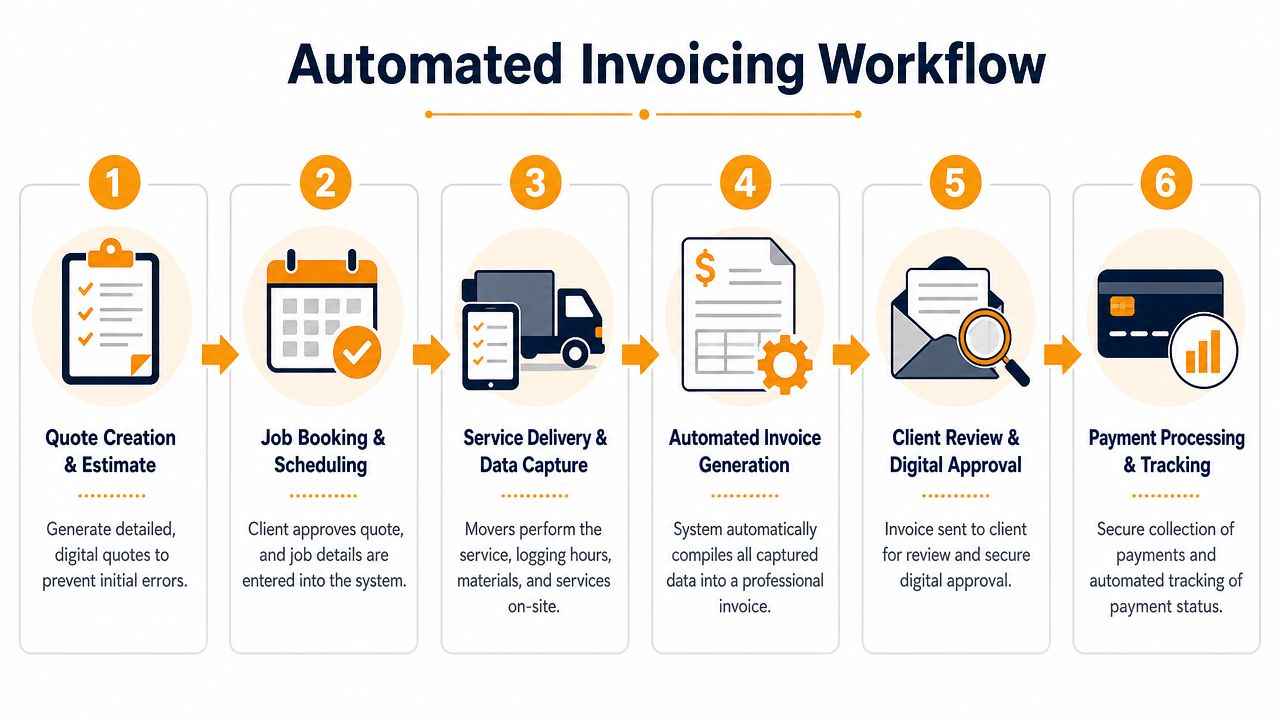
Where manual handoffs break the billing chain
In most growing moving companies, the quote and the invoice live in different places. One person takes intake notes. Another person builds the estimate. A dispatcher changes crew details. Then accounting tries to reconcile the file after the move.
That setup creates predictable problems:
- Quote drift: The final invoice doesn't match the structure of the original estimate.
- Missing add-ons: Materials, travel, or service changes never make it from the crew to billing.
- Slow collections: The invoice goes out late because someone has to piece the job back together.
- Internal confusion: Sales, dispatch, and accounting all think they have the correct version.
A lot of operators borrow invoicing practices from other industries and then wonder why the process feels clunky. Some broader ideas on workflow design are useful, though, especially in this UK business guide on invoicing, because the operational lesson is universal: the less manual re-keying you do, the fewer billing errors you create.
What an automated workflow should pass through
The best invoicing workflow starts before the truck ever leaves the yard. If the quote is clean, the invoice is easier. If the quote is vague, the invoice turns into damage control.
An automated process should carry these details from the first estimate all the way to payment:
| Workflow element | Why it matters downstream |
|---|---|
| Customer and job details | Prevents duplicate entry and address mistakes |
| Pricing model used | Keeps hourly, flat-rate, and distance-based billing consistent |
| Approved services | Ensures the invoice reflects what the customer actually accepted |
| Field updates from the job | Captures labor changes, materials, and accessorials |
| Final billing status | Speeds collection and keeps the office from chasing blind |
For moving companies cleaning up the front end of this process, a standardized moving company estimate template helps because it forces consistency before invoicing ever begins.
The invoice should be the last step in one connected record, not the first time the office tries to organize the job.
If your team still treats quoting, dispatch, and invoicing as separate administrative chores, the back office will keep creating friction. Tight operations connect them. That's how you reduce billing errors, protect approved charges, and shorten the time between completed move and collected payment.
Your Invoice Is Your Final Handshake
Customers don't judge your company only by how the crew handled the furniture. They also judge you by how clear the paperwork is at the end. A sloppy invoice makes a professional move feel questionable. A sharp one reinforces that your company knows exactly what it did and exactly what it's charging for.
That matters even more when the job changed from the original estimate. If your invoice cleanly ties the final charges back to the work performed, you protect revenue without sounding defensive. If it doesn't, your office ends up negotiating after the move is over. That's the worst time to discover your documentation is weak.
For operators who want stronger customer communication overall, this guide on how to improve CSAT is worth reviewing because billing clarity affects the customer's final impression just as much as arrival windows and crew conduct.
A good moving company invoice template does three jobs at once:
- It protects revenue: Every legitimate charge has a place and a reason.
- It reduces disputes: The customer can follow the bill without calling for a breakdown.
- It speeds payment: Clear totals and payment instructions remove friction.
If you run a busy moving company, this isn't minor back-office cleanup. It's part of operational discipline. You worked hard to win the lead, build the quote, schedule the crew, and complete the move. The invoice is where you either lock in that revenue or let it get messy at the finish line.
The fastest-growing movers don't just answer calls. They connect the full chain from quote to booked job to final payment. If you want to tighten that process and recover revenue that's slipping through the cracks, take a look at MoveJoy.