A Moving Company Call in Script That Books More Jobs

Your phone rings while your dispatcher is taking a payment, a driver is asking about tomorrow's start time, and a new lead wants “just a quick price.” In a lot of moving companies, that call gets handled off the cuff. Someone gives a rough hourly rate, forgets to ask about stairs, never gets the email, and promises a callback that doesn't happen until the customer has already booked elsewhere.
That's where a weak moving company call in script hurts revenue. Not because your staff is lazy. Because an unscripted front office turns every inbound lead into a judgment call, and judgment calls get sloppy when the board is lit up, the season is busy, and the person answering is trying to do three jobs at once.
A strong script does more than help someone sound polished. It controls the call, gathers the details your estimator or dispatcher needs, explains pricing the right way, handles trust issues early, and asks for the booking before the caller starts shopping more quotes.
Table of Contents
- Why Your Call Script Is Costing You Jobs
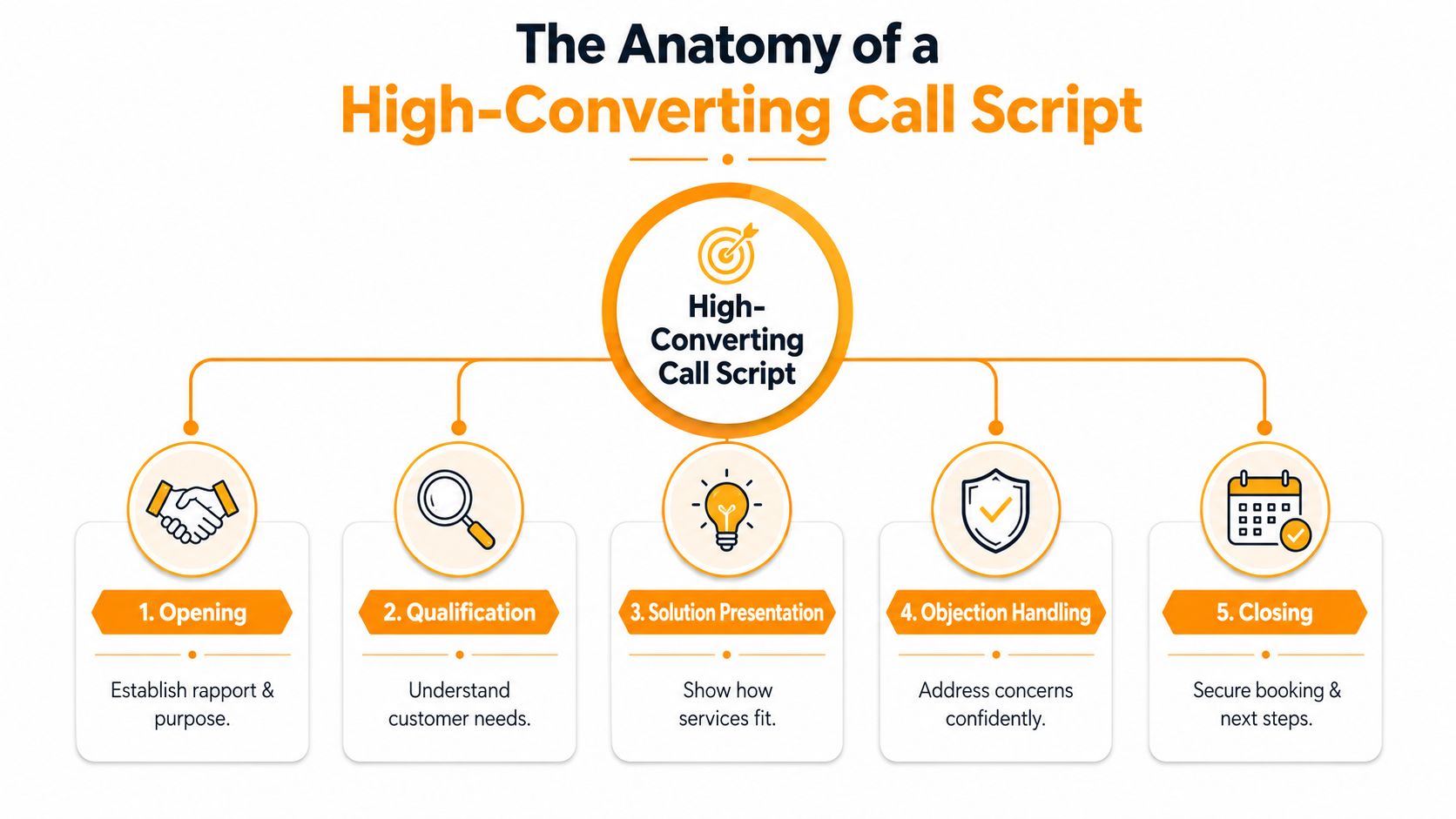
- The Anatomy of a High-Converting Call Script
- Mastering the Flow From First Hello to Booked
- Scripting for Scenarios That Kill Deals
- Training Your Team and Integrating Your Script
- Stop Answering Calls and Start Booking Jobs
Why Your Call Script Is Costing You Jobs
Most owners treat the phone script like a training accessory. It isn't. It's the front end of your sales process, your estimating process, and your risk-control process all rolled into one.
When the person answering the phone leads with, “Yeah, we charge hourly, where are you moving?” they've already lost control of the call. The customer is now comparing one incomplete number against another incomplete number. That rarely ends well for operations. It also rarely ends well for gross margin.
The real problem is inconsistency
One dispatcher asks all the right questions. Another skips inventory and gives a ballpark anyway. One CSR gets the email and move date. Another forgets both. One explains how pricing works. Another doesn't mention policy until the crew is on-site and the customer feels blindsided.
That inconsistency creates three expensive problems:
- Bad quotes: You under-collect details, then your estimate doesn't match the actual move.
- Weak follow-up: You can't work the lead later because you never captured complete contact info.
- Low trust: The caller hears uncertainty and keeps shopping.
A phone script should reduce decision-making for your staff. If they have to invent the process live on every call, your booking rate will always be unstable.
This is why reviewing calls matters. Tools that surface customer support call insights can help owners hear where calls go off the rails, especially around pricing, interruptions, and missed qualification questions.
Answering isn't the same as resolving
A lot of moving companies think the call was handled because someone picked up. That's the wrong standard. The standard is whether the caller got moved toward a confident booking.
If your team answers but can't clarify pricing logic, can't gather enough move details, or can't advance the next step, the call wasn't really handled. It was delayed. That same issue shows up in first-call resolution across service businesses, and it's worth studying how better first-call resolution practices reduce repeat callbacks and prevent deals from stalling.
A moving company call in script isn't there to make your office sound more professional. It's there to protect revenue, reduce avoidable surprises, and make sure every inbound lead goes through the same profitable path.
The Anatomy of a High-Converting Call Script
The best script isn't long. It's ordered. It gives your staff a reliable sequence so they can sound natural while still collecting what matters.
Industry guidance from Supermove is clear that structured qualification before quoting belongs at the center of the first call. Their first-call script recommends asking about move locations, home size, move dates, special belongings, and extra services, then recapping the call and scheduling the next step in the process, which is exactly how a serious booking call should work for residential moves (Supermove first-call script guidance).
Start with control, not chatter
The opening should do three things fast. Identify your company, identify yourself, and set the expectation that you'll ask a few questions so you can give the right next step.
A weak opening sounds passive:
- Weak: “Thanks for calling, how can I help you?”
A stronger opening sounds like a process:
- Better: “Thanks for calling ABC Moving, this is Sarah. I can help with that. Let me grab a few details about the move so I can point you to the right quote and next step.”
That opening matters because it tells the caller there is a system. Systems build confidence.
Qualify before you quote
If your script skips straight to price, it's broken.
At minimum, your moving company call in script should gather:
- Move locations: Origin and destination tell you distance, logistics, and service area fit.
- Home size: Apartment, house, office, and rough size help frame labor and truck needs.
- Move date or date range: This affects availability and whether the lead is urgent or flexible.
- Special items: Pianos, safes, large glass, gym equipment, antiques, and anything fragile.
- Access issues: Stairs, elevators, long carries, tight loading zones, and walkups.
- Extra services: Packing, unpacking, storage, shuttle, assembly, supplies.
- Best contact details: Name, phone, and email, every time.
Here's the trade-off. The more details you ask for, the more accurate your quote gets. But if you ask in a clumsy order, the call feels like homework. So group questions logically. Start broad, then narrow down.
Practical rule: Don't ask for the full inventory before you know the move date, addresses, and size. Get the frame first. Then fill in the cost drivers.
Set pricing expectations before the number
Many teams lose both trust and margin. They rush to say a number because the caller asked for one. That usually creates sticker shock, confusion, or a later dispute.
Your script should briefly explain how your company prices moves before giving any quote. That keeps the number from sounding random. It also helps the customer understand why details like stairs or packing affect the estimate.
A simple format works well:
| Script stage | What to say |
|---|---|
| Acknowledge | “I can give you pricing guidance.” |
| Explain logic | “Our pricing depends on move size, access, distance, and any extra services.” |
| State scope | “I want to make sure I'm giving you something useful, not a vague number that changes later.” |
| Transition | “Let me confirm two more details, then I'll walk you through it.” |
Close with a next step
Too many office teams end calls with, “Okay, we'll send that over.” That's not a close. That's a handoff to chance.
A high-converting script ends by asking for commitment. Depending on your process, that might be:
- Book the estimate: “I have an opening tomorrow afternoon for a survey. Want me to lock that in?”
- Book the move: “We do have that date available. Would you like me to reserve the slot?”
- Advance the file: “I can send the written quote now. What email should I use, and do you want me to text it as well?”
The close should feel like the natural result of a well-run call, not a pressure tactic. If you gathered the right details and explained pricing clearly, asking for the job won't feel pushy. It will feel professional.
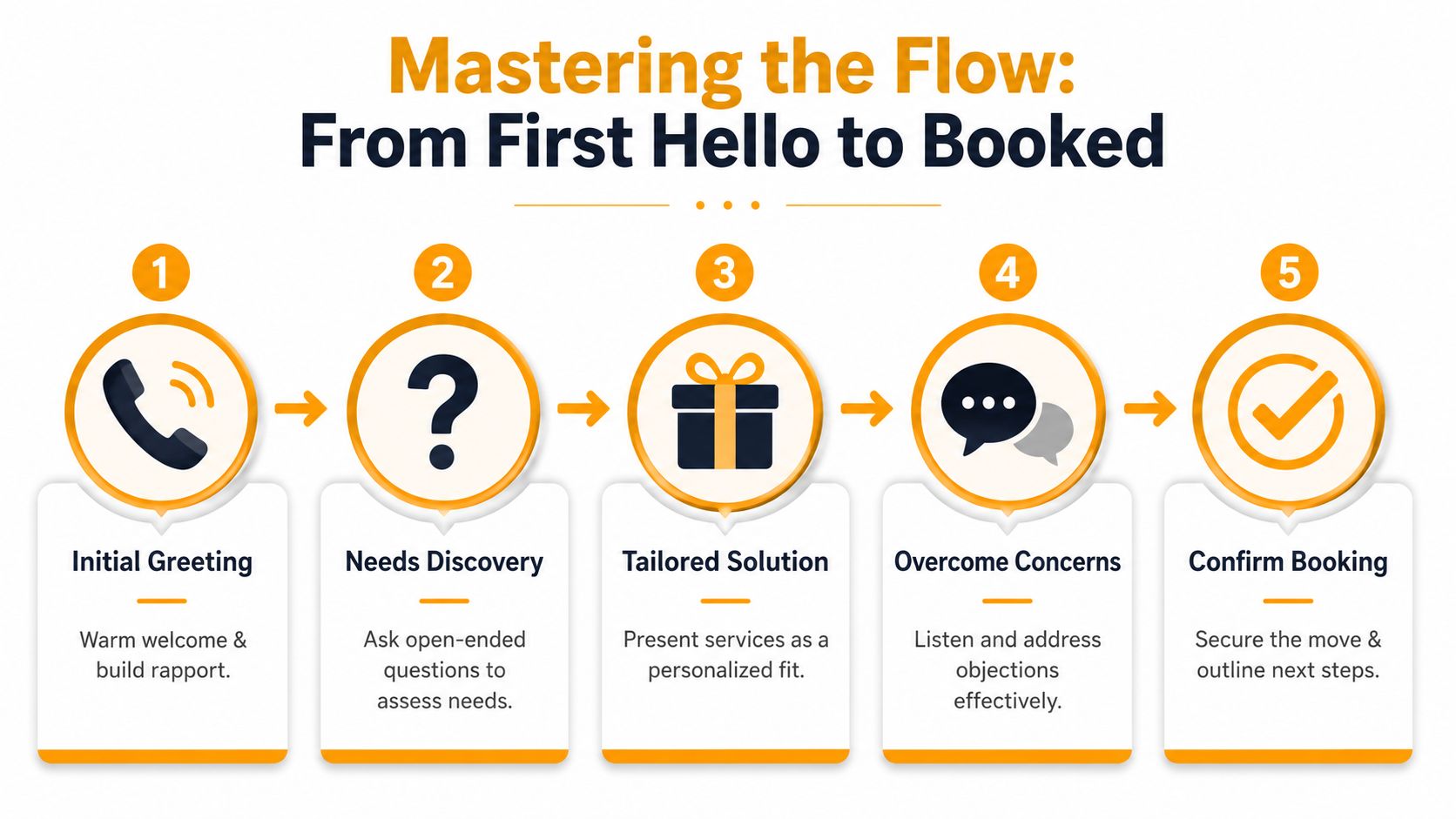
Mastering the Flow From First Hello to Booked
The difference between a decent script and a booking script is flow. Good calls don't feel like interrogations. They feel like guidance.
Industry advice on inbound call handling in moving is very consistent here. A strong workflow should capture name, email, phone, and move size early, then explain pricing logic and policies before quoting, and finally drive a booking commitment. Guidance also recommends standardizing the phrasing of top closers across staff and revising the script based on what books more moves (Louis Massaro on building a moving company sales script).
What the conversation should feel like
The caller shouldn't feel rushed, but they also shouldn't feel in charge of the process. Your rep should guide the call from one checkpoint to the next.
A clean booking call usually has this rhythm:
- Warm opening
- Fast capture of contact details
- Move discovery
- Price framing
- Quote or next step
- Booking attempt
- Recap
If your team skips the early contact capture, you create a common headache. The caller hangs up before the quote is sent, and now your office has no clean way to recover the lead.
A stronger phone presence also starts with the greeting itself. If your staff sounds flat, rushed, or vague, fix that first. Even a basic business telephone greeting framework can tighten the first few seconds and help the rep take control sooner.
A sample call flow that works
Here's a practical example of how the call should move.
Caller: “Hi, I'm moving next month and want to get a quote.”
Rep: “Absolutely. I can help with that. First, let me grab your name, best phone number, and email so I can send everything over once we go through the details.”
Caller: gives contact details.
Rep: “Great. Are you moving from an apartment, house, or something else? And what city are you moving from and to?”
Now the rep has the basic frame. Then they move into the cost drivers:
- size
- date
- stairs/elevator
- special items
- packing or storage
Only after that should they explain the quote.
“When a caller asks for a price in the first ten seconds, don't fight it. Redirect it. Tell them you can help, then earn the right to quote by collecting the details that make the number real.”
Trust has to be handled early
Moving customers are cautious for good reason. They've heard enough stories about bait-and-switch estimates, no-show crews, damaged items, and hidden charges that they often begin the call with some level of skepticism.
That means the script can't focus only on urgency and booking. It should also reduce fear. A good rep doesn't wait for the customer to say, “How do I know you're legit?” They answer that concern before it becomes a barrier.
A few trust-building lines work well:
- On identification: “I'm with ABC Moving, and I'm happy to walk you through how our estimate process works.”
- On transparency: “I'd rather ask a few extra questions now than give you a loose number that causes problems later.”
- On documentation: “We'll send the quote in writing so you can review the details clearly.”
When you handle trust inside the flow of the call, you lower resistance without sounding defensive. That's how you move from first hello to an actual booking instead of another “let me think about it.”
Scripting for Scenarios That Kill Deals
A script proves itself when the call gets messy. That's where most revenue leaks happen.
It's easy to sound polished on a straightforward apartment move. The harder test is when the caller wants a number immediately, leaves out important details, questions your pricing, or starts comparing you to a cheaper mover.

MoveItPro's guidance is useful here because it ties pricing to both timing and compliance. They advise that companies should state policies before giving a price, and Florida consumer guidance warns customers not to finalize an estimate or contract only by phone while also noting that legitimate movers should identify themselves clearly and provide licensing information (MoveItPro on writing moving company sales scripts).
When the caller wants a price too early
Don't refuse the question. Redirect it.
Use language like this:
“I can absolutely help with pricing. I just need to confirm a few move details first so I'm not giving you a number that turns into a problem later.”
That response does three things. It keeps control, protects quote quality, and frames detail-gathering as customer protection instead of bureaucracy.
When the move has ugly details
Fourth-floor walkups, long carries, tricky elevators, and oversized pieces are where underquoted jobs start. The mistake is to hide from those details because you don't want to scare the caller away.
You're better off being calm and specific.
Try this format:
- Acknowledge the condition: “Thanks for mentioning the fourth-floor walkup.”
- Explain why it matters: “That affects labor time and how we build the estimate.”
- Keep the tone steady: “It doesn't mean we can't do it. It just means I want the quote to reflect the actual work.”
For special items:
- Piano or safe: “We handle those, but I need the type, approximate size, and access details so we can quote it correctly.”
- Long carry: “How far is the walk from the truck to the door, roughly? I ask because carry distance can change crew time.”
When the caller says another mover is cheaper
Don't race to the bottom. Also don't lecture them.
Use a comparison script that keeps the conversation on scope:
| Caller objection | Better response |
|---|---|
| “Your competitor is cheaper.” | “They may be. The key question is whether they're quoting the same move conditions and services.” |
| “I just want the lowest price.” | “I understand. I'd still want to make sure the quote covers the actual job, so you're not surprised later.” |
| “Can you match it?” | “If you tell me what's included, I can compare the scope with you and make sure we're looking at the same move.” |
This approach keeps you out of the weakest possible sales position, which is defending a higher number with no structure.
When the caller is vague or guarded
Some callers don't want to answer questions. They think every detail means the price will go up. Your rep has to lower that resistance.
Use this line:
“The more accurate the information, the more accurate the quote. I'm not trying to make this complicated. I'm trying to keep you from getting the wrong number.”
If they still stay vague, narrow the question. Don't ask, “What are you moving?” Ask, “Would you say this is more like a studio, a one-bedroom, or a two-bedroom amount of furniture?”
That kind of scripting keeps the call moving. It also gives your office enough data to decide whether to quote, schedule a survey, or slow the process down before a bad booking creates dispatch problems later.
Training Your Team and Integrating Your Script
Most moving companies don't have a script problem. They have an execution problem.
The owner writes solid talking points, drops them into a doc, and assumes the office will use them consistently. They won't. Not without practice, review, and systems that make the script part of daily operations.
A script in a doc does nothing
Your team needs repetition, not just instructions. The fastest way to tighten call handling is to role-play real scenarios from your own operation.
Focus on the calls that create the most damage:
- Incomplete quote calls: The rep gave pricing before getting access details.
- Trust-heavy calls: The customer asked about legitimacy, insurance, or written estimates.
- Price-shopper calls: The rep got dragged into defending rate instead of clarifying scope.
A simple weekly training rhythm works:
- Pick one call type
- Role-play it twice
- Review one real recording
- Rewrite weak phrasing
- Standardize the stronger version
If your team struggles to turn rough points into usable language, resources on how to create training scripts with AI can help owners and managers draft practice scenarios faster. The useful part isn't automation by itself. It's getting more reps without making your office build every training asset from scratch.
Build the script into your systems
A mature moving company call in script shouldn't live only in people's heads. It should show up inside your CRM, estimate forms, and booking workflow.
That means:
- Required intake fields: Don't let reps move forward without date, locations, contact info, and move size.
- Prompted question order: Make the system follow the same logic every time.
- Written recap templates: Help the rep summarize what was discussed and what happens next.
- Trust checkpoints: Include prompts for licensing, insurance, written estimate process, and business identification when appropriate.
Consumer-facing guidance around moving scams highlights why this matters. Buyers are often told to verify licenses, insurance, physical address, written estimates, and complaint history because scams are common, which leaves a major opening for scripts that proactively address trust on the first call (consumer guidance on spotting sketchy movers and what real pros do differently).
Prepare for automation without losing control
Once your script is stable, the next step is embedding that logic into the tools that handle intake and quoting. That can mean custom forms in SmartMoving or Supermove, guided workflows in MoveitPro, or automated follow-up that chases unbooked estimates.
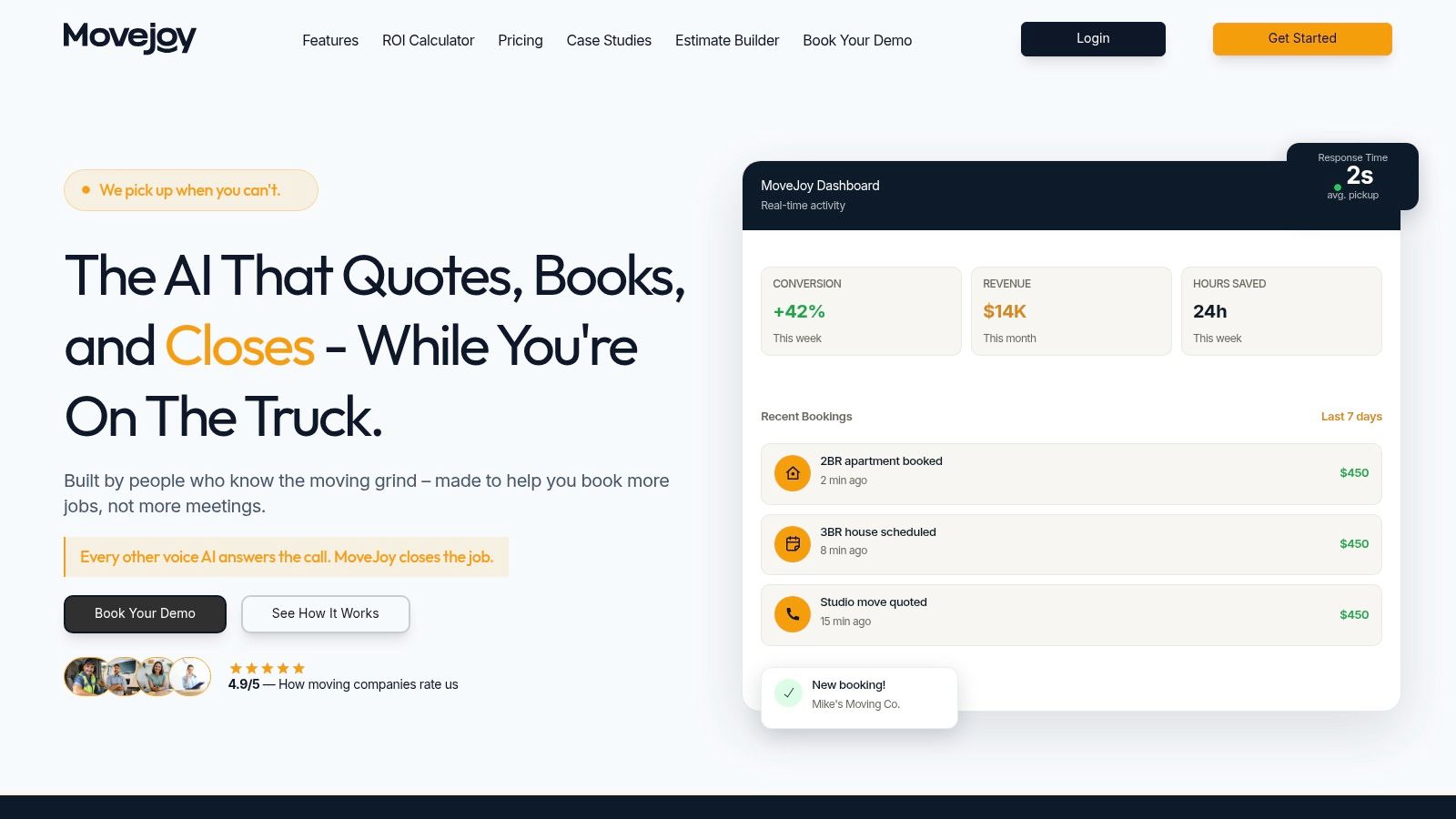
It can also mean using a system that applies your own rate card during the call and pushes the result into your calendar or CRM. For example, MoveJoy is built around that front-end gap. It qualifies the lead, generates a quote using the company's rate card, and books directly into systems like SmartMoving, Supermove, MoveitPro, or Google Calendar.
That's the bigger lesson. The companies that tighten intake first are the ones that get the most value from automation later. If your process is sloppy, software just scales the sloppiness. If your process is structured, automation can finally help you close jobs when your staff is busy, off the clock, or buried during peak season.
Stop Answering Calls and Start Booking Jobs
The goal of your front office isn't to be polite on the phone. It's to turn inbound demand into booked, workable jobs.
A strong moving company call in script gives your team a repeatable path. It improves quote quality, reduces confusion around pricing, catches problem jobs earlier, and builds trust before the customer starts doubting everything. Just as important, it gives owners a standard they can train, measure, and improve.
The larger shift is operational. Your phone system should support workflows, not just ring and route. If you want a broader perspective on that, this piece on phone system workflows that do more than take calls is worth reading because it matches what growing service businesses learn the hard way. Taking a message is not the same as moving a job toward revenue.
If you're still relying on voicemail, memory, and whatever the dispatcher remembers to ask, you're leaving too much to chance. Tighten the script. Build it into your tools. Then look at whether a more automated call answering and booking workflow for movers fits the way your company sells.
If you want to see how a structured call process can turn more inbound leads into quoted, booked jobs, take a look at MoveJoy. It's built for moving companies that want accurate quoting on the call, direct booking into their existing systems, and fewer front-office revenue leaks during busy hours, nights, and weekends.