What Is Quality Assurance in a Call Center for Movers?
"Quality Assurance" might sound like a stuffy corporate term, but for a moving company owner, it’s your playbook for winning more jobs. It’s the process you use to make sure every caller gets the same professional, confidence-inspiring experience that turns them from a price-shopper into a booked customer.
Missed details on a call can lead to chaos on moving day. A vague quote can kill your profit margin. Quality assurance (QA) is how you ensure consistency, whether you're answering the phone yourself between jobs or you have a small team in the office. It’s about making sure your first impression is always your best one.
Understanding Quality Assurance for Your Moving Company
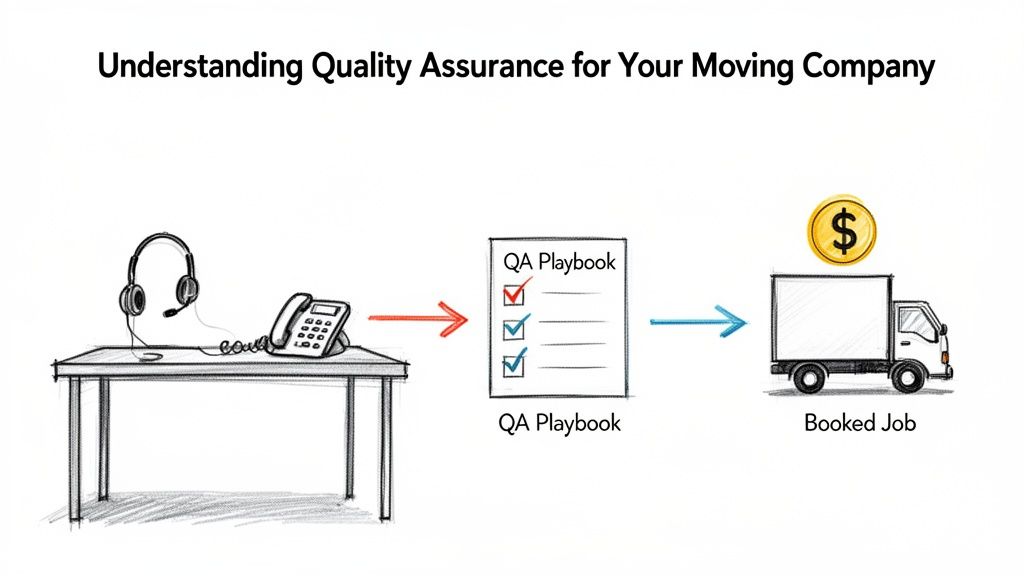
If you're running a moving business with anywhere from 1–20 trucks, you know every phone call is a high-stakes opportunity. A fumbled inquiry isn't just a missed call; it's thousands of dollars in revenue walking straight over to your competitor who answered faster and sounded more professional.
Quality assurance is your best defense against that loss. It’s what transforms your front office from a source of expensive unpredictability into a reliable, revenue-generating machine.
The Real Problems QA Solves for Movers
Think about the last time a job went sideways. Maybe your crew showed up expecting a ground-floor apartment and was met with three flights of stairs. Or perhaps a priceless piano wasn't mentioned on the initial call, throwing your entire schedule and quote into chaos on moving day.
These aren't just operational headaches. They kill your profit margins and chip away at your hard-earned reputation.
A solid QA process is designed to stop these exact problems before they start. It standardizes how your team gathers information, ensuring:
- Consistent Quoting: Every customer gets an estimate based on the same thorough questions, which means no more nasty surprises or under-quoted jobs.
- No Missed Details: Critical info like building access, specialty items, and packing needs are captured every single time.
- Professional First Impressions: From the first "hello," callers feel like they're in capable hands, making them far more likely to book with you instead of shopping around.
Why It’s a Necessity, Not a Luxury
Many moving company owners hear "QA" and tune out, thinking it’s for massive corporations. In reality, the stakes are much higher for a smaller operation. A single bad review from a botched job or one lost customer has a much bigger impact on your bottom line.
Without a structured way to give feedback, training new staff feels like a shot in the dark. This is a huge reason why call centers in other industries see employee turnover rates as high as 30-45% annually—people leave when they don't get consistent coaching to succeed.
Implementing QA isn’t about micromanagement; it's about building a simple, repeatable system that gives every lead the best possible experience. The table below shows the difference it can make.
The Impact of Call Quality Assurance on a Moving Business
| Operational Area | Without QA (The Common Reality) | With QA (The Goal) |
|---|---|---|
| Quoting Process | Inconsistent, based on who answers. Leads to under-quoting and lost profits. | Standardized questions ensure accurate quotes every time. |
| Job Details | Key info (stairs, special items) is often missed, causing chaos on moving day. | A checklist approach captures all critical details upfront. |
| Customer Experience | Hit-or-miss. Some callers get a pro, others get someone distracted or new. | Every caller receives a consistently professional and reassuring experience. |
| Team Training | "Here's the phone, good luck." New hires learn by making costly mistakes. | Structured feedback and call reviews help the team improve systematically. |
| Revenue | Leaks money through lost leads, inaccurate quotes, and operational errors. | Maximizes booking rates and job profitability, plugging revenue leaks. |
| Owner's Stress Level | High. Constantly worrying if calls are being handled correctly and if money is being lost. | Low. Confidence that the front office is a well-oiled, revenue-driving machine. |
This isn't about adding more work to your plate. It's about building a reliable engine for growth, one that doesn't depend on you being there to oversee every single call. For a deeper dive into the numbers, you can explore our guide on call center costs for small businesses.
The Three Pillars of an Effective QA Program for Movers
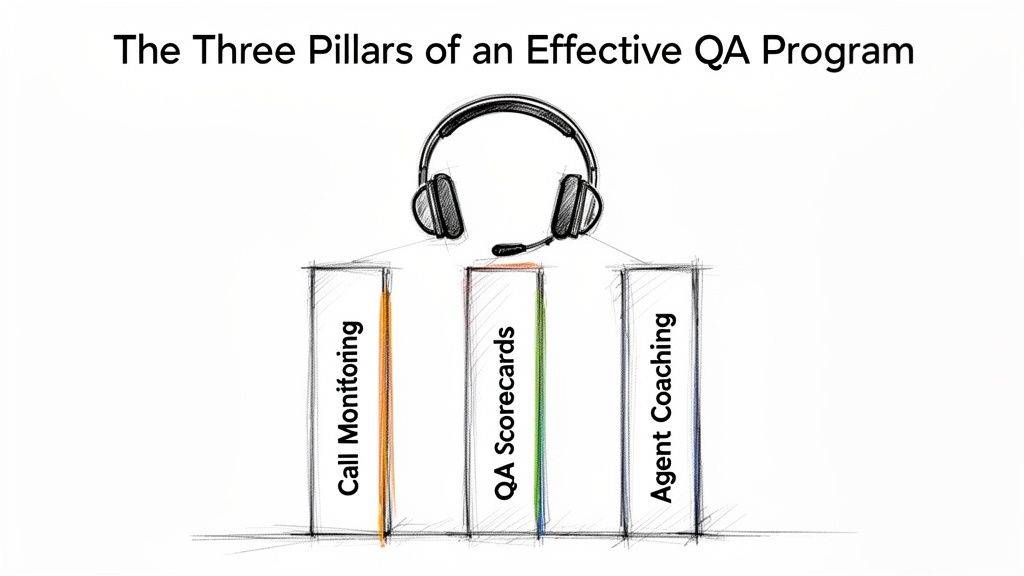
Putting together a quality assurance program sounds like a huge project, but for a moving business, it boils down to three simple components.
Think of these as the legs of a stool. If one is weak, the whole thing wobbles. But when all three are solid, you get a system that creates a consistent customer experience and turns more calls into booked jobs. Getting these right means you can finally step away from the phones with confidence, knowing your team has a clear playbook to follow.
Pillar 1: Call Monitoring
The first pillar is Call Monitoring. This is your "game film" review. It's the simple act of listening to recorded calls—both the ones that led to a booking and the ones that didn’t.
The goal here isn't to micromanage your team. It’s to spot the patterns. Are calls dropping off the second the price is mentioned? Is your team forgetting to ask about tough-to-move items like pianos or hot tubs? Listening to just a handful of calls each week gives you priceless, real-world insight into what’s actually happening on the front lines.
Pillar 2: QA Scorecards
Next up: QA Scorecards. This is where you turn observations from call monitoring into a simple, objective checklist. A good scorecard isn't a complex spreadsheet; it's a tool to measure what actually matters for booking a moving job.
For every call, your scorecard should answer a few critical questions:
- Did the agent greet the customer professionally?
- Did they gather all the key details (inventory, access issues, stairs)?
- Did they confidently explain why your service is the right choice?
- And most importantly, did they ask for the booking?
This is how you turn subjective opinions (“that call felt a bit weak”) into measurable data (“the agent missed 3 out of 5 key questions”). Many modern QA approaches use scorecards to standardize evaluations across calls and emails. You can dig deeper into how these align with bigger business goals in these call center quality monitoring best practices.
Pillar 3: Agent Coaching
Finally, we get to the most important pillar: Agent Coaching. This is where everything comes together. The data you get from your scorecards isn’t for pointing fingers; it’s for making your team better.
Coaching is the bridge between identifying a problem and actually fixing it. It's about giving your team practical, constructive feedback that helps them handle calls more effectively and book more jobs.
For instance, if you notice your team gets hesitant when quoting, you can role-play different pricing scenarios. If follow-ups are getting missed, you can create a simple, foolproof process to ensure every lead gets the attention it deserves. This is the feedback loop that drives real, lasting improvement in your booking rates.
Key Performance Metrics Movers Should Actually Track
Forget the complicated acronyms they use in corporate call centers. For a moving company, quality assurance boils down to a handful of numbers that tell you one of two things: you’re booking more jobs, or you’re letting money walk out the door.
Think of these metrics as the vital signs of your sales process. They show you exactly where your team is crushing it and where a little coaching could make a huge difference.
First Call Resolution (FCR)
For movers, First Call Resolution (FCR) means one thing: booking the job on the very first call. When a potential customer calls for a quote, the goal is to get all the details, build their trust, give them a confident price, and lock in the booking right then and there.
A high FCR is a massive win. It kills the need for endless, time-sucking follow-up calls that eat into your day and shrink your profit margins. Every job booked on the spot is proof of a smooth, effective sales conversation.
Average Handle Time (AHT)
Average Handle Time (AHT) is how long your team spends on a call, from "hello" to "goodbye." But don't get hung up on making this number as low as possible. In the moving business, a super-low AHT can be a red flag—it might mean your team is rushing and skipping crucial questions about inventory, building access, or specialty items.
The real goal with AHT is finding that sweet spot between being efficient and being thorough. A good handle time means your team is gathering everything needed for an accurate quote without wasting anyone's time.
Booking Rate
This is it. The big one. The ultimate metric for any moving company owner. Your Booking Rate is the percentage of qualified leads that turn into actual, paying jobs. It’s the clearest sign of whether your quality efforts are working.
Tracking your booking rate connects the dots between specific actions—like asking for the booking or clearly explaining your value—and real-world revenue. If your booking rate is low, that’s your signal to dig into your call recordings and scorecards to find out where things are going wrong.
Remember, the experience on that first call is critical. By 2025, happy customers are 2.6 times more likely to come back for another job. You can discover more insights about contact center trends and see how much a good first impression impacts what customers are willing to spend.
How to Build a QA Scorecard That Books More Moves
A Quality Assurance (QA) scorecard is your playbook for winning more jobs over the phone. Forget complicated corporate documents; this is a simple checklist that turns vague feelings about a call—like "that sounded good"—into hard, measurable actions.
For a moving company, this is how you standardize what works. It’s how you make sure every caller gets the same professional experience that ends with them booking a move. The goal is to focus only on the specific behaviors that directly grow your revenue.
Defining Your Key Categories
Your scorecard should walk through the critical stages of a successful booking call, like a roadmap from "hello" to "we'll see you on the 15th."
For any moving business, these categories are non-negotiable:
- Professional Opening: Did the agent sound friendly? Did they state your company name clearly? A strong start builds instant trust and sets the tone.
- Thorough Information Gathering: This is where the real money is made or lost. Did they ask about the tough stuff—tight stairwells, long carries from the truck, specialty items like pianos or antiques? Getting these details right prevents problems later and shows expertise.
- Confident Quoting: Was the price presented clearly, not mumbled? Did they explain the value behind the number, or just throw a price out there and hope it sticks?
- Effective Closing: This is the most important part. Did the agent actually ask for the booking? If there's no clear call to action, you're just giving out free quotes for your competitors to beat.
These actions are the foundation for the metrics that really matter.
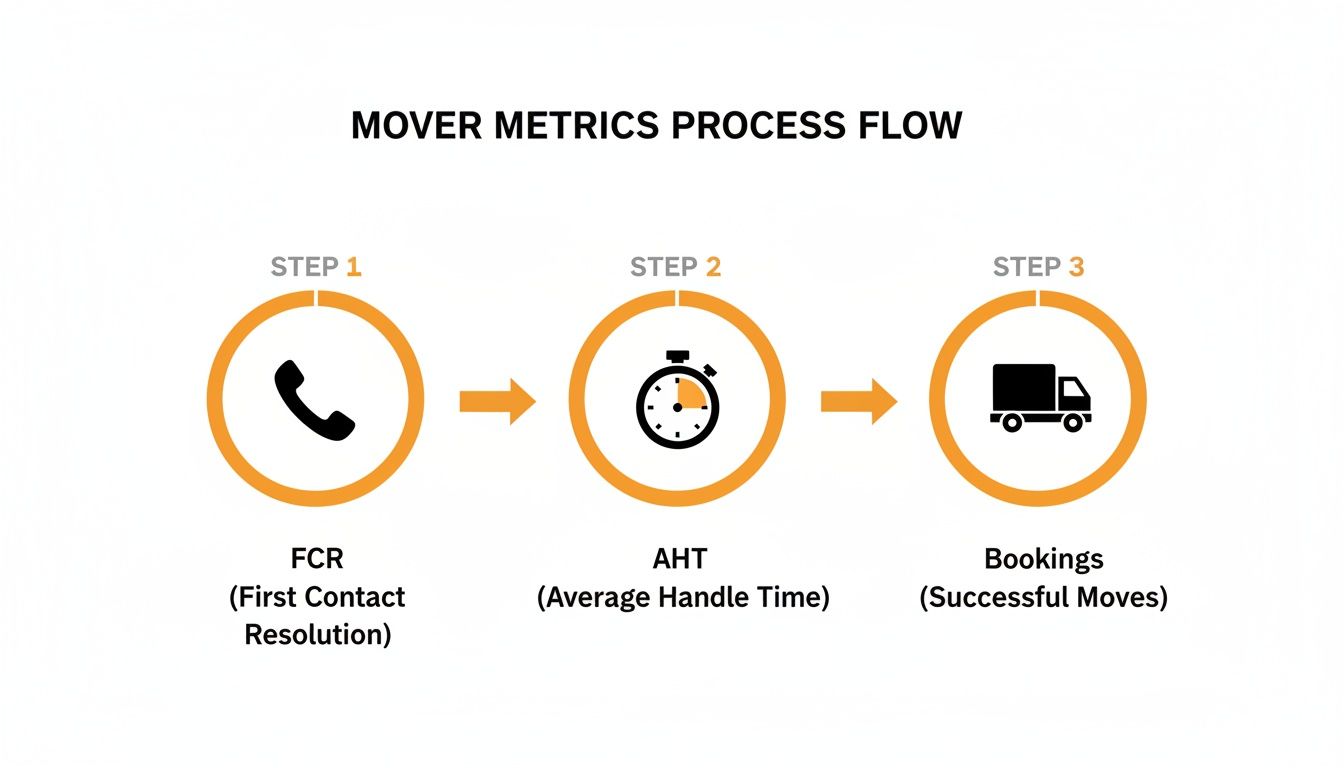
This flow shows exactly how nailing the call (high FCR, efficient AHT) leads straight to more booked jobs. That’s the entire point of your scorecard.
Creating a Simple Scoring System
You don't need a PhD in statistics to grade a call. For a busy moving company, a simple Yes/No checklist is often the fastest and most effective way to go. Each "Yes" means your agent performed a critical, revenue-driving action.
Pro-Tip: Pull three calls that ended in a booked job and three that didn't. Listen to them back-to-back. The patterns that separate the wins from the losses will jump out at you. Those patterns are the questions you need on your scorecard.
Here’s a practical template you can adapt for your own business. It focuses on the actions that directly impact whether a caller books with you or hangs up and calls the next company on their list.
Sample Moving Company QA Scorecard Template
| Category | Evaluation Question | Score (1-5) |
|---|---|---|
| Opening | Greeted the customer professionally and stated the company name? | |
| Discovery | Asked for both the origin and destination addresses? | |
| Discovery | Inquired about the size of the home (e.g., number of bedrooms)? | |
| Discovery | Asked about access issues (stairs, elevators, long carries)? | |
| Discovery | Asked about specialty items (piano, safe, antiques)? | |
| Quoting | Presented the quote clearly and confidently? | |
| Quoting | Explained what the price includes (e.g., crew size, truck, materials)? | |
| Closing | Directly asked to book the move? | |
| Closing | Attempted to overcome at least one objection (if presented)? | |
| Overall | Maintained a positive and helpful tone throughout the call? |
This kind of focused scorecard gives your team a tangible tool they can use to immediately improve their performance. It’s not about micromanaging—it’s about giving them the playbook to win.
Of course, your QA process shouldn't stop at inbound leads. If you're doing outreach, having separate criteria for quality assurance for cold calls is just as important to ensure you're making the right impression.
A strong scorecard is a core piece of your entire sales engine. To see how it fits into the bigger picture, check out this detailed moving company sales process flowchart.
Using Automation to Hit a Perfect Score, Every Time
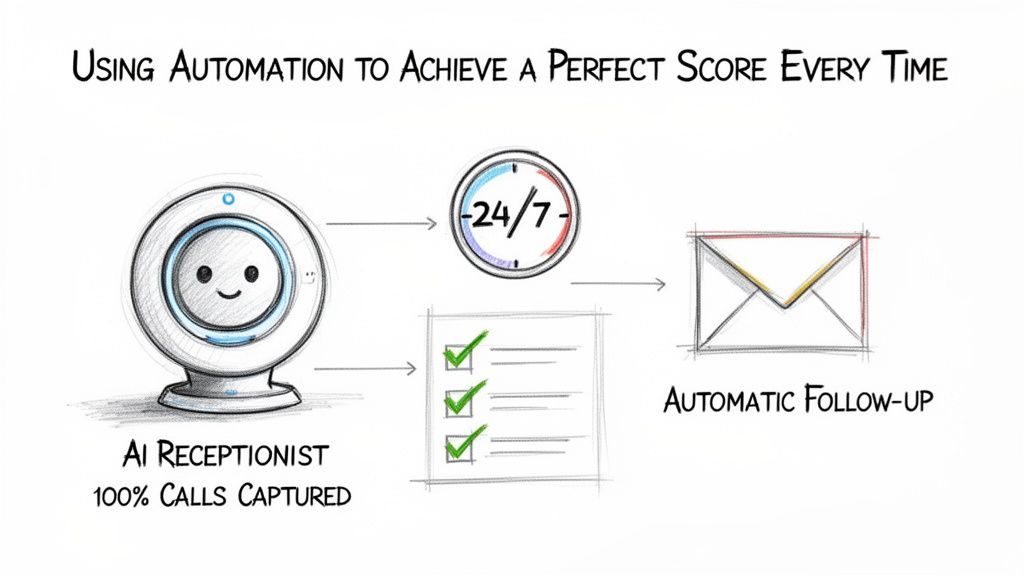
Manually reviewing calls and coaching your team is a huge step in the right direction. But let’s be honest—it’s impossible to listen to every single call, especially during the busy season when your phone is ringing off the hook.
This is where automation stops being a "nice-to-have" and becomes your biggest competitive advantage. It’s how you scale the "perfect" call across 100% of your interactions, making sure no opportunity ever slips through the cracks, even when you're swamped.
Deploying Your Perfect Agent 24/7
Imagine an agent who never has a bad day. They never forget to ask about building access or stumble when it's time to ask for the booking. That's what a well-tuned AI system brings to the table. It acts as your ideal receptionist, hitting every mark on your scorecard, every single time.
This isn't about replacing your valuable team. It's about giving them a tool that handles the repetitive intake tasks perfectly. This frees up your human staff to focus on what they do best: managing complex jobs, building customer relationships, and growing the business.
With this approach, you can:
- Capture every lead 24/7, including the nights and weekends when your competitors send calls to voicemail.
- Provide instant, accurate quotes based on the exact same questions your best salesperson would ask.
- Automatically follow up with every prospect without you or your team lifting a finger.
Turning Insights into Automatic Action
While some companies use advanced sales call analysis software to get automated insights into agent performance, the real game-changer for a small moving business is when you stop just analyzing calls and start automating the perfect call from the get-go.
An AI-driven system doesn't just score calls; it is the perfect score. It's built from the ground up to follow your best practices, ensuring every inbound lead is handled with precision and professionalism. It guarantees a consistent experience that wins trust and books jobs.
This consistency is the key to scaling your moving business. Instead of just hoping every call is handled correctly, you can guarantee it. You can see how an AI phone answering system for movers makes this happen, effectively turning your quality assurance goals into an automated reality.
Your Path to More Booked Jobs and Higher Revenue
Let’s bring it all together. Building a quality assurance strategy—whether it's a simple checklist or a fully automated system—is the single most direct path to boosting your booking rate.
This isn’t about micromanaging your team. It’s about building a consistently professional customer experience that makes people trust you instantly and choose you over the other guys. When you control the quality of every phone call, you plug the two biggest revenue leaks in the moving industry: missed calls during peak season and lost leads from sloppy, inconsistent service.
From Good to Unbeatable
A manual QA process is a fantastic starting point. Creating a simple scorecard, like the one we discussed, is a huge first step you can take today. It gives your team a clear playbook for what a "perfect" call sounds like.
But what if every single call could be perfect, even at 2 AM on a Saturday?
Embracing automation is how you scale that perfection. It’s the difference between hoping your team follows the playbook and guaranteeing the playbook is executed flawlessly on every single call, 24/7.
What's a Missed Opportunity Really Costing You?
Think about it. A single booked job often pays for an entire month of an automated solution like MoveJoy. Automation makes sure no lead is ever fumbled, no critical detail is ever forgotten, and your company hits its full revenue potential.
An AI receptionist doesn’t just answer calls; it runs your perfect quality assurance process every time. It’s your guarantee that from the first ring, every potential customer gets the professional, efficient, and trustworthy experience that turns them from a shopper into a booked job on your calendar.
Answering Your Questions About Call QA for Movers
Most moving company owners have the same questions when they first hear about Quality Assurance. It sounds complicated, but it’s simpler than you think and pays for itself almost immediately by plugging leaks in your sales process.
How Many Calls Should I Really Be Listening To?
You don't need to listen to every call. That's a fast track to burnout. A good, manageable starting point is 3-5 calls per team member, per week. The trick is to listen strategically. Pull a couple of your wins—the calls that turned into booked jobs—to see what your team is doing right. Then, listen to a few lost leads to pinpoint where things went off the rails. This simple mix will show you the winning and losing patterns faster than anything else.
What are the Most Common Mistakes My Team is Making?
In the moving business, the same mistakes cost companies money every day. The most common slip-ups are:
- Forgetting Building Access: Not asking about stairs, elevators, or long walks from the truck to the door is a recipe for a nightmare on move day.
- Fumbling the Valuation Talk: When your team can't confidently and clearly explain valuation coverage options, customers get confused. Confused customers don't book.
- No Sense of Urgency: If you don't give a customer a reason to book now, you've just become a free quoting service for the next company they call.
Is This Whole QA Thing Really Necessary for a Small Team?
Yes. In fact, it's more important for a small moving company. When you're a smaller operation, you have fewer leads coming in. Each one of those calls represents a much bigger piece of your potential weekly revenue. A single botched call hurts a small business way more than it hurts some massive national van line.
A simple, consistent QA process is your best defense against leaving money on the table. It makes sure every single lead gets the best possible shot at becoming a booked job, protecting the revenue that keeps your trucks rolling.
Ready to make sure every call is handled perfectly, without you having to listen in? MoveJoy is your 24/7 AI receptionist, built to follow your ideal script every single time to capture, qualify, and book more jobs on autopilot. See how it works at https://getmovejoy.com.