How to Improve First Call Resolution and Book More Moves
When a potential customer calls your moving company, they want two things: a price and a date. If you can give them both on that first call, you win the job. If you have to say, "Let me check the schedule and call you back," you've probably lost them to the next mover on their list.
Improving your first call resolution is all about closing that gap. It's about giving your front-line team everything they need—instant access to pricing, scheduling, and job details—to turn an inquiry into a booked move in one conversation. For a small moving business, this isn't a corporate metric; it's the key to survival and growth, especially during the busy season.
Why First Call Resolution Is Your Moving Company's Secret Weapon
For a moving company owner with 1-20 trucks, "First Call Resolution" (FCR) isn't some corporate buzzword. It's the clearest measure of how much money you're capturing versus letting slip through your fingers every single day.
Think about it. When someone calls you for a move, they're stressed and ready to make a decision. You can bet they're calling other local movers right after you. The first company to give them a confident answer and a booked date gets the job. Speed wins the job, period.
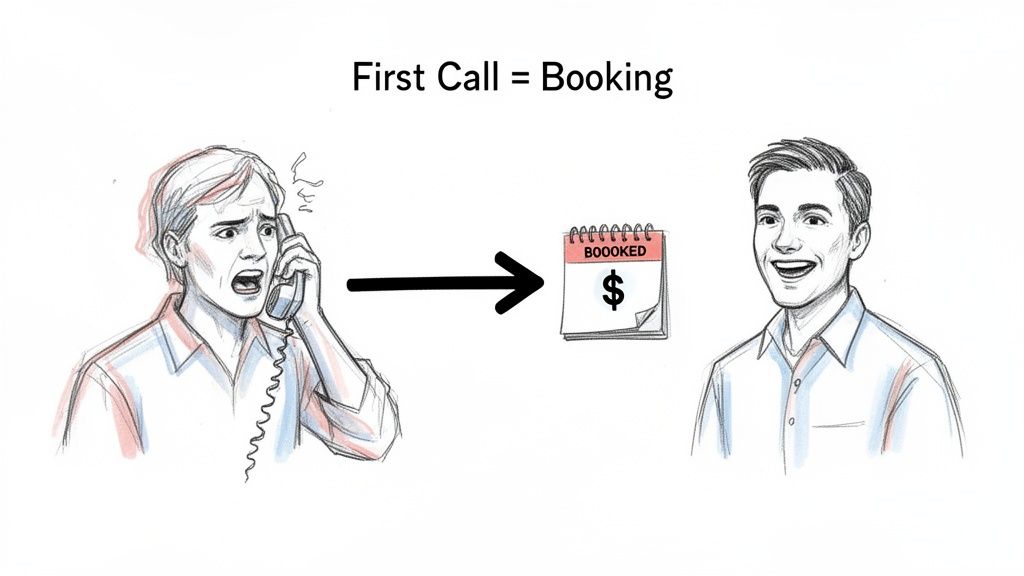
Every time you put someone on hold to check a truck's availability, promise a callback with a quote, or miss the call entirely because you're on a job site, you're just opening the door for your competition. Today’s customers don’t wait. They hang up and dial the next number on their list.
The Real Cost of a Failed First Call
A low FCR isn’t just an inconvenience; it’s a direct drain on your bottom line. It’s a cycle of inefficiency that costs you time, money, and your sanity, especially during seasonal spikes.
Take a look at what actually happens when a call isn't handled right away.
| FCR Failure Point | Impact on Your Moving Business |
|---|---|
| "Can I call you back with a quote?" | The customer calls 3 other movers while waiting. The first one to give a firm price wins. You lost the lead. |
| Call goes to voicemail during a job. | They don't leave a message. They call the next company on Google. You just paid for an ad click that your competitor converted. |
| "Let me check the schedule." | Even a 30-second hold is enough time for them to lose confidence and decide to call someone who sounds more organized. |
| Your new receptionist can't answer. | They don't know the rates or availability, so they take a message. By the time you get it, the customer has already booked. |
See the pattern? A missed first call isn't just a missed opportunity—it's actively sending business to your competitors. During peak moving season, this can mean losing 3-7 jobs a month, which can easily add up to thousands in lost revenue.
Industry-wide, a first call resolution rate above 70% is considered the gold standard. In fact, customers whose issues are resolved on the first try are 2.1 times more likely to recommend your business. For a high-stakes service like moving, where a single booking can be worth thousands, the gap between an answered call and a missed one is massive.
The core principle is brutally simple: speed wins the job. The mover who provides immediate answers and a clear next step will almost always book the move over a competitor who promises to call back later.
Ultimately, focusing on how to improve first call resolution is one of the highest-impact things you can do for your business. It's not about complex software. It's about fixing the fundamental process of turning an interested caller into a paying customer, right then and there.
A professional business telephone answering service designed for movers can help bridge these gaps, ensuring you never miss a chance to book a job just because you were busy running your company.
Pinpointing the FCR Killers in Your Moving Business
If you want to boost your first-call resolution, you have to play detective first. You can't fix the leaks in your booking process until you know exactly where they’re coming from. For most moving company owners, the problems are painfully familiar—they're the same operational bottlenecks that pop up every day, especially when the busy season hits.
Let's do a quick self-audit to figure out why your calls aren't getting resolved on the first try. These are the common FCR killers that cost local movers thousands in lost revenue every month.
Disconnected Quoting and Scheduling
This is the big one. By far, the most common reason for a callback is a gap between your quoting process and what’s actually on your schedule. A customer calls, gives you their details, and asks, "Are you available on the 28th?" If your answer is anything other than a confident "Yes," you're already losing.
This happens when:
- The schedule lives in your head or on a paper calendar. You can't give a firm answer because you're on a job site and the calendar is back at the office.
- Your office manager has to check with you. They take a message, interrupt you to confirm crew availability, then have to call the customer back—often after they've already booked with your competitor.
- Your quoting tool is separate from your calendar. Maybe you use a spreadsheet for quotes but a different app for dispatch. That disconnect forces a two-step conversation where a one-step conversation is all the customer has patience for.
That tiny delay, even if it's just an hour, creates doubt. A customer on the phone is a customer who is ready to give you their credit card. Making them wait is basically an invitation for them to call the next mover on their list.
Information Silos and Inconsistent Answers
In a small moving business, critical information often gets trapped with one person—usually, it's the owner. So when a customer calls with a slightly unusual question, like moving a piano or asking about specific insurance coverage, what happens?
If the person who picked up the phone doesn't have that information on hand, the call grinds to a halt. They promise to find out and call back, but the damage is done. The customer hears a lack of professionalism and organization. This is a classic FCR failure, and it stems from not having a central place for all your company's knowledge.
A potential customer doesn't care if they're talking to you, your dispatcher, or a new hire. To them, everyone who answers your phone is the company. If one person sounds unsure, the entire company sounds unsure.
The After-Hours Voicemail Trap
Here’s a scenario every mover knows: It’s 7 PM on a weekday. A motivated customer, finally free after work, starts planning their move. They call your business, ready to book, and get dumped into your voicemail. You just paid for a lead that you now have a zero percent chance of closing on the first call.
Missed calls are the ultimate FCR killer because they guarantee a follow-up is needed. By the time you call them back the next morning, up to 80% of those leads have already spoken to another mover. The race was over before you even knew you were in it.
This is where automation, like a 24/7 AI receptionist, isn't just a nice-to-have. It directly solves this problem by ensuring every call is a first call, even when you're off the clock. One booked job it captures after hours often pays for the entire cost of the technology.
Getting Your Team Equipped to Resolve Calls on the Spot
Once you’ve figured out what’s stopping you from closing jobs on the first call, it’s time to get tactical. This is about arming your team—whether it's an office manager, a dispatcher, or you grabbing the phone between jobs—with the tools and confidence to turn every single inquiry into a booked move.
Think about it: the person answering your phone is the most important salesperson in your company. Are they set up to win, or are they flying blind?
The "One-Call" Toolkit
To get a high first-call resolution rate, your team needs a core set of information they can access instantly. Without it, they're forced to say those words that kill deals: "Let me check and call you back." In the moving business, that’s a losing game.
Here’s what everyone on your team must have at their fingertips, no exceptions:
- A Centralized, Live Calendar: This is non-negotiable. Not a paper diary, not a whiteboard, but a single, shared digital calendar that shows real-time availability for every crew and truck. This single tool wipes out all the guesswork.
- Standardized Quoting Info: Put together simple, easy-to-read pricing sheets or a digital calculator for different move types (e.g., 2-bedroom apartment, 4-bedroom house). This makes every quote consistent and, more importantly, fast.
- A "Frequently Asked Questions" Guide: What are the top 10 questions customers hit you with? Write down the answers for things like insurance, packing supplies, travel fees, and how you handle specialty items. This builds instant authority on the call.
Having this information ready is the foundation of FCR. In the service industry, a shocking 60% of FCR failures happen because the person on the phone simply lacks the right information at that exact moment. For moving companies, where a single lost booking is a big revenue hit, that gap is incredibly expensive.
Crafting a Simple, Effective Call Guide
You don’t need a rigid, robotic script. What you need is a flexible call guide—a simple roadmap that steers the conversation from "Hello" to a confirmed booking. A good guide helps your team control the call, gather all the necessary details efficiently, and close the deal without fumbling.
Your guide should hit four key stages:
- Qualify the Lead: Ask the right questions right away to understand their needs. Where are they moving from and to? What's the size of their home? What's their ideal move date?
- Provide a Confident Quote: Using your standardized pricing, give them a firm estimate. No hesitation. State the price clearly and explain what it covers.
- Handle Objections Smoothly: Have simple, honest answers ready for common pushback like, "That's more than I expected," or "I need to talk to my spouse."
- Close with a Clear Next Step: Don’t end the call vaguely. The goal is to get them on the calendar. Say something direct like, "We have an opening on the 28th at 9 AM. Can I go ahead and book that for you?"
For more detailed guidance and templates, check out our moving company call-in script.
Training Your Team to "Own the Problem"
Beyond tools and guides, the most critical piece is mindset. Train your team to take full ownership of the customer's problem from the second they pick up the phone. Their goal isn't just to answer questions; it's to provide a complete solution.
This means shifting from a passive "message taker" to an active "problem solver." When a customer feels like the person on the other end is truly invested in helping them, their confidence in your company skyrockets.
Equipping your team also means giving them tools that let them work smarter, not harder. This is where you can improve agent productivity with AI-powered support. Automation can handle the repetitive stuff, like gathering addresses and inventory details, which frees up your team to focus on building rapport and actually closing the job.
When your people have the right info and the right mindset, they stop being a cost center and become your most powerful revenue driver.
Streamlining Your Quoting and Scheduling Workflow
For a moving company, quoting and scheduling are the two biggest reasons a call doesn't get resolved on the first try. A clunky workflow where your team is jumping between spreadsheets, a paper calendar, and their own memory is a recipe for delays, callbacks, and lost jobs.
Building a seamless process that works during a live call is how you turn a simple inquiry into booked revenue. The goal is simple: connect your systems so the person on the phone can capture job details, generate an accurate quote, confirm a date, and send a booking confirmation—all in one smooth conversation.
This isn't about buying complicated software. It's about closing the manual gaps that cause customers to hang up and call the next mover on their list.
Creating Standardized Quoting Templates
Hesitation kills sales. When a customer asks for a price, a long, awkward pause while your team scrambles to calculate costs sounds unprofessional. Standardized quoting templates get rid of this problem entirely. They empower anyone on your team to give a fast, accurate, and confident estimate without putting the customer on hold.
A good template should be dead simple and cover the most common moves you handle.
- Factor in the Core Variables: Have fields for the number of bedrooms, the estimated truck size needed, and how many movers are required.
- Account for Time and Distance: You should have pre-calculated hourly rates and standard travel fees for your service area ready to go.
- List Add-on Services: Make sure you have clear, upfront pricing for extras like packing supplies, handling specialty items (like pianos or safes), and storage.
To really nail this and make sure you're resolving calls on the first try, think about using a dedicated moving service quote form. This gives your team a consistent script for every single call, ensuring no detail gets missed and every quote is consistent.
This simple, three-step process is all it takes to get your call-handling team ready for success.
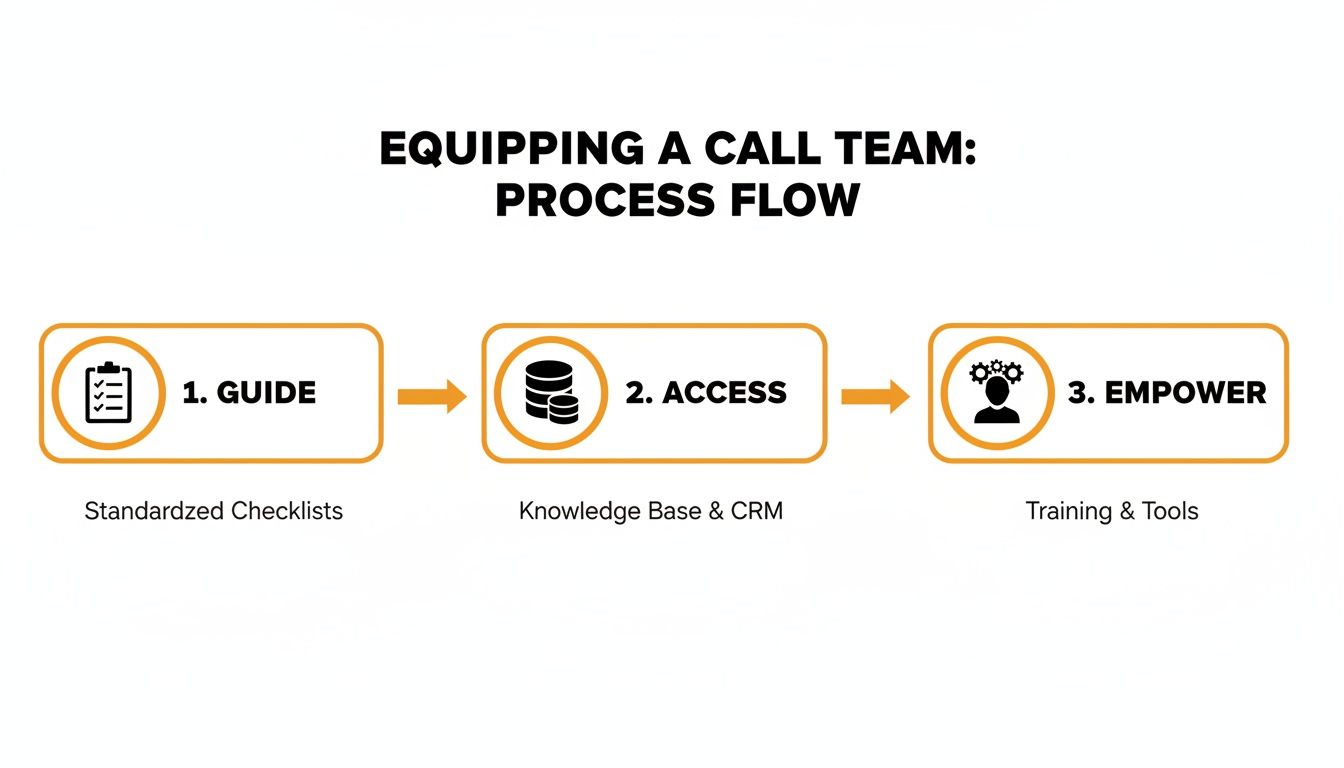
As you can see, it boils down to giving your team clear guides, instant access to information, and the power to make decisions. That’s the core of effective call resolution.
The Power of a Live, Shared Calendar
Your schedule is the single source of truth for your entire moving business. If it isn't live, shared, and accessible to everyone who answers the phone, you're flying blind. A paper calendar on the office wall or a spreadsheet only one person can update is a guaranteed FCR killer.
A live calendar is the difference between saying, "I think we have an opening that week," and "Yes, we have a crew available on Tuesday the 14th at 9 AM. Can I book that for you?" The first response creates doubt; the second one closes the deal.
A shared digital calendar shows your crew's real-time availability. It completely eliminates the risk of double-bookings and the constant "let me check and call you back" routine. When your team can see open slots instantly, they can confidently offer dates and times, guiding the customer directly to a decision.
This integration is foundational. When your quoting process feeds directly into a live calendar, you create one powerful, unified workflow. Answering a call, giving a quote, and booking the job becomes one fluid motion instead of three separate, clunky tasks.
This level of organization doesn't just boost your FCR rate. It impresses customers from the very first interaction, showing them they're dealing with a professional and efficient company.
Using Automation to Achieve 24/7 First Call Resolution
Training your team and streamlining workflows are huge steps forward, but they eventually hit a brick wall: the clock. You can’t have an expert dispatcher working 24/7. You’re always going to lose jobs when a motivated customer calls after hours, on a busy Saturday, or during a seasonal rush when your lines are jammed.
This is where you stop patching leaks and actually fix the problem. Automation isn't just about being more efficient; it's the key to hitting a perfect first-call resolution rate, day or night, without blowing up your payroll.

How an AI Receptionist Solves FCR Challenges
Imagine an AI receptionist that works for you around the clock. This isn't some frustrating robot; it's a smart system built to handle the exact conversations you have with moving customers every day. It’s the perfect employee—never gets tired, never misses a detail, and is always ready to book a job.
This kind of tech directly solves the three core problems that kill your FCR rate:
- Staff Availability: It answers every single call instantly. It doesn't matter if it's 2 PM on a Tuesday or 10 PM on a Friday. The voicemail trap is gone for good.
- Access to Information: It plugs right into your live calendar and quoting rules, giving it the exact same info your best dispatcher would have. No more "let me check and call you back."
- Speed and Consistency: It follows the perfect call script every single time. It asks the right qualifying questions and gives instant, accurate answers without missing a beat.
A Real-World Scenario
Let's see what this looks like in practice. It's 10:30 PM on a Friday. A customer is getting a head start on planning their move and searches for "local movers near me." Your company pops up.
Without Automation: They call, it rings a couple of times, and they get dumped into voicemail. They hang up—no message—and immediately call your competitor. By the time you hear that voicemail Saturday morning, they've already booked the job. You lost that lead completely.
With Automation:
- The customer calls. Your AI receptionist answers on the first ring with a friendly, professional greeting.
- It asks the key questions: "Where are you moving from and to? How many bedrooms is your current home? What’s your ideal moving date?"
- The AI checks your live calendar, sees you have two slots open on their preferred date, and offers both.
- The customer picks a time. The system automatically texts them a booking link to lock in their spot with a deposit.
The whole thing is done in under two minutes. The lead is captured, qualified, and on the calendar—all while you were asleep. That's a perfect first-call resolution, and no one had to lift a finger.
Connecting Automation to Your Business
Today's customers expect instant answers. Research shows that 93% of people expect their issues to be solved on the first call, whether they're talking to a person or an automated system. This is especially true for local service businesses like moving, where a missed call during peak hours is just lost revenue.
By using an AI receptionist designed for moving companies, you meet this demand head-on. It works as a force multiplier for your entire operation, making sure every inbound lead is handled perfectly. It frees you and your team from being glued to the phone so you can focus on what you do best—running the business—with the peace of mind that you’re not leaving thousands of dollars on the table every month. The first job it books for you after hours usually pays for the service for the entire month.
Your FCR Improvement Action Plan
Look, improving your first call resolution isn’t some abstract goal. It’s about one thing: turning more of your phone calls into booked, paying jobs. It’s a direct lever for growing your revenue.
So, let's put together a simple, effective plan to get you there.
Find Your Leaks First
Before you do anything else, you need to figure out exactly where your calls are breaking down. Are you bleeding leads after hours? Is your team constantly putting people on hold to check the schedule, only to have them hang up?
Pinpoint the one or two biggest “FCR killers” in your operation. Don't try to fix everything at once. Just find the biggest leaks so you know where to focus your energy first.
Give Your Team the Right Tools
You can't expect your team to close deals on the first call if they're flying blind. Giving them the tools to succeed is non-negotiable.
This means a shared, live calendar and standardized quoting information. When they have instant access to real-time availability and pricing, they stop sounding hesitant. They sound confident. And confident reps book jobs on the spot.
Connect the Dots in Your Workflow
Your quoting and scheduling process should feel like a single, fluid conversation for the customer. If there are clunky handoffs or gaps that force a callback, you’re losing money.
The goal is to remove any step that requires your team to say, "Let me get back to you." Because every single callback is a potential lost job. A customer who hangs up is already dialing your competitor.
Let Automation Handle the Rest
Finally, you have to embrace technology to capture every single opportunity. An AI-powered receptionist like MoveJoy that works 24/7 isn't just a convenience; it's a massive competitive advantage.
It can handle calls, qualify leads, and book jobs when you’re on-site, asleep, or on vacation. This ensures you never, ever lose another lead to voicemail again.
Improving FCR directly translates to a higher booking rate and more revenue. Think of automation not as a cost, but as your most reliable employee—one that pays for itself with the very first job it books for you.
Still Have Questions?
What’s a Good First Call Resolution Rate for a Mover?
Most sources will tell you 70-75% is the industry standard. For moving companies, you should be aiming for 80% or higher.
Here’s why: moving leads are hot. People call when they need to book, and they usually call a few companies back-to-back. If you can’t give them a quote and a slot on that first call, they're just going to call the next name on their list. Falling below that 80% mark means you’re almost certainly losing jobs to competitors who are faster on the draw.
How Can a Small Team Improve FCR Without Hiring More People?
This is the classic moving company owner's dilemma. You're stretched thin but can't afford another salary. The answer isn't working harder; it's working smarter with better systems.
First, get your house in order. Create a single "source of truth"—a shared digital calendar and a simple, standardized quoting sheet that anyone, even a new hire, can use correctly. No more scribbled notes or "let me check with the boss."
Then, you bring in a force multiplier. An AI-powered tool like an automated receptionist can screen every single inbound call, 24/7. It qualifies the lead, gathers the details, and can even schedule the job right on the spot. It frees up your human team to handle the complex moves, all without the cost of another full-time employee.
How Do I Figure Out My Company's Current FCR Rate?
You don't need fancy software to get a baseline. Just grab a notepad and track your calls for one week. It’s pretty simple:
- Count up the total number of calls from new customers asking for a quote or info.
- For each call, make a note: did you book the job or give a firm quote right then and there? Or did you have to promise a callback?
- Then, just do the math: divide the number of calls you resolved on the spot by the total number of inquiry calls.
Let's say you got 20 inquiry calls and managed to handle 14 of them completely in that first conversation. Your FCR is 70% (14 ÷ 20). Now you have a real number to work from and a clear goal to improve.
Ready to stop missing calls and start booking more jobs? See how MoveJoy can answer and handle every customer inquiry 24/7, turning missed opportunities into confirmed revenue.