The Best Software for Moving Companies Isn’t a CRM — It’s a Revenue Engine

Most moving company software solves the wrong problem.
SmartMoving, Supermove, and MoveitPro are excellent tools — but they’re built to manage jobs you’ve already booked. They assume the lead came in, the quote went out, and the customer said yes. They pick up the story in chapter two.
Chapter one — the phone call, the quote, the booking — is where most independent movers are hemorrhaging revenue right now. And there’s almost no software built specifically to win that moment.
That’s the gap this article is about.
Why Most Moving Companies Are Losing Revenue Before the Job Is Even Booked
If you’re running a 1–20 truck operation, your biggest revenue problem probably isn’t operations. It’s the 25% of inbound calls that go unanswered while your crew is on the truck.
Here’s what that actually costs you in real numbers:
Take 150 calls a month. Miss 25% of them — that’s 37 calls. Assume 30% of those callers would have booked. At a $1,000 average job value, that’s $11,100 walking out the door every single month.
Annually: over $130,000 in revenue that was never recovered, never tracked, and never even noticed — because you didn’t know the calls came in.
This isn’t an operations problem. Your crews are doing great work. This is a front-office problem, and most moving company software doesn’t touch it.
The Three Types of Software Moving Companies Use (And What Each One Misses)
Before we get into what actually works, it’s worth understanding why the tools most movers rely on fall short at the front end.
Moving CRMs (SmartMoving, Supermove, MoveitPro)
These are the backbone of a well-run moving operation. They handle job management, crew scheduling, invoicing, dispatch, and customer records. If you’re running more than 5 trucks and you don’t have one of these, get one.
“MoveJoy booked three jobs for us in the first week. It’s like having a perfect salesperson who never sleeps or takes a day off.” – Chris, Speedy Moves
But here’s what they don’t do: they don’t answer your phone at 9pm on a Saturday. They don’t generate a quote for an inbound caller who found you on Google and is comparing three local movers simultaneously. They don’t close the lead — they manage it after it’s already closed.
Generic AI Voice Platforms (Bland, Vapi, Retell)
These tools can technically answer a call and collect information. But they’re built for developers, not moving company owners. Setting them up requires technical configuration, custom scripting, and ongoing maintenance most operators don’t have time for.
More critically: they have no understanding of moving-specific quoting logic. They don’t know the difference between a long carry and a standard move. They can’t factor in stairs, floor level, distance, and your specific rate card to produce an accurate estimate on the call. They capture the lead — and then hand you a problem instead of a booking.
Human Answering Services (Ruby, Smith.ai)
These work, but they’re expensive ($800–$2,000/month) and they have a ceiling. A human receptionist can take down caller details and promise a callback — but they can’t quote the job. Every call still ends with “someone will be in touch,” which means the customer is still shopping while you’re returning messages.
The Gap None of Them Fill
There is no tool on the market that answers a moving company’s phone, asks the right intake questions, generates an accurate quote using your rate card, and books the job directly into your calendar — at a price a 5-truck operation can afford.
That’s the gap MoveJoy was built to fill.
What “Best Software for Moving Companies” Actually Means in 2025
The best software for your moving company isn’t the one with the most features. It’s the one that solves the problem closest to your revenue.
For most independent movers, that problem is this: a lead calls, no one answers, the lead books with someone else. Everything downstream — scheduling, dispatch, invoicing, reviews — is irrelevant if you’re not winning the job in the first place.
The software that matters most right now is the one that bridges the gap between an inbound call and a confirmed booking. Here’s what that looks like in practice.
The Features That Actually Drive Revenue for 1–20 Truck Operations
1. Accurate Quoting on the Call — Not a Callback Promise
This is the single feature that separates revenue-generating software from administrative software.
When a customer calls asking what it costs to move a 2-bedroom apartment from Queens to Brooklyn on June 14th, they want an answer now — not a promise that someone will email them a quote tomorrow. By tomorrow, they’ve booked with the competitor who gave them a number on the spot.
The best software generates an accurate moving estimate on the call, in real time, using your own rate card. That means it factors in:
- Origin and destination (and distance)
- Home size and number of rooms
- Floor level and whether there’s an elevator
- Stairs, long carries, or access challenges
- Special items — pianos, gun safes, artwork
- Hourly vs. flat-rate pricing based on your structure
A quote built on your rates, generated in the moment the customer is most engaged, closes jobs that callback promises lose every time.
2. 24/7 Call Answering — Including Nights, Weekends, and Busy Season
The majority of moving leads call during the hours you’re least able to answer: mid-morning on weekdays when your crew is on a job, Saturday afternoons, and evenings when people are planning their upcoming move after work.
The software that solves this answers every call, every time — not with a phone tree or a hold message, but with an intelligent response that sounds like your business, understands the moving industry, and moves the caller toward a booking.
One recovered call during a busy Saturday in May can pay for the software for two months.
3. Direct CRM Integration — No Manual Handoff
Answering the call and quoting the job means nothing if the booking disappears into a text message or a sticky note.
The right software books confirmed jobs directly into SmartMoving, Supermove, MoveitPro, or Google Calendar — no manual data entry, no dropped leads, no lag between “yes” and the job appearing on your dispatch board.
This is what connects your front office to your back office: a customer says yes on the phone, and the job is on your calendar before you hang up.
4. Automated Follow-Up on Unbooked Estimates
Not every quoted lead books immediately. Most customers compare two or three movers before committing. The company that follows up first — with the right message at the right time — usually wins.
The best software automates this entirely. A lead that received a quote on Tuesday but hasn’t confirmed gets a follow-up text on Thursday. Not a pushy sales message — a simple, professional nudge that keeps you top of mind when they’re ready to decide.
This alone recovers jobs that would otherwise quietly disappear.
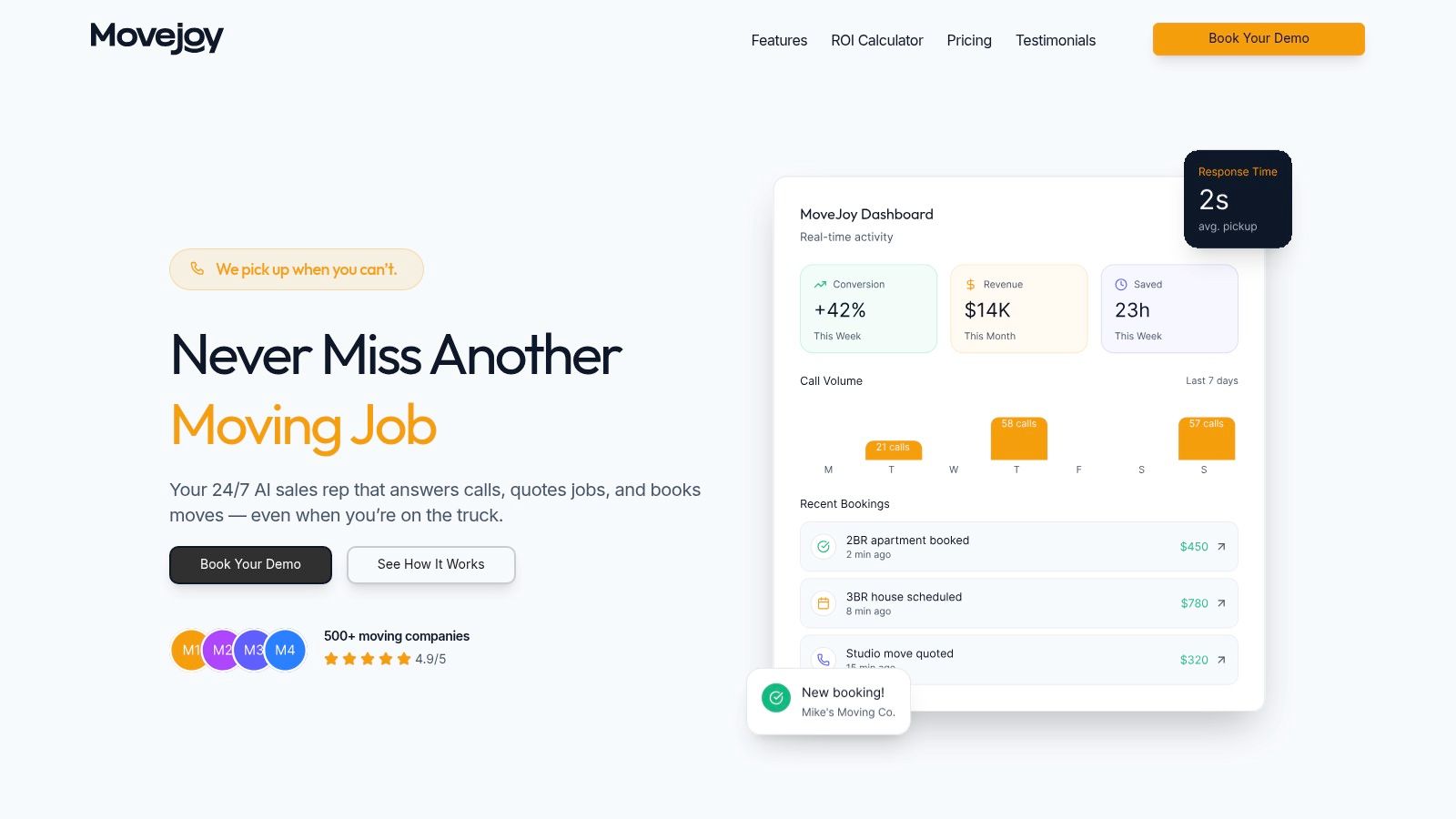
5. Revenue Tracking — So You Know What You’re Actually Recovering
One of the most underrated features in moving software is the ability to see, in plain numbers, what the system is earning you.
How many calls came in this week? How many were quoted? How many converted to bookings? What was the total value of jobs booked automatically vs. jobs that required a callback?
This dashboard turns your front-office operation from a black box into a measurable revenue channel. It also makes the ROI of the software impossible to argue with — when you can see that MoveJoy recovered $14,000 in bookings this month, the $299 subscription cost stops being a question.
The Revenue Leak Calculation Every Mover Should Run
Pull out a napkin and do this math for your own business:
Monthly calls × % missed × % that would have booked × average job value = monthly revenue leak
For a typical 8-truck operation running 150 calls a month:
150 × 25% × 30% × $1,000 = $11,250/month
That’s $135,000 a year. Not from bad service. Not from poor marketing. From unanswered calls.
MoveJoy at $299/month pays for itself the moment it recovers a single $1,000 booking. Everything after that is recovered revenue that didn’t exist before.
Choosing the Right Setup for Your Company Size
1–3 Trucks: Plug the Leaks First
At this stage, your highest-return investment is making sure every inbound call gets answered and every interested caller gets a quote. You don’t need a sophisticated dispatch system yet — you need a front office that works while you’re on the truck.
Priority features: 24/7 call answering, accurate quoting, Google Calendar integration, call recordings and transcripts.
What to look for: Setup in under 10 minutes, no technical skills required, pricing that pays for itself with one recovered booking.
4–10 Trucks: Connect Front Office to Back Office
At this stage you’re running enough volume that dropped leads and slow follow-ups are costing you serious money. You need the front-end call and quoting layer to integrate directly with your CRM so nothing falls through the gap between “interested” and “booked.”
Priority features: Full CRM sync (SmartMoving, Supermove), automated follow-up sequences, revenue and conversion tracking, priority support.
What to look for: Native integrations with your existing CRM, conversion tracking that shows you exactly what the software is recovering.
10–20 Trucks: Systemize and Scale
At this scale, the front-office bottleneck is no longer just missed calls — it’s the inconsistency of how calls are handled across a larger team. You need custom workflows, performance analytics, and dedicated support to maintain quality as volume grows.
Priority features: Custom call workflows, advanced analytics dashboard, dedicated account manager, 24/7 priority support.
What to look for: Flexibility to adapt to your specific quoting structure and operational setup.
Getting Started: From Signup to First Answered Call in 5 Minutes
The biggest myth about moving software is that implementing it is a project. It isn’t — not for the front-office layer.
Here’s all it takes to go live with MoveJoy:
Step 1 — Upload your rate card. Your pricing structure, truck sizes, hourly rates, stair fees, long carry charges. This is what the quoting engine uses to generate accurate estimates on every call.
Step 2 — Forward your business number. A one-time change that takes two minutes. From that moment, every inbound call is answered.
Step 3 — Connect your calendar or CRM. SmartMoving, Supermove, MoveitPro, or Google Calendar. Confirmed bookings go directly into your schedule.
That’s it. No IT project. No training day. No technical expertise required.
The Bottom Line
The best software for your moving company is the one that solves the problem closest to your revenue — and for most independent movers, that problem is the front office.
CRMs manage jobs you’ve already won. Answering services take messages. Generic AI tools capture leads without closing them.
The software that actually moves the needle is the one that answers the call, quotes the job accurately using your rates, and books it to your calendar — before your competitor even calls back.
That’s what MoveJoy does.
See it in action at getmovejoy.com — or book a demo and watch it close a job live.
Frequently Asked Questions
How is MoveJoy different from SmartMoving or Supermove?
SmartMoving and Supermove are CRMs — they manage jobs after they’re booked. MoveJoy operates before the CRM: it answers the call, generates the quote, and books the job. The two work together — MoveJoy feeds confirmed bookings directly into your SmartMoving or Supermove account.
Will the AI quote accurately for my specific pricing?
Yes. MoveJoy uses your rate card — your hourly rates, truck sizes, stair fees, long carry charges, and any other variables specific to your operation. It doesn’t use generic pricing. The accuracy comes from your own data.
How long does setup take?
Under 10 minutes for most operations. Upload your rate card, forward your number, connect your calendar. You’re live before your next call comes in.
What happens if MoveJoy can’t handle a call?
Complex or unusual situations get flagged immediately. MoveJoy captures the caller’s information and alerts you for follow-up. You never lose a lead — you just handle the edge cases yourself.
Is this affordable for a small operation?
MoveJoy starts at $149/month. A single $1,000 job recovered from a missed call pays for it six times over. The ROI question answers itself the first week.
Ready to stop losing jobs to voicemail? Book a demo at getmovejoy.com