For a moving company, an affordable answering service isn't the one with the lowest monthly bill. Not even close.
True affordability is all about return on investment—how much revenue the service generates versus what it costs. If a service books even one extra job for you, it has already paid for itself. The difference between answering a call and booking a job is where your profit is made or lost.
What "Affordable" Truly Means for Your Moving Company
If you run a moving company with 1–20 trucks, the word 'affordable' can be a trap. It’s tempting to hunt for the cheapest service that promises to answer your calls. But that mindset almost always leads to a much bigger, more expensive problem: revenue leakage from unbooked jobs.
The real cost isn't the monthly fee. It's the jobs you lose while that "cheap" service is on the clock.

Shifting from Cost Center to Revenue Engine
A traditional human answering service might only set you back a few hundred dollars a month. On paper, that feels affordable. But think about what actually happens when a customer calls.
Imagine a customer calls at 7 PM on a Friday during your busy season. Your answering service politely takes a message and sends you an email. By the time you call back Saturday morning, that customer has already booked with a competitor who answered, gave an accurate quote, and took a deposit on the spot. You never even had a chance to win the business.
The most expensive answering service is one that only takes messages. Each missed booking can mean $500 to $2,000 in lost revenue—far more than the monthly cost of a system that actually quotes and books the job.
This is why moving company owners must redefine what "affordable" means. A good solution isn't a cost center for catching calls; it's a revenue engine that actively turns callers into booked jobs. It should pay for itself many times over.
Consider the ROI in these two scenarios:
- Option A (The "Cheap" Service): You pay $200/month for a service that takes 10 messages after hours. You manage to call back and book two of them. You lost eight potential jobs to faster competitors. Net result: A loss of thousands in potential revenue.
- Option B (The "Value" Service): You invest in an automated system that can answer, generate accurate quotes from your rate card, and book jobs 24/7. It costs more upfront but converts eight of those 10 callers, booking them directly into your CRM. Net result: A gain of thousands in new revenue.
Suddenly, the choice is obvious.
A truly affordable answering service for your moving business understands the difference between answering a call and booking a job. It plugs the holes in your sales process—especially after hours and during seasonal spikes—turning missed calls into confirmed revenue.
The Four Answering Service Options (And What They Actually Cost You)
When the phone rings, you’re not just answering a call—you’re competing for your next booked job. Picking who handles that first impression is a critical business decision. It’s not about finding the cheapest option; it’s about choosing the one that actually puts moves on your calendar.
For a busy owner running a 1–20 truck operation, the choice really boils down to four paths. Let’s break them down by what matters most: cost, operational control, and their ability to actually close a deal.
In-House Staff
This is the traditional method: you hire a receptionist or assign phone duty to your office manager. It offers high control, as your staff knows your business and brand.
However, this is easily the most expensive and least flexible route. You’re not just paying a salary; you're responsible for benefits, payroll taxes, training, and paid time off.
And what happens during the busy season from March to September? Your best person gets overwhelmed, calls in sick, or takes a vacation, and your entire sales pipeline grinds to a halt. Worse, this solution only works from 9 to 5, leaving all your after-hours and weekend leads to die in voicemail.
Traditional Human Answering Services
These services offer a live person to answer your calls 24/7. They sound professional and ensure no call goes to voicemail.
Here’s the catch: they are professional message-takers, not job-bookers. They cannot give a customer an accurate moving quote. They can’t answer questions about packing services or valuation. They definitely can’t book the job. All they do is take a name and number and forward it to you.
That delay is a revenue killer. While you’re waiting for that message, your potential customer is already calling other movers. The first company to answer and provide a quote usually wins the job. You’re paying for the privilege of showing up late to your own lead.
Generic AI Voice Tools
A wave of cheap AI bots has recently hit the market, promising 24/7 call answering for a low monthly fee.
They’re inexpensive, and they do answer the phone. But that’s where the value ends. These tools are not built for the moving industry. A generic AI has no idea what a “long carry” is, can’t differentiate between a studio and a 3-bedroom house, and will completely fail when asked to generate a quote from your company’s rate card.
The result? A frustrated customer and a lost lead. It’s the modern-day equivalent of an answering machine that talks back but can’t actually help anyone.
Mover-Specific AI Automation
This is a new breed of technology, built from the ground up for one purpose: booking moving jobs. Instead of just answering a call, it’s designed to run your entire front-office sales playbook automatically.
The core difference is capability. Other options capture a lead, at best. A mover-specific AI qualifies the caller, generates an accurate quote using your company’s own rates, and books the job directly into your CRM or calendar.
It provides the 24/7 coverage of an answering service combined with the intelligence to handle real moving-specific conversations. It turns a ringing phone into a booked job, often without you or your team lifting a finger. The only real "con" is that it requires a mindset shift—from just "answering calls" to fully automating your lead conversion and revenue recovery.
To make the differences even clearer, here's how the four models stack up side-by-side.
Answering Service Models for Moving Companies Compared
| Feature | In-House Staff | Human Answering Service | Generic AI Voice | Mover-Specific AI (MoveJoy) |
|---|---|---|---|---|
| Availability | Business hours only | 24/7/365 | 24/7/365 | 24/7/365 |
| Can It Quote? | Yes, if trained | No | No | Yes, instantly & accurately |
| Can It Book? | Yes, manually | No | No | Yes, automatically into your CRM |
| Moving Knowledge | High, after training | None | None | Built-in from day one |
| Lead Follow-Up | Manual | None | None | Automated |
| Typical Cost | $3,500+/mo (salary) | $300-$2,000/mo | $50-$200/mo | $149-$499/mo |
| ROI | Low to Negative | Low | Very Low | Very High |
As you can see, the options that feel “cheaper” on the surface, like generic AI or human message-takers, have the lowest return on investment. They stop the phone from ringing but do little to actually grow your revenue.
Understanding these trade-offs is crucial. As we explore in our guide to the best answering services for small businesses, the “best” choice isn’t the one with the lowest price tag. It’s the one that delivers the most booked jobs.
The Hidden Costs of a ‘Cheap’ Answering Service
It’s one of the most common—and costly—mistakes moving company owners make. You shop for an answering service and choose based on price. That low monthly fee is tempting and feels like a smart, budget-conscious decision.
But what you don’t see is the revenue draining out the back door.
The most expensive part of a cheap answering service isn’t the invoice. It’s the business it loses for you.
Picture this: It’s 8 PM on a Friday. Peak season. A high-intent lead, ready to book, calls your number. They get a polite agent from a generic answering service who promises a callback. But that customer is on a mission. They hang up and immediately dial the next mover on their list. By the time you get that email message Saturday morning, they’ve already put a deposit down with your competitor.
The Illusion of Affordability
This isn’t a hypothetical; it happens every single day. A cheap service that just takes messages isn’t a safety net; it’s a leaky bucket. It creates a false sense of security that your calls are “handled,” while your most valuable leads get scooped up by competitors who can give a quote and book on the spot.
Or what about this common scenario? A caller gets a generic AI bot that can’t answer a simple question like, “Do you offer short-term storage?” The bot gets confused, the caller gets frustrated, and you just lost another job.
This is how the different options truly stack up for a moving company’s bottom line.
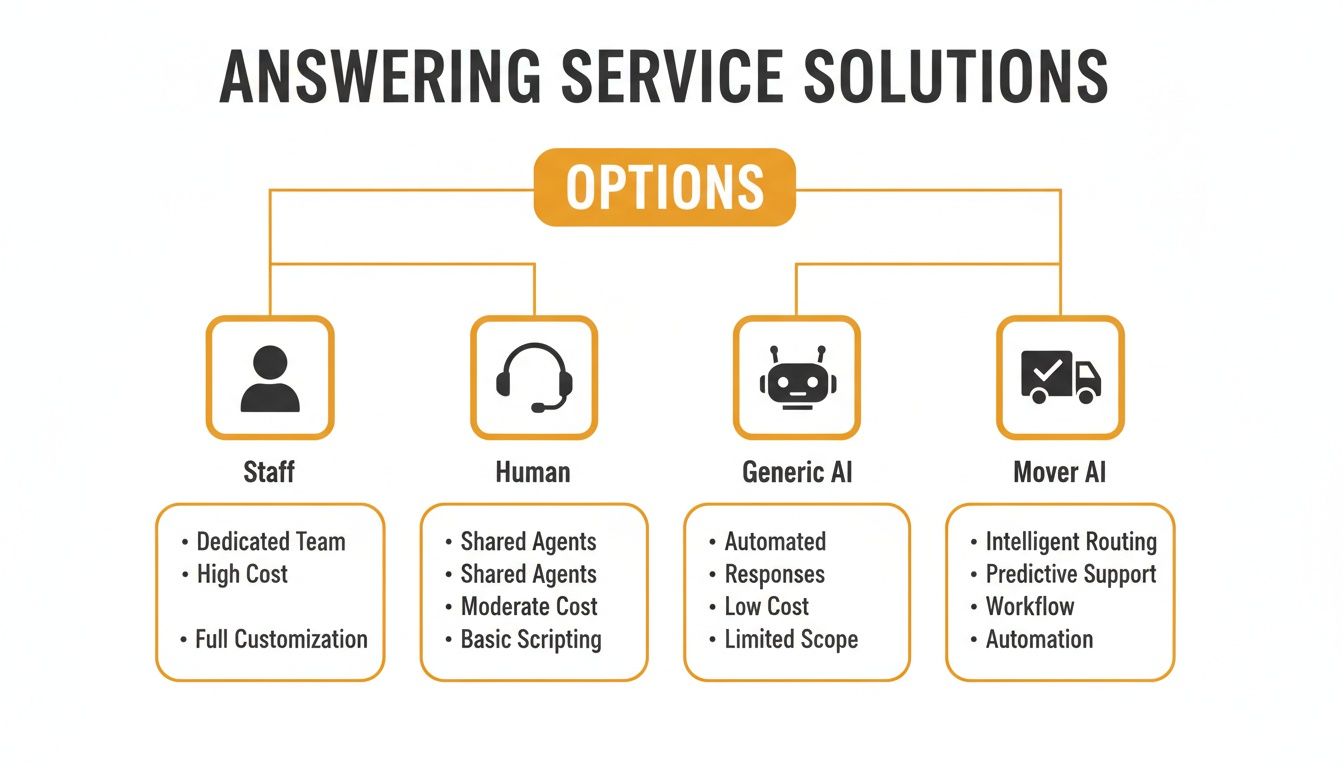
It’s clear: only a solution built specifically for the moving industry can actually handle the job from start to finish.
The goal isn’t just to answer the call. It’s to book the job. Any service that can’t give an accurate quote from your rate card and secure a booking right then and there is actively costing you money.
Calculating the True Cost
Let’s do the math. The average local move is worth about $1,200. If your “cheap” service fumbles just three of these leads a month, you’re losing $3,600 in revenue. That’s a staggering loss that makes the few hundred bucks you “saved” on the monthly fee look insignificant.
Understanding the true cost of an answering service means looking past the price tag and focusing on the return.
A truly affordable solution isn’t the one with the lowest bill. It’s the one that turns your ringing phone into booked jobs. It’s a tool that pays for itself with the very first job it saves, becoming a revenue engine, not just another expense.
The Difference Between Answering a Call and Booking a Job
For any moving company, the goal isn’t a 100% call answer rate. It’s a higher job booking rate. This is the critical detail where most “affordable” answering services completely fall apart. The gap between picking up the phone and actually booking a job is where you either make money or leak thousands in revenue.
Picture this: It’s 9 PM on a Tuesday. A potential customer needs to move and is ready to book. They find you on Google and call. They don’t want to leave a voicemail. They want a price, and they want it now.
A service that politely takes a message and promises, “Someone will call you back tomorrow,” is a guaranteed lost lead. In this business, “tomorrow” is too late. That customer is already calling the next mover on their list.
From Lead Capture to Booked Revenue
This is the real test of any answering solution: Does it just capture a lead, or does it turn that lead into a booked job?
- Answering a Call: A generic operator or a simple bot picks up. They confirm the company name and take down a name and number. Now you have another task on your to-do list: a cold lead you have to chase down.
- Booking a Job: The call is answered by an intelligent system that understands the moving business. It immediately asks the right questions, provides an accurate quote based on your rates, and books the job directly into your CRM or calendar.
The first option just stops the phone from ringing. The second one actually puts money in your bank account.
The ultimate measure of an answering service isn’t how many calls it takes, but how many jobs it books. A system that can quote and book on the first call transforms a cost center into your most profitable salesperson.
This is a totally different way of thinking about your phone operations. The right tool doesn’t just act like a receptionist; it acts as your best sales rep, working 24/7. It understands that moving customers are in a hurry and closes the deal while your competition is still asleep.
Think about the numbers. The average cost for a live agent to handle a single customer service call can be anywhere from $2.70 to $5.60. That adds up fast. AI, on the other hand, can handle that same call for pennies, turning what was once a big expense into a massive revenue opportunity. You can explore these call center statistics to see the financial impact for yourself.
A purpose-built AI fills that massive gap between answering a call and booking a job, turning a simple phone call into a confirmed appointment in your CRM. That’s the difference between just getting by and actually growing your business. If you want to make sure your whole team is on the same page, check out our guide on how to answer a call to maximize bookings.
Your Checklist for Choosing the Right Answering Service
Picking an answering service is a big decision. It’s not just about who answers your phones—it’s about who’s protecting your ad spend, representing your brand, and ultimately, booking jobs that hit your bottom line.
To make a smart choice, you need to ask questions that go way beyond price. This isn’t about finding the cheapest service; it’s about finding a partner that actually makes you money. Here’s a checklist to help you instantly tell the difference between a real solution and a glorified voicemail box.
And remember, the person answering your phone is the first impression a customer gets. They are on the front lines of building your reputation and play a huge role in your effective review management strategies.
Questions That Separate Contenders from Pretenders
Before you sign any contract, get straight answers to these questions. Their responses will reveal whether they can actually grow your revenue or are just another monthly expense.
The Quoting and Booking Test:
- Can you generate an accurate quote on the first call, using my company’s exact rates and rules?
- Do you integrate directly with my moving CRM—like SmartMoving, Supermove, or MoveitPro—and book the job right into my calendar?
- What happens after you get the lead’s info? Do you book the move, or just send an email that I have to chase down later?
The Industry Knowledge Test:
- How do you handle a customer asking about packing, long carries, or valuation coverage?
- Can your system differentiate between a local move, a long-distance inquiry, or someone who just needs storage?
- What’s the process if I need to update my prices, block off a date, or change my service area?
A “yes” to these questions means you’re looking at a potential revenue engine. A “no” or a nervous “we can take a message for that” means it’s just another cost center. The goal isn’t to find an affordable answering service; it’s to find one that delivers booked jobs.
A generic answering service will fail this test almost instantly. They’re built to be a one-size-fits-all message pad, which is useless when a customer wants an immediate quote for their 2-bedroom apartment move on the last Saturday of the month.
Use this checklist to cut through the noise. Filter out the time-wasters and find a partner who understands that the point of answering a call isn’t just to talk—it’s to book the job. The right choice will pay for itself with the very first job it books.
Turning Your Answering Service into a Revenue Engine
Let’s get one thing straight about what an “affordable answering service” really means for your moving company. It’s not about finding the cheapest monthly bill. Not even close.
The real test is simple: Does it book you one extra job a month? If the answer is yes, then you don’t have an expense. You have a revenue engine.
It’s a total shift in thinking. A service that just takes messages is a cost center, plain and simple. It’s a bucket with a hole in it, letting leads you paid for leak out to your faster competitors. A system built to actually book jobs, on the other hand, plugs that hole and starts generating cash.
The goal isn’t just to answer every call. It’s to turn every possible caller into a booked job. One single move you would have otherwise missed can cover the entire monthly cost, making it the most profitable tool you own.
From Cost to Investment
Take a hard look at how you handle calls right now. How many do you miss after hours? How many go to voicemail during the peak season chaos? Go ahead and calculate that lost income. It stings.
To truly turn your call handling from a cost to an investment, you need to see how an effective booking system for small business does more than just answer the phone—it grows the business.
This is where automation built specifically for movers comes in. It’s the key to stopping those revenue leaks for good.
When a caller gets an instant, accurate quote based on your rates and can book directly into your calendar, you win the job. Period. It’s time to stop just answering calls and start booking more moves.
Answering the Hard Questions
As a moving company owner, you’re right to be skeptical. Upgrading your phone system is a big decision, and you probably have a few questions about whether it’s worth the investment. Let’s tackle the ones I hear from movers every single day.
How Much Money Am I Really Losing from Missed Calls?
The number is almost always higher than you think. You can run the numbers yourself, and you don’t need a fancy spreadsheet.
It’s a simple formula:
(Average Job Value) x (Estimated Missed Calls Per Week) x (4.3 weeks per month)
Let’s be conservative. Say your average job is worth $1,200 and you only miss two calls a week—one after hours, one during a busy morning. That math works out to a potential loss of $10,320 in revenue. Every. Single. Month.
That’s not a small leak. That’s a fire hose of cash walking out the door that no growing moving business can afford.
Can an AI Actually Give an Accurate Moving Quote?
A generic chatbot you find online? Absolutely not. It would be a complete disaster. Those things have no clue what a “long carry” is or why a certificate of insurance matters.
But an AI built from the ground up for the moving industry is a totally different ballgame.
These systems are trained on thousands of real moving scenarios. More importantly, a purpose-built AI like MoveJoy uses your company’s own rate card. It knows your rules for travel time, your fees for stairs, your pricing for packing, and your minimums. The quote it generates is the same one you’d give yourself.
Will My Customers Hang Up on an AI?
Let’s be honest about what customers really want, especially the ones booking online. They care about two things more than anything: speed and convenience.
Think about their experience. What does a customer want when they call you? They want a price, and they want to book their move. That’s it.
An AI that gives them an instant, accurate quote and books the job in under five minutes is often a way better experience than being put on hold, transferred, or promised a callback that might never happen. They get what they called for immediately. And in 2026, that immediate answer is what wins the job.
Ready to stop leaking revenue and start booking more jobs on autopilot? MoveJoy turns every call into a booked move using your rates, 24/7. See exactly how it works.