2026 Guide: How Do Moving Companies Get More Leads

A moving company can spend thousands to make the phone ring and still lose revenue before the sales process really starts.
Owners ask, how do moving companies get more leads. The harder and more profitable question is how many existing opportunities die between the first call, the first quote, and the final booking.
In this business, growth usually comes from two places. You bring in more demand, or you get more jobs from the demand you already paid for. The second option is often faster, cheaper, and easier to control. A missed call during dispatch, a quote sent three hours late, or a vague estimate that creates doubt can wipe out the value of your marketing spend for that lead.
That is why smart operators look at marketing and front-office performance together. Local visibility matters. Paid ads matter. Reviews matter. But tighter call handling, faster follow-up, and cleaner quoting usually produce a better return first. If your team needs a better process, start with a proven call answering system for moving companies.
The companies that book more jobs do not always buy more traffic first. They fix the path from inbound call to accurate quote to booked move.
Table of Contents
- Your Phone Is Your #1 Lead Source Are You Treating It That Way
- Master Your Local Presence for High-Intent Leads
- Run Paid Ads That Convert to Booked Jobs Not Just Clicks
- Build a Powerful Review and Referral Engine
- Stop Leaking Revenue from Missed Calls and Slow Follow-Ups
- Improve Quoting Accuracy to Win More Bids on the First Call
- Your Action Plan for Booking More Jobs This Month
Your Phone Is Your #1 Lead Source Are You Treating It That Way
A moving company can spend thousands a month on Google Ads and still lose the highest-intent prospects for one simple reason. Nobody answers the phone fast enough.
For most movers, inbound calls sit closest to revenue. These are not cold prospects filling out a form to compare prices later. They are people with a moving date, a problem, and a short list of companies to call. If your office treats the phone like a side task instead of a sales channel, you do not have a lead problem first. You have a booking problem.
That distinction matters because the fix is usually cheaper than buying more traffic. One missed call during the morning dispatch rush can cost far more than a week of call handling software. One rushed intake can turn a profitable local move into a lost bid before your rep even gets the inventory right.
What a packed morning does to close rate
Peak hours expose weak systems fast. Crews are pulling out. Existing customers want ETAs. Dispatch is juggling changes. New callers are checking availability with two or three movers at the same time.
In that environment, slow pickup, short answers, and voicemails do real damage. The loss rarely shows up as a clean line item. It shows up next week as open truck capacity, lower average revenue per day, and an owner blaming marketing for a front-office failure.
I see this pattern often with 5 to 20 truck operators. They keep asking for more lead flow when the better move is to tighten call coverage from 8 to 10 AM, lunch, late afternoon, and weekends.
Treat each inbound call like a half-sold move
The companies that book more jobs set a higher standard for call handling. They assign ownership, script the first two minutes, and make speed part of the sales process. A caller should get confidence, a clear next step, and a path to a quote without friction.
Your process for answering moving company calls consistently should be documented the same way dispatch procedures are documented. That includes who answers first, when overflow gets routed, how after-hours calls are handled, and how fast missed calls get returned.
Strong phone handling also supports the visibility work covered later in the article. ZenChange Marketing’s local SEO tips are useful here because better local visibility only pays off if your office converts that demand into booked surveys and quotes.
Use a quick internal check this week:
- Review missed-call windows by hour and day.
- Assign one person to own first response for each shift.
- Listen to five recorded calls and check for rushed intake, weak probing, or vague next steps.
- Track booked jobs from calls, not just total lead count.
Owners looking for more demand often need a more profitable first move. Capture the people already trying to hire you.
Master Your Local Presence for High-Intent Leads
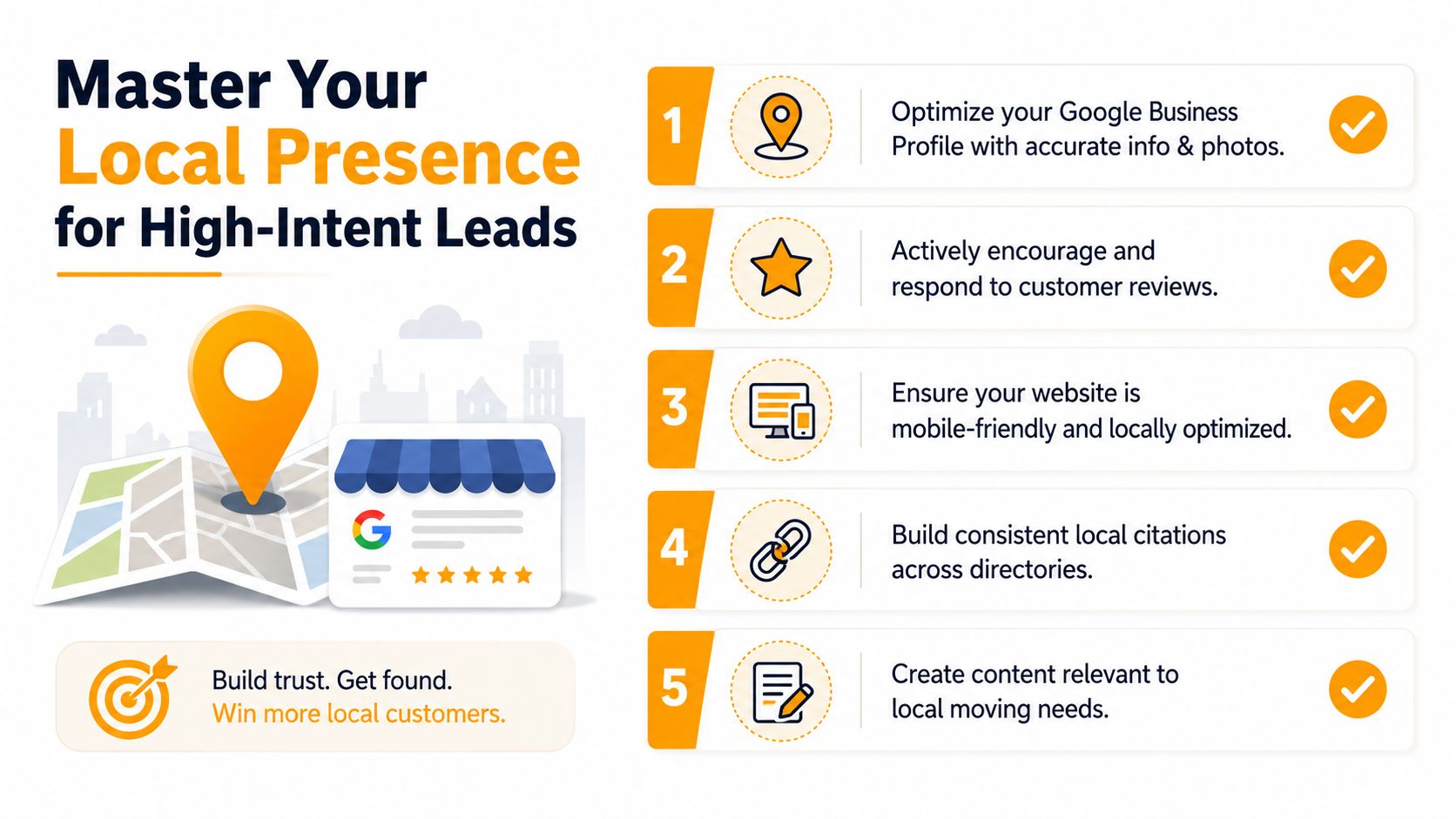
Google owns a huge share of local moving intent, which means your local presence affects booked jobs long before a prospect fills out a form. Owners who treat local visibility as a booking system, not a branding exercise, usually get more value from the demand already in their market.
Build a Google Business Profile that pulls qualified calls
Your Google Business Profile needs to answer three questions fast. Are you legitimate. Do you serve this area. Can someone reach you right now.
Reviews do heavy lifting here, and so does service-area discipline. SmartMoving’s moving lead benchmarks note that more than a third of jobs should come from Google Business Profile reviews, and they also suggest cutting zip codes that fail after 50 clicks can reduce cost per lead by 30 to 50 percent. The practical takeaway is simple. A profile that earns trust in the right neighborhoods brings in better calls, and a profile aimed at weak territory wastes time your office could spend booking profitable work.
Use a tighter checklist than most movers do:
- Set service areas you can cover well: If a distant suburb creates long drive time, higher labor drag, or frequent quote misses, remove it.
- Upload real operating photos: Crews, trucks, protection materials, apartment moves, office jobs, and difficult carries beat stock images every time.
- List services the way customers search: Local moving, packing, labor-only help, apartment moving, office moving, and storage if you offer it.
- Keep business hours aligned with reality: A profile that says you’re open while calls roll to voicemail costs money.
- Respond to reviews with specifics: Thank customers for mentioning on-time arrival, careful handling, or clear communication. Those details help future buyers trust your team.
Strengthen the local signals that support the profile
Google Business Profile performance improves when the rest of your local footprint matches it. Your website, directory listings, and location pages should all reflect the same company name, phone number, hours, and service area. Sloppy local data creates doubt for both Google and the customer.
ZenChange Marketing’s local SEO tips cover the basics well for home-service businesses, and the same rules apply to movers. Consistent citations, city-specific service pages, and useful local content help you show up for searches with real buying intent. I also recommend reviewing local pages against margin, not just traffic. If a city page brings in quote requests that rarely book, it is not doing its job.
Local search is also changing. More customers now ask ChatGPT or Google’s AI Mode to recommend a mover, and those tools favor businesses with clear, consistent information across the web. This guide on how SEO, AEO and GEO work together in AI-driven search explains what that means for local visibility.
The best local lead is the one that fits your crews, your schedule, and your pricing model.
If you’re tightening your local strategy, a focused moving company marketing strategy should connect your profile, your website, your reviews, and your quote process. More visibility helps, but better fit and faster booking usually pay more.
Run Paid Ads That Convert to Booked Jobs Not Just Clicks
Plenty of movers spend money to generate activity. Fewer spend with a clear view of what that activity turns into. That’s the difference between marketing that feels busy and marketing that books profitable jobs.
Think cost per booked job not cost per lead
A lead is not a win. A lead that books at acceptable margin is a win.
According to Lead Helpline’s moving lead benchmarks, Google Local Service Ads charge moving companies between $55 and $95 per call, and the average cost per booked job can be managed between $130–$260. That’s why many operators prefer LSAs over looser PPC setups. The spend is easier to track against real conversations and actual booked moves.
Use this lens when reviewing campaigns:
| Channel question | What matters |
|---|---|
| Are calls coming from your actual service area | Better fit usually beats more volume |
| Are leads ready to move soon | Urgency improves booking odds |
| Can your team answer and quote fast | Ad performance falls apart without intake discipline |
| Does the job fit your crew mix and schedule | Revenue without operational fit can still hurt margin |
If you want broader ideas for home-service ad structure, Wojo Media's advertising strategies are a useful reference point. The key is adapting that thinking to moving economics, where route density, labor allocation, and quote accuracy matter more than vanity metrics.
What to cut before you raise budget
A lot of wasted spend comes from weak targeting, not weak demand. Some clicks were never likely to become good jobs.
Common cleanup areas include:
- Low-intent keywords: Terms that signal bargain hunting rather than readiness to hire.
- Bad geography: Zip codes that generate calls but not profitable bookings.
- Mismatch with your operation: Don't push hard on services you can't staff smoothly.
- No call-first structure: If ads push traffic to forms while your business closes best by phone, the setup is wrong.
The right paid strategy for a 5 to 20 truck mover is usually narrower than people expect. Fewer territories. Better call handling. Cleaner exclusions. More focus on booked jobs.
Build a Powerful Review and Referral Engine
The cheapest lead is usually the one your operation earned before your marketing team touched anything. In moving, reputation compounds when you build a system around it.
Reviews and responsiveness work together
Reviews don't start on Google. They start with the customer experience you create before, during, and after the move. Fast communication matters more than most movers admit.
According to Get NextPhone's moving company answering service analysis, 78% of customers book their move with the first moving company that answers their call. That speed advantage doesn't just help win the job. It shapes the tone of the entire relationship. Customers who feel taken care of early are more likely to trust the crew, accept the process, and leave strong feedback later.
A strong review engine usually includes:
- A same-day review ask: Best sent while the move is still fresh.
- A direct link: Don't make happy customers hunt for where to post.
- A response standard: Thank the good reviews. Address the mixed ones calmly and specifically.
Fast answer times help twice. First, they win the lead. Later, they help create the kind of customer experience that earns public trust.
Make referrals operational not accidental
Referrals are too valuable to leave to luck. Most movers say referrals matter. Fewer have a repeatable way to generate them.
Build simple habits into your closeout process:
- Ask satisfied customers who they know that may be moving soon.
- Keep past clients on a light follow-up cadence.
- Stay visible with real estate agents, apartment managers, and local partners.
- Train your office team to recognize warm inbound referral calls and handle them with urgency.
If your company already delivers a solid move, you don't need a clever brand campaign first. You need a system that turns good service into the next booked job.
Stop Leaking Revenue from Missed Calls and Slow Follow-Ups
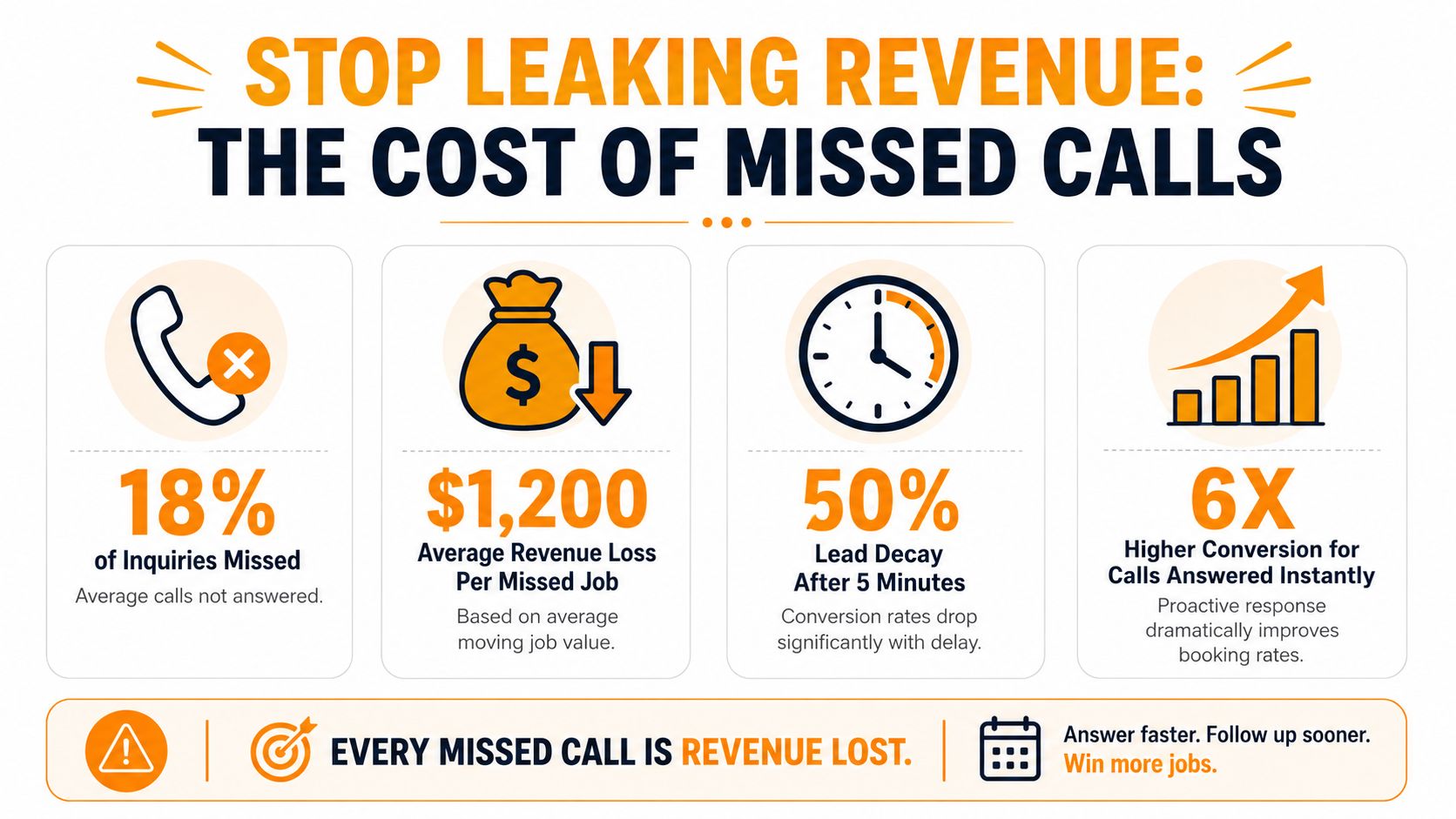
Most moving companies don't have a lead shortage. They have an answer-rate problem.
Voicemail is not a neutral outcome
Owners often treat missed calls as unavoidable. They aren't. They're one of the clearest revenue leaks in the business.
According to Boosted Movers' analysis of voicemail losses, if a moving company triggers an automated callback within 60 seconds after a call slips through, they recover the majority of leads, and being under 5 minutes makes a business 21x more likely to convert the lead. That should change your standards immediately. A callback later today is not fast follow-up in this market. It's usually a lost race.
The practical implication is simple. During March through September, and especially on weekends, every unanswered call needs immediate recovery. Not “when the coordinator gets free.” Immediate.
A simple recovery process that operators can use today
Most moving offices don't need a complicated workflow. They need one that happens every time.
Use a missed-call recovery sequence like this:
- Instant alert to the right person: Sales, office manager, or whoever owns new inbound.
- Automated callback attempt within 60 seconds: That's the window that gives you the best chance to recover the lead.
- Text backup if the callback misses: Short, direct, and built around next action.
- Clear disposition tracking in your CRM: SmartMoving, Supermove, or MoveitPro only help if your team updates them.
A basic text can be plain and effective: company name, acknowledgment of the missed call, a request for move details, and a fast path to continue the quote.
Here's where many operators go wrong:
- They rely on voicemail. Prospects shopping movers don't wait around politely.
- They batch callbacks. By then, the customer has usually moved on.
- They separate marketing from intake. The ad generated the call, but the office failed the conversion.
- They don't measure voicemail rate. If you don't track it, you can't fix it.
Missed calls during busy season aren't random noise. They're unbooked jobs that already raised their hand.
For owners asking how do moving companies get more leads, this is the blunt answer. You can buy more traffic. But recovering the calls you already paid for is often the faster path to revenue.
Improve Quoting Accuracy to Win More Bids on the First Call
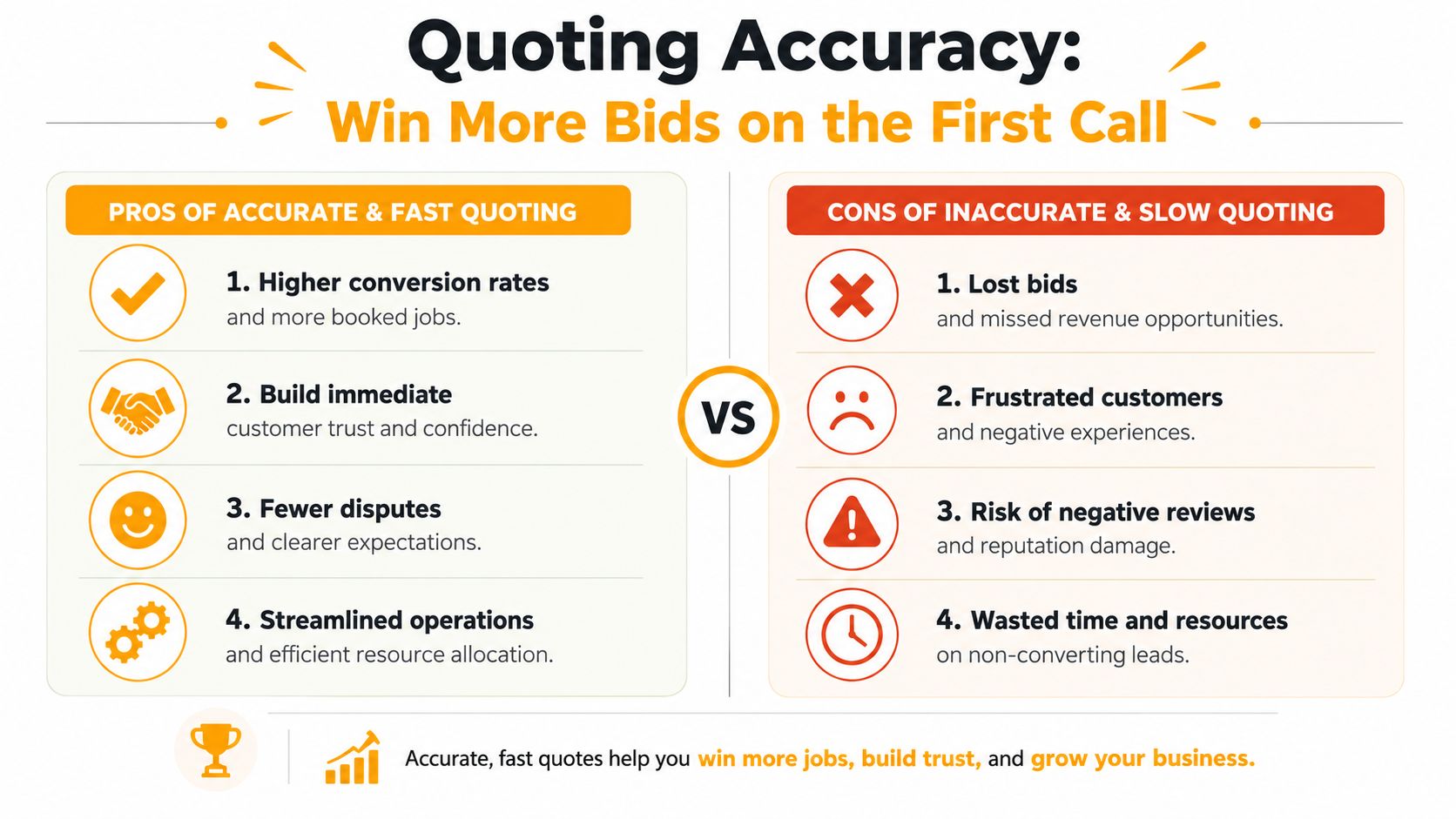
A fast answer is only half the sale. The quote is where trust either locks in or falls apart.
Why generic quoting loses trust
Moving quotes aren't simple. A two-bedroom walkup with a long carry is not the same job as a first-floor suburban move with easy access. The customer may not know the pricing logic, but they can tell when the person on the phone is guessing.
According to Boei's moving company lead generation analysis, generic AI tools often fail because 78% of moving leads convert only with quotes reflecting industry-specific pricing logic, and moving companies using AI trained on their actual rate cards see 2.3x higher booking conversion. That fits what experienced operators already know. Precision beats generic scripting.
A weak quote usually creates one of three bad outcomes:
| Quoting problem | What happens next |
|---|---|
| Too vague | Customer keeps shopping |
| Too low | Day-of friction and margin damage |
| Too slow | Another mover gets the booking first |
What better quoting looks like in a real moving office
Good quoting starts with the right intake questions. Not a long interrogation. Just the details that affect labor, time, and truck requirements.
That usually means asking about:
- Access conditions: Stairs, elevators, long carries, walkups
- Inventory profile: Bedrooms, bulky items, specialty pieces
- Service scope: Packing, disassembly, storage, shuttle needs if applicable
- Move timing: Date flexibility, building restrictions, preferred window
Then the quote needs to map to your real pricing rules. That's where many offices break down. One coordinator knows the logic. Another forgets the stair charge. Someone else rounds too aggressively to keep the lead warm.
Customers don't expect a miracle on the first call. They expect confidence, clarity, and a quote that sounds like it was built for their move.
If you want a benchmark for what strong intake and accurate moving quotes over the phone should look like, focus on consistency. The best front offices don't just capture names and dates. They turn the conversation into a bookable, operationally usable quote.
This is also why generic tools underperform in moving. Capturing a lead is not the same as closing a job. The mover who can quote accurately on the initial call has a real edge.
Your Action Plan for Booking More Jobs This Month
The fastest path to growth usually isn't “more leads.” It's a tighter chain between lead, quote, and booking.
Focus on the leaks first
If your company runs 5 to 20 trucks, the pressure points are predictable. Busy mornings. After-hours calls. Slow callbacks. Inconsistent quoting. Review requests that happen only when someone remembers. Those aren't small admin issues. They affect revenue directly.
A useful way to think about this comes from demand generation more broadly. This practical guide for B2B growth makes a distinction between generating interest and converting it into pipeline. In moving, that distinction is even sharper. Lead generation gets the phone ringing. Operations determines whether that ring becomes a booked job.
What to change this month
Don't try to rebuild the whole company at once. Fix the highest-impact points first.
- Audit missed calls by time block: Find where your intake process fails under load.
- Tighten your local presence: Make your Google Business Profile, reviews, and service-area pages reflect how you operate.
- Judge ads by booked work: Pause campaigns that create noise instead of profitable jobs.
- Standardize quote intake: Everyone should ask the details that affect pricing and scheduling.
- Create a review and referral habit: Turn completed moves into future revenue.
Most movers don't need more software clutter. They need automation and process that just work in the background while crews stay focused on service. The operators who win the next few years will be the ones who stop treating front-office leaks as normal.
If you want more booked jobs this month, answer faster, quote better, and make it easier for local prospects to trust you the first time they find you.
MoveJoy helps moving companies close more jobs by doing the part most tools miss. It answers inbound calls around the clock, generates accurate quotes using your own rate card, and books jobs directly into SmartMoving, Supermove, MoveitPro, or Google Calendar. If you want to stop losing revenue to missed calls, slow follow-up, and inconsistent quoting, explore MoveJoy.