Moving Company Software to Grow Your Business
When the phone rings, it's the sound of money. But what about the calls you miss? That’s not just a missed opportunity; it’s a hole in your pocket, leaking cash every time you're on a job or after you’ve locked up the office for the night.
Why Your Moving Company Is Leaking Revenue
Let's be real. If you run a moving company, you've felt the sting of a missed call. You get back to the office after a brutal day, check the voicemail, and hear a message from a customer who needed a quote six hours ago. You call back, but it's too late. They already booked with the company that answered first.
That's not just a lost lead. That's cash that walked right out the door.
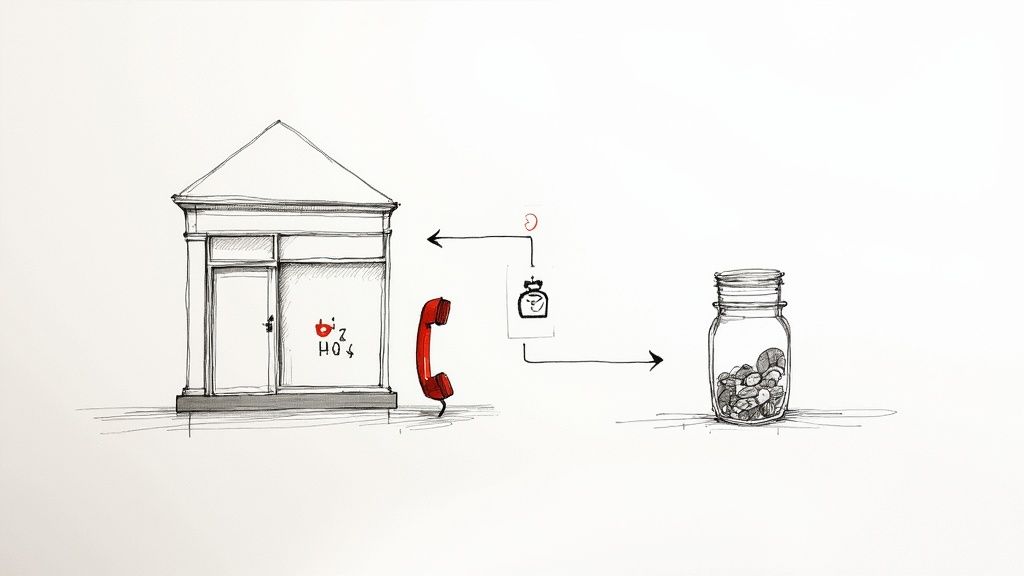
This happens constantly. The gaps in most moving operations are wider than owners realize, and the costs add up fast. This isn't about working harder—it’s about plugging the holes where your revenue is escaping.
The Real Cost of a Ringing Phone You Don't Answer
The numbers don't lie. When we talk to owners of small and mid-sized moving companies, we see the same patterns over and over. This isn't theory; this is what's hitting your bank account every single day.
- Unanswered Calls: During the busy season, it’s not uncommon to miss 15-25% of your calls. Your team is on a truck, stuck in traffic, or dealing with a customer face-to-face. Every one of those missed rings is a potential job booking with your competitor.
- After-Hours Goldmine: A surprising 35-40% of all moving inquiries come in after 5 PM or on weekends. If your phone just goes to voicemail, you're shutting the door on a huge slice of the market.
- The Price of One Missed Call: The average local move is worth over $1,000. Miss just one of those calls a day, and you could be losing over $5,000 a week during your peak months.
Do the math. It’s staggering. A small operation can easily leak $50,000 to $150,000 in annual revenue from these missed chances alone. This is the exact problem that modern moving company software was built to solve. It’s not a fancy tech upgrade; it’s a tourniquet for the financial bleed that's quietly killing your profit margins.
For a lot of movers, the biggest competitor isn't the company down the street—it's their own voicemail. The game is about capturing every single lead, instantly, without piling more work onto your already full plate.
From Chaos to Control
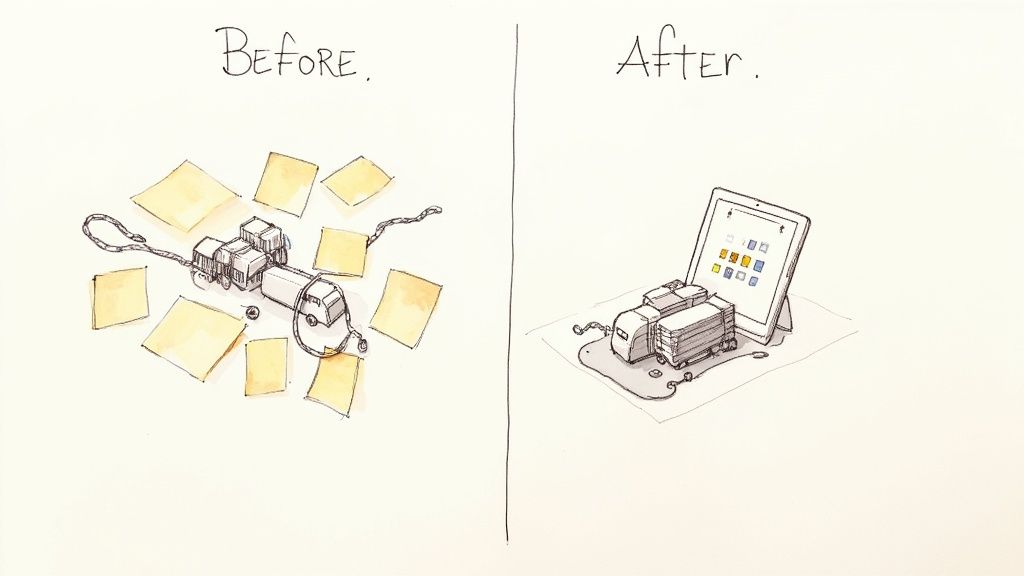
Right now, you’re probably juggling spreadsheets, sticky notes, and a calendar that looks like a war zone. This manual mess isn't just slow; it’s a breeding ground for expensive mistakes. Double-bookings, missed follow-ups, and quotes that are all over the place—they all drain your revenue. A solid moving company estimate template can help standardize your pricing, but that’s just one piece of a much bigger puzzle.
The goal here is to stop being reactive—chasing down missed calls and fixing scheduling fires—and become proactive. You need a system where leads are captured and qualified automatically, the second they reach out.
This is where the right software becomes your most valuable employee. It works 24/7, never calls in sick, and stops the leaks so you can get back to what you do best: running great moves and growing your business.
So, What Exactly Is Moving Company Software?
Let’s cut through the jargon. You're a mover, not an IT guy. When you hear "moving company software," don't picture confusing code or a dashboard with a million buttons. Think of it as your digital operations manager—the one reliable system that finally pulls your business out of the chaos of spreadsheets, sticky notes, and your overloaded cell phone.
Imagine a central hub that catches every single lead, whether they call you at 2 PM on a Tuesday or 2 AM on a Saturday. It fires off a professional quote, sticks the job on your calendar, and sends a confirmation to the customer, all without you having to lift a finger. It’s the difference between trying to move a three-bedroom house with just a pickup truck versus showing up with a fully-equipped 26-foot rig. One is chaotic, exhausting, and asking for trouble. The other is professional, efficient, and profitable.
The Central Nervous System for Your Business
At its core, good moving software replaces chaos with control. It acts like a central nervous system for your whole operation, plugging every critical piece of your business into one single platform. This isn't just a small upgrade; it’s a fundamental change in how you run your business day-to-day.
This system takes all the scattered, manual tasks that eat up your time and puts them on autopilot.
- Lead Capture: No more scribbled notes or missed voicemails. Every single inquiry is logged and organized.
- Quoting: It gets rid of the guesswork. You get consistent, professional estimates sent out in minutes.
- Scheduling: The nightmare of double-bookings is over. Everything syncs to one central calendar.
- Customer Communication: It keeps your customers in the loop with automated reminders and follow-ups, so you don't have to.
This isn’t just some tech trend; it's quickly becoming the standard for any moving company that wants to grow. The global market for this kind of software is projected to jump from USD 16.03 billion in 2025 to USD 38.11 billion by 2035. That’s a loud and clear signal that movers are ditching the old ways for smarter, cloud-based tools. You can dig into these moving industry technology trends and see the data for yourself.
Think of it this way: your software is your best salesperson and your most organized dispatcher, rolled into one. It works 24/7, never drops the ball, and makes sure you're always the first to respond to a new lead.
It's More Than Just a Digital Calendar
Look, at the end of the day, this software is about one thing: booking more jobs with less effort. It’s not about adding another complicated tool to your plate. It’s about putting a system in place that handles the tedious, repetitive work for you.
For an owner-operator or a small fleet, this is a total game-changer. When you’re out on a truck, you can’t be answering the phone. When you’re finally home with your family, the last thing you want to do is chase down leads. The right platform handles that entire front-end sales process. This frees you up to focus on giving great service and training your crew, knowing that your business is still capturing every single opportunity in the background. It turns those missed calls—which can easily cost you anywhere from $50,000 to $150,000 a year—into booked jobs, putting money directly back into your pocket.
Core Features That Drive Your Bottom Line
Alright, let's cut through the noise. You don't need a thousand bells and whistles; you need a few powerful tools that plug the holes where money is leaking out of your business. The right moving company software isn't about flashy tech—it's about solving the real-world operational headaches that cost you jobs.
When you're comparing options, these are the non-negotiables. Think of them as the pillars holding up a profitable operation. They're the features that deliver a clear, measurable return by fixing the exact reasons you're losing work right now.
Good software brings order to the chaos. It connects your lead capture, your quoting, and your schedule into one cohesive system so nothing ever falls through the cracks.
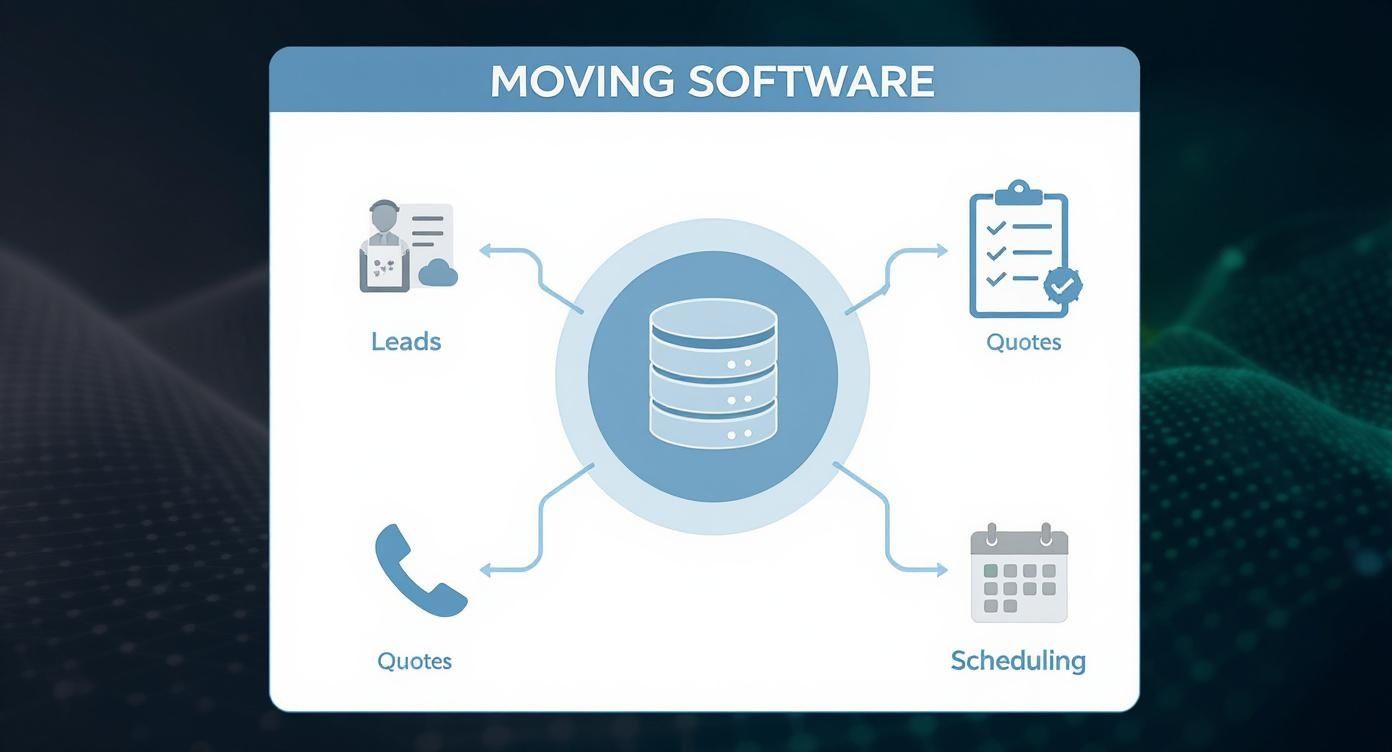
This is the basic idea: a central brain that makes sure your left hand (sales) always knows what your right hand (operations) is doing.
24/7 Automated Phone Intake
This is the big one. The absolute game-changer. You already know that a huge chunk of your potential customers—somewhere around 35-40%—are calling after you've locked up for the day. If those calls hit a voicemail box you won't check until 9 AM tomorrow, you've already lost the job. Guaranteed.
An automated phone intake system is your secret weapon. It’s your best employee, working around the clock without needing a coffee break. When a call comes in at 9 PM on a Saturday, it doesn't just ring and ring. It gets answered. Instantly.
This isn't some clunky robot frustrating your customers. It’s an intelligent assistant that greets them professionally, asks the right qualifying questions about their move, and gathers all the essential details you need.
This single feature transforms your biggest vulnerability—missed calls—into your greatest strength. You start booking jobs while you sleep, turning what was once lost revenue into guaranteed work on your calendar.
This isn't some futuristic fantasy; it's rapidly becoming the standard. In fact, industry projections show that by 2025, an estimated 95.6% of moving companies will rely on at least one type of software for their operations. The smart operators are automating everything from vehicle tracking to booking.
Instant, Intelligent Quoting
Let me ask you something. How long does it take you to get a quote back to a customer right now? An hour? End of the day? By the time you call them back, they’ve already gotten three other estimates and are close to booking.
In this business, speed wins. The first company to put a professional, accurate quote in a customer's hands has an enormous advantage.
Modern software automates this entire race. It takes the details gathered from the initial call—home size, distance, special items—and generates an accurate estimate. Then it texts that quote directly to the customer's phone. The whole process takes seconds, not hours.
This does two critical things for you:
- You beat your competitors to the punch. You look incredibly responsive and professional while they're still scrambling to return calls.
- You filter out the tire-kickers. Serious customers get the info they need immediately, and you don't waste an hour on the phone with someone who was just price-shopping from the start.
To see just how much this can tighten up your sales process, take a look at our deep dive into how moving company estimate software helps you close deals faster and more consistently.
Seamless CRM and Calendar Integration
A messy schedule is a profit killer. We’ve all been there. Double-bookings that lead to furious customers. Forgetting to follow up with a promising lead. It’s chaos, and it’s expensive. Good software acts as the central command center for your entire operation.
The key here is seamless integration. It has to play nice with the tools you already rely on, like Google Calendar. When a job gets booked—whether it's automatically by your phone system at midnight or manually by you during the day—it should instantly appear on your master schedule, blocking off the crew and truck.
This simple connection eliminates the human error that costs you so much. No more "I forgot to write it down" or "I thought you told them." Everything is in one place, updated in real-time, giving you a crystal-clear view of your day, week, and month. It’s what separates the pros from the guys who are constantly putting out fires.
How To Choose The Right Software For Your Business
Let’s be honest, not all moving software is built the same. A system designed for a massive national van line is a clunky, overpriced nightmare for a guy running five trucks. You need a tool that fits your business—something simple, powerful, and built for an owner who’s still out on the truck, not sitting behind a desk all day.
Choosing the right software isn't just about buying a tool; it's about finding a partner. This decision is an investment in your company’s future, so it pays to ask the right questions and look past the slick sales pitch.
Your Practical Evaluation Checklist
When you're watching a demo, it's easy to get wowed by features that look cool but don't actually solve your biggest headaches. You have to cut through the noise and focus on what really matters to a business your size. The goal is to find something that makes your life easier and your business more profitable, starting from day one.
Here’s a no-nonsense checklist to keep you grounded:
- Can I set it up myself? Today? You don’t have an IT department. You need a system you can get running in minutes, not weeks. The setup should be as simple as connecting your phone number and syncing your Google Calendar.
- Is the pricing honest? Watch out for hidden fees, long-term contracts, and confusing pricing tiers designed to trap you. You need a straightforward cost that grows with your business, not one that locks you into a plan you can't afford.
- Do they actually get the moving business? When you call for help, you should be talking to someone who knows the difference between a studio apartment and a three-bedroom house. Generic tech support is useless when you’re dealing with industry-specific problems.
A great software provider is more than just a vendor; they're an advisor. They've seen what works for hundreds of other moving companies just like yours and can offer practical advice, not just technical support.
Finding a Partner, Not Just a Vendor
Think of it this way: the right software partner is invested in your success. They should be able to show you exactly how their system will help you book more jobs and stop leaving money on the table. They should be talking about outcomes—like how to capture the 35-40% of leads that call you after hours—not just listing a bunch of technical features.
During your evaluation, ask them straight up about the ROI. Ask, "If your system helps me book just two extra jobs a month, what does that look like for my bottom line?" With an average job value of over $1,000, the math gets pretty clear, pretty fast. You can dive into a detailed comparison of the best software for moving companies to see how different platforms stack up on these critical points.
A Critical Note on Your Data
Finally, let’s talk about your data. Your customer list is one of your most valuable assets. It’s the result of your hard work, your marketing dollars, and your reputation. Under no circumstances should that data belong to anyone but you.
Before you sign anything, get a clear, simple answer to this question: Who owns my customer data?
The only acceptable answer is, "You do." Period.
Your software partner must guarantee that your information is secure, protected, and always your property. Look for enterprise-grade security. This isn't just a "nice-to-have"; it's a non-negotiable. You’re trusting a system with your entire business, so make sure it's built on a foundation of security and respect for your ownership. This is about protecting your legacy and making sure you’re always in control of your company’s future.
How This Actually Works for Guys Like You
Theory is one thing, but what matters is what happens on the truck and on your balance sheet. All this talk about features is pointless until you see how it works for a real business—one that probably looks a lot like yours. Let's look at some stories from other movers who plugged the leaks in their bucket and got their business back under control.
These aren't giant corporations with unlimited cash. They're hardworking guys facing the same daily grind you are: missed calls, leads going cold, and the constant stress of juggling sales and operations.
From Drowning in Calls to Booking More Jobs
One of our partners runs a solid five-truck operation down in Texas. Every spring, it was the same story. The phones would blow up, and he and his small office team were completely swamped. They were losing leads to voicemail every single hour because they were either stuck on another call or out dealing with a job.
He knew he was leaving money on the table but couldn't justify hiring another full-time office person just for the busy season. It was a trap—either miss out on profitable work or take on payroll he couldn't afford year-round.
This is where an automated intake system changed everything. Instead of ringing until it hit voicemail, every call got answered instantly. The system qualified the lead, gathered the key move details, and shot over a quote by text, all on its own.
The result? In the first month, he captured an extra $15,000 in booked jobs. This was work that previously would have vanished into the voicemail void. He didn't have to hire anyone; he just put a system in place to make sure no opportunity was ever missed again.
Waking Up to a Fuller Calendar
Here's another great one from a two-truck owner-operator in Florida. He's on the truck busting his hump all day and, like most of us, wants to shut things down at night. The problem was, a huge chunk of his potential customers—around 35-40%—were searching for movers after 6 PM. Every morning, he’d come in to a handful of voicemails, but by the time he called back, most had already booked with a competitor who answered the phone.
He was literally sleeping while his competition was stealing his jobs.
By setting up a 24/7 automated system, he turned his biggest weakness into a huge advantage. Now, when a customer calls at 10 PM, they don’t get a recording. They get a professional response, an instant quote, and can book the job right then and there. He now regularly wakes up to new, confirmed jobs on his calendar that were booked while he was asleep. This simple shift stopped the after-hours revenue leak and created a steady stream of work he was missing out on completely.
This move toward automation is a big reason the moving software market in North America is exploding, growing from USD 827.2 million in 2021 to a projected USD 1.108 billion in 2025. More movers are realizing these tools aren't a luxury; they're essential for growth. You can dig into the specifics of these moving software market trends if you want to see the numbers.
These stories aren't outliers; they're becoming the new standard for movers who want to be profitable. The right moving company software isn't an expense. It’s a tool that pays for itself almost immediately by capturing the revenue you're already earning but failing to collect.
Your Simple Implementation Plan
Look, I get it. The idea of adopting new software sounds like one more headache to add to an already packed schedule. You don't have time for a six-week training course or some complicated setup that requires an IT degree.
The good news? Getting started with the right kind of moving company software isn’t like that at all. It should be a simple, straightforward process that starts paying you back almost immediately. Think of it less like a major construction project and more like flipping a switch. The whole point is to get you from leaking revenue to booking more jobs in a few simple steps, without messing up your daily operations. A good partner does the heavy lifting so you can stay focused on running your moves.
Your Quick-Start Roadmap
Getting you up and running should be a clear, three-phase process. It's designed to be fast, easy, and focused entirely on getting you results—specifically, capturing every single lead that comes your way.
Here’s what that looks like:
- The Kick-Off Call (About 30 Minutes): This isn't a sales pitch. It’s a strategy session. We’ll dig into your specific challenges. Are you missing too many calls during the day, or is the after-hours gap your biggest money pit? We'll map out your goals and make sure the system is set up to solve your biggest revenue leaks first.
- The Setup (Less Than 15 Minutes): This is where people usually get nervous, but it couldn't be simpler. You don't need to be a tech person. The entire "technical" part is connecting your business phone number and syncing your Google Calendar. That’s it. From that moment on, every call is captured and every booked job lands on your schedule automatically.
- Team Training (As Easy as Using Your Phone): The best software is the kind you don't have to learn. There’s no complex dashboard or confusing interface. If you and your crew can use a smartphone, you can use this system. We’ll show you where to see your new leads and your booked jobs, but the system itself does all the real work in the background.
The question I hear most is, "How long until this actually starts working?" The answer is: immediately. The second your phone number is connected, our system is on the job, 24/7. You could literally book your first automated job that same night while you’re asleep.
Built For Movers, Not Tech Wizards
This whole process is designed around the reality of your business. You’re on the truck, in the office, or trying to have dinner with your family—you don’t have time to become a software expert. The right platform is built to work for you from day one, not create more work for you. It’s about making your business more profitable and your life a little easier.
The path to a more efficient operation is way shorter than you think. It's not about overhauling your entire business; it's about plugging one or two critical holes that are costing you tens of thousands of dollars a year. Let's talk about building a simple plan that fits your company and starts putting that lost revenue back in your pocket.
Got Questions? Here Are Some Straight Answers.
We hear the same questions from owners all the time. Here are some real-world answers, based on the reality of running a moving business, not some tech startup.
How Much Does This Stuff Actually Cost?
Prices are all over the map, but you should look for a model that grows with you instead of hitting you with a massive upfront fee. Most modern systems use a subscription that scales up as your business does.
But here’s how I’d think about it: this is an investment, not just another bill. If the software books just one or two extra jobs a month—and each of those is worth over $1,000—it’s already paid for itself. The real focus should be on the ROI, like getting back that $50,000 to $150,000 in revenue you might be losing to missed calls, not just the monthly subscription cost.
Can My Crew Actually Learn This Without a PhD in Computers?
Absolutely. The best systems are built for guys on a truck, not Silicon Valley engineers. Your team is busy lifting furniture and navigating traffic, not sitting behind a desk clicking through complicated menus. Look for something that feels intuitive right out of the box and doesn't throw a wrench in your daily flow.
Any provider worth their salt will offer real, hands-on support to get you and your crew comfortable from day one. The whole point is to make your life easier and your business more profitable, not to add another headache to your plate.
Does This Play Nice With the Tools I Already Use?
It has to. Any modern moving software that doesn't is just another siloed-off app creating more work for you. It should be the central hub that connects everything.
At a minimum, you need to look for these integrations:
- Your Calendar (Google Calendar, etc.): This is completely non-negotiable. It's what stops you from double-booking a truck and having to make that awful "we messed up" phone call.
- Your CRM: This is where all your customer history and notes live. Tying it together means you never drop the ball on a follow-up or forget a key detail about a customer's move.
When everything talks to each other, you get a smooth workflow and stop wasting time bouncing between five different apps just to manage one job.
How Long Until I’m Actually Up and Running?
Way faster than you think, provided you pick the right partner. A good, clean onboarding process should have you capturing leads within a couple of days, not weeks or months. The software provider should be doing all the technical heavy lifting. Your job is to focus on what you do best—running your moving company.
Ready to stop letting revenue slip through the cracks and actually book the jobs you're paying to generate? The team at MoveJoy can give you a dead-simple plan to capture every single lead, even when you’re on-site or after hours. Let's find out how much we can add to your bottom line. Learn more at getmovejoy.com.