
You’re probably reading this between calls, jobs, and follow-ups that should’ve happened yesterday.
A customer calls while you’re walking a crew through a tight downtown loadout. You let it go to voicemail because the truck is double-parked and one mover has a question about access. By the time you call back, the customer already booked with the company that answered first and gave a clear price. That’s how a lot of moving revenue disappears. Not in dramatic blowups. In ordinary moments.
For small and mid-sized movers, moving company rate card software matters because it closes the gap between interest and commitment. Plenty of systems can store lead details. Plenty of people can take a message. What wins booked jobs is the ability to turn a live inquiry into an accurate quote based on your own pricing rules, without hunting through spreadsheets or texting the office manager for stair charges.
Early in the buying process, owners usually compare software by feature count. That’s not the right lens. The core question is simpler. Does the system help you quote faster, quote more accurately, and book jobs with less admin friction?
Here’s how to evaluate rate card software like an operator who cares about margin, not just software screens.
The Hidden Cost of a Ringing Phone
The phone rings at 6:42 p.m. A prospect wants a move next Saturday. They’re calling after work because that’s when they finally had time to think about it. Your office is closed, your dispatcher is done for the day, and you’re still wrapping up a job that ran long.
You don’t just miss a call in that moment. You miss the booking window.
Most moving customers don’t behave like commercial accounts with a long buying cycle. They call a few movers, ask roughly the same questions, and go with the one that responds quickly, sounds organized, and gives them confidence that the quote won’t change for bad reasons later. If your process depends on “we’ll get back to you tomorrow,” you’re already behind.
Manual quoting leaks revenue in quiet ways
The problem usually isn’t effort. Owners and office teams work hard. The problem is that the quoting process lives in too many places at once.
Maybe your rates sit in:
- A spreadsheet only one person really understands
- A printed tariff binder with handwritten updates
- A notes app on someone’s phone
- Team memory about what to charge for stairs, long carries, or awkward access
That setup works until volume rises. Then the cracks show. A rep forgets to add travel time. Another quotes the wrong truck configuration. Someone promises a flat rate based on an old rate sheet. None of this feels catastrophic in the moment. Over a month, it becomes a margin problem and a booking problem.
Practical rule: If your best estimator is also your only reliable source of pricing truth, you don’t have a system. You have a bottleneck.
The call matters less than the quote
A lot of movers try to solve missed revenue with better call coverage alone. That helps, but only halfway. Answering is not the same as closing.
If the person answering can’t confidently produce a quote using your actual pricing logic, the customer still leaves the call without a reason to book. They may have had a pleasant interaction, but you haven’t moved the sale forward. In a fast shopping window, that’s often the same as losing the job.
That’s why rate card software deserves more attention than it usually gets. It isn’t just an office tool. It’s the mechanism that turns inbound demand into booked work.
What Is Moving Company Rate Card Software
Moving company rate card software is the pricing brain of your business. It stores your rules once, then applies them consistently every time your team builds a quote.
That sounds basic, but it changes how a moving company runs. Instead of relying on memory and patchwork documents, you centralize the logic behind how you charge. Hourly labor, truck fees, travel time, fuel-related adjustments, packing, valuation-related line items, stairs, long carries, elevator constraints, special handling, local versus long-distance logic. The system turns those variables into a usable quote structure.

The category is no longer niche. The global moving company software market, which includes automated quoting and rate card tools, was valued at approximately $2.18 billion USD in 2024, and 95% of moving companies already utilize some form of software. Full-featured solutions with rate card integration typically range from $150–$500 per month, according to this moving company estimate software overview.
Think of it as stored business judgment
A good rate card system doesn’t replace judgment. It captures the judgment you already use so the business can operate consistently.
If you’ve been in the industry long enough, you already know the questions that affect price:
| Pricing input | What it changes in the quote | Why it matters operationally |
|---|---|---|
| Job size and inventory | Crew size, truck need, time estimate | Prevents under-scoping |
| Distance and travel conditions | Drive time and route pricing | Protects schedule realism |
| Building access | Stair, elevator, long carry charges | Preserves margin on hard jobs |
| Service mix | Packing, unpacking, materials, storage | Raises ticket value cleanly |
| Move type | Hourly or flat-rate logic | Keeps billing aligned with job type |
When those rules live in software, a new salesperson can follow the same pricing structure as your most experienced estimator. That reduces quote drift. It also makes your business less fragile when one key office person takes a day off.
What it replaces
Owners often ask whether this is just a nicer calculator. It isn’t.
A calculator gives you math. A rate card platform gives you repeatable pricing logic, connected to operations. That difference shows up in a few practical ways:
- Less rework: Reps don’t need to rebuild quotes from scratch every time.
- Fewer exceptions: Your team stops improvising on common charges.
- Cleaner handoff: Sales, dispatch, and billing work from the same pricing assumptions.
- Better customer trust: The quote feels organized because it came from a real system, not guesswork.
A mover with 3 trucks and a mover with 18 trucks have different complexity levels, but they need the same thing from pricing. One source of truth.
What weak systems get wrong
A weak setup usually fails in one of two ways. It’s either too generic, so it can’t reflect how movers price jobs, or it’s too dependent on one power user who knows all the hidden workarounds.
The best systems make your pricing easier to maintain, not harder to decode. If changing one stair charge requires a consultant, or if your staff keeps side notes because they don’t trust the software output, the system isn’t doing its job.
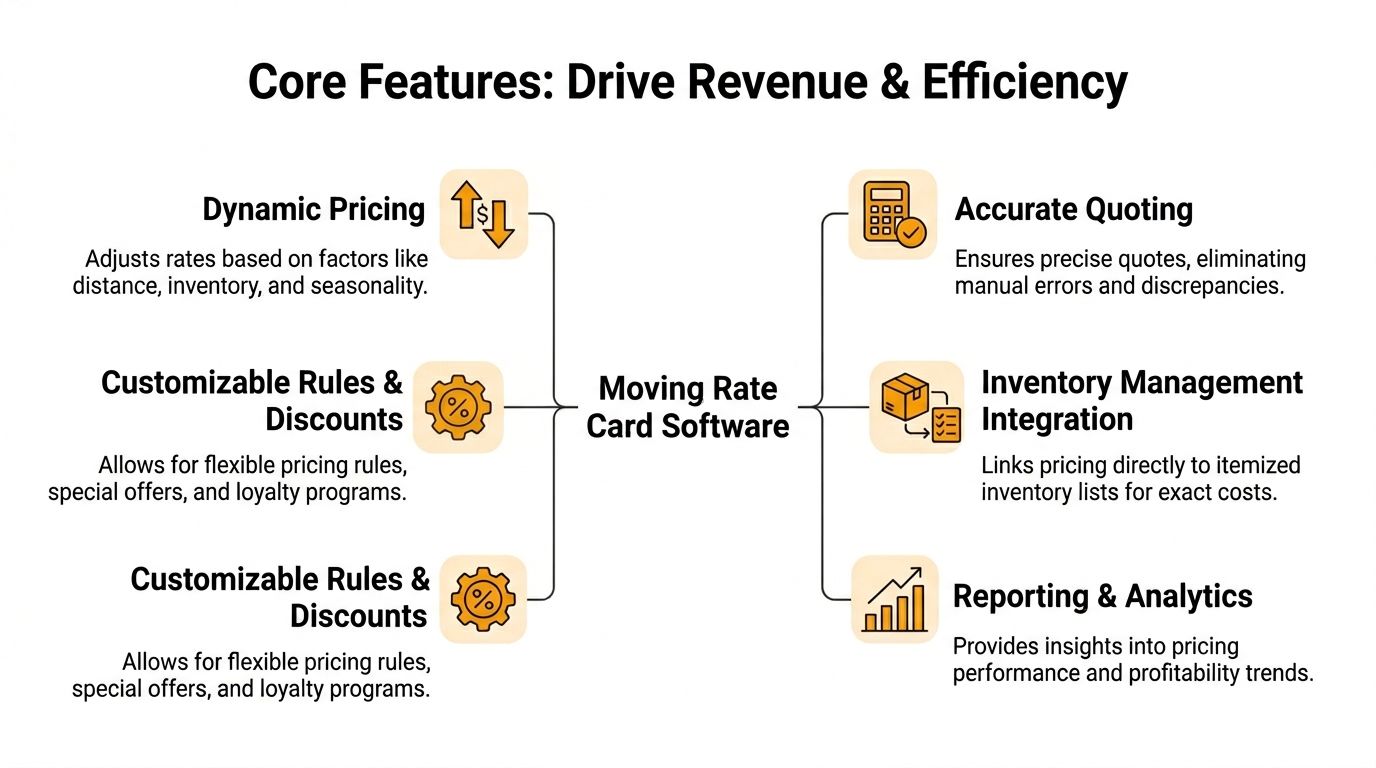
Core Features That Drive Revenue and Efficiency
Owners don’t buy software because they want better menus and buttons. They buy it because the right workflow helps them book more jobs with fewer mistakes. That’s the true standard.
A strong rate card platform earns its place when it removes delay from quoting, keeps pricing consistent, and reduces admin friction between sales and ops.
Here’s the high-level picture.
| Capability | What it does for the business | What happens without it |
|---|---|---|
| Automated quoting | Turns inquiry details into a usable estimate fast | Leads cool off while staff chase info |
| Centralized pricing rules | Keeps all reps on the same pricing logic | Every estimator quotes a little differently |
| CRM and dispatch connection | Carries quote data into booked job workflow | Staff re-enter details and create errors |
| Reporting visibility | Shows what’s being quoted and booked | Owners manage by gut feel |
| Moving-specific rule support | Handles real moving charges properly | Margin leaks through missed line items |
Integrated platforms with rate card functionality outperform standalone estimators by 25-50% in operational efficiency, and top tools use AI to cut estimate delivery from hours to under 30 minutes, according to this moving software comparison. For 1-20 truck firms, the same source notes that recovering just one booking often covers the typical $149–$499 monthly software cost.
Fast quoting wins jobs
Most local movers don’t lose jobs because their brand is unknown. They lose jobs because another company responded faster with enough detail to sound trustworthy.
That’s why automated quote generation matters. A system that can pull from inventory assumptions, labor logic, truck needs, and access charges gives your team a head start. Instead of saying, “Let me work this up and email you later,” they can move the customer closer to a decision while the lead is still warm.
This is especially useful for operators who still quote between field tasks. When the office isn’t fully staffed, speed becomes a survival issue, not a convenience issue.
Centralized rate management protects margin
Raising or adjusting rates sounds simple until you realize how many places outdated pricing can hide. One rep updates the new base hourly rate. Another still has an older template saved on their desktop. Your after-hours process still references an old weekend minimum.
With centralized rate management, you update the rule once and the quoting engine applies it going forward. That matters most during seasonal swings, high-demand weekends, and periods when your costs shift faster than your office habits do.
If your rates changed last month and you’re not sure every estimator is using the new version, you’re still pricing manually.
Integration cuts duplicate work
The software should not stop being useful after the quote is sent. If a customer says yes, the quote should feed the next step cleanly.
That means the useful platforms connect quoting to the rest of the workflow:
- Sales handoff: Customer details, job notes, and pricing assumptions stay attached.
- Dispatch readiness: Crew size and service needs transfer without a second build.
- Billing consistency: The final invoice starts from the same rule set as the estimate.
- Follow-up visibility: The office can see which quotes are open, pending, or dead.
When this handoff breaks, office staff become translators between systems. That’s expensive in time and dangerous in peak season.
Reporting shows where quoting goes wrong
A lot of owners think of rate cards as purely operational. They’re also a management tool. If you can’t see which quote types close, which lead sources produce profitable work, or where reps override pricing most often, you can’t improve the process.
Useful reporting doesn’t have to be elaborate. It just needs to answer practical questions. Are flat-rate jobs being quoted consistently? Are certain access charges regularly missed? Are some reps discounting too freely? The right software makes that visible.
The features that matter most for smaller movers
For a 1-20 truck operation, the most valuable setup usually isn’t the most customizable on paper. It’s the one that handles your real-world quoting rules without adding office burden.
Focus on systems that do these five things well:
- Price as movers price. Hourly, flat-rate, tariffs, travel, stairs, and access issues should all be native logic.
- Shorten response time. Faster estimate turnaround gives customers less reason to keep shopping.
- Reduce admin drag. Good software cuts down on re-entry and quote cleanup.
- Support growth without chaos. A new rep should be able to follow the same pricing framework.
- Keep the field and office aligned. Sales promises and dispatch reality should match.
That’s how software turns into a revenue tool rather than a back-office expense.
The Real ROI Calculating the Value of Automated Quoting
The easiest mistake owners make is comparing software cost to zero. That’s not the actual comparison. The actual comparison is software cost versus what manual quoting already costs you in lost bookings, slow follow-up, and preventable mistakes.
Dedicated rate card software allows companies to recover 1-2 lost leads per month, generating an extra $1,500–$6,000 in monthly revenue, while also saving 5-10 hours weekly on dispatch and quoting, according to this analysis of moving software ROI. That same source also notes reduced payroll and booking errors.
A simple owner-level ROI check
You don’t need a finance team to evaluate this. Use a basic three-part test.
| ROI driver | Practical question | Why it matters |
|---|---|---|
| Recovered bookings | How many jobs do you lose because response is slow or inconsistent? | One saved job can change the math quickly |
| Saved admin time | How many office hours go into quote building, corrections, and follow-up? | Time saved can support more bookings without more payroll |
| Margin protection | How often do missed charges or bad assumptions show up? | Underbidding hurts more than software cost |
If your office regularly scrambles to return calls, rebuild quotes, or clean up job details after booking, there’s already a hidden cost sitting in the workflow.
Run the math conservatively
Use conservative assumptions. Don’t build a rosy spreadsheet just to justify a purchase.
Start here:
- Recovered lead value: If you recover even one of the lost leads described above, that can offset much of the monthly spend.
- Time returned to staff: If your team gets back part of the 5-10 hours weekly that software can save on dispatch and quoting, that time can go toward follow-up, scheduling, or handling more volume.
- Error reduction: If a cleaner process prevents even a few quoting or payroll mistakes, the savings don’t show up as a flashy metric, but they show up in cleaner jobs and fewer office headaches.
Owners usually underestimate the cost of quote lag because it doesn’t hit one line item. It shows up across sales, dispatch, and customer confidence.
A useful outside example is how other trade businesses think about pricing systems. This Electrician Pricing Guide is worth a read because it shows the same underlying lesson. Once pricing becomes structured and repeatable, the business stops depending on memory and rushed judgment.
Don’t ignore the compounding effect
The first gain isn’t just one extra booked job. It’s the knock-on effect of a cleaner front office.
When quote turnaround improves, your team follows up from a stronger position. When job details enter the system correctly, dispatch doesn’t have to reinterpret a salesperson’s notes. When billing starts from the same assumptions used in the estimate, the customer sees a more consistent experience.
If you want a fast sanity check for your own operation, use a purpose-built moving software ROI calculator and compare your current leakage against what even modest automation could recover.
For most movers, the surprise isn’t that software has a return. It’s how long they’ve been absorbing the losses without labeling them.
Integration How Rate Card Software Powers Your Workflow
A rate card on its own is helpful. A rate card connected to the rest of your operation is where its maximum effectiveness is achieved.
The cleanest moving businesses use pricing as a shared operational layer. Sales uses it to quote. Dispatch uses the resulting job details to schedule correctly. Billing uses the same structure to avoid surprise discrepancies. That’s what people mean when they talk about software “working together,” but in moving, the details matter more than the buzzword.
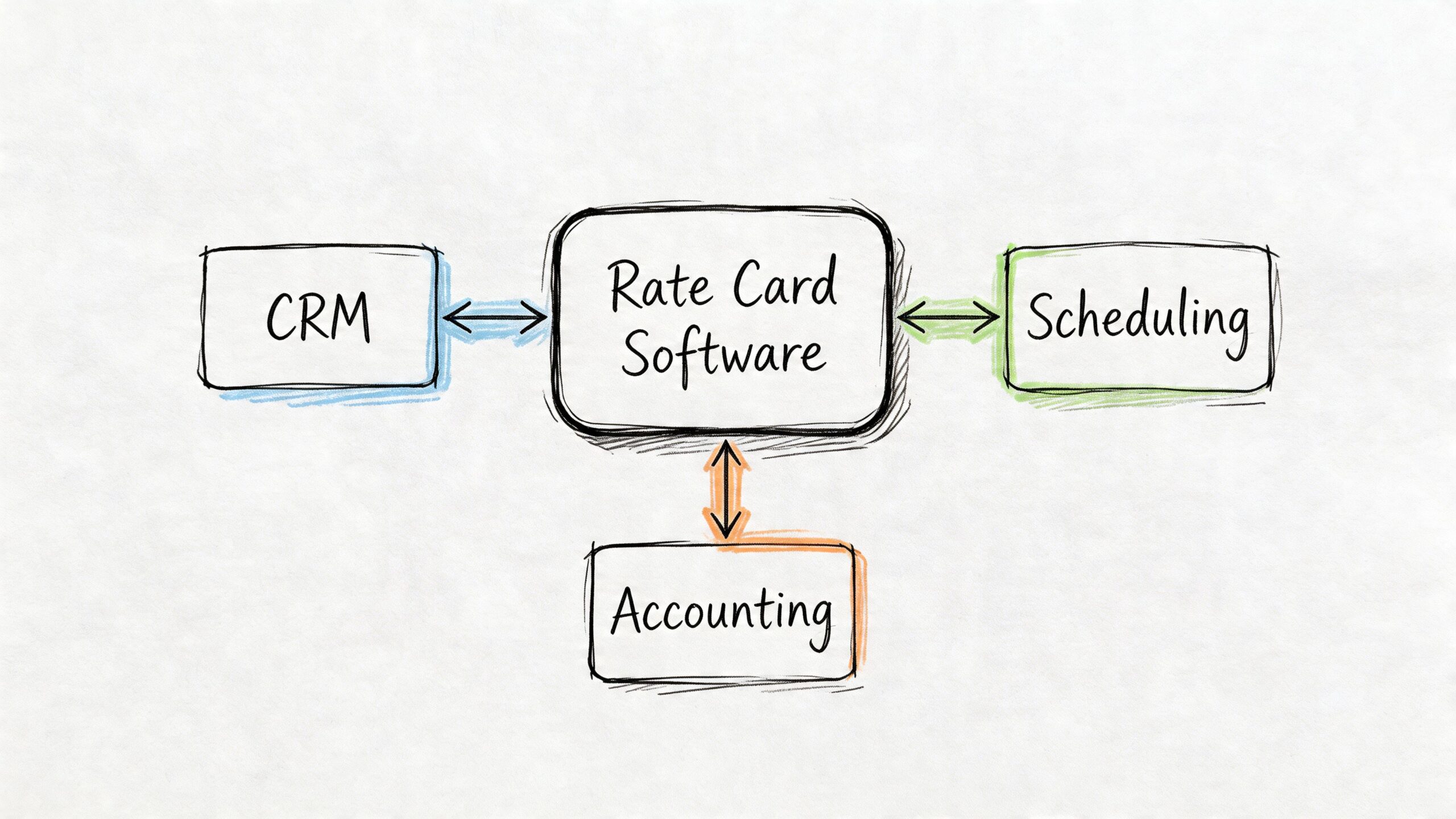
Leading platforms such as MoveitPro, SmartMoving, and Supermove offer integrated rate card engines, but success depends on handling moving-specific logic like state tariffs, hourly crew costs, and stair charges. Generic tools often fail on that logic, leading to 20-30% revenue leakage, especially in 1-5 truck operations, according to this software comparison for movers.
The rate card should be the source of truth
In a well-run workflow, the quote isn’t a separate document floating around in email. It’s the starting point for execution.
That means your software should connect these steps:
- Lead intake: Customer details and move basics enter the system once.
- Quote logic: The rate card applies your pricing rules consistently.
- Booking: Accepted quotes convert into scheduled jobs without re-keying.
- Dispatch: Crew, truck, timing, and service notes move with the job.
- Billing and closeout: The financial record starts from the original pricing structure.
If one of those steps breaks, the office starts compensating manually. That’s where errors creep in. The salesperson thinks the job is a simple third-floor walkup. Dispatch only sees “apartment move.” The crew arrives and discovers the quote missed a long carry and a service add-on.
Why generic systems keep disappointing movers
A lot of operators have already tried “good enough” software from outside the moving category. It usually looks promising in a demo because generic systems are fine at storing contacts and tasks.
They break down when pricing gets specific.
A moving quote has to account for job type, service level, labor assumptions, truck allocation, access complexity, and timing. Generic platforms can capture lead information, but they often can’t calculate moving-specific charges in a way your team trusts. Once trust is gone, reps start building side spreadsheets again.
The moment your team says, “I’ll just calculate this one outside the system,” integration is already failing.
CRM is not the whole front end
This is another common confusion. A CRM is good at organizing leads, tracking status, and preserving customer history. It is not automatically good at quoting live, especially when the inquiry comes in after hours or during a call rush.
That front-end gap matters. A moving company can have a solid CRM and still lose jobs because nobody converts the inquiry into a priced offer fast enough. The strongest workflow fills that gap with automation that can use your own rate card logic during intake, then push the result into the systems your office already uses.
That’s why owners looking at software should think beyond “Does it integrate?” and ask a better question: does it remove the handoff delay between inquiry and quote?
For operators building a more connected stack, this broader guide to a CRM for service business workflows is useful because it shows how intake, quoting, and follow-up need to work as one process rather than separate tools.
What a healthy workflow looks like
You don’t need a huge tech stack. You need a connected one.
A healthy workflow usually looks like this:
- One pricing framework: No hidden side documents or unofficial rate sheets.
- One customer record: Notes, quote data, and booking status stay together.
- One handoff path: Sales doesn’t throw work over the wall to ops.
- One follow-up process: Open quotes don’t disappear after the first call.
When those conditions are in place, software stops feeling like another thing to manage. It starts acting like operational discipline built into the business.
Your Migration Checklist for Choosing the Right Software
Switching software is where good intentions go sideways. Owners buy a platform because the demo looks polished, then find out the setup doesn’t reflect how they price jobs. A month later, the team is still using old spreadsheets “just for certain quotes.”
That usually happens because the buying process focused on features instead of fit.

One of the biggest gaps in software guidance is how movers should structure dynamic rate cards for changing market conditions. Tools can adjust rates, but there’s little practical guidance on how often independent movers should update pricing for seasonality or local competition. That gap matters for companies losing $50K–$150K annually from missed calls, as noted by PricePoint’s product overview.
Questions to ask before you sign
Use these questions in every demo and every internal discussion.
- Can it handle your real pricing rules? Ask specifically about hourly pricing, flat-rate jobs, travel time, long carries, stairs, elevator jobs, and any state or distance logic you use.
- Can your team maintain it without outside help? If every pricing change requires vendor intervention, your rates will go stale.
- Does it support seasonality cleanly? Busy season pricing shouldn’t require workarounds or duplicate templates.
- What happens after the quote is accepted? If booking still requires manual re-entry, you’ve only solved half the problem.
- How visible are overrides and exceptions? You want to know when reps are pricing outside the rules.
Pay close attention to setup reality
Implementation is where a lot of software projects get judged. Not because owners are impatient, but because moving companies don’t have spare office capacity to babysit bad onboarding.
Watch for these warning signs:
| Good sign | Warning sign |
|---|---|
| The vendor asks detailed questions about your pricing logic | The vendor gives a generic setup checklist |
| Your team can test sample quotes before launch | You’re expected to trust a template blindly |
| Rate updates look simple inside the admin area | Changes require support tickets for basic edits |
| The booking handoff is clearly mapped | Nobody can explain what happens after “send estimate” |
Dynamic pricing needs owner discipline
A lot of movers often need a more practical framework. The software can make updates easier, but it won’t decide your pricing strategy for you.
You should have a repeatable habit for reviewing:
- Busy season pressure: When capacity tightens, old rates may stop matching demand.
- Local competition: If your market shifts, your quoting logic should be reviewed, not guessed at.
- Job difficulty patterns: If certain move types keep causing disputes or thin margins, update the rate card.
- Service packaging: Packing, storage, and special handling should be priced intentionally, not added ad hoc.
A useful comparison comes from compliance software buying. This article on AOBRD vs. ELD is in a different industry, but it shows a familiar lesson. Buyers often get tripped up when they focus on category labels instead of how the tool fits day-to-day operations. The same mistake happens with moving software.
Good software doesn’t remove the need to manage pricing. It removes the chaos of managing pricing in five places.
A simple migration approach that works
If you’re moving off spreadsheets or fragmented tools, keep the rollout practical.
- Document current pricing rules first. Don’t start with software screens. Start with how you price jobs now.
- Identify the exceptions that matter most. Stairs, long carries, travel minimums, difficult access, and service add-ons usually deserve special attention.
- Test real quotes before launch. Use recent jobs, not clean demo scenarios.
- Train the office on when not to override. Too many exceptions kill trust in the system.
- Review the first wave of booked jobs closely. This catches gaps before they spread.
That process is less glamorous than a feature tour, but it’s how owners avoid buying software twice.
Frequently Asked Questions About Rate Card Software
How long does setup usually take
It depends on how organized your current pricing is. If your rules already live in one place and your team agrees on how to quote, setup is straightforward. If your pricing lives partly in spreadsheets, partly in memory, and partly in “how we usually do it,” the cleanup takes longer than the software entry.
The important part is not speed for its own sake. It’s accuracy. A rushed setup that misses common charges will create distrust fast.
Can one system handle both hourly and flat-rate quotes
Yes, if the platform is built for moving-specific pricing logic. That’s a basic requirement for many movers, especially those who price local work one way and larger or more structured jobs another way.
What matters is how clearly the software separates the rule sets. If reps need awkward workarounds to switch between quote types, mistakes will follow.
What’s the difference between a CRM quote tool and dedicated rate card software
A CRM quote tool often helps you generate a document and track the sales process. Dedicated rate card software goes deeper into the pricing logic itself.
That distinction matters when your quotes depend on multiple moving-specific variables. If the system can’t reflect your actual pricing structure, your CRM may still be useful for pipeline management, but your team will keep calculating outside the platform.
Will this help train a new salesperson or office manager
Yes. This is one of the most practical benefits.
When your pricing rules are structured in software, a new team member doesn’t have to learn the business by chasing one experienced estimator around the office. They still need judgment, but the system gives them guardrails. It reduces the chance that training turns into a string of avoidable quote errors.
Do I still need human review on every quote
Not always. Routine jobs with standard variables should move quickly through the system. More unusual jobs may still deserve a second look.
The point isn’t to eliminate oversight. It’s to make sure human attention is spent on the complicated jobs, not wasted rebuilding routine estimates manually.
How do I know if my current process is already costing me bookings
Look for operational symptoms. Calls that get returned late. Quotes that sit in draft status too long. Different reps giving noticeably different prices for similar jobs. Jobs that dispatch has to reinterpret before assigning crews.
You don’t need a formal audit to spot a revenue leak. If quoting depends on whoever happens to be available and remembers the right rules, the process is already fragile.
What should I prioritize if I can’t fix everything at once
Start with the part of the process closest to revenue. That usually means pricing consistency and quote speed.
You can live with some internal inefficiency longer than you can live with a weak front end. If leads are coming in but not converting cleanly, the quoting process deserves attention before secondary workflow improvements.
Is cheaper software good enough for a smaller mover
Sometimes. But smaller movers usually feel quoting mistakes more sharply because there’s less margin for waste and fewer office people to catch errors.
For a 1-5 truck company, the best software is rarely the one with the longest feature list. It’s the one that handles your actual pricing rules, is easy to maintain, and helps you respond while the customer is still ready to book.
What should owners ask their team before making a change
Ask the people doing the work where quotes slow down and where jobs get misread.
The best questions are simple:
- Where do you have to re-enter information?
- Which charges get forgotten most often?
- What kinds of jobs make you leave the system and use a spreadsheet?
- Where do customers get confused between estimate and final bill?
Those answers will tell you more than a polished demo ever will.
If missed calls, slow quotes, and unbooked estimates are costing you jobs, it’s worth looking at a system built to close that gap. MoveJoy helps moving companies generate accurate quotes using their own rate card, then book jobs directly into their CRM or calendar, so inquiries don’t stop at lead capture.