Improving Operational Efficiency: Your Guide to a More Profitable Moving Business
Improving your operational efficiency isn't some corporate buzzword. For a moving company owner, it's the only way to get your life back, stop crew burnout, and actually grow your profits without buying another truck. It means finally swapping the daily chaos of running a 1-20 truck operation for predictable, scalable growth. You get there by fixing all the small leaks that quietly drain your time and money.
The Hidden Costs of a Chaotic Moving Business
If your day feels like you’re constantly fighting off missed calls, last-minute schedule changes, and quotes scribbled on random notepads, you’re not alone. This isn't a sign you're failing; it's a symptom of the friction that hits every growing moving company. But while it feels like just another busy day, that disorganization has steep, invisible costs holding you back.
Every single unanswered phone call is more than a missed chance—it's revenue you’re handing directly to a competitor who was ready to pick up. Most owners I talk to are shocked when they realize they lose 3–7 jobs per month just because a customer hit their voicemail. When a family is ready to book a move, they don’t wait for a callback; they just call the next name on their list. Speed wins the job, period.

The Real Price of Manual Workflows
The financial drain goes way beyond just missed calls. Think about the time your team—or let’s be honest, you—spends on repetitive, manual tasks that a simple system could handle. These little inefficiencies pile up into a massive operational drag, especially during the peak moving season.
You'll feel this friction in a few key places:
- Delayed Quoting: A lead who waits hours for a quote is a lead who's already talking to two other movers. Manual quoting isn't just slow; it puts you at a huge competitive disadvantage in a fast-moving market.
- Inconsistent Follow-Up: Without a system, leads just fall through the cracks. A simple follow-up text can be the difference between a booked job and a lost one, but it’s always the first thing forgotten during a busy day.
- Scheduling Errors: Double-bookings, wrong job details, and last-minute scrambles create stress for your office, your crews, and your customers. These mistakes chew up your profit margins with wasted drive time and overtime pay.
This constant state of reaction, rather than proactive management, creates an environment where growth feels impossible. You're too busy putting out fires to build a stronger foundation for your moving business.
To see just how much modern tools can drive efficiency, it's worth exploring the benefits of Field Service Management software. Automating these manual tasks is the most direct path to getting your operations in order. It lets your team focus on high-value work instead of administrative busywork. The goal isn't just to work harder; it's to build smarter systems so your moving business can scale without the chaos.
How to Measure What Truly Matters in Your Operations
You can't fix what you can't see. If you want to make your moving company more efficient, you first need an honest picture of what’s actually happening day-to-day. This isn't about staring at your total monthly revenue. It's about digging into the numbers that expose the real health of your operation.
Think of it as establishing a baseline. Once you know your numbers, you can spot the leaks in your process, whether it's losing leads on the phone or spending way too much to land each booked job.
Go Beyond Surface-Level Metrics
It's a story I hear all the time: an owner knows his top-line revenue but has no idea what his profit was on a specific job last Tuesday. This is a massive blind spot across the industry. In fact, a recent analysis showed that a staggering 54% of movers do not monitor profit per job, and 41% can't even track basic key performance indicators (KPIs).
To get a true feel for your business's pulse, you have to go deeper. You can learn more about these industry insights into moving company data management on smartmoving.com.
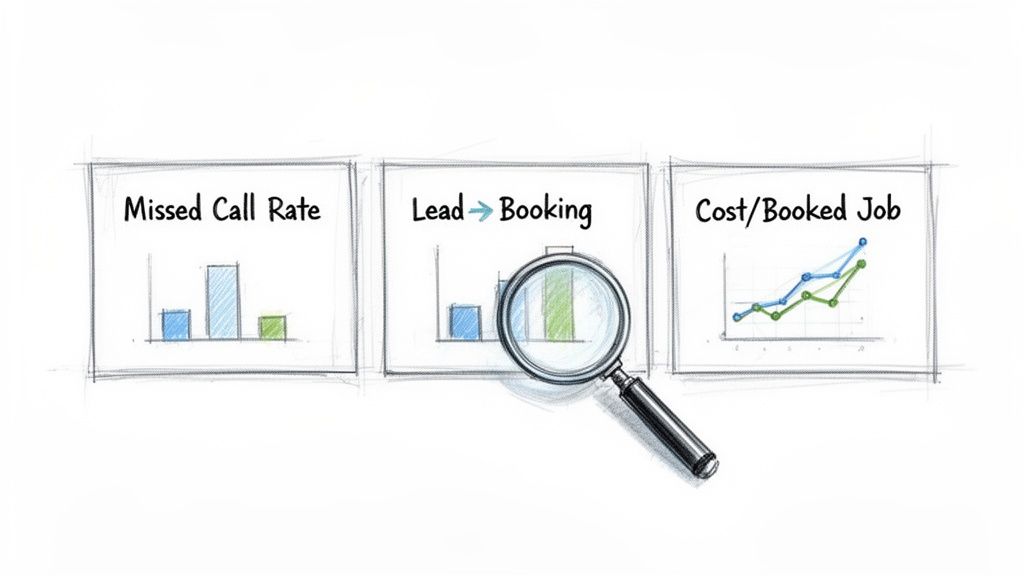
It all starts with tracking the handful of KPIs that have the biggest impact on your bottom line. These are the numbers that tell the real story of how well your front office is selling and how efficiently your crews are working.
The Essential KPIs for Every Mover
Before we get into fancy dashboards, let's talk about the metrics themselves. The table below breaks down the must-track KPIs that reveal the true performance of your moving business.
Essential KPIs for Moving Company Efficiency
| KPI | What It Measures | Why It Matters for Efficiency |
|---|---|---|
| Missed Call Rate | The percentage of incoming calls that go to voicemail. | This is your biggest revenue leak. A high rate means you're sending paying customers directly to competitors who answer the phone. |
| Lead-to-Booking Rate | The percentage of qualified leads (calls, web forms) that become booked jobs. | This shows how effective your sales process is. A low number signals a problem with your quoting, follow-up, or pricing. |
| Cost Per Booked Job | Total marketing and sales spend divided by the number of jobs booked. | This tells you exactly how much it costs to acquire one customer. The goal is to drive this number down without sacrificing job quality. |
| True Profit Per Job | Job revenue minus all associated costs (labor, fuel, insurance, marketing, overhead). | This is the ultimate health metric. It helps you price correctly and shows which types of moves are actually making you money. |
These four metrics are the foundation. You don't need complicated software to start—a simple spreadsheet will do. The trick is consistency. Track them every single week, without fail.
A high missed call rate is a direct signal of a broken lead capture process. It’s not just a customer service issue—it's a sales prevention problem that immediately impacts your monthly revenue. Every voicemail is a potential job you never got a chance to quote.
Putting Your KPIs into Action
Tracking these numbers is just step one. The real magic happens when you use them to ask the right questions and make smarter decisions.
For example, if your Lead-to-Booking Conversion Rate is below 25%, that’s a huge red flag. It tells you that your marketing is working—people are calling—but your sales process is letting them slip through your fingers. Is your team too slow to quote? Are your follow-ups weak? Is your pricing off?
Or maybe your Cost Per Booked Job is creeping up. This could mean your Google Ads are getting less effective, or perhaps your office staff is spending too much time on tire-kickers who never convert.
This is where automation can be a game-changer. Imagine a system that answers every call 24/7, qualifies the lead, and captures their details automatically. Suddenly, your team's valuable time is spent talking only to serious, ready-to-book customers, which dramatically lowers your cost to acquire each job.
Modern platforms can put these critical KPIs on a real-time dashboard, giving you a constant pulse on the business without any manual spreadsheet work. This immediate feedback loop allows you to spot problems the moment they arise, making improving operational efficiency a daily habit instead of a quarterly headache.
Automating Your Front Office to Capture More Revenue
Once you start tracking the right KPIs, the bottlenecks in your moving business become painfully clear. For most owners I talk to, the biggest operational drag isn't on the truck—it's in the front office.
This is where the real time-suck happens. Answering calls, creating quotes, chasing down leads, and scheduling jobs can eat up hours every single day.
Improving your efficiency starts by tackling these repetitive admin tasks head-on. This isn't about replacing your team; it's about giving them leverage. Automation frees up your staff to focus on high-value conversations and complex jobs instead of getting buried in busywork.

Introducing the AI Receptionist
Think about your phone for a second. Every time it rings, you face a dilemma: answer it and potentially interrupt a job, or let it go to voicemail and probably lose that lead forever. It’s a massive revenue leak that movers deal with daily.
An AI receptionist is built to solve this exact problem. It acts as your 24/7 front line, ensuring you never miss a lead again.
This isn't just a fancy answering machine. A purpose-built AI receptionist can:
- Answer 100% of your calls instantly, day or night, so a customer never hears your voicemail greeting again.
- Capture all essential lead details—name, number, move size, addresses—in a clean, structured way.
- Send an accurate quote via text message within seconds of hanging up, striking while the customer's interest is at its peak.
That immediate, professional response completely changes the game. Instead of waiting hours for a callback, a potential client gets the info they need right away. Suddenly, you're the most responsive mover they've contacted.
From Manual Quoting to Instant Estimates
The quoting process is a major source of friction. Manually calculating prices is slow and prone to errors, especially when you're slammed during the busy season. Every hour a customer waits for your estimate is an hour they spend getting quotes from your competitors.
Automation turns this weakness into a serious advantage. By integrating a smart quoting engine, you can deliver instant, accurate pricing based on the details captured on the initial call.
When a customer gets a professional-looking quote on their phone just moments after their inquiry, it builds immediate trust and dramatically increases your booking rate. You can learn more about how to structure your pricing with the right moving company estimate software to ensure your quotes are both competitive and profitable.
Automating manual tasks is the single most effective way to improve your process. One study found that 74% of businesses saw automation of repetitive tasks as having the most potential to boost efficiency. For movers, this means turning quoting and follow-ups into a system that runs itself.
The Power of Automated Follow-Up
How many leads have you lost simply because you forgot to follow up? It happens to the best of us. A customer gets your quote, says they’ll "think about it," and then life gets in the way. Without a system, that lead goes cold.
Automated follow-up is your safety net. Imagine a system that automatically sends a friendly text 24 hours after sending a quote, just asking if the customer has any questions. This simple touchpoint keeps you top-of-mind and often nudges the customer to book right then and there.
This isn't about being pushy; it's about being helpful and persistent. It ensures no lead ever falls through the cracks again. Booking just one extra job a month from a lead you otherwise would have forgotten often pays for the entire automation tool. For a small moving business, that’s a massive win.
Eliminating Scheduling Chaos with Call-to-Calendar Integration
Double-bookings and scheduling mistakes aren't just frustrating; they damage your reputation and cost you real money in wasted fuel and crew time. These errors almost always happen because of a disconnect between your sales conversations and your dispatch calendar.
This is where call-to-calendar integration becomes a game-changer. When a lead is captured and qualified, an automated system can check your crew’s availability in real time.
The process is seamless:
- The system checks the live schedule for open slots that match what the customer needs.
- It temporarily holds a slot once a customer expresses interest in a time.
- It sends a booking confirmation link via text for the customer to finalize their move.
This kills the back-and-forth and ensures your calendar is always accurate. Your dispatcher sees a perfectly organized schedule without having to manually punch in every detail.
For comprehensive efficiency across all departments, consider how corporate training automation can streamline learning and development for your whole team. By automating the front office, you free up your people to focus on what truly matters: delivering exceptional service on moving day.
Getting Your Dispatch and On-The-Road Ops Dialed In
Booking the job is only half the battle. I've seen it a hundred times: a company will nail the sales process only to watch their profits get eaten alive on moving day. It all starts the moment your trucks leave the yard.
A chaotic dispatch process doesn't just frustrate your crews—it's a direct hit to your margins. We're talking wasted time, sky-high fuel consumption, and on-site mistakes that can tank your reputation. This is where all your hard work in the front office either pays off or falls apart.
Start with Smart Route and Crew Planning
Before a single box gets loaded, you need a plan. And no, just sending the closest truck isn't a plan. Real efficiency comes from looking at the entire day's schedule to slash drive time and fuel burn—two of your biggest (and rising) costs.
This isn’t just a hunch. Industry surveys show that a whopping 62.2% of moving companies say rising operational costs are their number one headache. It's why nearly 40% of movers are now laser-focused on operational efficiency, shifting away from just being the cheapest option. You can see more on how companies are adapting to these moving industry trends on supermove.com.
The same thinking applies to your crews. Throwing your best guys on every job might seem smart, but it's a recipe for burnout, sloppy work, and bloated labor costs from all that overtime. A well-managed schedule rotates crews properly, keeping them fresh and motivated for every single job.
The Perfect Dispatch Checklist
Solid dispatch is all about communication. Your crew should never have to call the office to ask for the customer's phone number or what floor they're on. They need the full picture before they even start the truck.
A simple, standardized checklist can wipe out 90% of the usual on-site problems.
Here's what every crew lead absolutely needs to know before they roll out:
- Customer Contact Info: Primary and backup phone numbers. No excuses.
- Job Addresses: Both origin and destination, double-checked for accuracy.
- Inventory Gotchas: Any monster armoires, fragile antiques, pianos, or specific packing notes.
- Access Headaches: Is there a long carry? A winding staircase from hell? A nightmare parking situation? Note it down.
- Special Customer Requests: Anything the customer mentioned during booking that could make or break their experience.
This info shouldn't live on a messy whiteboard or a crumpled work order. It needs to be clean, clear, and accessible.
The second a crew has to call the office for basic info, you've failed. Those little delays seem harmless, but add them up across dozens of jobs and you're losing hours of productive time every single week.
Give Your Crews the Right Mobile Tools
This is where technology stops being a buzzword and starts making you money. Ditch the paper job sheets. Integrated mobile calendars put all those critical details right on your crew leader's phone. This isn't about adding some clunky, complicated software; it's about using simple tools that just work.
Imagine this: a job gets booked and instantly pops up on the crew's calendar, complete with every single detail from that dispatch checklist. This one move connects your office to your guys in the field, empowering them to get the job done right without having to constantly call back for help.
This is exactly what dedicated moving company crew schedule software is built for. It bridges the gap between your booking system and your guys on the ground, ensuring everyone is on the same page from start to finish. That's how you start improving operational efficiency where it counts the most—on the job.
Your Action Plan for a More Efficient Moving Company
Theory is one thing, but action is what grows your business. Making your company more efficient isn't some massive, one-time project. It's a series of small, intentional steps that add up to big changes in your revenue and, just as importantly, your stress levels.
This is your roadmap to get started today. We're breaking the journey down into manageable chunks. The goal isn't to tear down your entire business overnight but to make targeted fixes that deliver the highest return, starting with the biggest leaks in your process.
Month 1: Get Honest About Your Numbers
Before you can fix anything, you have to know where you're starting from. This month is all about mastering your KPIs and getting brutally honest with your numbers. Don't skip this—it's the foundation for every decision you’ll make from here on out.
- First: Start tracking your four essential KPIs: Missed Call Rate, Lead-to-Booking Rate, Cost Per Booked Job, and True Profit Per Job. A simple spreadsheet is all you need to get going.
- Next: Review these numbers weekly. You're looking for patterns. Is your missed call rate spiking after 5 PM? Is your booking rate tanking on weekends?
- Finally: Pinpoint your single biggest problem. For most movers I talk to, it’s the sheer volume of missed calls and the slow response time to new leads. This becomes your first target.
This phase is about moving from guesswork to strategy. The data tells you exactly where to focus your effort.
Month 2: Automate How You Capture and Follow Up on Leads
Now that you know where the leak is, it's time to plug it. This month is all about fixing your biggest revenue drain: unanswered calls and slow lead response. This is where a little bit of automation gives you a massive competitive advantage.
An AI receptionist can ensure 100% of your calls get answered, capturing lead details and sending instant quotes. This one change can completely transform your booking rates.
Think about it: while your competitors are letting calls go to voicemail, you’re already in your customer's text messages with a professional quote. That kind of speed builds immediate trust and often wins the job on the spot. Automated follow-ups then make sure no lead goes cold, turning forgotten quotes into booked moves.
This simple workflow connects planning, execution, and confirmation, which is the key to a smoother dispatch operation.
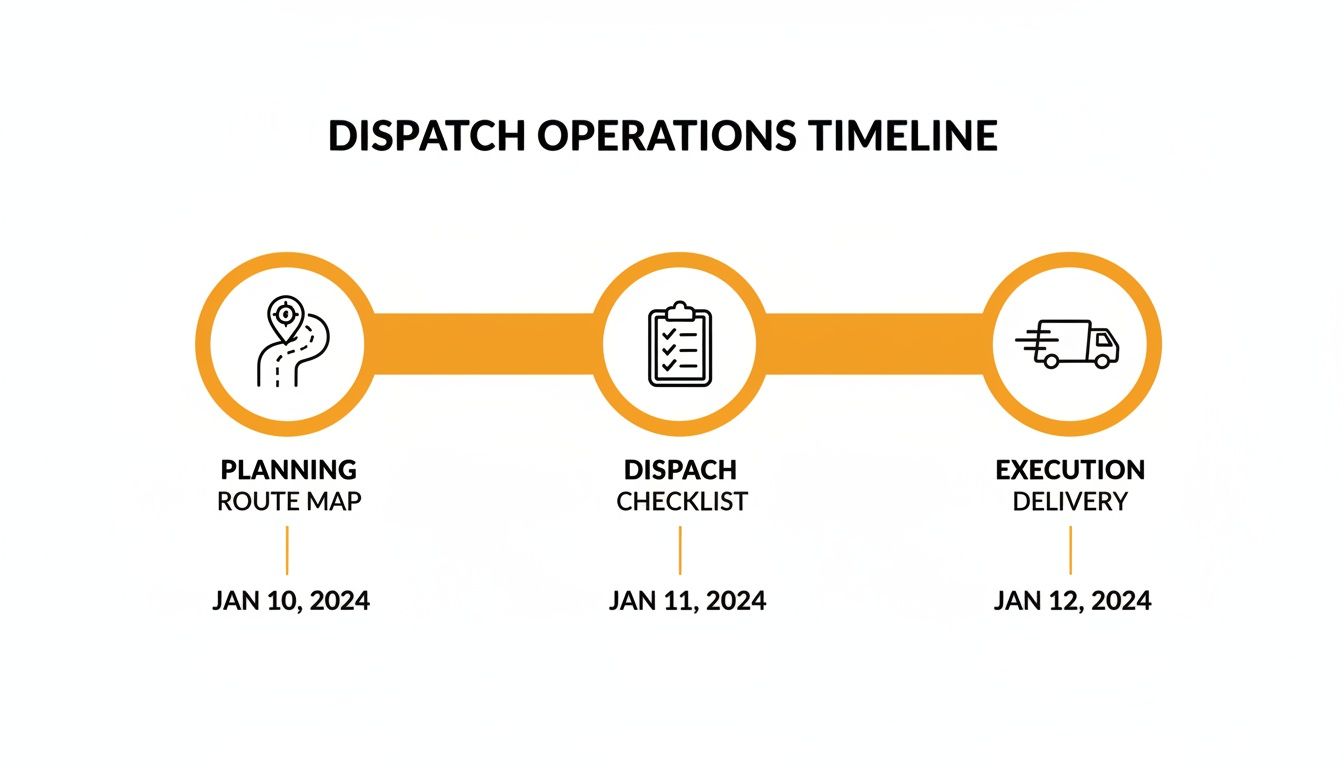
This visual shows how a well-oiled dispatch process should flow, moving seamlessly from the initial plan to the final delivery, cutting out friction at every step.
Month 3: Nail Down Your Dispatch Communication
With your front office running like a well-oiled machine, it's time to bring that same efficiency to your crews on the road. A smooth dispatch means fewer mistakes, happier customers, and better profit margins on every single job.
- Create your "Perfect Dispatch Checklist." Standardize the information every crew needs before leaving the yard—no exceptions. This ends the "forgot to ask" phone calls.
- Ditch the paper and move to a shared digital calendar. This gives your crews access to job details right on their phones, drastically cutting down on calls back to the office.
- Hold a brief daily huddle. A five-minute meeting to run through the day's schedule can prevent hours of confusion and mistakes later on. It’s the highest ROI meeting you can have.
Remember, technology should solve problems, not create them. The goal is to find a solution that automates the tedious work and "just works," letting you focus on running the business. Often, booking just one extra job a month more than pays for the entire system.
This phased approach makes improving operational efficiency feel achievable. For moving company owners exploring their options, understanding the best software for moving companies can provide clarity on what tools will actually fit your needs. Start small, measure your progress, and build a more resilient and profitable business one step at a time.
A Few Common Questions I Hear
When I talk to moving company owners about this stuff, the same questions always come up. Let's tackle them head-on.
“I Only Have 2 Trucks. Is Automation Too Expensive for Me?”
This is the number one concern I hear from smaller operators, and it’s a fair question. But the way this technology is built today is specifically for businesses your size. Honestly, the cost is often less than the revenue from one extra job you probably missed last month because the phone rang at the wrong time.
Forget the clunky, complicated software of the past. These tools are designed to be dead simple. No technical skill needed, and you can get them running in a few minutes. They completely level the playing field, giving a 2-truck operation the same 24/7 responsiveness as a massive franchise, but without the cost of another office manager.
The right tech should feel like cloning your best employee—one who never calls in sick, works around the clock, and costs less than a single job you didn't book. It’s supposed to make you money, not just be another line item on your budget.
“How Do I Get My Crew on Board with New Technology?”
Nobody wants another app to learn or another password to remember. The key to getting your team on board is to show them how a new tool makes their job easier, not harder. Frame it as something that eliminates the chaos.
Explain that automation is here to handle the grunt work—the repetitive calls asking for quotes, the endless follow-ups with leads who go cold. This frees up your team to focus on what they're best at: talking to serious customers who are ready to book and managing the actual logistics of a move.
When they see how an integrated calendar means no more frantic calls asking for a customer's address or confusion over start times, they'll get it. Once your crew realizes a tool directly cuts down their daily stress and stops communication breakdowns, they'll wonder how they ever worked without it.
“What’s the Single Most Impactful Change I Can Make Right Now?”
Without a doubt, the fastest way to see a real difference in your bottom line is to solve your missed call problem. Every single call that goes to voicemail is a potential job you just handed to a competitor who was ready to pick up the phone.
Let's be real: customers looking for a mover are ready to book now. They don't wait around for callbacks.
Putting a system in place to make sure every call gets answered and every lead is captured gives you the quickest and highest return on your investment, period. Whether it's an AI receptionist or a dedicated answering service, it plugs the biggest and most common revenue leak that almost every moving company has. It’s not just about being more efficient; it’s about immediately stopping the flow of paying customers to other companies.
Ready to stop losing jobs to voicemail and book more moves without lifting a finger? MoveJoy is the AI-powered assistant that answers 100% of your calls, sends instant quotes, and books jobs for you 24/7. See how it works.