Moving Company Automation: Book More Jobs 2026
By the time most moving company owners start thinking about automation, they’re already in the middle of the mess. It’s busy season. The office line is ringing while dispatch is trying to reshuffle crews, a salesperson still owes yesterday’s estimates, and leads that came in Friday night are sitting untouched on Monday morning. Nobody feels “anti-technology” in that moment. They feel overloaded.
That’s why the best approach to moving company automation isn’t starting with software demos. It’s starting with the business process. You need to know where jobs are slipping out of the funnel, which tasks should be automated first, and what a booked-job system looks like for a 5 to 20 truck operation. If you get that order right, automation reduces owner stress, speeds up quoting, and helps your team close more work without adding front-office chaos.
Table of Contents
- The Hidden Costs of Your Ringing Phone
- First Find the Leaks in Your Sales Funnel
- Map Your Automation Game Plan for Booked Jobs
- How to Choose the Right Automation Solution
- Your Step-by-Step Implementation Roadmap
- Measuring Success and Calculating Your ROI
- Common Pitfalls and How to Avoid Them
The Hidden Costs of Your Ringing Phone
A familiar scene plays out in a lot of growing moving companies. It’s July. Crews are on jobs, one truck is running late, a coordinator is answering the office line between dispatch updates, and every inbound call feels urgent because it probably is. One missed call at 11:15 a.m. turns into a voicemail. Three more come in during lunch. By evening, the owner is staring at a list of leads that still need callbacks and quotes.
Cost isn’t just the unanswered phone. It’s the broken chain behind it. A caller wants pricing now, not tomorrow. If your team answers but can’t quote, that lead still isn’t secure. If your team sends the quote late, the customer keeps shopping. If nobody follows up, the opportunity dies unnoticed.
A lot of articles still treat movers like they’re resisting technology. That’s outdated. The bigger issue is that most systems weren’t built around how moving companies price and book jobs. As noted in this industry analysis on movers and specialized automation, 72% of owners rank AI and chatbots as their #1 priority for 2026, yet generic tools still miss moving-specific quoting logic, and missed calls can contribute to $50K to $150K in annual revenue leaks.
Practical rule: If a system can answer a call but can’t move the customer toward a quote and a booking, it’s helping less than you think.
This is why broad education on automation benefits for professional firms is useful, but movers need to translate those benefits into one question. Does this reduce missed opportunities during busy hours, nights, and weekends?
For many operators, the biggest leak isn’t bad marketing. It’s front-end execution. Leads are coming in, but the business can’t consistently catch, price, and convert them when demand spikes. That’s also why owner stress stays high even when the schedule looks full.
If you want a clear picture of how much business slips away before your team even gets to the quote stage, this guide on missed call revenue for moving companies is a useful place to pressure-test your current process.
First Find the Leaks in Your Sales Funnel
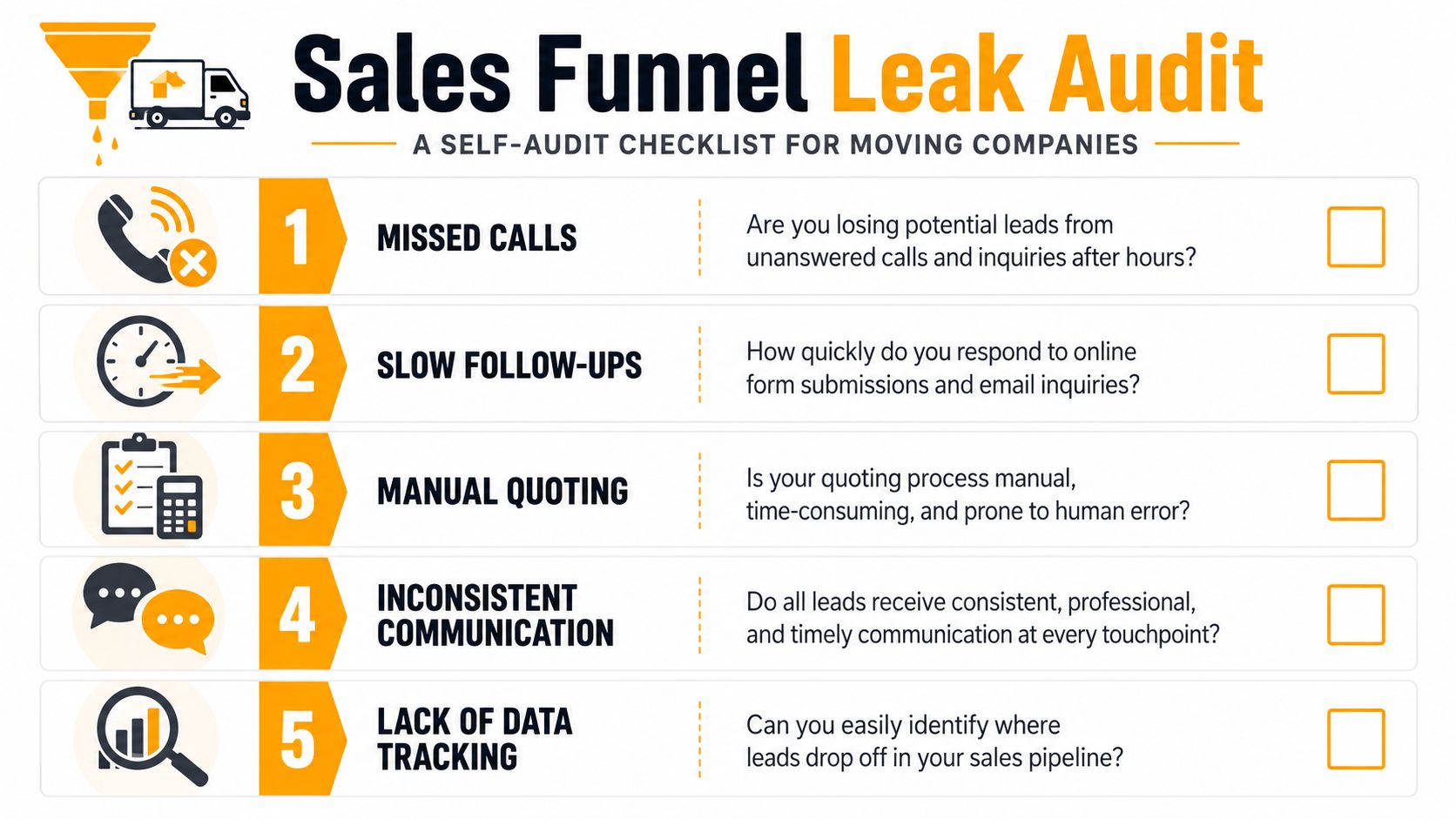
Before you automate anything, audit the path from first contact to booked move. Most companies don’t have one big problem. They have five small breakdowns that stack on top of each other.
Run a simple front-office audit
Take one recent week and review it like an operator, not like a marketer.
- Missed inbound calls: Check when they happened. Were they during dispatch rush, after hours, weekends, or while office staff were already on live calls?
- Quote turnaround: Look at how long it took to send estimates after first contact. Don’t use your ideal number. Use the precise one.
- Follow-up consistency: Identify whether every estimate got the same follow-up treatment or whether some leads depended on who remembered.
- Booking friction: Review whether leads had to wait for a callback, wait for a revised estimate, or wait for someone to manually confirm the calendar.
- Data visibility: Ask whether you can quickly tell why a lead didn’t book. If the answer is “not really,” you have a management problem before you have a software problem.
Many owners benefit from reading broader thinking on implementing AI in sales, but in a moving business the practical application is narrower. You’re not trying to automate persuasion. You’re trying to automate speed, consistency, and the repetitive admin that delays booked jobs.
What good diagnosis looks like
A useful audit should reveal specific leaks, not vague frustration.
Here’s the kind of pattern you want to uncover:
| Funnel stage | Common leak | What it usually means |
|---|---|---|
| First call | Calls hit voicemail during peak office hours | Staffing and call-handling process don't match demand spikes |
| Quote prep | Estimators build everything manually | The business relies too heavily on individual memory |
| Follow-up | Leads go cold after first estimate | No standard cadence exists |
| Booking | Calendar confirmation is slow | Sales and operations aren't connected tightly enough |
A busy phone line can create the illusion of growth while the front office is still leaking jobs.
For 5 to 20 truck movers, this audit usually reveals one of two realities. Either the business isn’t responding fast enough, or it’s responding without enough structure to close consistently. Both problems are fixable. But they need different fixes.
If your biggest issue is missed calls, solve capture first. If your biggest issue is slow quoting, solve estimate workflow first. If the team is answering and estimating but not closing, your next problem is follow-up and booking discipline.
Map Your Automation Game Plan for Booked Jobs
The strongest automation plans don’t start with features. They start with a simple outcome. More booked jobs with less owner involvement in repetitive front-office work.
That matters because the category itself is expanding fast. The Moving Company Software market reached USD 1.54 billion in 2024 and is projected to grow at a 12.7% CAGR from 2025 through 2033, reaching an estimated USD 4.55 billion by 2033. That kind of growth isn’t happening because movers want more dashboards. It’s happening because operators need systems that protect margin and handle demand without hiring more admin staff.
The three parts that matter
A real automation plan for a moving company has three connected parts.
1. Lead capture that works all the time
This is the front door. If a prospect calls after hours, during lunch, or while your coordinator is buried in dispatch, the business still needs to capture the lead cleanly. Name, move date, zip codes, home size, service type, and the basic details needed to price the job should all be gathered without friction.
2. Quoting that reflects your actual business rules
Most generic tools fall short. Moving isn’t one product with one price. Local hourly moves, intrastate work, commercial jobs, and labor-only requests all require different logic. If the system can’t work from your rate card and your rules, it can’t really help you close.
3. Booking and follow-up that finish the job
A quote sitting in someone’s inbox isn’t a result. A booked job is. Good automation connects the estimate to the calendar, CRM, or scheduling workflow so the lead doesn’t stall waiting for manual handoff.
Operator view: The difference between a lead-capture tool and a booked-job system is where revenue gets won or lost.
What doesn’t count as real automation
A lot of movers buy tools that solve only one slice of the problem.
- Human answering services can be helpful for coverage, but they often stop at message taking.
- Generic AI voice platforms may collect contact information, but they usually struggle with moving-specific price logic.
- CRMs like SmartMoving, Supermove, and MoveitPro are valuable once data is inside the system, but they don’t automatically fix front-end call handling on their own.
That’s why your game plan has to connect all three actions. Capture the lead. Quote the move. Book the job.
If you’re evaluating what that workflow should look like in practice, this overview of an appointment booking system for moving companies is useful because it frames booking as an operational handoff, not just a calendar event.
How to Choose the Right Automation Solution
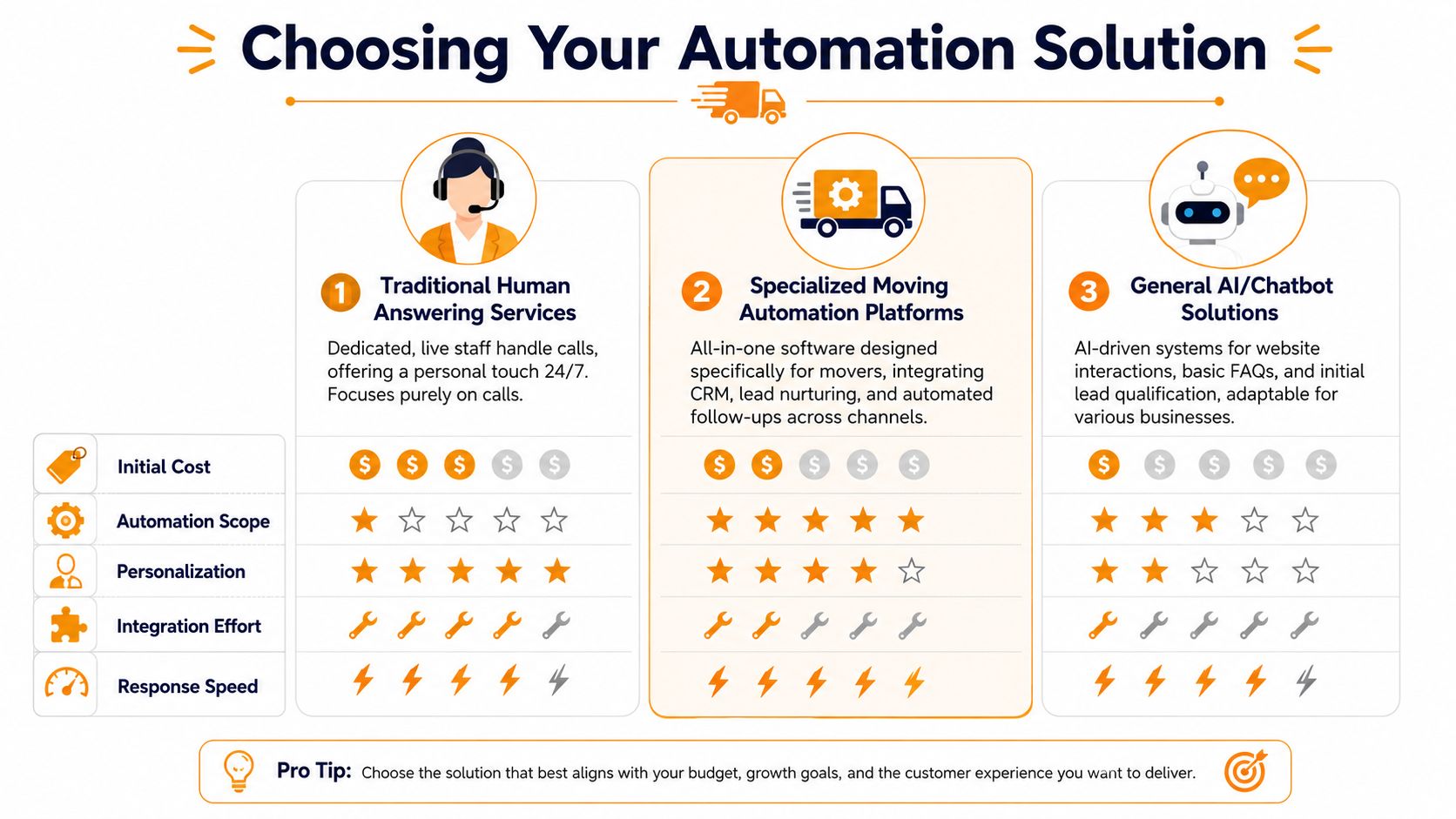
Most movers end up comparing three categories, whether they realize it or not. Live answering coverage, general-purpose AI tools, and moving-specific automation. The right choice depends on what you need the system to accomplish after the call is answered.
A practical comparison for movers
| Option | Where it helps | Where it falls short | Best fit |
|---|---|---|---|
| Human answering service | Live voice coverage and basic intake | Usually can't quote from your rate card or book directly into operations | Companies that only need overflow call coverage |
| Generic AI voice or chatbot tool | Fast responses and basic qualification | Often too generic for stairs, long carries, service type differences, and move complexity | Businesses with simple intake needs |
| Moving-specific automation | Connects intake, quote logic, and booking workflow | Requires thoughtful setup of your rules and process | Operators who want front-end revenue recovery, not just call coverage |
The questions that separate good tools from expensive distractions
Ask these questions before you buy anything:
- Can it quote accurately using our own pricing logic? If not, you’re paying for a nicer version of voicemail.
- Can it fit the systems we already use? For many movers, that means SmartMoving, Supermove, MoveitPro, or at minimum Google Calendar.
- Can it handle different move types? Local and intrastate jobs shouldn’t flow through one oversimplified template.
- Can it support after-hours demand without adding office labor? Nights and weekends often decide who wins the booking.
- Can our team trust it enough to use it daily? If office staff keep bypassing the tool, adoption fails even if the software is good.
A smart buying process also means reading side-by-side evaluations with a skeptical eye. This roundup of moving company software review criteria is useful if you want a clearer framework for comparing workflow fit instead of chasing flashy features.
If the tool doesn’t shorten the path from inbound lead to confirmed job, it doesn’t deserve a front-office budget.
For junk removal operators, the evaluation is similar. The service details differ, but the core problem is the same. Calls come in fast, customers want pricing quickly, and delays push them to the next company.
Your Step-by-Step Implementation Roadmap
Implementation gets easier when you stop treating it like a tech project and start treating it like an operating procedure. You’re not installing complexity. You’re deciding how your business should handle incoming work when humans are busy.
The timing matters too. According to this moving automation implementation guide, measurable success typically appears within 60 to 120 days. The recommended sequence is clear: deploy dispatch automation and CRM lead capture first in Days 1 to 45, then add automated follow-up and digital estimating in Months 2 and 3. That same source notes estimate turnaround can drop from 18 to 24 hours to under 2 hours when the process is set up correctly.
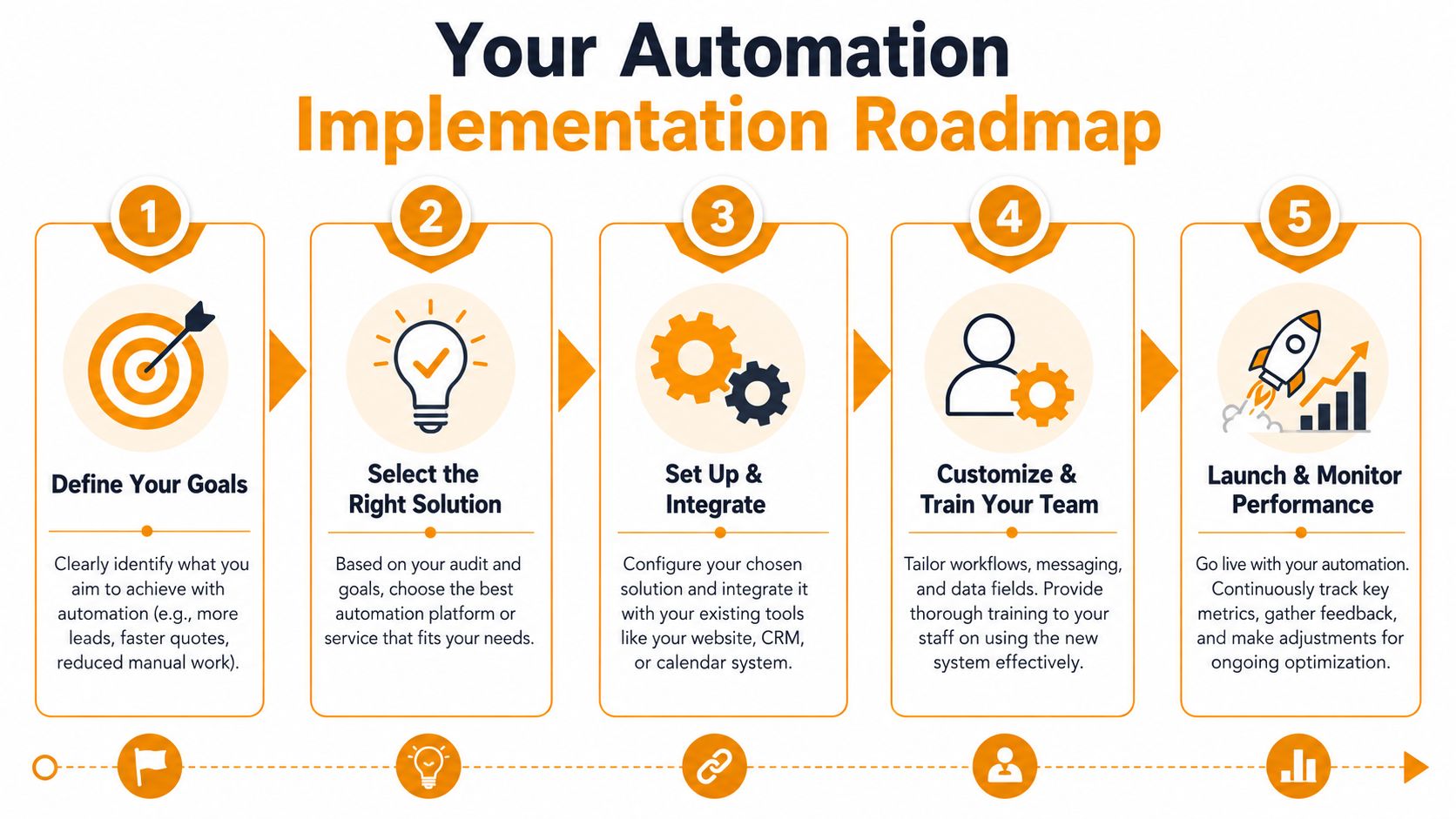
Days 1 through 45
Start with the pieces that stabilize your inbound flow.
Decide what happens to every incoming call
Forwarding rules should be simple. During office hours, maybe calls ring your team first with overflow support behind it. After hours, the system should capture and qualify every lead instead of pushing callers into voicemail.Define your quoting rules in plain business language
List the charges your team already uses. Hourly rates, travel time, minimums, stair charges, long carries, packing add-ons, and service-area rules. Don’t overcomplicate this. If your best coordinator can explain the pricing logic on a whiteboard, it can usually be configured.Set booking boundaries
Decide what can be booked instantly and what needs review. Some companies are comfortable booking standard local jobs directly. Others want anything unusual flagged for human approval.
Months 2 and 3
Once intake is stable, automate the follow-through.
- Add quote follow-up: Every estimate should trigger a consistent sequence so leads don’t depend on memory.
- Connect scheduling: Sync the booking flow with your CRM or calendar so office staff aren’t copying details between systems.
- Train the team on exceptions: Staff should know when to trust the workflow and when to step in for edge cases.
- Review early recordings and transcripts: This helps catch pricing gaps, unclear questions, and service areas that need tighter rules.
Don’t launch with every edge case solved. Launch with your common jobs handled well, then refine from real calls.
The biggest mistake here is trying to automate everything at once. Get the high-volume, repeatable jobs working first. Then layer on the more complex scenarios.
Measuring Success and Calculating Your ROI
Owners don’t need a fancy financial model to know whether automation is paying off. They need a simple way to connect recovered jobs and saved admin time to actual profit.
Across industries, automation ROI benchmarks show that 60% of organizations achieve ROI within 12 months, with average productivity gains of 25% to 30% and error reduction of 40% to 75%. In a moving company, those gains show up in cleaner handoffs, faster quoting, and the ability to secure more work without adding staff.
Use a simple operator formula
Use this back-of-the-napkin model:
Monthly ROI view = (Recovered jobs x average job value) + labor/admin savings – monthly automation cost
You don’t need to publish the number to anyone. You just need an honest internal estimate. If the system helps recover jobs that used to disappear after hours or sit unquoted too long, the math becomes pretty obvious.
The KPIs worth watching
Track a short list, not twenty dashboards.
- Answered lead coverage: Are fewer inbound calls going unanswered during rush periods, nights, and weekends?
- Time to quote: Are standard estimates getting out faster than before?
- Booking rate from inbound leads: Are more qualified calls converting into scheduled moves?
- Follow-up completion: Are estimates receiving consistent communication without relying on staff memory?
A good operator review happens weekly. Pick one day, review the prior week’s leads, and ask a blunt question. Did the system help us close work we would have otherwise fumbled?
Common Pitfalls and How to Avoid Them
Most automation failures don’t happen because the concept is bad. They happen because the setup ignores how moving companies operate.
One of the biggest errors is forcing every move through one pricing template. As explained in this breakdown of technology and quote accuracy in moving, the better approach is a service-type-driven pricing architecture that separates local, intrastate, and other move types. That shift can reduce inaccurate quotes by 10% to 50% after automation is implemented.
The pricing mistakes that break trust
If your pricing logic is sloppy, automation just makes the sloppiness faster.
- One-template quoting: Local hourly, intrastate, commercial, and specialty jobs shouldn’t all be priced the same way.
- Missing edge charges: Stairs, long carries, shuttle situations, and access issues need clear rules.
- No exception path: Some leads need review. That’s normal. The mistake is pretending every move can be fully automated from day one.
The operational mistakes that slow adoption
Plenty of teams buy a tool, then nonetheless keep doing everything manually.
- No staff training: Dispatchers and sales staff need to know what the system handles and when they should intervene.
- Unrealistic first-month expectations: The first few weeks are for tuning. You’re listening for gaps, not expecting perfection immediately.
- Poor handoff discipline: If bookings don’t land cleanly in your workflow, office staff will stop trusting the process.
- Ignoring risk management: Cleaner intake and better booking help, but they don’t replace the need for sound operational protections. As your process matures, it’s smart to revisit fundamentals like moving company insurance planning alongside your workflow improvements.
The goal isn’t to remove humans from the business. The goal is to remove delays, inconsistency, and preventable front-office mistakes.
Owners who win with moving company automation usually take the same path. They audit the funnel, automate the repeatable work first, keep pricing logic grounded in real operations, and measure booked jobs instead of vanity metrics.
If your company is losing jobs to missed calls, slow quoting, or inconsistent follow-up, MoveJoy is worth a look. It’s built for movers that need more than call coverage. It helps capture inbound leads, generate accurate quotes using your own rate card, and book jobs directly into your CRM or calendar so the phone doesn’t just get answered, the work gets closed.