So, what exactly is automated customer service? Forget the clunky, robotic definitions. For a moving company, it's a digital receptionist that works 24/7. It's the system that answers your phone, captures lead details, and sends instant follow-up texts so you never, ever miss a job again.
Your Best Employee Who Never Sleeps
Imagine a front-office employee who never calls in sick, never takes a vacation, and never misses a single call—not even at 2 AM on a Saturday when a potential customer is planning their move. That’s the real idea behind automated customer service. It’s not about replacing your team; it’s about handing them a powerful tool to offload the repetitive, time-sucking tasks that clog up their day.
Instead of a potential customer hitting voicemail when your lines are busy or your office is closed for the day, they get an immediate, professional response from an AI-powered system designed specifically for the moving industry.
This "digital receptionist" can instantly:
- Answer every single inbound call, 24/7/365, making sure no lead ever slips through the cracks.
- Ask the right qualifying questions, like "Where are you moving from and to?" and "How many bedrooms is your home?"
- Collect the caller's contact information with perfect accuracy, every time.
- Fire off an immediate text message to the caller, confirming their inquiry was received and you'll be in touch.
A missed call used to be lost revenue, plain and simple. This system turns it into a captured lead, ready for your team to close.
From Voicemail Tag to Booked Jobs
For a busy moving business, the time gap between a missed call and a callback is everything. It's the difference between winning and losing a job. Customers looking for movers move fast. If you don’t answer, they just call the next company on their list.
The reality is simple: The first moving company to provide a helpful response is almost always the one that gets the business. Automation ensures you are always first in line.
One of the most common tools for this is an AI chatbot, which can seriously upgrade how you interact with customers online. If you're curious about the tech behind it, there are some great resources that explain how to build an AI chatbot that people actually find useful.
By handling that first point of contact, the system frees up your office manager or sales team. They can now focus on the high-value stuff—crafting detailed quotes, talking to high-value clients, and actually building relationships. Check out our detailed guide for more on how a virtual assistant can support your customer service.
This isn't just a small tweak. It's a fundamental shift from a reactive front office that's constantly playing catch-up to a proactive one that seizes every single opportunity for growth.
How Automation Works for Your Moving Company
Forget about complex software for a minute. Instead, think about your best-ever office manager—the one who knew every detail of your business. She had your service areas memorized, knew the truck capacity by heart, could quote a three-bedroom house in her sleep, and never forgot your policy on moving pianos.
Now, imagine that same person could handle hundreds of calls at once without ever getting flustered or needing a coffee break.
That’s what an AI receptionist does. It's not magic. It’s a highly trained system designed to manage all the repetitive, time-sucking conversations that eat up your day, freeing your team to focus on what matters.
So when a customer calls asking, "I need a quote for a move from downtown to the suburbs," the system knows exactly what to do. It instantly understands their goal and starts asking the right questions to gather the details for an accurate estimate.
That initial conversation—the one that takes a human employee 5-10 minutes—is done in seconds. The system captures the lead’s name, contact info, and job specifics. This frees up your team to handle the big-ticket commercial jobs, solve complex customer issues, and actually build relationships.
The Simple Path from Call to Lead
The whole process is designed to be ridiculously simple. Every single call becomes a captured opportunity, not a missed one.
This is what it looks like in practice:
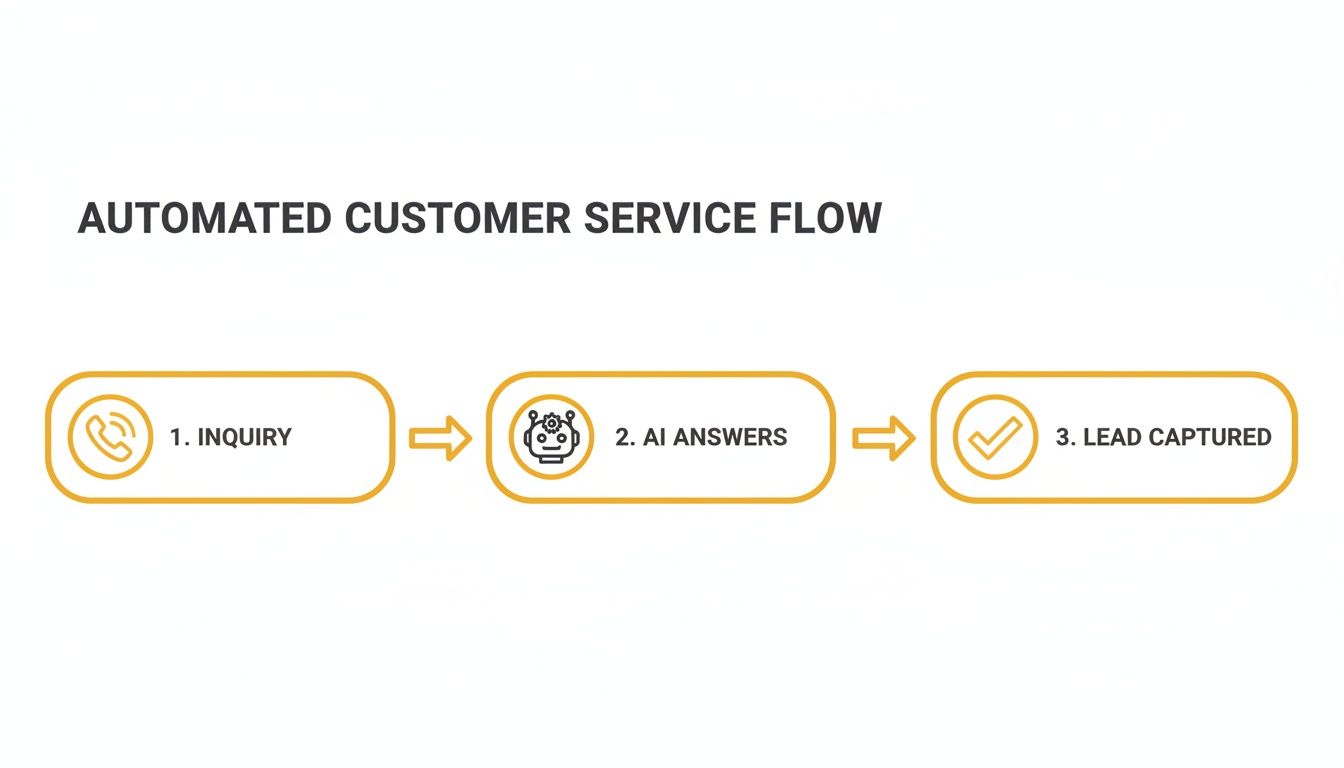
This kind of streamlined workflow means no caller ever hits your voicemail again. They’re engaged immediately, and their info is secured for your sales team before they have a chance to call your competitor.
The best part? This technology is built to understand the unique language of the moving industry. It knows terms like "studio apartment," "packing services," and "long-carry fees," ensuring the information it gathers is actually useful.
It's not just a concept, either. Businesses are already using this approach to build their own 24/7 AI sales agent, handling customer calls around the clock. The principle is the same: use smart technology to be there the moment a customer needs you.
By automating that first touchpoint, you create a powerful system that works for you even when you’re out on a job or home with your family. In an industry where speed wins, that's the ultimate competitive edge.
The Real-World Value of Automating Your Front Office
It's one thing to understand the theory behind automated customer service. It's another thing entirely to see what it does for your bottom line.
As a moving company owner, you know every dollar counts. Any new system you bring in has to prove its worth—and fast. Automation isn't just another expense line on your P&L; it's a direct investment in generating more revenue.
Let's get practical and talk about the actual economics.
The True Cost of a Missed Call
Every time your phone rings and nobody picks up, you’re not just missing a call. You’re likely losing a job worth $1,000, $2,000, or even more.
During the chaos of peak season, it’s not unusual for a small moving company to miss three to seven calls every single week while crews are out on jobs or the office is swamped.
Think about it. Say your company misses just four qualified leads in one month. If your average move brings in $1,500, that’s a staggering $6,000 in lost revenue. That’s not some hypothetical number; it's real money that walked away simply because you couldn't answer the phone at the exact moment a customer was ready to book.

An AI-powered system that catches every call flips this entire equation on its head. By making sure no lead ever hits voicemail, it turns your front office from a potential weak spot into a revenue-generating machine.
One single booked move that would have otherwise been missed often pays for the entire automation system for the month. Everything after that is pure profit.
Automation Drives Down Operational Costs
Beyond just snagging lost revenue, automation actively chips away at your operating expenses. It's not just a hunch; the data backs it up. By 2026, conversational AI is projected to cut call center labor costs by a massive $80 billion worldwide, and some systems can slash operational costs by up to 30%. You can dig into more of these customer service findings to see how this plays out across different industries.
For your moving business, this translates to real savings:
- Reduced Labor Costs: You can handle a much higher volume of calls without having to hire another receptionist or pay for an expensive—and often unreliable—answering service.
- Increased Team Focus: Your existing staff can finally stop spending their time on the same repetitive intake calls over and over. Instead, they can focus on high-value tasks like putting together detailed quotes and managing crew schedules. Our guide on improving operational efficiency dives deeper into this.
- Scalability During Peak Season: You can handle the flood of calls in spring and summer without the stress of being understaffed. The system scales with demand, making sure you actually capitalize on your busiest months instead of just surviving them.
At the end of the day, automation makes your business more resilient, profitable, and competitive. It ensures you’re not just surviving the daily chaos but are actively set up to grow.
Four Ways Automation Helps Movers Book More Jobs
Knowing what automated customer service is and how it works is one thing. Seeing how it actually puts money in your pocket is another. For a moving company owner, the real value is in the practical, on-the-ground changes that make your business more competitive and, frankly, easier to run.
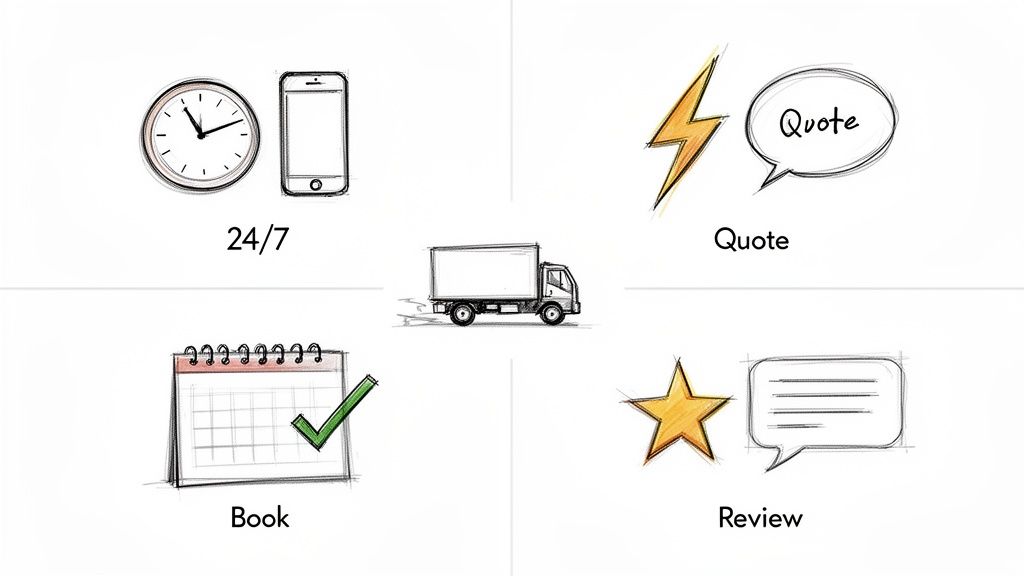
Let’s break down four specific ways automation can turn your lead flow from a leaky bucket into a firehose of confirmed bookings.
1. 24/7 Call Answering Ends Voicemail for Good
Let’s be honest: your busiest time for calls is often when your office is closed. Potential customers are looking for movers after work, on weekends, and late at night. Every single one of those calls that hits your voicemail is a lead you’re handing directly to your competition.
Automated customer service is your always-on receptionist. It picks up every call, day or night, and instantly gets the caller's details.
Think about this scenario: A motivated customer calls your company at 10 PM on a Friday. Instead of hearing a recorded message, they’re greeted by a professional AI assistant. It asks about their move, collects their info, and sends a confirmation text. When your team walks in Monday morning, that lead is already qualified and waiting, ready for a quote. No missed opportunity.
2. Instant Quoting Beats Competitors to the Punch
Speed is everything in this business. We all know customers call three or four companies for quotes. The first mover to give a helpful, professional response usually wins the job. Waiting hours—or god forbid, a full day—to reply just doesn’t cut it anymore.
An automated system can be set up to provide instant, preliminary quotes based on the information it gathers on the call. This immediate feedback keeps the customer engaged with your brand while your competitors are still playing catch-up.
By providing an instant response, you set the standard for service. You frame the customer's expectations, making it much harder for slower competitors to win their business.
3. Automated Appointment Booking Fills Your Calendar
Scheduling in-home estimates or confirming move dates can turn into a painful game of phone tag. That back-and-forth wastes valuable time for both you and your customer, adding friction to the one thing you want to be smooth: the booking process.
Automation can sync directly with your team’s calendar and handle this whole dance for you.
- An AI receptionist offers available time slots for an estimate.
- The customer picks a time that works for them, right on the phone or via text.
- The system automatically books the appointment in your calendar and sends confirmations to everybody.
This simple, automated workflow gets rid of the manual grind and ensures your sales calendar stays packed with qualified leads.
4. Post-Move Review Requests Build Your Reputation
Your online reputation is one of your most powerful marketing tools. Good reviews on Google build trust and bring in new business without you lifting a finger. The problem is, manually following up with every client to ask for a review is a task that easily falls through the cracks when you're busy.
An automated system can trigger a follow-up text or email a day or two after a job is done. The message thanks the customer and gives them a direct link to your Google Business Profile or Yelp page. This simple, hands-off process consistently builds your five-star reputation, driving more organic leads to your business for years to come.
Why Automation Is a Competitive Necessity
Let's be honest, the game has changed in the moving industry. Customers don't leave voicemails and patiently wait for you to call back anymore. They expect answers now.
If your phone rings and you don't pick up, that potential customer is already dialing your competitor. Speed isn't just a nice-to-have; it's the single biggest factor that decides who gets the job.
Relying on old-school, manual processes while your competitors automate is like showing up to a truck race on a bicycle. You're putting your moving company at a huge disadvantage. The business that responds in seconds—not hours—is the one that builds instant trust and locks in the lead before anyone else even gets a chance.
The New Standard for Customer Expectations
Automation isn't some high-tech gadget reserved for the big national van lines. It's a standard operational tool that local movers are already using to pull ahead. Think of it less like a futuristic robot and more like another essential piece of equipment, just like a dolly or moving blankets.
This isn't about replacing your trusted office manager. It's about giving them the backup they need to handle the flood of calls during peak season without losing their minds—or your leads.
With an automated system, your company is always the first to respond. That means you’re always the first one with a shot at booking the job.
The reality is, automation has hit a tipping point in the service industry. It's no longer a differentiator—it's the baseline expectation for professional communication.
The numbers don't lie. Projections show that by the end of 2025, over 80% of businesses will be using some form of chatbot or voice automation. And why? A whopping 71% of industry pros say their main reason for adopting this tech is to improve the customer experience. You can see how these customer service trends impact businesses across every sector.
Falling Behind Is Not an Option
Ignoring this shift means you’re actively choosing to let jobs slip through your fingers. While your team is out on a move or your office is closed for the day, your automated competitors are busy capturing leads, answering questions, and scheduling estimates around the clock.
Every single call you miss is a job handed directly to another local mover who was ready at that exact moment.
By bringing in automated customer service, you’re not just keeping up. You’re building a scalable, reliable front office that never calls in sick, positioning your moving company to dominate your local market, season after season.
Getting Started With Automation in Three Simple Steps
Look, I get it. Adopting new technology can feel like a massive headache, especially when you’re already juggling crews, dispatch, and a phone that won’t stop ringing.
But getting started with automation isn’t about becoming a tech genius or blowing your budget. It’s about taking a simple, practical approach. You find your single biggest problem and you solve it. That's it.
Breaking it down this way makes the whole thing feel a lot less intimidating. And the best part? You can start seeing a return almost immediately by focusing on what actually moves the needle.
1. Find the Leak in Your Bucket
Before you even think about software, you need to figure out where you’re losing the most money. Where is the single biggest point of friction in your front office?
For most moving companies I talk to, it’s almost always one of these three things:
- Missed Calls: Are leads hitting your voicemail after hours, on weekends, or just when your lines are swamped? This is hands-down the easiest and most profitable problem to fix first.
- Slow Follow-Up: Does it take your team a few hours—or even a full day—to get back to new web leads? In this business, that kind of delay is the same as handing the job to your competitor.
- Scheduling Hell: How much time do you waste playing phone tag just to book an estimate or lock in a move date? That back-and-forth isn’t just annoying; it’s slowing down your entire booking pipeline.
Be brutally honest with yourself. Which one of these is causing the most damage? That’s your starting line.
2. Choose a Tool That Actually Knows Moving
Once you’ve identified the problem, don’t just grab the first generic tool you see. Software built for a dentist's office or an e-commerce store has no clue what you do. It doesn't know the difference between a studio apartment and a three-bedroom house, and it will get totally confused if a customer asks about packing services or a COI.
You need a solution built specifically for the moving industry. An industry-specific system already knows the right questions to ask, ensuring it captures qualified leads that your sales team can actually close.
3. Start Small, Prove It Works, Then Expand
You don't have to automate your entire business overnight. That’s a recipe for disaster. The smart way to do this is to start small, prove the value to yourself, and then build from there.
The highest-impact, lowest-effort change you can make is almost always the same: implementing 24/7 automated call answering to finally stop bleeding money to voicemail.
Just turn it on. Then, track one simple number: how many qualified leads did you capture after hours in the first 30 days? When you see those calls you used to miss turning into thousands of dollars in booked revenue, you’ll have all the proof you need.
Answering Your Questions About AI for Movers
Look, it’s smart to kick the tires before you bring any new tech into your business. You’ve got questions, and you should. Here are the straight-up answers to the concerns we hear most from moving company owners just like you.
Will This Thing Sound Like a Robot and Piss Off My Customers?
This is the number one worry we hear, and it’s a good one. We’ve all been stuck in a nightmare phone menu, yelling “OPERATOR!” into the void.
The good news is, modern AI isn't like that anymore. The tech has come a long, long way. Today’s best AI receptionists are trained on thousands of real calls from the moving industry. They get the slang, the accents, and the weird questions customers ask. The result is a conversation that feels surprisingly natural—less like a machine and more like a sharp, well-trained office assistant who never has a bad day.
Isn't This Too Expensive for a Smaller Moving Company?
Not even close. In fact, it's almost certainly cheaper than the money you're already losing to missed calls.
The return on investment (ROI) here is dead simple. Think about it: if your average move is worth $1,500, and the system captures just one job that would have been a hang-up or a voicemail, it’s already paid for itself for the entire month. This isn’t just another overhead cost; it’s an investment that puts money directly back into your pocket.
How Hard Is This to Set Up? I’m Not a Tech Guy.
You don’t have to be. Any system worth its salt in the moving industry is built to be simple. We know you’re running a business, not an IT department.
The setup process is usually painless and takes less than an hour. You just give it your basic business info—your service area, your hours, your rates—and it’s ready to go. It’s designed to "just work" so you can get back to what you do best: moving people.
Ready to see how an AI receptionist can capture every lead and book more jobs for your moving company? MoveJoy offers a simple, powerful solution built specifically for movers. Explore how MoveJoy can work for you.