Automated Moving Estimates: A Guide to Revenue Recovery
On a busy Tuesday in May, the phone usually rings when you’re already doing three jobs at once. One customer wants a ballpark price from a half-complete inventory list. A crew lead is texting about access problems. Dispatch needs an answer on tomorrow’s schedule. You give the quote anyway because if you don’t, the caller will hang up and call the next mover.
That five-minute phone quote feels efficient. In many small moving companies, it’s one of the biggest revenue leaks in the business.
When owners of 1 to 20 truck moving companies talk about growth, they usually talk about leads first. Fair enough. But plenty of movers don’t have a lead problem. They have a quoting problem. They answer too slowly, quote too loosely, forget charges, follow up too late, or hand the customer a number that no one can defend once the crew gets onsite.
Automated moving estimates matter because they fix the front-end leaks that kill margin. They help you respond faster, quote with more consistency, and turn more inbound demand into booked work instead of callbacks, revisions, and customer disputes.
The Real Cost of a Five-Minute Phone Quote
A manual phone quote usually starts with good intentions and bad information.
The customer says it’s a “small two-bedroom.” You ask about stairs. They say “just a few.” You ask about packing. “Maybe some boxes.” You ask about distance, elevators, long carry, assembly, storage, or awkward items. Now you’re guessing, and they can hear it.
That guess has three possible outcomes. None of them are good.
You underquote and pay for it later
If you leave out labor complexity, access issues, or specialty handling, the job can look profitable when you book it and turn ugly on move day. Crews stay longer. Truck space gets tight. The customer argues because the final bill doesn’t match the expectation you set on the phone.
You overquote and lose the job
The opposite happens too. You pad the number because you don’t trust the information. The customer thanks you, says they’ll “talk it over,” and books with the mover who gave them a cleaner, faster answer.
You burn owner time on work that shouldn’t be manual
Manual moving estimates take an average of 20 minutes using spreadsheets, while competitors using automated software can generate and send a quote in under 5 minutes according to SmartMoving’s breakdown of estimate software speed.
For a small operator, that difference doesn’t just affect admin time. It affects win rate, callback speed, and whether the owner spends the day selling jobs or patching holes.
Most quoting problems don’t start with bad employees. They start with rushed decisions inside a messy process.
If you’re still building quotes from memory, notes, and spreadsheet formulas, start by cleaning up the pricing logic itself. Even a structured moving company estimate template can show you where charges are getting missed before you automate anything.
What Are Automated Moving Estimates Really
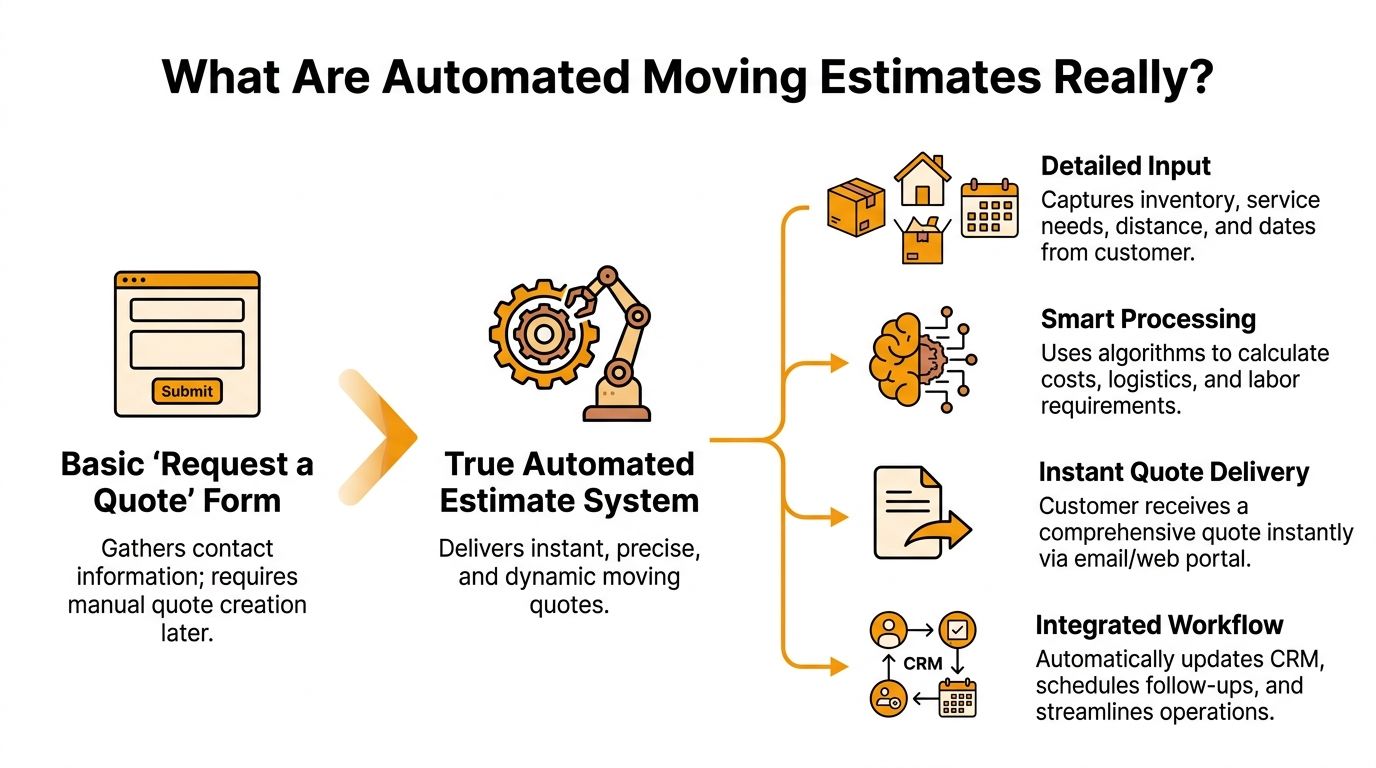
A lot of movers think automated moving estimates means a website form that collects a lead and emails the office.
That’s not automation. That’s a digital voicemail.
A real automated estimate system takes customer input, applies pricing logic, and returns a usable quote without waiting for someone at the office to build it by hand. It behaves more like a sales coordinator who never goes home.
The simple version
A basic request form does one thing. It captures information.
A true automated estimate system does four things:
- Collects detailed job inputs like inventory, distance, dates, service type, and access conditions
- Processes those inputs against pricing and operational rules
- Delivers a quote quickly in a format the customer can review
- Pushes the job data forward into your CRM, calendar, or follow-up workflow
That last part matters more than most owners realize. If the quote sits in an inbox, the system hasn’t solved the core problem.
The three logic layers that matter
Most automated moving estimates run on some mix of the same logic a strong estimator already uses.
Rules-based pricing
This is the foundation. If the move has stairs, add a stair charge. If the customer needs packing, add packing labor and materials. If the job is long carry, storage-in-transit, or a specialty-item move, the system applies the matching rule.
This is what keeps the quote from turning into a generic internet guess.
Rate-card integration
The system should use your pricing, not some average market model.
That means your travel time policy, your hourly minimums, your flat-rate structure, your zip-based adjustments, your seasonal rules, and your line items for things crews deal with. If it can’t work from your rate card, it won’t produce bookable quotes.
AI refinements
Good tools differentiate themselves from static forms. AI-powered moving estimate tools using virtual surveys and machine learning can deliver up to 85% accuracy rates from the initial quote, according to Yembo’s overview of AI moving estimates.
That doesn’t mean every quote should be treated as final without review. It means the system can get much closer, much faster, than a rushed manual process.
Practical rule: If the tool can’t explain how it handles your pricing rules, it isn’t automated estimating. It’s lead capture wearing better clothes.
If you’re evaluating platforms, compare them against what real moving company estimate software should do inside a mover’s workflow, not just what it says on a demo page.
How Automation Plugs Your Biggest Revenue Leaks
Saturday, 7:12 p.m. A family is calling for a move at the end of the month. Your office line rolls to voicemail because the coordinator already left. By 7:20, that lead has filled out a form on a competitor’s site and gotten a quote. Small movers lose jobs that fast.

Automation matters because it closes the gaps where revenue slips out. In a moving company, those gaps usually show up in three places: response time, quote accuracy, and follow-up discipline. Fix those three and the software often pays for itself with one recovered job.
Leak one is delayed response
Leads age badly in this business.
If a customer has to wait until Monday morning for a callback, the sale is already in trouble. The same thing happens during the weekday rush. Phones stack up, the estimator is busy, dispatch needs an answer, and the quote sits half-finished while the customer keeps shopping.
Automated estimating cuts that delay by turning intake into a usable quote path right away. The customer answers the right questions, the system applies your rules, and your team can respond while the lead still has intent. That speed improves close rate, and it also improves lead economics. If you’re paying for Google Ads or lead providers, a slow process drives up your actual cost per lead for booked moves because too many paid inquiries never make it to a real quote.
Leak two is preventable margin loss
Bad quotes hurt twice. You lose jobs when the number is too high, and you lose profit when the number is too low.
Manual quoting breaks down under pressure. Someone forgets the long carry. Somebody skips packing materials. Travel time gets handled one way on Tuesday and another way on Friday because a different person answered the call. Owners usually blame sales performance when quoting discipline is the underlying problem.
Automation helps by forcing consistency. It applies the same pricing logic every time, flags missing scope details, and gives the office a repeatable process instead of a memory test. That does not replace judgment. It gives your team a cleaner starting point, so they spend less time correcting mistakes after the quote goes out.
Leak three is slow follow-up after the quote
This leak gets ignored because it looks like an admin problem. It is a revenue problem.
A quote sent without a follow-up sequence is just paperwork. Good systems trigger the next step immediately: confirmation email, text message, reminder task, deposit request, or handoff to a coordinator. That gap between quote sent and next action is where a lot of “warm leads” die.
The same workflow principle shows up in other service businesses. This article on automating client onboarding explains the operational side well. For movers, the lesson is simple. Collecting information is only half the job. Converting that information into a scheduled next step is what protects revenue.
What better quoting operations look like
When automated estimates are set up properly, the office stops depending on heroics.
- After-hours inquiries get captured and qualified while the customer is still shopping
- Quotes go out faster because staff are not rebuilding the same pricing logic on every call
- Follow-up starts right away instead of waiting for someone to remember
- Operations receives cleaner job details because the intake process uses standard fields and required inputs
The goal is not more software. The goal is fewer places for a good lead to die.
Automation will not fix weak pricing, poor training, or bad dispatch habits. It will stop the expensive leaks that come from missed calls, uneven quotes, and slow follow-up. For a small mover, that is where a big piece of lost revenue hides.
The Revenue Recovery Model for Your Moving Company
Saturday, 7:12 p.m. A family gets off work, realizes they need a mover fast, and starts calling around. Your office is closed. Another company picks up, gives them a clean estimate path, and books the job before Monday.
That is what revenue leakage looks like in a small moving business. It rarely shows up as one dramatic failure. It shows up in missed first contacts, underpriced jobs, and hours lost rebuilding quotes your team has already priced ten times before.
Start with money already slipping through the cracks
Owners often look at quoting software as an overhead decision. In practice, it is a recovery decision.
A better estimate process does three jobs at once. It captures leads your staff misses, protects margin on jobs that would have been quoted too loosely, and shortens the gap between inquiry and booking. For a small mover, one recovered job can cover a month of software. Sometimes more than that.
I have seen this firsthand. The companies that get the best return are not always the biggest or the most technical. They are the ones with obvious leaks and enough discipline to fix them.
Audit the leaks before you price the tool
You do not need a spreadsheet marathon for this. Review one normal week and score the front end accurately.
| Revenue leak | What to review | What it usually means |
|---|---|---|
| Missed inquiries | Calls, web forms, and texts that sat unanswered after hours or during busy dispatch windows | Real demand came in, but nobody moved it toward a quote |
| Slow estimate turnaround | Time from first contact to quote sent | Shoppers had time to call two or three competitors |
| Rework on quotes | Jobs that needed clarification, repricing, or follow-up corrections | Intake was incomplete or pricing rules were inconsistent |
| Underquoted jobs | Moves that needed added labor, truck space, travel time, or access charges later | Margin was given away before the truck left the yard |
Do not chase perfect math here. Look for patterns you can put a dollar amount on.
Build a simple recovery model
The model I use with movers has three buckets.
1. Missed demand
Count the leads your office does not handle well. That includes after-hours calls, weekend forms, and the weekday rush when everyone is tied up with dispatch and problems in the field.
Then ask a harder question. How many of those people were ready to hire someone that day?
For many small movers, the answer is enough to matter. Internal analysis across small-operator quoting workflows has shown annual losses can climb into the tens of thousands when missed calls and slow responses pile up during peak season. The exact number varies by market and truck count, but the pattern is consistent. unhandled demand turns into booked revenue for someone else.
2. Margin lost on bad quotes
This leak hurts more because it looks like booked business.
A job gets sold. The crew arrives. Then the surprises start. Long carry. Third-floor walk-up. Extra packing. More volume than the caller described. If your pricing logic did not account for those conditions up front, the office already gave away profit.
That is why generic estimate forms disappoint so many movers. They collect contact details, but they do not reflect how your company prices work. Local minimums, stair fees, shuttle conditions, bulky items, travel time, packing labor, storage handling. If that logic is missing, the estimate is only half-built.
The 4logist case study makes the broader point well. Operational systems create value when they reduce manual handling and tighten decision quality, not when they just add another screen for staff to click through.
3. Owner and office time pulled off revenue work
In small companies, admin drag does real damage.
If the owner is still handling quote reviews, fixing intake mistakes, chasing missing inventory details, and reminding staff to follow up, the business is paying for that in lost sales capacity. That time should go to coachable work. Sales calls. Referral relationships. Dispatcher oversight. Crew quality. Problem jobs.
Ask one blunt question.
If you stepped away from the phone for a day, would your team still send accurate, bookable quotes on time?
If the answer is no, the company does not have a quoting process yet. It has a person covering for one.
Turn the leaks into a payback estimate
Once you total those three buckets, the economics usually stop being abstract.
Say the system helps recover one missed booking a month. Or it prevents one underquoted move from chewing up the profit on a busy Saturday. Or it saves enough office time that your coordinator can follow up on warm leads instead of rebuilding the same estimate template all afternoon. Any one of those can justify the monthly cost.
That is the frame to use. Recovered revenue, protected gross margin, and labor time moved back into selling.
If you want to pressure-test the math, use this guide to calculate cost per lead for a moving company. It helps tie lead spend to what happens after the phone rings, which is where a lot of small movers either make their money back or waste it.
The Four Pillars of a Modern Quoting Workflow
A quoting tool can look impressive in a demo and still fail in a real moving office.
The difference usually comes down to workflow. If the estimate sits in isolation, your team still ends up copying, checking, correcting, and chasing. A modern setup needs four parts working together.
CRM integration
If you use SmartMoving, Supermove, or MoveitPro, the quote tool should feed the CRM directly.
That removes duplicate entry and keeps customer records consistent from first inquiry to final job file. Without that connection, office staff retype information, details get lost, and follow-up becomes dependent on someone’s memory.
Much “good enough” software falls apart. It may create a quote, but it doesn’t create a reliable sales process.
Calendar connectivity
A quote isn’t fully useful if the customer can’t move from pricing to an actual date.
Good quoting workflows check schedule reality early. They help the office offer times that can be serviced. That matters when the customer is calling multiple local movers and wants a firm answer, not “let me check and call you back.”
A digitized rate card
This is the brain of the whole system.
Your rate card needs to live in structured logic, not inside one estimator’s head or a spreadsheet no one wants to touch. That includes base rates, labor rules, travel time, specialty items, access conditions, minimums, and whatever pricing exceptions your company relies on.
If the rate card isn’t digitized properly, automation just produces mistakes faster.
A weak rate card inside a strong tool still creates weak quotes.
Automated follow-up
Most movers stop the process too early.
They send the estimate and wait. Meanwhile the customer gets distracted, keeps shopping, or forgets which mover responded first. Automated follow-up closes that gap. It keeps the quote active with reminders, answers, next steps, and a path to book.
That doesn’t mean spamming people. It means building a simple, consistent system that nudges the lead toward a decision.
Why throughput matters
AI-powered virtual walkthroughs allow moving companies to complete up to three times more surveys per day than traditional in-person methods, according to WeMove’s discussion of virtual survey throughput. For growing movers, that doesn’t just save time. It removes a sales bottleneck.
A useful parallel outside the moving industry is this 4logist case study, which shows how workflow improvements matter most when they connect planning, operations, and execution instead of solving one isolated task.
The same rule applies here. Modern quoting works when pricing, booking, and follow-up share the same system logic.
Your Implementation Checklist for Automated Quoting
Most owners delay automation because they think the rollout will be messy.
It doesn’t have to be. The bad implementations are usually the ones where the company skips the prep work and expects software to guess how the business runs.

Step one, audit the current process
Run a one-week observation period.
Write down:
- Missed inquiries that came in after hours or during heavy call windows
- Quotes that took too long because someone had to stop and gather missing details
- Charges that were forgotten and had to be added later
- Jobs that felt messy at dispatch because the original intake was incomplete
This gives you a baseline. Without it, every automation decision turns into guesswork.
Step two, document your real rate card
Most small movers think they already have a rate card. What they have is part spreadsheet, part office memory, part owner judgment.
Get it out of people’s heads and onto paper.
Include items like:
- Hourly or flat-rate logic by service type
- Travel and drive-time rules
- Stair, elevator, and long-carry charges
- Packing and materials pricing
- Specialty item handling
- Minimums, deposits, and service-area exceptions
If a new office employee can’t read the document and understand how to quote a job, it isn’t documented enough.
Step three, map the handoffs
Look at where the estimate needs to go after it’s created.
For most movers, that means:
| Workflow point | Question to answer |
|---|---|
| CRM | Where should lead and quote data live after intake? |
| Calendar | How will the team check availability before offering dates? |
| Dispatch | What details must operations receive to avoid day-of surprises? |
| Follow-up | What messages should go out if the customer doesn’t book right away? |
This step is where you catch hidden friction. A lot of office pain isn’t caused by quoting itself. It’s caused by bad handoff after the quote.
Step four, choose a mover-specific engine
Don’t buy generic automation and hope it can learn moving logic later.
Use a system built for moving company operations, especially if your business deals with walkups, long carries, custom rate cards, and mixed pricing models. The right platform should help you quote and move the customer toward booking, not just collect contact info.
The best tool for movers is usually the one that handles the ugly real-world details your office deals with every day.
Step five, test before you go live
Run sample jobs through the system before turning it loose on real leads.
Use a mix of common and annoying scenarios:
- Simple local apartment move
- House move with packing
- Walkup with stair charges
- Long carry or difficult access
- Specialty item add-on
Compare the output to what your best estimator would quote. If there are gaps, fix the logic before launch.
Step six, review the first batch closely
After launch, inspect the first set of quotes and booked jobs. You’re looking for recurring misses, not perfection on day one.
Tighten rate rules. Improve intake questions. Remove anything that creates confusion for customers or office staff. The companies that get value from automated moving estimates are the ones that treat setup like operations work, not just software setup.
Common Pitfalls That Derail Moving Company Automation
The biggest automation mistakes usually start with a shortcut.
An owner gets busy, buys a tool that sounds modern, and expects it to solve a quoting problem it was never built to handle. Then the office ends up doing cleanup work on top of the old workload.
The generic AI trap
This is the most common failure.
Generic AI tools often fail small moving companies because they aren’t trained on pricing variables like stair charges, long carries, and the difference between hourly and flat-rate quoting, which leads to inaccurate and unbookable estimates during peak season, as described in QuickMoveTech’s discussion of mover-specific quoting gaps.
For movers, “close enough” logic isn’t close enough. A quote must reflect how your company bills.
The answering-service misconception
A lot of companies still confuse call coverage with job booking.
If a service takes a message but can’t quote the job, the work isn’t done. Now your team still has to call back, re-qualify the lead, rebuild the estimate, and hope the customer hasn’t already booked somewhere else.
That’s not revenue automation. That’s a more expensive version of voicemail.
The set-it-and-forget-it myth
Some owners install a system and assume the software will figure out their business rules on its own.
It won’t.
If your pricing is sloppy going in, the output will be sloppy too. Every moving company has quirks. Service areas, minimums, truck structures, packing policies, seasonal differences, and edge-case charges all need to be set clearly. Automation amplifies whatever logic you feed it.
The wrong success metric
Some teams judge automation by how many calls were answered or how many forms were submitted.
Those numbers matter less than these questions:
- Did the customer receive a usable quote?
- Was the quote accurate enough to move toward booking?
- Did the information land where operations needed it?
- Did the process reduce owner involvement instead of adding another review step?
If the answer is no, the system may be active, but it isn’t helping.
Tools don’t fail because they’re automated. They fail because they stop at lead capture instead of finishing the sales step.
How to avoid the usual mess
Keep the filter simple when you evaluate any platform.
- Check quoting depth before you check flashy features
- Test custom pricing rules with real scenarios from your company
- Verify workflow integration with the tools your office already uses
- Review actual output and ask whether the quote is something you’d confidently send to a paying customer
Owners who do that homework usually avoid the expensive detour. Owners who don’t end up back where they started, answering phones at night and patching bad quotes by hand.
Stop Quoting and Start Booking More Moves
The point of automated moving estimates isn’t to make quoting feel more high-tech.
The point is to book more profitable jobs with less chaos.
For small and mid-sized moving companies, the front office usually breaks before the crews do. Calls stack up. Estimates slow down. Follow-up gets pushed. Customers compare movers in real time, and the company with the cleaner process wins. Not because they have better marketing language, but because they make it easier for the customer to say yes.
That’s the primary value of automation. It recovers revenue that was already trying to come in.
A better quoting workflow does three things at once. It responds fast enough to stay in the game, prices consistently enough to protect margin, and hands off clean information to the rest of the operation. When those three pieces line up, the business feels different. Fewer fires. Fewer pricing surprises. More bookable jobs from the same lead flow.
Owners don’t need more dashboards. They need fewer dropped opportunities between inbound call and scheduled move.
If you’re still manually piecing together estimates from spreadsheets, notes, and memory, start with the basics. Audit the leaks. Tighten the rate card. Clean up the handoff. Then put automation in the places where your team keeps losing momentum.
One recovered job can change how this math looks very quickly. A consistent quoting system reshapes how the company operates.
If you’re ready to stop losing jobs to missed calls, slow quotes, and messy follow-up, take a look at MoveJoy. It’s built for moving companies that want to do more than answer the phone. It helps turn inbound demand into accurate quotes and booked jobs using your own rate card, with direct booking into the tools your team already uses.