
For most moving company owners, the biggest threat to your business isn't another local mover. It’s the phone that rings while you're on a job, directing a crew, or stuck in traffic. That one call you can't get to? That's not just an inconvenience. It's a lost job, a frustrated customer, and a direct hit to your bank account.
The Hidden Revenue Killer In Your Moving Business

Picture this. It’s 11 AM on a Tuesday in June, right in the middle of your busy season. You're on-site, making sure a tricky move goes smoothly, when your phone buzzes. Unknown number. Probably a new lead. But with your hands full and the customer watching, you can’t answer. It goes to voicemail.
You make a mental note to call back during your lunch break. But by the time you finally get a minute to yourself, it's too late. The customer already booked with the company that picked up the phone.
That one missed call just cost you a $1,500 job.
This isn't some rare, unlucky break. For owners with 1–20 trucks, this is a daily reality. You're the expert mover, the head of sales, and the dispatcher, all rolled into one. When you’re busy running moves, your business phone might as well have a "closed" sign on it.
The True Cost of a Missed Call
Most owners I talk to seriously underestimate how fast this problem adds up. That single $1,500 missed job isn't a one-off loss. If it happens just a few times a week during your busy season, you're watching over $100,000 in revenue walk out the door every year.
That's not just lost money. That's the new truck you can't buy. The extra crew you can't hire. The first real vacation you haven't been able to take in years.
The moving industry is all about speed. When a customer decides they need to book a mover, they start calling down a list. The first company to answer and give them a confident, accurate quote wins the job. Voicemail is where your expensive leads go to die.
A staggering 62% of calls to small businesses go unanswered, even during work hours. This isn't just a minor problem for service businesses—it's a revenue killer.
For moving company owners, that statistic is especially painful. You spend hard-earned money on marketing to make the phone ring, only to lose the customer at the last possible second.
Why Your Current System Is Failing
Look, I've heard all the "fixes" before. Most movers are trying to patch this leak with solutions that just don't work for a growing moving business.
- Voicemail: Let's be honest, almost nobody leaves a message anymore. They just hang up and call the next mover on Google.
- Calling back later: By the time you call back, the lead is cold. They've either moved on emotionally or, worse, already booked with your competitor.
- Hiring office staff: Finding, training, and keeping a reliable person to answer the phone is a nightmare. It's expensive, they can't be available 24/7, and they often can't provide an accurate quote on the spot without your help.
These "solutions" fail because they miss the point. You don't just need someone to answer the phone. You need a system that can instantly quote and book the job.
A generic answering service can take a message, but they can't qualify a lead, quote a job using your specific rates, or book it directly into your calendar. And as you know, the gap between "taking a message" and "closing a job" is where all your profit is made—or lost. That's the power of a 24/7 call answering service that's actually built for the way movers work.
What A Call Screen Service Actually Is For A Moving Company
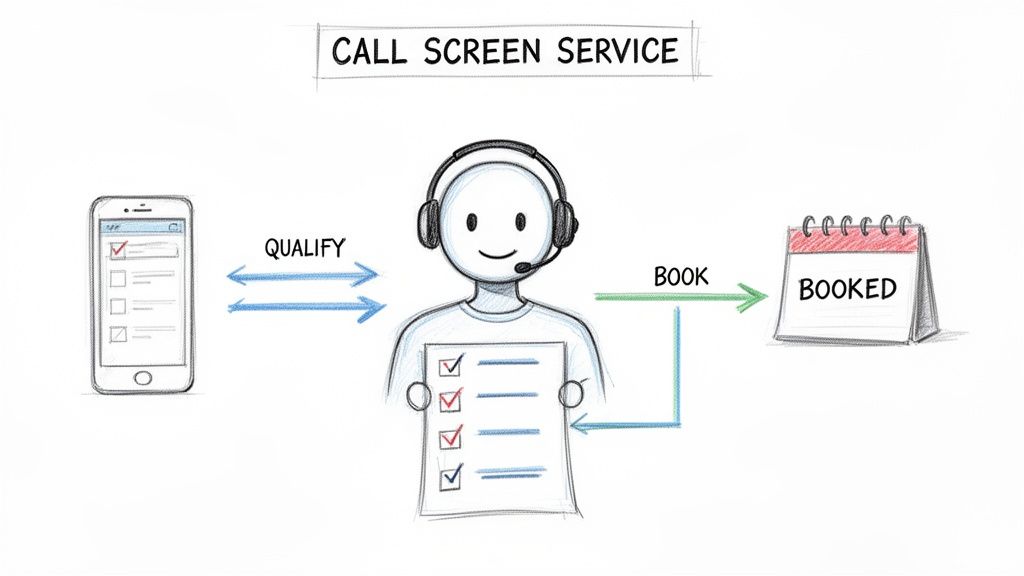
When you hear "call screen service," you probably think of your iPhone blocking a spam number. For a modern moving company, a real call screen service is something else entirely. It’s not about filtering out calls; it’s about converting every good call into a booked job.
Think of it as a digital dispatcher who never sleeps, never gets sick, and never takes a vacation. Their only job is to engage every single caller, instantly determine if they're a potential customer, and turn that phone call into revenue.
That’s the crucial difference. A generic service just answers a phone. A specialized service for movers is built to close a job. It’s the difference between a glorified voicemail and a machine that generates revenue.
From Spam Filter To Revenue Engine
What started as basic junk-call blocking has morphed into a serious business tool, especially now that AI doesn't sound like a robot from the 90s. Conversational AI is set to cut labor costs by $80 billion globally by 2026 as it takes over routine qualification and booking tasks. You can read more about how the industry is changing in the call center outlook for 2026.
This isn’t just some corporate trend. It's a competitive advantage for independent movers who lose between $50K and $150K a year just from missed calls.
Let's be honest about the so-called "solutions" most movers have tried:
- Spam Filters: Great for blocking robocalls. They do nothing to help you book the legitimate customer calling for a quote.
- Traditional Answering Services: They're basically expensive message-takers. An operator who knows nothing about your business takes a name and number, creating a delay that gives your customer time to call the next mover on their list.
- Generic AI Voice Bots: These can answer 24/7, but they’re clueless about moving. They can’t tell the difference between a studio apartment and a 4-bedroom house with a grand piano, so they can't provide an accurate quote.
- Industry-Specific AI Quoting & Booking: This is where things get powerful. It's a system built for the moving business. It knows what a "long carry" is, it asks about stairs, and it uses your rate card to generate a real quote and book the job on the call.
The goal isn’t to just get a lead’s name and number. The goal is to give that lead a firm, accurate quote so they can decide to book with you on the spot. If your "solution" just creates another callback for your to-do list, it isn't solving the problem—it's just delaying it.
It's Not About Answering, It's About Closing
A proper call screen service for movers isn’t a passive observer. It's an active part of your sales process. It doesn't just take down information; it works to turn that caller into a booked job on your calendar.
It does this by automating the repetitive front-office work that bogs you down. It answers every call. It asks the right qualifying questions. It calculates a price based on your rates, and then it pushes that confirmed job straight into your CRM—whether you use SmartMoving, Supermove, or MoveitPro.
This is why a tool like this is no longer a luxury. Customers want instant answers. The moving companies that can give them an immediate, accurate quote are the ones who are going to win. The rest will be stuck playing phone tag, losing revenue one missed call at a time.
Comparing Your Call Handling Options for Booking More Jobs
Picking the right way to handle your calls is one of the biggest decisions you'll make for your moving business. It's not just about customer service—this choice hits your revenue, your stress levels, and whether you grow or stagnate. Let's cut through the noise and look at the four main ways movers handle their phones, judging them on the only thing that really matters: booking jobs.
Option 1: The Owner Answers All Calls
This is the classic starting point for most moving companies. You, the owner, know the business inside and out. When you pick up, you can give a perfect quote, build trust, and close the deal.
But here’s the brutal truth: this model doesn’t scale. It makes you the bottleneck. Every call you miss while you're on a job, stuck in traffic, or trying to have dinner with your family is a job you just handed to your competitor.
- Pro: The best booking rate… for the calls you actually manage to answer.
- Con: It's impossible to be available 24/7. You’ll miss calls during the day and have zero coverage at night or on weekends, leaving thousands of dollars in revenue on the table.
Option 2: A Traditional Human Answering Service
Okay, so you hire a human answering service. It seems like the right move. You get 24/7 coverage and a professional voice on the other end of the line. The problem? They’re professional message-takers, not a sales team.
These operators are reading from a generic script. They can take a name and number, but the second a customer asks about stair fees or if you move pianos, the conversation grinds to a halt. Every single one of these leads becomes a "cold transfer"—a lukewarm message you have to chase down hours later.
The fatal flaw with these services is the delay they create between the customer's first call and getting a real quote. In the moving business, that delay is a deal-killer. By the time you get the message, the customer has already booked with another mover who actually gave them a price.
This gap between a cold message and a qualified, quoted lead is where jobs go to die. We break this down further in our guide on cold transfers versus warm transfers and how it directly impacts your booking rates.
Option 3: A Generic AI Voice Bot
Trying to save money, some owners get lured in by cheap, generic AI voice platforms. They promise to answer calls around the clock for a low monthly fee. But they are dangerously clueless about the moving industry.
A generic bot has no idea what a "long carry" is. It can't differentiate between packing fragile items and just loading boxes. This leads to two outcomes, and both are terrible for your business:
- It gets confused and frustrates the caller, who hangs up and calls your competitor.
- It can't provide a real quote, so it just captures a lead that you still have to call back, defeating the purpose.
You end up doing more work, not less, because you have to re-qualify every single garbage lead it captures. It answers the call, but it can't close the job.
Option 4: An Industry-Specific AI Call Service
This is the only solution built from the ground up to do one thing: book the job. A specialized AI for movers isn't just an answering machine; it’s your best salesperson, working tirelessly 24/7.
Here’s what makes it different:
- It Knows Moving: This AI has been trained on thousands of real calls from moving companies. It understands the lingo, the questions, and the nuances of quoting a job.
- It Quotes With Your Numbers: It integrates with your rate card. It provides instant, precise quotes that include your hourly rates, travel fees, packing materials—everything.
- It Books the Job. For Real. It doesn't just pass along a message. It confirms the move details, secures the booking, and pushes the job straight into your CRM—whether you use SmartMoving, Supermove, MoveitPro, or even a simple Google Calendar.
This isn't just about answering calls. It’s about closing the loop instantly. While every other option focuses on just answering, this one focuses on the only metric that puts food on the table: booked revenue.
The Perfect Call-to-Book Workflow for a Moving Company
Ever wonder what separates a moving company that’s constantly scrambling from one that’s smoothly scaling? It’s not about having more trucks or cheaper ads. It’s about how fast and clean you can turn a ringing phone into a booked job on your calendar.
Your entire sales process boils down to a few critical minutes on the phone. The ideal workflow is a machine built for speed and precision. It leaves no gaps for leads to fall through and no "let me call you back" moments that kill a sale.
Let's walk through the blueprint, step-by-step.
Step 1: Instant Answer and Smart Qualification
The second a potential customer dials your number, a stopwatch starts. They aren’t just calling you. They’re calling down a list of movers they found on Google, and the first one to give them a confident answer wins the job. Period.
- Answer in Under 2 Seconds: The call gets picked up immediately. No endless ringing. No voicemail. The customer instantly knows they’ve reached a pro.
- Smart Qualification: The conversation starts right away, gathering the critical details: move date, addresses, home size, tricky inventory, special needs—just like your best dispatcher would.
This isn’t about just taking a message. It’s about actively qualifying the lead on the spot to understand exactly what they need.
Step 2: The Real-Time, Accurate Quote
This is where most moving companies lose the job. A vague "ballpark" or a promise to "run the numbers and call you back" is just an invitation for your customer to call the next mover.
The system has to generate a precise, real-time quote using your company's actual rate card. This is not optional for winning the job.
That means the quote reflects your business, not a generic template. It must factor in all your variables:
- Hourly rates for 2, 3, or 4-man crews
- Your specific travel and fuel surcharges
- Fees for stairs, elevators, or a brutal long carry
- Packing materials and box costs
- Extra charges for specialty items like pianos or gun safes
When you give a firm price on the call, you build instant trust. You’re not guessing. You’re giving them a real number they can use to make a decision, which skyrockets your chances of closing the job on the spot.
Step 3: Seamless Booking and CRM Sync
Once they say "yes" to the price, the final step needs to be dead simple. You have to get them from "hot lead" to "booked job" without any manual data entry from you or your staff.
A top-tier call screening service makes this automatic. It confirms the booking details and then pushes the job directly into your operations calendar.
This integration is everything. It means that whether you run on SmartMoving, Supermove, MoveitPro, or even just a Google Calendar, the job just appears, ready for dispatch. It cuts out human error, frees up hours of admin time, and lets you focus on running moves instead of running your front office.
This blueprint—instant qualification, accurate quoting, and seamless booking—isn’t just a nice-to-have. It’s the new standard. By 2026, many customer service leaders are already using a "human-in-the-loop" model, where AI handles the initial grunt work. You can read more about how these evolving call center strategies are reshaping the game for service businesses.
How To Choose The Right Call Screen Service
Picking a call screening service isn't like buying software. It's a decision that directly impacts your revenue and your sanity. Get it right, and you turn calls you’d normally miss into booked jobs. Get it wrong, and you’ll just end up with frustrated customers and more work.
The only goal here is to get from the first ring to a confirmed job in your calendar as fast as possible.
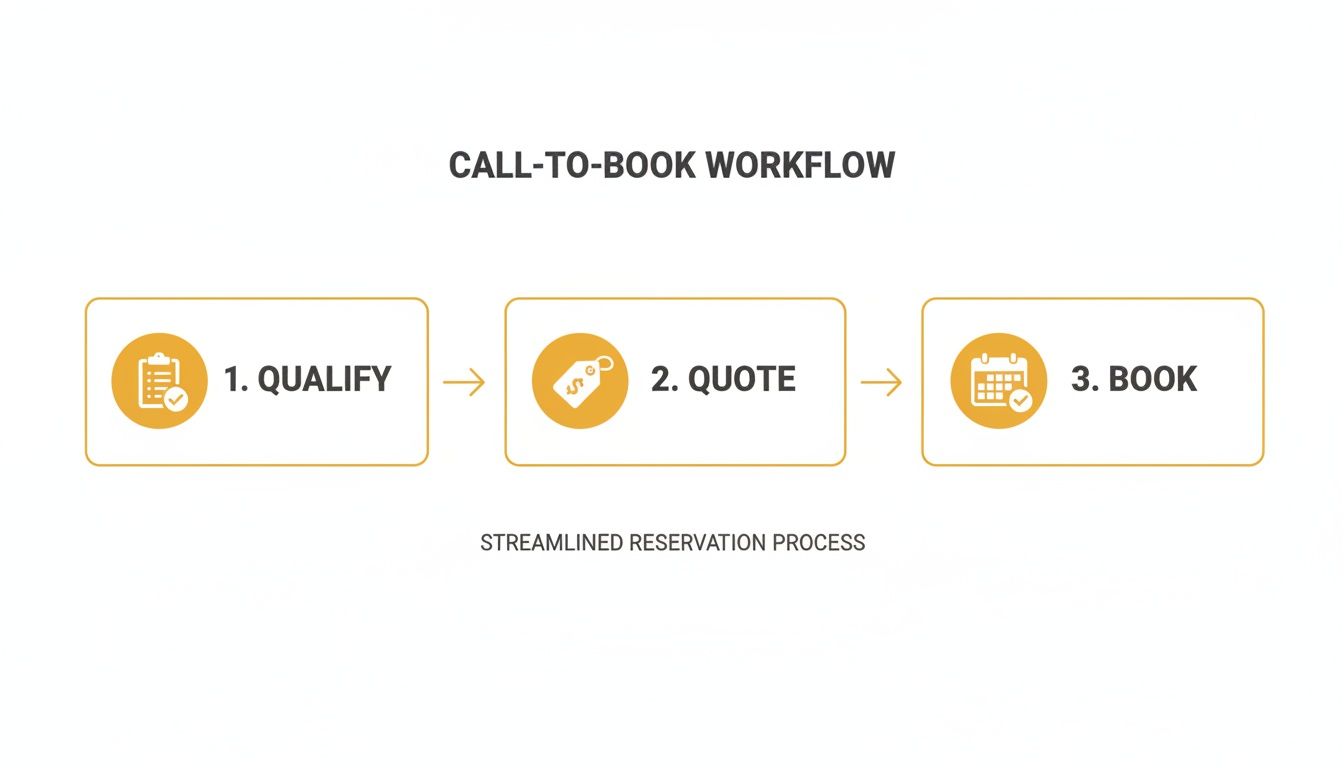
This is it. This is the only workflow that matters: qualify the caller instantly, give them an accurate quote on the spot, and book the job straight into your system. No delays. No "I'll call you back."
The Vendor Evaluation Checklist for Movers
Before you sign any contract, run every potential vendor through this checklist. Their answers will tell you whether they actually understand the moving business or are just peddling a generic tool.
1. Does it integrate with your CRM?
- What to ask: "Does your system plug directly into my moving CRM, like SmartMoving, Supermove, or MoveitPro? What if I just use a simple Google Calendar?"
- Why it matters: If it doesn’t integrate, you’re just creating another data entry task for yourself. The service must be able to drop booked jobs right into the calendar you use to run your business. A "solution" that makes you copy and paste information is no solution at all.
2. Can it quote using your rate card?
- What to ask: "Can your system build a quote using my company's specific rate card, including all our variables like travel time, stair fees, and hourly rates?"
- Why it matters: This is the most important question. If a service can't quote using your prices, it's worthless. It'll either scare good leads away with high estimates or lock you into jobs that lose you money.
3. How does it handle complex moves?
- What to ask: "How does your system handle tricky jobs? I’m talking about multi-stop moves, apartments with terrible access, or customers who need full packing services."
- Why it matters: Moving isn't just A-to-B. The service needs to be smart enough to ask the right follow-up questions to quote these jobs correctly. Or, just as important, it needs to know when to escalate the call to a human for a final review.
4. What is the onboarding process?
- What to ask: "What does onboarding look like? How long will it take before we're live, and do you handle loading our rate card?"
- Why it matters: You're too busy to spend weeks on a complicated setup. The process should be simple, with the vendor doing the heavy lifting of getting your rate card and business rules configured in their system.
As you look at different partners, it's also smart to check out their various services and pricing options to make sure they actually fit your company's budget and needs.
A Low-Risk Implementation Plan
Jumping into new tech can feel like a gamble, especially during busy season. Here’s a simple, low-risk way to prove the ROI before you go all-in.
- Start with After-Hours and Weekends. To begin, forward only your after-hours, weekend, and holiday calls to the new service. These are the calls you are 100% guaranteed to miss anyway.
- Track the Results. After a month, just look at the numbers. How many jobs did it book that you would have otherwise lost completely? Just one booked job—worth, say, $1,500—will often pay for the service for several months.
- Calculate the ROI. Compare the revenue you brought in from those recovered jobs to the monthly cost of the service. For a deeper look at this, you can learn more about the real cost of an answering service and how to measure its true value.
- Roll It Out Full-Time. Once you see the undeniable ROI, you can flip the switch with confidence. Let the service handle all your incoming calls, freeing you and your team up to focus on running the business.
From Cost Center To Revenue Engine
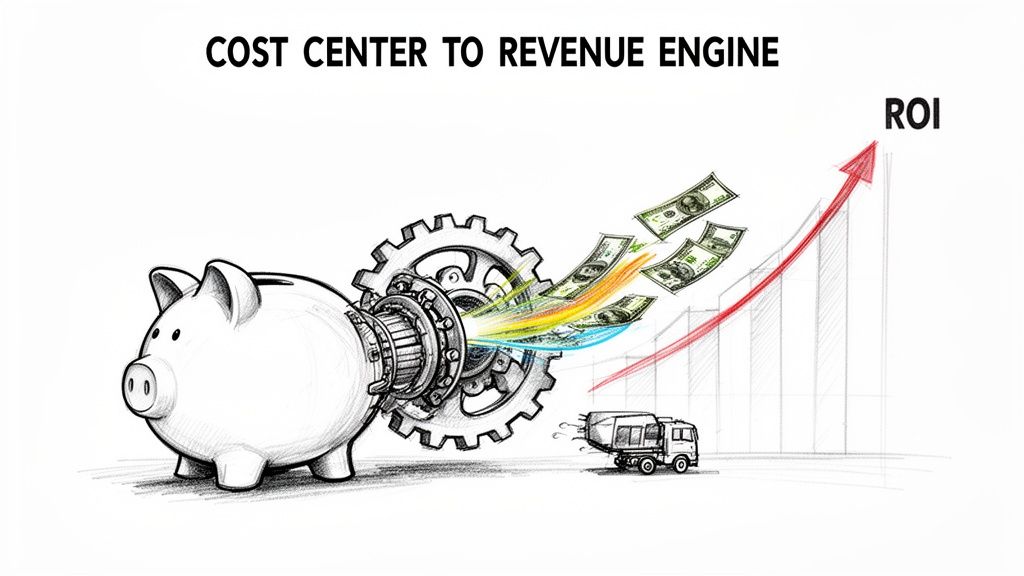
It’s easy to look at a call screen service and see another line item on your profit and loss statement. Another monthly bill. But that’s the wrong way to look at it.
This isn’t a cost. It’s a revenue engine. The right tool doesn’t cost you money—it makes you money by capturing jobs you would have otherwise lost forever.
The return on investment isn’t some complicated spreadsheet formula. It's simple, direct, and powerful.
The Simple ROI Calculation for Movers
Let's do the math. Your average local move is worth $1,500. A specialized AI quoting and booking service might cost around $299 per month. The numbers don't lie.
By booking just one single job that you would have missed—a call at 10 PM, a weekend inquiry, or an overflow call you couldn't grab during peak season—the service pays for itself five times over.
Every single job it books after that first one? That's pure profit dropping straight to your bottom line. This isn't about saving a few bucks; it's about generating thousands in new revenue from calls you’re already getting but failing to convert.
To make sure every call leads to a good outcome, a solid approach to call center quality assurance is critical, whether you're using AI, humans, or a mix of both.
How ROI Scales With Your Moving Company
This isn’t just for the one-truck operator trying to get by. The ROI gets even more dramatic as your call volume grows.
For a 3-Truck Operation: You're probably missing 3-5 calls a week during your busy season. Capturing just one of those is a game-changer. An automated booking service is your perfect front-office employee who never sleeps, takes a lunch break, or calls in sick.
For a 15-Truck Fleet: With a bigger operation, the number of missed calls explodes. You have office staff, but they can't be there 24/7. An intelligent call screen service handles the nights, the weekends, and the overflow, turning what was once a black hole of unanswered calls into a reliable stream of new bookings.
A missed call isn't a minor hiccup. It’s a direct, preventable loss of thousands of dollars.
In a competitive local market where the first company to give an accurate quote almost always wins the job, automation is how you stop leaking profit. It's how you build a more resilient, scalable, and successful moving company.
A Few Honest Questions (And The Straight Answers)
Even when the numbers make sense, bringing a new system into your business feels like a big step. I get it. Most moving company owners I talk to have the same three hesitations. Let’s tackle them head-on.
“Will this AI sound like a robot and annoy my customers?”
We’ve all been tortured by some company’s terrible automated phone system. The good news is, technology has come a long way.
A good system built for movers uses a natural, friendly tone. More importantly, it’s trained on thousands of real moving calls, so it understands the lingo. The goal isn’t to trick people into thinking they’re talking to a human—it’s to solve their problem fast.
Think about it. What’s more frustrating for a customer? A slightly formal voice that provides an accurate quote in 3 minutes, or getting sent to voicemail and never hearing back? Speed and accuracy win jobs.
“What if the call is too complicated for an AI?”
Not every job is a simple 2-bedroom local move. What happens when someone calls about moving a grand piano to another state or asks about long-term storage options you don't list online?
A quality system is built with a “safety net.” It’s designed to know its limits.
When it recognizes a call is too complex—an interstate move, a commercial job, or a customer with a dozen unusual questions—it doesn’t get stuck in a loop. It smartly captures the basic info and then routes the call, or a detailed summary, directly to you or your lead salesperson. The complex lead still gets handled by a human expert, but the opportunity isn't lost.
“Is this really better than just hiring another person for the office?”
This isn't about replacing people. It’s about making your operation smarter and more profitable. An AI service works 24/7/365. It never calls in sick, takes a lunch break, or goes on vacation during your busy season. It costs a tiny fraction of a full-time employee’s salary plus benefits.
The right automation handles the high-volume, repetitive calls—the quote requests, the after-hours leads, the overflow when you’re slammed. This frees up your human team to focus on the things they’re best at: managing crews, handling complex customer issues, and actually growing the business.
When one single job booked after hours pays for the entire month's service, the math becomes pretty clear.
Ready to stop leaking revenue and start capturing every single job? MoveJoy is the AI-powered revenue engine that answers 100% of your calls, provides accurate quotes using your rate card, and books jobs directly into your CRM.
Learn how MoveJoy can turn your missed calls into booked jobs at getmovejoy.com.