
Buying more leads won’t fix a moving company that’s slow to answer, slow to quote, or inconsistent on follow-up. That’s the trap a lot of owners are in right now. They’re paying for attention, then watching calls hit voicemail while crews are in the field, office staff are tied up, and weekend inquiries cool off before anyone gets back to them.
That hurts more in moving than in a lot of other trades. The market is big, but it’s crowded. IBISWorld estimates the U.S. moving services industry will reach $25.7 billion in 2026 with 9,430 businesses, so every local market has plenty of competitors ready to pick up the phone first. If you’re comparing the best moving leads companies, that’s the lens to use. Not just lead volume, but whether your operation can turn that lead into a booked job.
This list is built for owners who care about booked moves, margin, and front-office efficiency. Some of these platforms are true lead sources. Some are demand channels. A few are only worth paying for if you’ve already fixed the leaky bucket on intake. If you need a broader foundation before choosing vendors, this primer on lead generation for local businesses is a useful starting point.
1. MoveJoy
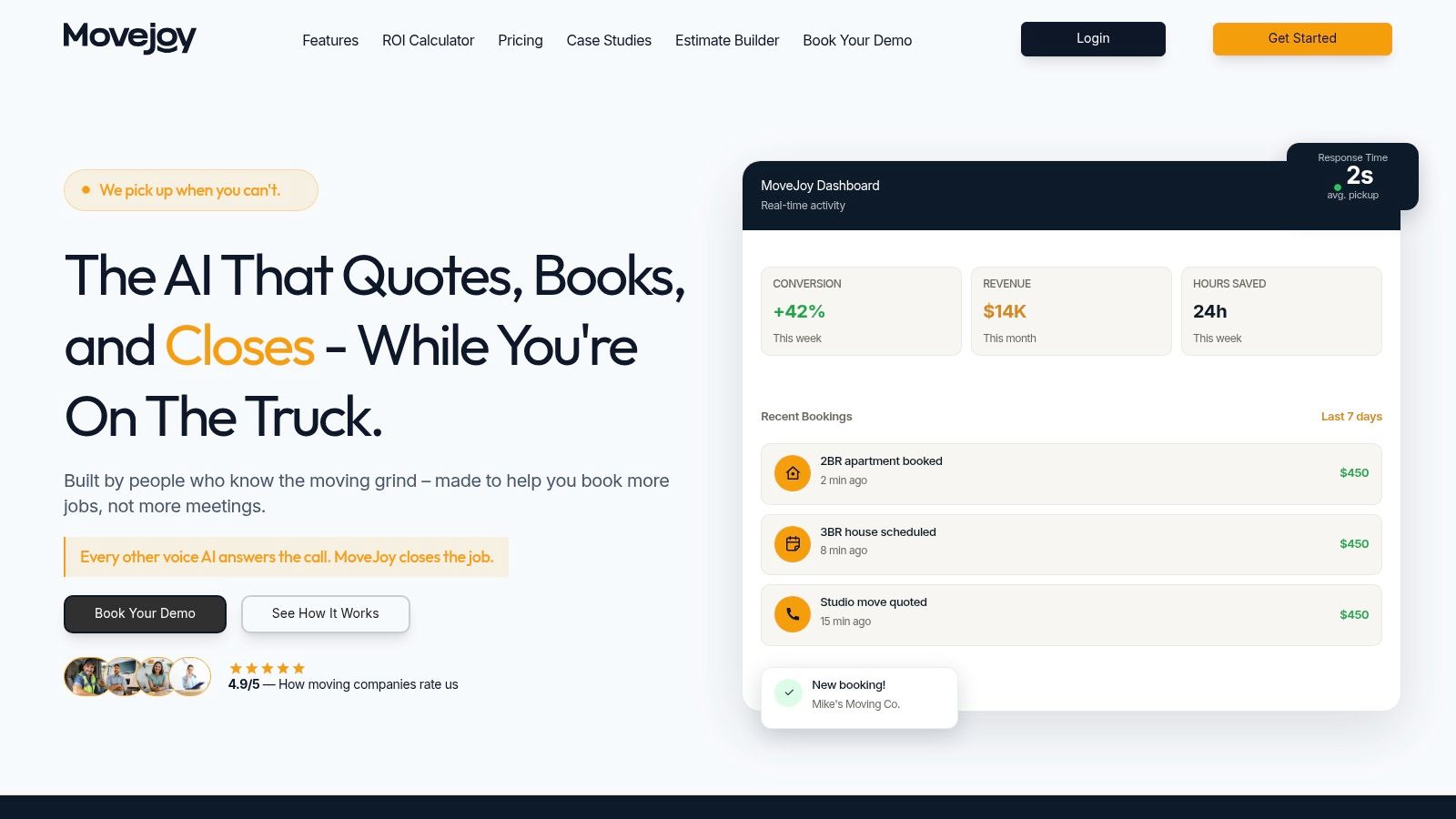
MoveJoy is the outlier on this list because it doesn’t just generate or capture leads. It handles the part most movers lose money on. The call comes in, nobody answers fast enough, nobody quotes cleanly, and the prospect moves on. MoveJoy is built around that gap.
For a moving company, that matters more than another shared lead source. The moving business runs on timing. Extra Space Storage notes that the U.S. mover rate was 8.4% in 2021, the lowest since tracking began in 1948, yet demand still bunches into strong seasonal waves and regional shifts. If your office gets slammed during busy periods, speed on inbound calls becomes a revenue issue, not just a customer service issue.
Why it stands out
MoveJoy is purpose-built for movers. It answers inbound calls around the clock, qualifies the lead, gives a quote using your own rate card, and can book directly into systems like SmartMoving, Supermove, MoveitPro, or Google Calendar. That’s the operational difference between “captured a lead” and “closed a job.”
Practical rule: Don’t buy more leads until your company can answer, quote, and follow up consistently after hours and on weekends.
Three things stand out in practice:
- Moving-specific quoting: It’s built around real moving variables like stairs, long carries, apartment layouts, hourly jobs, and flat-rate work.
- Workflow fit: It’s useful for companies that already rely on SmartMoving or Supermove and don’t want another disconnected tool.
- Revenue focus: It addresses missed-call leakage first, which is usually the fastest way to recover booked jobs without adding office headcount.
Best fit
MoveJoy fits best when you already have demand coming in and the bottleneck is intake. That’s common in the 5 to 20 truck range. Phones ring while estimators are driving, dispatch is juggling crews, and nobody wants to staff the office late into the evening.
It’s also one of the few options here that aligns with the fundamental difference between lead management and lead conversion. A lot of tools send inquiries. Very few can price the move on the call and get it onto the board.
2. MovingLeads.com

MovingLeads.com takes a different path from the instant-quote marketplaces. It leans into pre-mover and new-mover data, often paired with direct mail, so you can reach households before they’re hammering quote forms across the internet.
That timing is the appeal. You’re not always fighting over the same active shopper who sent the same request to several companies in the last ten minutes. For a mover with decent sales discipline, that earlier touch can be useful. This breakdown of moving leads companies gets at the same core issue. Quality only matters if your team can work the lead properly.
Where it works well
This service makes the most sense when you want geographic control. If you’re trying to fill trucks in selected ZIP codes, target owner-heavy neighborhoods, or keep lead flow aligned with capacity, MovingLeads.com gives you more control than broad consumer marketplaces.
It’s also a better fit for operators who can run a process, not just react to ringing phones.
- Good for planned outreach: Direct mail and mover-focused data can support a steady local pipeline.
- Good for territory control: ZIP and radius targeting are useful when you’re protecting labor efficiency.
- Less ideal for weak follow-up: If your office doesn’t call back, text, and rework aging leads, this kind of source underperforms.
The trade-off is simple. This is not a live-transfer style channel. It rewards consistency, scripting, and follow-up cadence.
3. Moving.com (Realtor.com network) – Moving Company Leads

Monday at 8:15 a.m., three quote requests hit the inbox before the office has settled in. One gets called in two minutes. One waits until lunch. One never gets worked because the coordinator was covering dispatch. That is the ultimate test with Moving.com leads. The issue is rarely lead volume. It is whether your team can turn inbound interest into booked jobs before the shopper moves on.
Moving.com sits in the real-estate funnel, which gives it a different advantage than pure quote marketplaces. You are reaching people who are already taking concrete steps around a move, not just price-checking out of curiosity. That can produce solid opportunities for interstate, local, and apartment moves if your office responds fast and qualifies well.
The business case is straightforward. This source can fill the board, but it can also expose a leaky sales process fast. If missed calls, slow callbacks, and inconsistent quoting are already costing you jobs, buying more leads just makes the waste more expensive. A simple lead management software for small business setup often improves ROI here more than adding another ZIP code.
Where it tends to perform
Moving.com is usually a better fit for movers that already have the basics under control. Fast call handling matters. Quote accuracy matters. Service-area discipline matters.
A few trade-offs stand out:
- Good for steady inbound demand: The Realtor.com network gives movers access to homeowners and renters who are already in motion.
- Good for companies with a real sales desk: Shops that answer live, pre-qualify cleanly, and follow up the same day usually get more booked jobs from the same lead count.
- Less forgiving on weak intake: If your team is still slow on first contact or vague on pricing, comparison shoppers will move to the next company quickly.
I would test this channel with narrow coverage first, then review booked revenue, not just cost per lead. Some movers see decent top-line lead flow here and still lose money because too many prospects go cold between the first inquiry and the estimate. That is why response discipline has to come before scale.
Shared-demand channels can work well. They just reward operators who answer fast, quote with confidence, and know their numbers.
4. Angi Leads (formerly HomeAdvisor)
Angi for Pros is familiar territory for home-service operators. It can deliver moving opportunities at useful volume, especially in larger metros, but it also demands discipline on spend and follow-up.
The biggest mistake I see with channels like this is buying volume before fixing qualification. That’s how you end up celebrating lead counts while your booked jobs stay flat. If you’re working on that part of the operation, proper lead management software for small business matters more than another campaign toggle.
Best use case
Angi is usually best as a controlled test channel, not a blind growth lever. Set strict service areas. Be selective on categories. Review call outcomes weekly, not quarterly.
A few practical truths apply here:
- Volume can be useful: If your spring and summer board needs help, a marketplace can create fast demand.
- Shared competition is real: Speed and confidence on the first response decide whether the lead has value.
- Bad intake gets exposed fast: If your team can’t qualify and quote cleanly, this channel magnifies the problem.
This is a decent option for operators who already know their acceptable lead cost and can cut weak ZIPs quickly.
5. Thumbtack for Pros

Thumbtack for Pros usually shows its value on a Tuesday morning when a crew opens up and you need one more job on the board by noon. That is the right frame for this channel. It can produce local demand for apartment moves, labor-only work, and last-minute bookings. It usually does not produce the kind of steady, high-margin pipeline a mover wants to build the company around.
That distinction matters because Thumbtack can look productive on paper while profits stay thin. You may get inquiries. You may even get quotes out quickly. If those jobs are small, price-sensitive, or outside your ideal service mix, booked revenue does not always turn into healthy margin.
Where Thumbtack helps, and where it hurts
Thumbtack works best for operators who know their minimum job value and protect it. If a two-man crew and truck need schedule filler, this platform can help keep assets working. If your calendar is already healthy, low-fit inquiries can distract the sales team from better opportunities.
The common failure point is treating every inquiry like a full sales opportunity. On Thumbtack, many shoppers are comparing three or four movers at once and making a fast decision based on response time, price, and basic trust. That means your process has to be tight. Fast pickup, clear scope questions, and a firm floor on pricing matter more here than polished follow-up sequences.
As noted earlier, local move pricing can vary widely depending on size and service level. That is exactly why quote discipline matters on Thumbtack. A same-day labor request and a full local household move may sit in the same category, but they are not equally valuable leads.
A practical rule: use Thumbtack to fill unused capacity, not to mask weak direct marketing or missed-call problems. If calls go unanswered after hours, buying more marketplace leads just pours water into the same leaky bucket. This guide on moving leads for moving companies covers that conversion problem well. If you are also building paid search alongside Thumbtack, AdStellar AI’s Google Ads tutorial is a useful companion on the traffic side.
Thumbtack can pay for itself. It just needs guardrails. Set a target cost per booked job, review which request types turn into profitable work, and cut the rest quickly.
6. Google Local Services Ads (LSA) – Movers

Google Local Services Ads for movers are one of the stronger channels for local intent because the customer is already searching for help in-market. You’re paying for leads rather than standard search clicks, and the placement is prominent enough to matter in competitive areas.
This is one of the few channels I’ll recommend early, but only if you’ve tightened response time first. If you want a broader look at paid search setup, AdStellar AI’s Google Ads tutorial is a helpful companion for the ad side, while this guide on moving leads for moving companies is more useful on the conversion side.
Why movers like LSA
LSA often brings in stronger intent than broad PPC because the shopper is already in decision mode. That said, the economics still depend on what happens after the lead arrives. Consumer guidance tends to focus on trust and comparison shopping, but it rarely addresses the after-hours gap that costs movers real bookings. That’s one of the big blind spots highlighted in broader mover coverage from ConsumerAffairs.
If LSA leads hit your office after hours and nobody can quote, you’re paying premium lead costs for voicemail.
For established local movers with solid reviews and a real answer process, LSA belongs high on the shortlist.
7. Yelp Ads for Movers

Yelp Ads aren’t a pure lead marketplace, and that’s exactly why some movers misuse them. You’re paying for visibility and clicks, not guaranteed booked conversations. In review-heavy metros, that can still be valuable. In weaker Yelp markets, it can become expensive brand exposure.
The deciding factor is usually your profile strength. If your reviews are thin, outdated, or inconsistent with your website and Google presence, paid traffic won’t save the campaign. It just pushes more people into a weak conversion path.
When it makes sense
Yelp Ads make sense when Yelp already influences local buying behavior in your city. That usually means customers compare mover profiles there, not just browse and leave.
A few operators use Yelp well by keeping budgets controlled and watching call quality closely.
- Strong fit: Dense urban markets where reviews heavily shape buying decisions.
- Weak fit: Markets where Yelp has low consumer trust or low local usage for movers.
- Best practice: Pair it with fast responses and a strong review-generation process.
Yelp isn’t usually the first channel I’d scale, but it can support a healthy lead mix in the right city.
8. Nextdoor Ads (Local Business)
Nextdoor advertising is less about high-intent quote demand and more about neighborhood-level visibility. That makes it more useful for local movers with tight service zones than for companies chasing broader territory.
If you run several trucks inside a compact metro and know exactly which neighborhoods produce your best jobs, Nextdoor can reinforce your name where homeowners already talk about service providers. I like it most as a supporting channel, not as the main engine.
A practical way to use it
Treat Nextdoor like a local brand and referral amplifier. Use it to stay visible in communities where you already want to grow, then make sure your phone handling and quote process are ready when people reach out.
Move.org’s consumer guidance notes that seasonal discounts can cut prices by around 10%, which is a good reminder that lead value shifts by season and shopper mindset. On a neighborhood platform, that matters. The same ad can attract a planned homeowner move in one month and a cluster of low-intent price shoppers in another.
This one works best when your market knowledge is strong and your expectations are realistic.
9. Porch for Pros

Porch for Pros sits in the middle ground. It’s a home-services marketplace, but it also benefits from being connected to homeownership-related activity, which can produce moving demand earlier than some general quote channels.
That earlier signal is the useful part. For movers who like testing multiple lead streams without committing the whole budget to one source, Porch can earn a place in the mix. I wouldn’t build the entire sales plan around it, but I also wouldn’t ignore it if your market shows decent response.
What makes it useful
Porch is at its best when you have disciplined callback habits and clear service filters. It’s not a magic source. It’s a workable source for operators who understand that shared demand has to be processed fast.
One reason this matters is the size of annual consumer movement and spend. The verified research set notes about $19 billion in annual spending on moving services and millions of households changing addresses each year. A platform like Porch doesn’t need to dominate your lead mix to be worth testing. It just needs to produce profitable jobs in your lanes.
Good lead sources don’t have to be perfect. They have to be trackable, repeatable, and profitable in your market.
10. MoveLead.co

MoveLead.co appeals to movers who want a moving-only vendor without building every campaign in-house. That alone can cut noise. You’re not wading through a generic home-services funnel that barely understands the difference between a studio apartment move and a multi-stop household relocation.
This kind of vendor can work well when you want a narrower test. Choose a territory, decide whether you want shared or exclusive lead flow, and measure outcomes with discipline.
Who should test it
MoveLead.co is worth a trial for operators who already know their quoting and scheduling process is solid. If you still have holes in intake, a moving-specific vendor won’t solve them by itself.
The broader market context supports that caution. The moving industry remains fragmented, and thousands of firms are competing for a large but price-sensitive pool of consumers, according to the verified IBISWorld and moveBuddha research set cited earlier. In practical terms, that means specialized lead sources help most when the office team knows how to turn urgency into a booked job.
Top 10 Moving Leads Companies Comparison
| Solution | Core Features ✨ | Quality & Performance ★ | Value & Pricing 💰 | Best For / Target 👥 |
|---|---|---|---|---|
| MoveJoy 🏆 | ✨ 24/7 AI call answering (<2s), quote with your rate card, auto-book to CRM/Calendar, native SmartMoving/Supermove/MoveitPro & Google Cal | ★★★★★ ~95% quote accuracy; ~98% booking rate; 100% answer rate | 💰 $149–$499/mo (typical); ROI from a single recovered booking; fast 5‑min setup | 👥 Independent movers (1–20 trucks) losing revenue to missed calls |
| MovingLeads.com | ✨ Pre‑mover/new‑mover lists, ZIP & value filters, done‑for‑you postcards, month‑to‑month | ★★★☆☆ High‑intent data; offline conversion depends on follow‑up | 💰 Package or per‑lead/postcard pricing; predictable geo targeting | 👥 Local movers who can nurture postcard leads |
| Moving.com (Realtor.com) | ✨ Real‑time consumer quote marketplace; filter by lane, size, timing | ★★★★☆ Large national reach; steady volume; leads often shared | 💰 Pay‑per‑lead / marketplace fees; cost varies with volume | 👥 Ops seeking high volume & national exposure |
| Angi Leads (HomeAdvisor) | ✨ High‑volume marketplace, zip targeting, CRM integrations | ★★★☆☆ Lots of leads in peak season; shared leads common | 💰 Pay per opportunity; fees can add up, ROI market dependent | 👥 Movers prepared for aggressive speed‑to‑lead |
| Thumbtack for Pros | ✨ Pay‑on‑contact model, budget & area controls, in‑app messaging | ★★★☆☆ Good for short/urgent jobs; high price‑shopping | 💰 Pay when contacted; flexible budgets; variable CPL | 👥 Movers chasing quick, small or filler jobs |
| Google Local Services Ads (LSA) | ✨ Pay‑per‑lead, Google Guaranteed verification, geo targeting, disputes | ★★★★☆ Higher‑intent & often exclusive leads if verified | 💰 Lead cost varies with competition; requires background/insurance checks | 👥 Movers who can answer fast and pass verification |
| Yelp Ads for Movers | ✨ CPC ads, category targeting, profile enhancements, reporting | ★★★☆☆ Effective where Yelp influences decisions; review‑sensitive | 💰 CPC with daily/monthly budgets; clicks ≠ guaranteed leads | 👥 Movers in Yelp‑trusted markets with strong reviews |
| Nextdoor Ads (Local) | ✨ Neighborhood geo‑targeting, message/visit objectives, auction pricing | ★★★☆☆ Hyper‑local reach; results depend on community activity | 💰 Auction/daily budgets; good for brand reinforcement | 👥 Small trucks/short‑haul movers targeting specific neighborhoods |
| Porch for Pros | ✨ On‑demand lead purchase, Porch Vetted benefits, lead credits/dashboard | ★★★☆☆ Early‑move signals & protections; shared leads common | 💰 Pay per lead; lead credits & limited protections available | 👥 Movers wanting vetted homeowner requests & platform protections |
| MoveLead.co | ✨ Moving‑only lead generation (SEO/ads), exclusive/shared, territory targeting | ★★★☆☆ Moving‑focused intake; close rate depends on speed‑to‑call | 💰 Transparent starting prices; per‑lead models; exclusive upgrade | 👥 Movers wanting moving‑only leads without running ads themselves |
Final Thoughts
The best moving leads companies aren’t automatically the ones with the biggest brand, the broadest network, or the most aggressive sales pitch. They’re the ones that fit your actual operation. A 5 to 20 truck moving company needs lead sources that match capacity, geography, quote style, and office discipline. If those pieces don’t line up, even a decent lead source will look bad on paper.
That’s why I’d separate this decision into two layers. First, fix intake. Then, buy more demand.
The intake side is where most movers leave money on the table. Calls come in after hours. Dispatch is busy. Someone takes a message but doesn’t quote. An estimator follows up too late. None of that shows up cleanly when owners review marketing spend, but it destroys ROI. A lot of operators think they need better lead vendors when they really need tighter response, cleaner quoting, and better booking workflows.
Once that’s in place, choose channels by role. Some sources are better for volume. Some are better for local control. Some are better for filling gaps in the schedule. Some are useful because they create visibility in neighborhoods or review-driven markets, even if they aren’t classic pay-per-lead sources. You don’t need every channel. You need a small set you can track effectively.
A practical approach looks like this:
- Start with one primary source: Pick one channel that matches your move mix and service area.
- Track booked jobs, not just leads: Lead count can hide weak margins and weak qualification.
- Watch after-hours leakage: If the phone isn’t covered, your marketing data is incomplete.
- Review by move type: A source that works for small local jobs may fail on larger household moves.
- Cut slowly, scale carefully: Give channels enough time to produce signal, but don’t subsidize weak fit forever.
This is also where automation becomes a competitive advantage. Not because movers need more software. They don’t. They need fewer gaps between inquiry, quote, and booking. That’s the difference between systems that log activity and systems that recover revenue. If you’ve been studying broader customer acquisition shifts, this guide to digital marketing trends is worth reading alongside your own lead data.
If I were advising a growing mover today, I’d say this plainly. Don’t judge lead vendors in isolation. Judge them as part of a full booking system. The best moving leads companies can feed the pipeline, but your company still has to answer quickly, quote accurately, and lock the job down before the customer keeps shopping.
If your team is already generating calls but too many inquiries die before they turn into booked moves, take a look at MoveJoy. It’s built for moving companies that want to recover missed revenue by answering every inbound call, quoting with their own rate card, and booking jobs directly into the tools they already use.