Moving Leads for Moving Companies: 2026 Growth Playbook

It's Tuesday in June. One crew is waiting on a parking permit issue, another truck is running late on a walk-up, your sales rep is out on an in-home estimate, and the office line keeps lighting up. A Google Ads caller wants a ballpark quote. A website form asks for a move this weekend. A referral texts instead of calling. A directory lead hits the inbox with thin details and no context.
Most moving companies leak revenue from this source.
Not because demand is weak. Not because the market is impossible. Because the company has leads coming in from different directions, and nobody owns the full path from first inquiry to booked job. The phone gets answered sometimes. The form gets called back later. The estimate gets sent, then sits. Meanwhile, the customer keeps shopping.
For operators running 5 to 20 trucks, this gets worse during busy season. More lead sources create more noise unless the front office has rules, scripts, and follow-up discipline. If you're still relying on whoever happens to be free to call people back, your marketing is feeding a process that can't keep up. Good lead generation helps, and strong digital marketing for home service contractors can absolutely fill the pipeline. But volume alone won't save a weak intake system.
The core job is simpler and harder at the same time. Build a lead machine that answers fast, qualifies correctly, quotes accurately, and books before a competitor does.
Table of Contents
- Your Phone is Ringing But Who is Booking the Job
- The Modern Mix of High-Quality Moving Leads
- The 5-Minute Rule Why Speed to Lead Wins the Job
- From Inquiry to Quote Your High-Conversion Script
- Automating Your Lead-to-Booking Workflow
- Building a Lead Conversion Engine That Lasts
Your Phone is Ringing But Who is Booking the Job
A lot of movers think they have a lead problem when they really have a conversion problem.
A local operator might be paying for Google traffic, getting referral calls, showing up in map results, and buying a few shared leads on the side. On paper, that sounds diversified. In practice, it often means the office is triaging chaos. Calls come in while dispatch is handling same-day changes. Web forms pile up until lunch. Email leads get forwarded around with no clear owner.
The result is predictable. The company “got the lead,” but nobody moved it to the next step fast enough.
Practical rule: A lead isn't an asset until someone has qualified it, quoted it, and advanced it toward a booking.
This is especially true in moving because buyers usually aren't submitting one request and patiently waiting. They're under time pressure. They want availability, price clarity, and confidence that your crew knows what it's doing. If your process forces them into voicemail, delayed callbacks, or vague “someone from sales will reach out” language, you've already made the shopping process easier for the next mover.
What breaks first during busy weeks
The front office usually fails in one of three places:
- Initial response: The call gets missed, the form sits, or the inquiry lands in the wrong inbox.
- Qualification: Staff grab a name and phone number but miss details that affect price, crew size, and schedule fit.
- Follow-through: The estimate goes out, but nobody owns the follow-up sequence that turns interest into a deposit.
Those gaps hurt more than most owners realize because they stack. A weak intake process creates bad quotes. Bad quotes create ghosting. Ghosting makes you think the lead source was poor when the actual issue was what happened after contact.
The operators who win this don't improvise
The strongest 5 to 20 truck companies usually do a few basic things very well. They route every inquiry into one system. They define who answers first. They standardize intake questions. They make sure every quote has a clear next step. And they don't let after-hours opportunities lapse.
That's the difference between being busy and being booked.
The Modern Mix of High-Quality Moving Leads
Not all moving leads for moving companies deserve the same attention, and they definitely shouldn't get the same budget. Some channels create high-intent shoppers who already trust you. Others create a race where several movers call the same prospect with roughly the same offer.
A 2025 moving-lead statistics report says about 41% of all moves occur between May and August, and in 2023 about 12.1% of Americans moved, representing over 41 million people. The same report estimates the moving services industry at roughly $23 billion in 2025 and says around 40% of new moving customers are acquired through online lead forms, while shared third-party leads convert at only 2% to 5% versus 25% to 50% for organic leads and direct referrals, according to moving lead provider statistics for 2025.
That one comparison explains why volume can fool you. A cheap lead source can still be expensive if your team spends time chasing shoppers who never had real intent.
Owned channels usually produce the cleanest opportunities
Owned channels are the assets you control. Your website, Google Business Profile, branded search visibility, and direct referrals all sit here.
These leads usually come with better context. The customer searched your company name, found your reviews, read your service pages, or was told about you by someone they trust. By the time they call, you're not just another name in a list.
A few signs your owned channel strategy is healthy:
- Your website converts local intent: The quote form asks for enough detail to route leads properly.
- Your Google presence is active: Reviews, service descriptions, and accurate business details reduce friction.
- Your branded traffic is increasing: More customers already know who they want to call.
If you want a strong outside perspective on local visibility, the ideas in AI Tools for Local SEO's guide to local SEO leads are useful because they focus on how local service businesses turn search visibility into actual inquiries.
Paid channels create speed but demand discipline
Paid channels can fill gaps fast, especially when organic volume isn't enough. Google Ads, Local Services Ads, and paid directory placements can all work. But they only work well when your intake process is sharper than your competitors'.
Paid leads often show up with less trust attached. The prospect may not know your brand. They may be contacting several movers within minutes. That means your speed, call handling, and quoting quality matter more than your ad account.
Here's the practical trade-off:
| Lead channel | Typical intent quality | Main risk | Best use case |
|---|---|---|---|
| Website SEO and branded search | Higher | Slow growth if neglected | Long-term local market control |
| Google Ads and paid search | Mixed to high | Wasted spend if calls are missed | Fast demand capture |
| Shared lead providers | Lower to mixed | Heavy competition | Filling schedule gaps selectively |
| Referrals and partnerships | Higher | Inconsistent volume | Stable margin-friendly work |
For many operators, the right move isn't “pick one.” It's build a mix, then track which channels book profitable work. If you're comparing provider categories and how they fit your front-end process, this overview of moving leads companies is a helpful starting point.
Partner channels can stabilize the pipeline
Partner channels include real estate agents, apartment communities, storage operators, senior move managers, and local businesses that naturally encounter people in transition.
These leads often convert better than cold third-party traffic because the handoff carries trust. But partnerships only work if you make your company easy to recommend. That means quick answers, reliable scheduling, and a quoting process that doesn't embarrass the referrer.
Good partners don't just want a mover. They want a mover who makes them look reliable to their client.
That's why some of the best lead sources aren't the loudest ones. They're the ones that fit your operation and can be converted consistently.
The 5-Minute Rule Why Speed to Lead Wins the Job
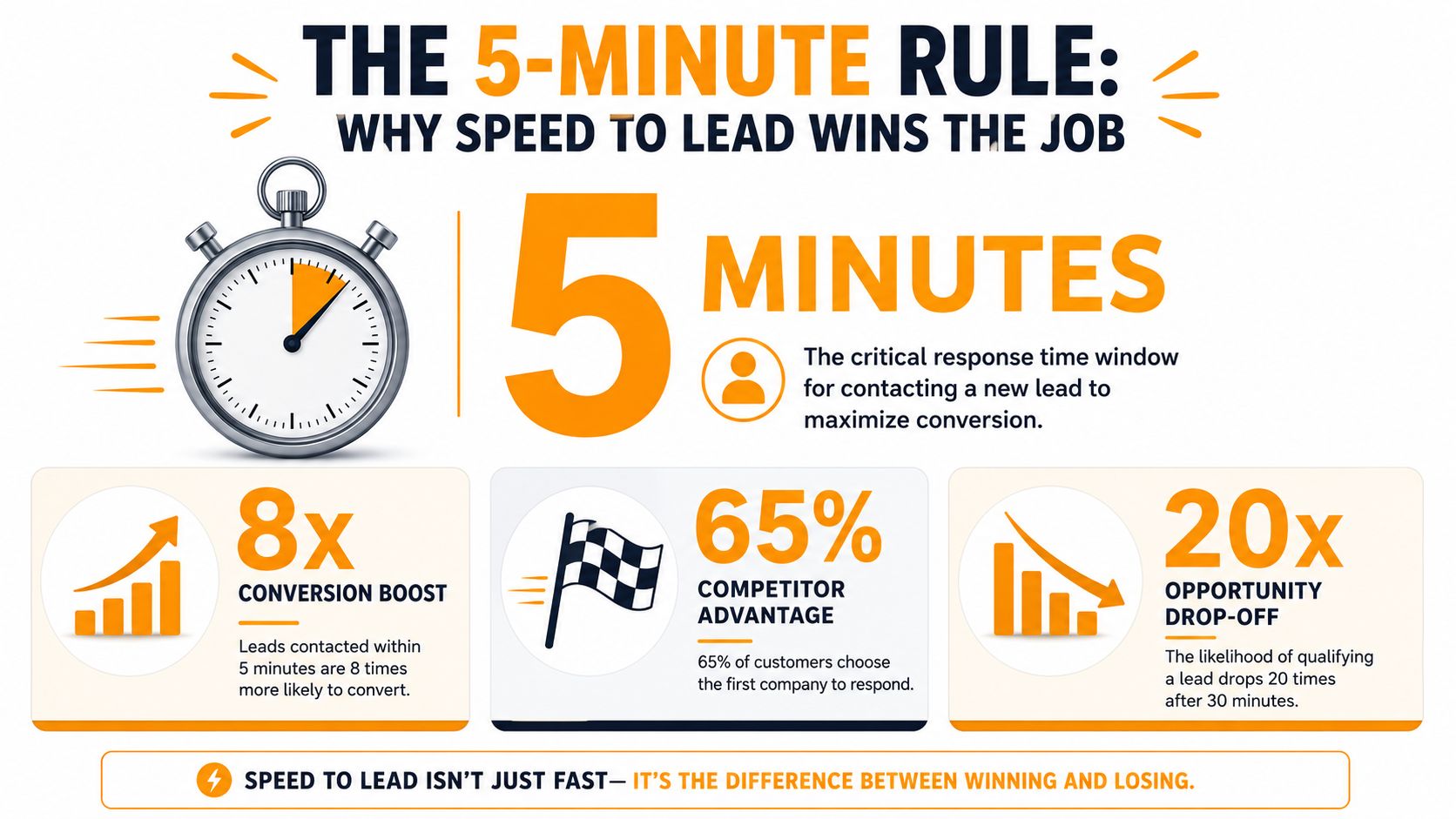
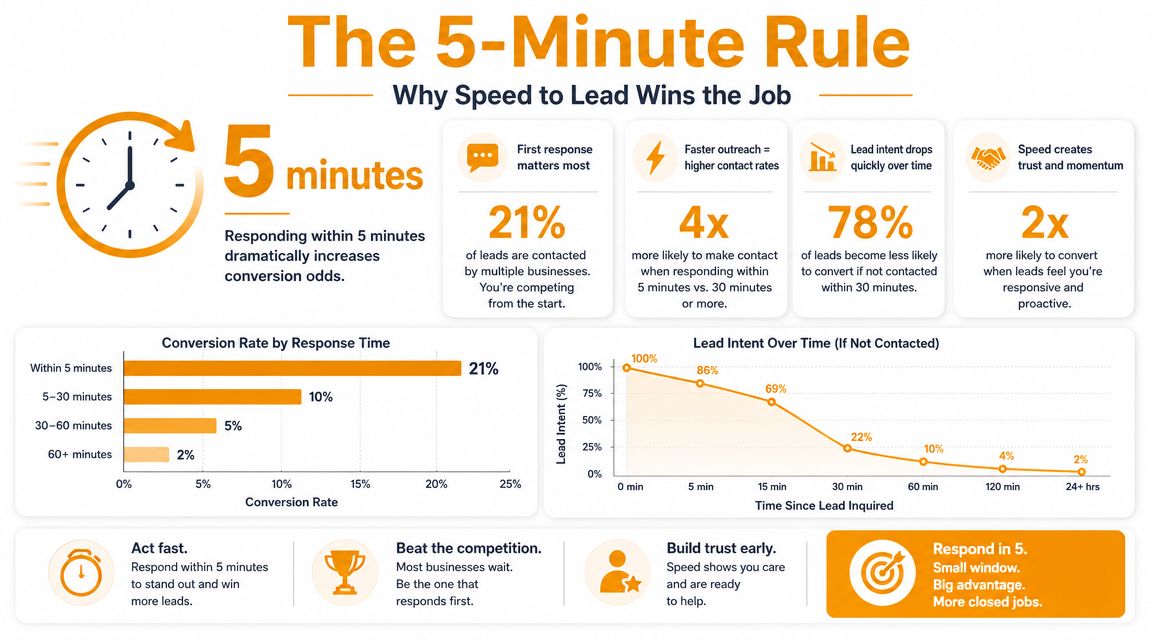
A practical lead-intake benchmark for moving companies is speed-to-lead under 5 minutes. Only 38% of movers respond that fast, meaning 62% miss the highest-intent window. Firms that tighten response times typically improve close rates because moving leads are highly time-sensitive and often contacted by multiple providers, according to Boosted Movers on speed to lead for moving companies.
That benchmark matters because a fresh moving lead behaves differently from an older one. Right after the inquiry, the customer is available, motivated, and actively comparing options. Later, they're at work, distracted, or already talking with someone else.
Why the first contact window matters so much
Moving buyers aren't asking for a whitepaper or browsing for fun. They have a date, a property, and a problem to solve. When they reach out, they want signs that your company is organized enough to handle the move.
A fast response does three things immediately:
- It lowers uncertainty: The customer knows someone is available.
- It captures details while the prospect is engaged: Fewer callbacks, fewer missing fields, fewer bad estimates.
- It creates momentum: Once a prospect starts discussing inventory, access, and timing with you, they become less likely to restart the process elsewhere.
A lot of owners underestimate the compounding effect of delay. It's not just that the callback happens later. The staff member who calls back later often has less context, sounds less confident, and needs to reopen a conversation that should have advanced on first contact.
For broader context on how slow response affects buying decisions across service businesses, Hyperleap AI's analysis of slow response times is worth reading.
What a fast response actually looks like
Fast response doesn't mean calling back and saying, “We got your request.” That doesn't move the sale forward.
It means the first touch does useful work. It confirms the move type, collects the core job variables, checks date urgency, and sets up either an estimate or a quote path. If your office can't do that consistently, your process is still too slow even if someone answered quickly.
The first company to create clarity usually has the advantage.
That's why so many operators outgrow generic call handling. Capturing a message is not the same thing as advancing a sale. If you're evaluating tools that sit at the front desk layer, this page on virtual receptionist service options for movers helps frame the difference between basic answer coverage and a real booking workflow.
From Inquiry to Quote Your High-Conversion Script
Most public advice about moving leads spends too much time on where to buy them and not enough on what happens after they arrive. Even mainstream industry guidance has started to focus more on speed-to-lead, call handling, and quote qualification because that's where deals are won or lost, as noted in SmartMoving's guidance on moving leads.
A strong intake script should feel natural to the caller but structured to the rep. You're not reading lines. You're controlling the conversation so the customer gets confidence and your team gets usable quoting information.

Start with control not small talk
The opening should be warm, but it needs direction.
Use a sequence like this:
- Confirm the customer's goal: “Are you looking for help with a local move, long-distance move, or labor-only?”
- Anchor the date early: “What date are you hoping to move?”
- Check both ends of the job: “What are the pickup and drop-off locations?”
- Establish home size and access: “How many bedrooms, and are there stairs, elevators, or a long walk from the truck?”
That order matters. If a caller asks “How much do you charge?” and your rep jumps straight into rates, the conversation becomes a price auction before you've defined the work.
Questions that improve quote accuracy
Good movers separate themselves by asking better questions. The right details protect margin and increase trust because the quote sounds informed.
Use questions like these:
- Inventory fit: “Are there any oversized pieces, appliances, safes, treadmills, or especially fragile items?”
- Access complications: “Will the truck have direct access, or are there carries, loading docks, or building restrictions?”
- Packing scope: “Are you looking for transportation only, or do you also need packing or materials?”
- Timing pressure: “Do you need a firm arrival window, or do you have flexibility?”
Field note: If your team isn't trained to ask about stairs, carries, elevators, and bulky items early, your close rate and your job margin both suffer.
A generic answering service usually can't handle this well. It can collect contact information, maybe note a move date, then hand the call back to your office. That creates a second conversation when the first one should have moved the customer closer to yes. If you want a structure to train staff around, this call-in script for moving companies is a useful reference.
How to end the call without creating drift
Weak endings sound like this: “We'll get something over to you.” That invites delay and shopping.
Strong endings create a next action:
- “I can get this priced and sent over today.”
- “Let's lock in a survey time.”
- “I have your move details. Once I confirm crew availability, I'll send the quote and follow up.”
The caller should leave knowing exactly what happens next and when.
Automating Your Lead-to-Booking Workflow
Manual intake breaks first after hours, during lunch, during dispatch crunches, and on weekends. That's the part many owners avoid admitting because the business still feels busy. But busy and controlled are not the same thing.
For independent movers using shared lead sources, reported performance benchmarks are 5–10% close rates, $20–$80 per lead pricing, and $200–$1,200 CAC per booked job. That makes the underlying methodology critical. Every inbound inquiry needs immediate qualification, persistent follow-up, and CRM tracking because low-intent or delayed responses erode ROI fast, according to Boosted Movers' guide to moving company lead providers.
Where manual systems break
Most front offices fail in routine ways:
- Calls hit voicemail after hours: Those leads often never come back.
- Form fills wait for office hours: By then, intent has cooled.
- Reps quote from memory: That creates inconsistency and margin mistakes.
- Follow-up depends on individual discipline: Good reps do it. Busy reps forget.
This is why adding more lead sources can make performance worse. More opportunities entering a weak system don't produce more bookings. They create more leakage.
What to automate first
The best automation projects start with revenue leaks, not software features.
Prioritize these layers:
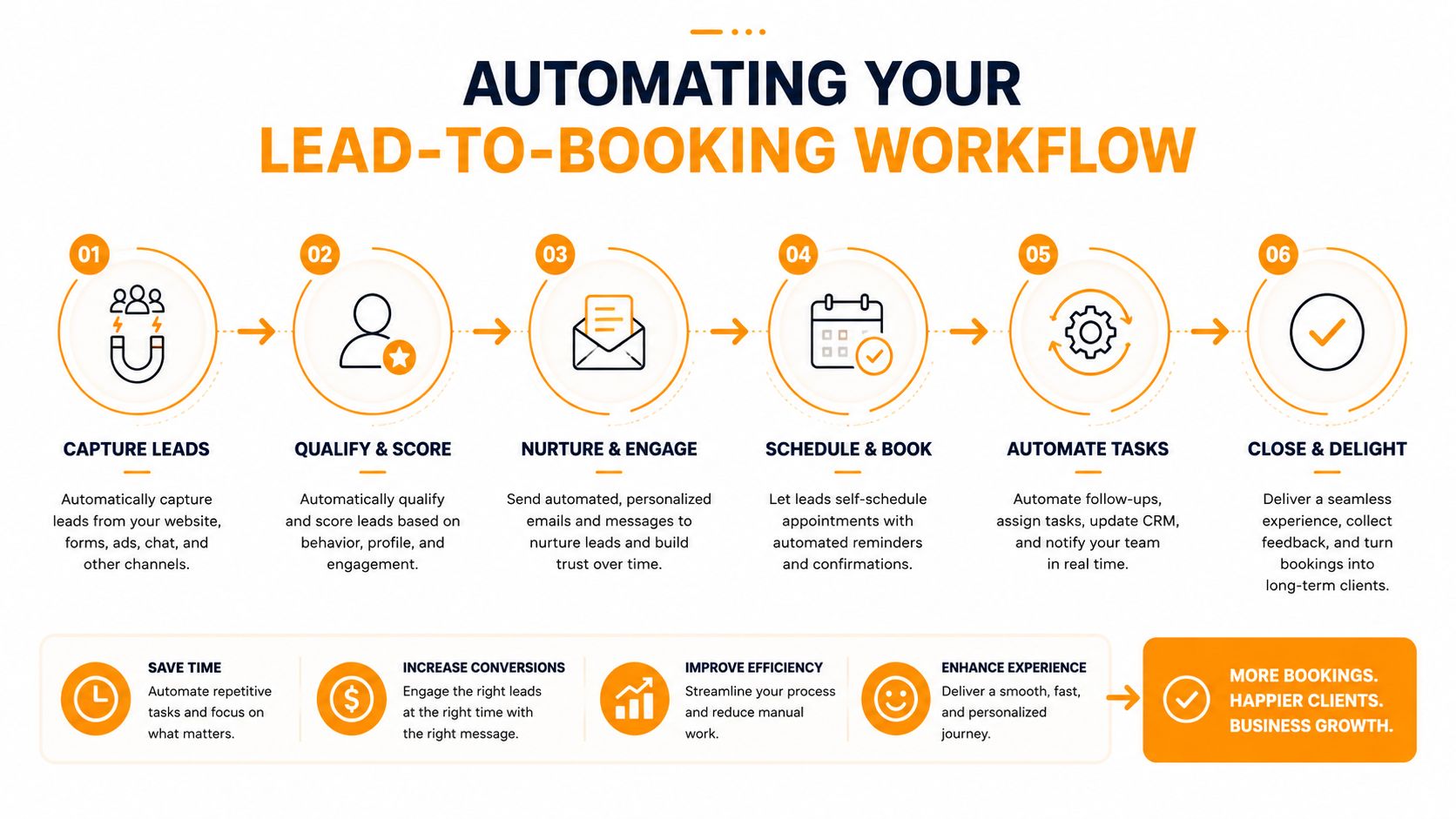
- Immediate inbound capture: Every call and form should trigger contact, qualification, or both.
- Quote logic: Your rates, service rules, travel assumptions, and access charges need to live in one quoting workflow.
- Booking handoff: The quote should connect to SmartMoving, Supermove, MoveitPro, or your calendar process without manual re-entry.
- Follow-up sequencing: Unbooked estimates need automatic reminders and a clear owner.
Here's the operational test. If a lead comes in at night, can your business still collect the move details, provide a usable next step, and keep the customer from drifting to a competitor? If the answer is no, your current setup is costing you bookings.
The operational standard to aim for
For a 5 to 20 truck operator, automation should act like a force multiplier for the office, not a gimmick.
A solid system should:
| Workflow step | What good looks like |
|---|---|
| First contact | The lead gets an immediate response path |
| Qualification | Job details are captured in a consistent format |
| Quote generation | Pricing follows your own rate card and service rules |
| Scheduling | Availability and next step are clear |
| CRM sync | Data lands in the system your team already uses |
| Follow-up | Unbooked quotes stay active until the prospect decides |
One option in this category is MoveJoy, which is built for movers to answer inbound calls, qualify the lead, generate an accurate quote using the company's own rate card, and book into SmartMoving, Supermove, MoveitPro, or Google Calendar. That matters because most tools stop at lead capture. They don't finish the sale path.
Building a Lead Conversion Engine That Lasts
The healthiest moving companies don't treat lead generation and lead handling as separate jobs. They treat them as one revenue system.
In 2026, a moving-industry benchmark report found that only 38% of moving companies respond to leads within 5 minutes, while the industry's average speed to lead is 8 minutes and the average close rate is 39%. The same benchmark reported an average time to book of 2.5 days, 215 leads per month, and $525K in revenue per sales rep, according to SmartMoving's 2026 moving company sales benchmarks. The takeaway isn't that you need more raw lead volume. It's that booking performance is shaped by response speed and sales discipline.
That's the playbook for moving leads for moving companies.
Build a balanced acquisition mix. Favor channels that produce trust and intent. Respond while the buyer is still engaged. Train your team to gather the details that produce accurate quotes. Then remove the manual bottlenecks that cause missed calls, delayed estimates, and dropped follow-ups.
A lead source can fill your inbox. Only a conversion system fills the schedule.
Operators who get this right usually find that growth gets less chaotic. Dispatch becomes easier because the jobs being booked are better qualified. Sales gets cleaner because the office isn't chasing cold leftovers. Ownership gets breathing room because the company stops depending on heroics to win routine work.
If you want a practical way to stop losing jobs between the first call and the final booking, take a look at MoveJoy. It's built around the part most movers still handle manually: qualifying inbound leads, pricing them accurately, and moving them straight into a real booking workflow.