Peak season exposes every weakness in a moving company’s front office. The crews are out, dispatch is juggling timing changes, and the phone lights up with people who want a price right now. If nobody can answer, or if the person answering can only take a message, that lead usually keeps shopping. If someone does answer but gives a shaky ballpark that misses stairs, long carries, packing, or service type, the job may still disappear later.
That’s why the real question isn’t whether your team can pick up the phone. It’s whether your process can quote accurately enough to win the job on the first call. For independent movers running multiple trucks, an AI quoting tool for movers matters when it does three things well: responds immediately, prices from your actual rate card, and moves the customer straight into a booked job instead of a callback queue.
The Quoting Bottleneck Every Mover Knows
A customer calls at 7:12 p.m. They’ve got a two-bedroom move, one flight of stairs at pickup, elevator at delivery, and they want to know the price before they call the next company. At the same time, one crew is running late, another truck needs a schedule adjustment, and your office manager is already buried in follow-ups from earlier estimates.
That’s the bottleneck. Not lead generation. Not brand awareness. Quoting speed under real operating pressure.
For most movers in the 5 to 20 truck range, the problem isn’t that demand disappears. The problem is that demand shows up all at once, usually when the people who know pricing best are busy doing something else. In those moments, the business starts leaking revenue from three places: unanswered calls, delayed callbacks, and quotes that aren’t specific enough to feel trustworthy.
The industry has hard evidence of how exposed movers are here. In the moving industry, the average company misses 20% to 35% of inbound calls, and the problem gets worse after hours and during peak periods where 40% to 60% of revenue-generating calls happen outside standard business windows, while only 12% are captured according to this moving industry missed-call breakdown.
Practical rule: If your quote process depends on one owner, one estimator, or one office person being available at the right moment, it isn’t a process. It’s a bottleneck.
That’s why a lot of movers start looking into automation in general. If you want a broader view of how operators are using systems to remove repetitive front-office work, Wayfinder Agents on business AI gives a useful high-level look at where automation helps and where it still needs real business logic behind it.
The mistake is thinking that “answered” automatically means “handled.” It doesn’t. If the caller still has to wait for pricing, wait for a callback, or wait for someone to review the move details later, your competitor still has a window to win that job.
If you want to see how expensive that gap gets in practice, this breakdown of missed call revenue for moving companies maps the leak to the kind of front-office chaos most operators already know too well.
What an AI Quoting Tool Is for the Moving Industry
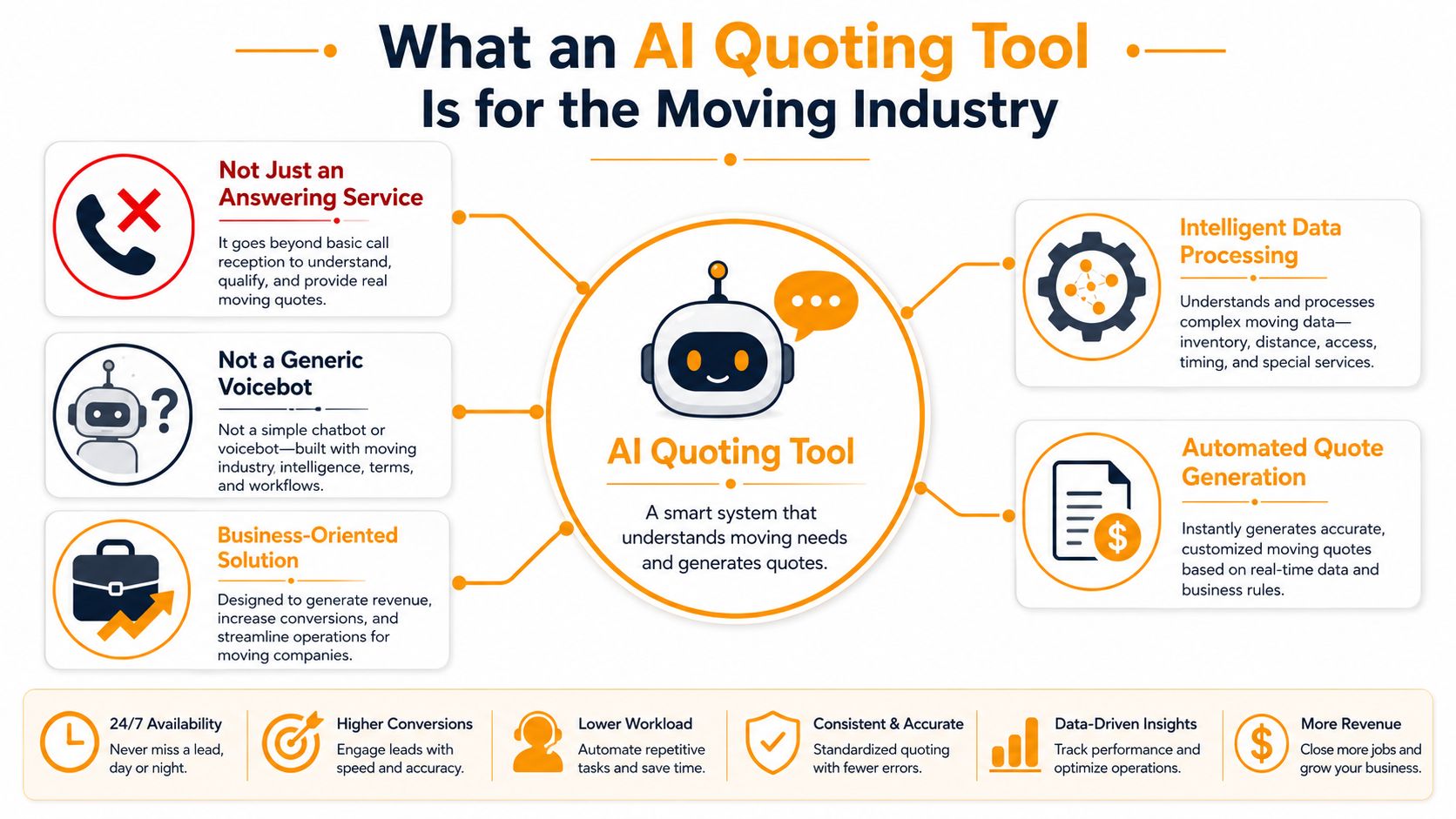
An AI quoting tool for movers isn’t just software that picks up the phone. It’s a revenue system built to do the part many front offices struggle to do consistently under load: gather the right move details, price the job from the company’s own rules, and move the customer toward a booking while interest is still high.
It’s a sales function, not a phone function
Most operators first think about this category as call coverage. That’s understandable, but it undersells the actual task. The system has to function like your best inside salesperson on a busy day. It needs to ask useful questions, understand how your company prices local versus long-distance work, and avoid promising something the operation can’t deliver.
That distinction matters because a lot of tools can capture contact info. Far fewer can turn a live inquiry into a quote the customer is willing to commit to.
A practical way to think about it is this:
- Call handling: Picks up, greets the caller, records details.
- Lead intake: Qualifies basic move information.
- Quote generation: Applies the mover’s pricing logic to the call.
- Job conversion: Sends the quote and moves straight into booking.
Only the last two steps shorten the sales cycle.
What separates it from the usual options
A true AI quoting tool for movers should understand moving-specific inputs, not just generic customer service prompts. That means service type, inventory, access conditions, timing, and extras all have to affect the outcome. If it can’t handle those variables, it becomes another intake layer that still pushes work back to your staff.
The best automation in a moving company doesn’t create another inbox to manage. It removes the need for the inbox in the first place.
If you want a plain-English primer on how operators in other industries think about systems like this, learn workflow automation is a good resource. The key takeaway for movers is simple: automation only helps when it follows your actual operating rules.
That’s why the useful version of this category isn’t “AI voice.” It’s a quoting and booking layer that sits in front of tools like SmartMoving, Supermove, MoveitPro, or Google Calendar and does the front-end work that usually gets delayed when the office is slammed.
How an AI Quoting Tool Actually Books a Job
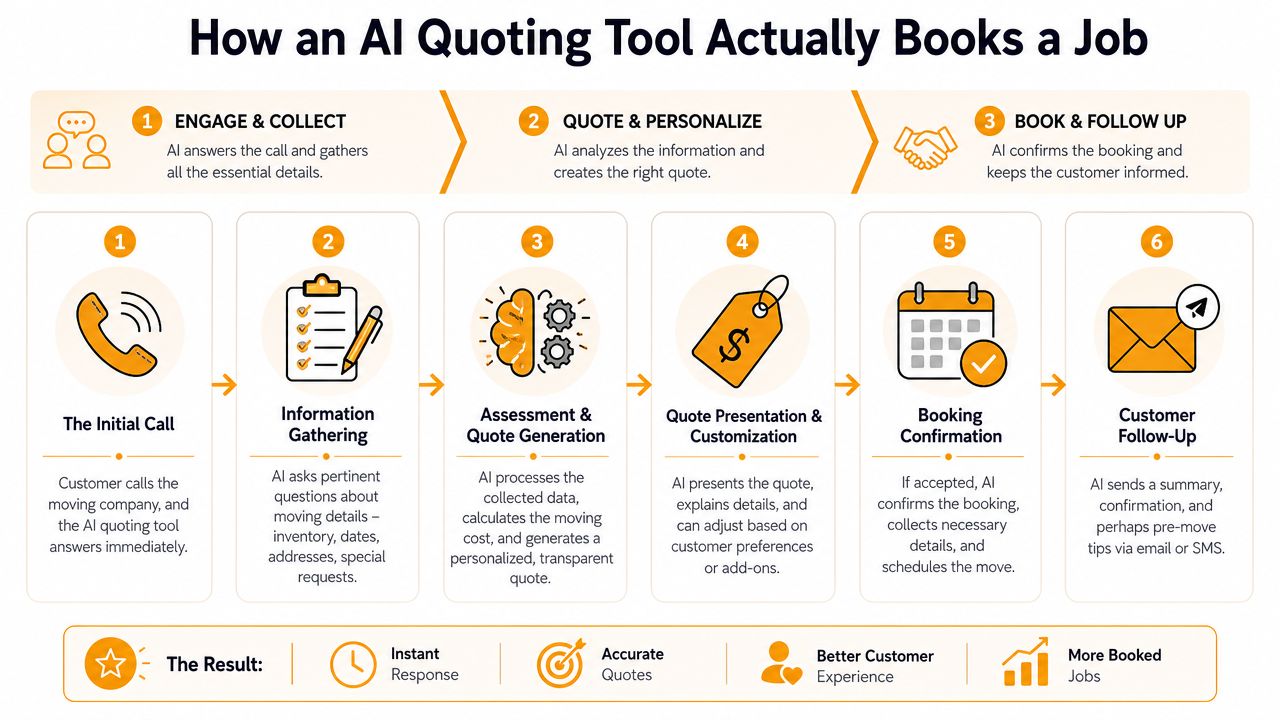
A lot of movers hear “AI quoting” and assume it means a gimmicky bot that spits out a rough number. That’s not the standard to hold it to. The standard to judge it by is whether it can move through the same practical steps a strong coordinator or estimator would handle on a live call.
The Initial Call and Lead Qualification
The first job is speed and control. The caller reaches a live response immediately, gives the move date, origin, destination, home size, and any obvious constraints, and gets guided through the conversation in a way that feels organized rather than robotic.
For movers, qualification has to be specific enough to support quoting. That usually means questions such as:
- Move type: Is this local, long-distance, or interstate?
- Property details: House, apartment, walk-up, elevator building, storage unit, office.
- Access factors: Stairs, long carry, tight access, loading dock, elevator reservation.
- Scope of work: Labor only, full-service move, packing, unpacking, specialty items.
- Timing: Preferred date, flexibility, and whether the customer needs a morning window.
If the system only collects name, phone, and “please tell us about your move,” it hasn’t solved the bottleneck. It has only created a cleaner callback list.
Teams using AI-driven follow-up tied to estimate status are also seeing deals close 2x faster than manual processes, according to this review of moving company software and virtual estimate workflows. That matters because the first call isn’t isolated. It’s the start of the close.
The Quoting Logic Explained
Most generic tools often fall short. Moving quotes break when the system doesn’t understand what changes price.
A workable quoting engine has to apply the mover’s own pricing logic. It needs to know whether the company prices local work hourly and interstate work from tariff logic, when to apply stair charges, how long carries affect labor, and whether packing or bulky-item handling changes crew size, time, or both.
That’s also why virtual survey and quoting systems have become more useful when paired with clean operational data. LoadIt’s overview of AI quoting for moving companies reports that AI-powered virtual survey technology can reduce quote generation time from 45 minutes to approximately 5 minutes, with AI vision systems detecting over 2,000 item types and firms with clean CRM data seeing AI-generated labor estimates within 10% to 15% of actual costs on standard residential moves.
Field note: A fast quote only helps if the customer can trust it. If the final bill swings because the original quote missed obvious access or service details, speed becomes a liability.
The practical lesson is straightforward. Quote logic has to be grounded in your real rate card, your service rules, and the exceptions your team deals with every week.
Seamless Booking and CRM Integration
Once the quote is accepted, the handoff matters. If the caller hears “great, someone will reach out tomorrow,” the sale isn’t finished. It’s paused. That pause is where a lot of booked-looking jobs die.
A strong setup should do the following on the spot:
- Present the quote clearly
- Confirm the service details
- Capture contact and move information cleanly
- Place the job into SmartMoving, Supermove, MoveitPro, or calendar workflow
- Trigger follow-up communication automatically
That’s the key difference between an intake tool and a booking tool.
For operators comparing systems, this page on automated moving estimates is useful because it reflects the operational standard you should expect: quote generation that flows into actual scheduling instead of creating one more task for the office. And if you’re evaluating how AI is being used earlier in the funnel as well, ReachLabs.ai on lead gen AI is a helpful outside read on where automation supports conversion and where businesses still need process discipline.
The Critical Difference Between Answering a Call and Closing a Job
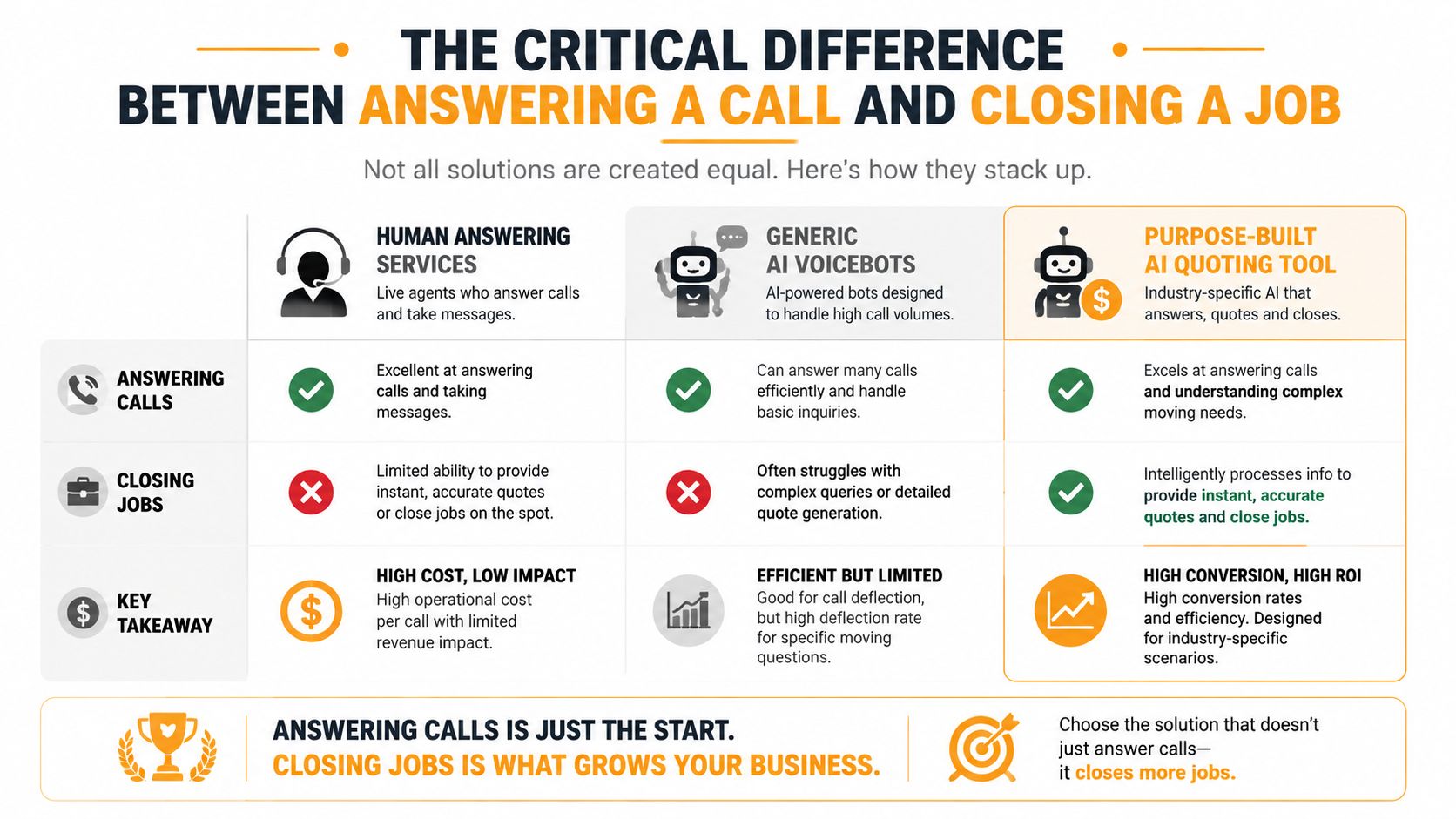
A lot of front-office tools sound similar in a demo. They answer calls. They collect information. They may even sound polished. But from a mover’s point of view, those are not equal outcomes.
Answering a call protects service levels. Closing a job protects revenue.
What human answering services do well, and where they stop
Human answering services are often reliable at basic coverage. They can answer overflow calls, keep a professional tone, and make sure inquiries don’t go straight to voicemail. For an owner who has been losing calls at night and on weekends, that can feel like immediate relief.
The problem is that most of those services don’t know your pricing rules. They don’t know when a walk-up changes crew time, when a “small move” still needs specialty handling, or how your company distinguishes local pricing from long-distance quoting. So they take a message and promise a callback.
That creates a familiar pattern:
| Option | Answers call | Quotes accurately | Books on first touch |
|---|---|---|---|
| Human answering service | Yes | Usually no | Usually no |
| Generic voice tool | Often yes | Inconsistently | Rarely |
| Purpose-built quoting tool | Yes | Yes, if tied to rate card | Yes |
The service did its job. The sale is still open.
Where generic voice tools break down
Generic AI voice platforms usually improve speed, but speed without quoting logic creates a different problem. The customer hears a fast response, then runs into vague pricing, weak move qualification, or a handoff to a human once the conversation gets specific.
That’s especially risky in moving, because a quote that feels “instant” but misses real cost drivers often backfires later. According to Realtor.com’s reporting on AI moving quotes, many tools promise instant AI quotes but often miss hidden fees, leading to 28% higher final costs for customers. The practical fix is committable AI quoting, where the system uses the company’s exact rate card to produce a binding quote immediately.
That issue isn’t just about customer experience. It affects booking trust. When callers suspect the number will change later, they keep shopping.
Why a true AI quoting tool closes faster
A purpose-built system changes the sales motion because it collapses multiple steps into one conversation. The customer gets a response, gives the move details, hears pricing tied to the mover’s real rules, and can commit while urgency is highest.
If your tool can’t explain the price and stand behind the quote, it’s not helping you close. It’s only helping you document the loss more neatly.
That’s the line operators should use when evaluating any platform. Don’t ask, “Can it answer my phones?” Ask, “Can it quote my jobs the way my office would, and can it turn that quote into a booking without a second step?”
That’s the business difference between lead capture and revenue capture.
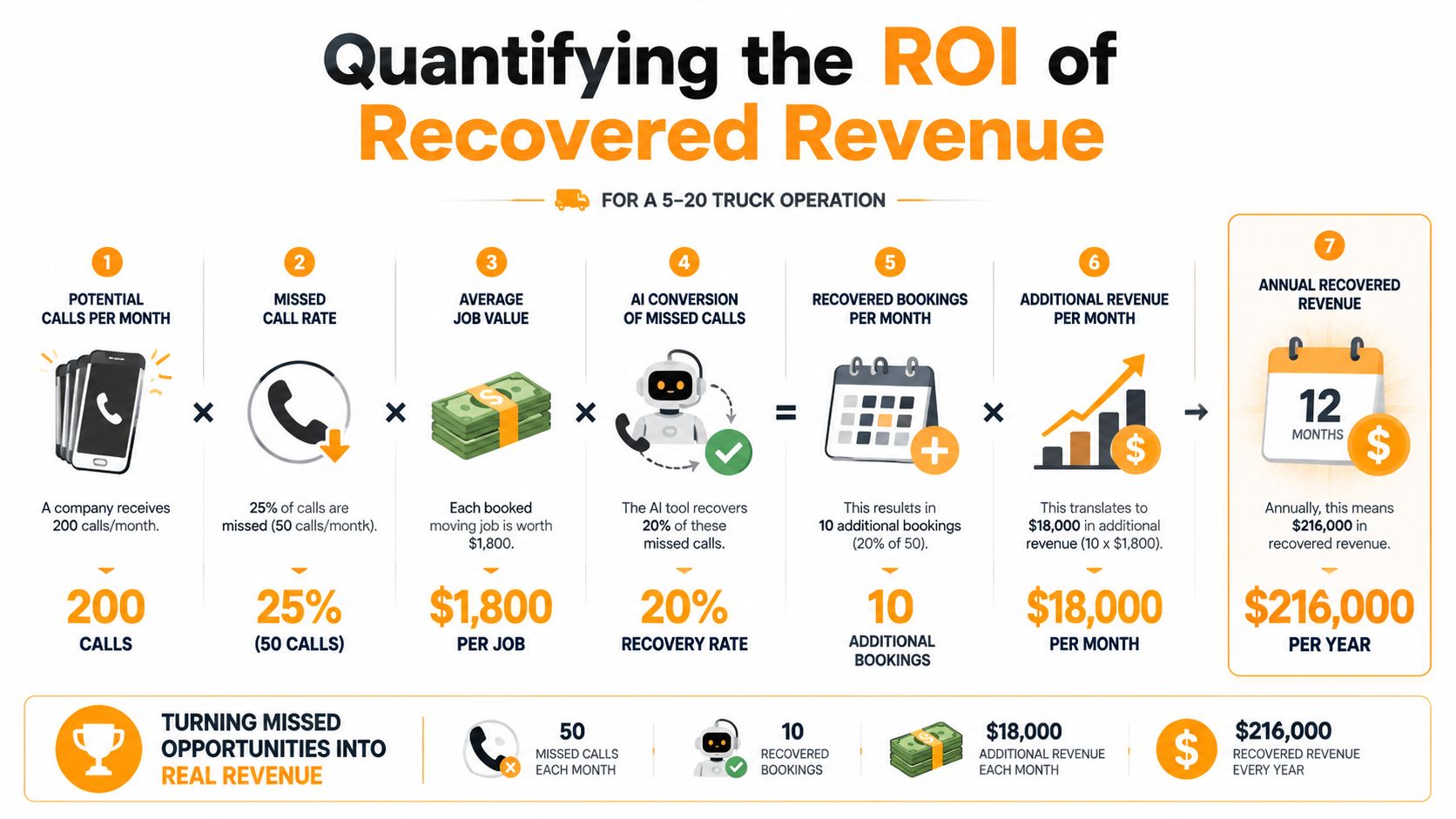
Quantifying the ROI of Recovered Revenue
Most owners already know missed calls are expensive. What helps is turning that gut feeling into a simple operating lens. Once you do that, an AI quoting tool for movers stops looking like a software expense and starts looking like a recovery mechanism.
A simple way to look at the leak
You don’t need a complicated model. Start with one question: how many real booking opportunities are slipping because the office can’t answer or quote fast enough?
One verified benchmark is blunt. OnCall Clerk’s missed-call revenue example shows that missing just 3 calls per day with an average job value of $300 results in roughly $56,000 lost annually. That lines up with the revenue pain many smaller and mid-sized operators feel when calls stack up during busy periods.
For a growing mover, the practical takeaway is this:
- Missed calls aren’t isolated events. They repeat daily.
- Callback delays reduce close rates. By the time your team follows up, the customer may already have another quote.
- Weak estimates create another leak. Some callers don’t ghost because they dislike the price. They ghost because they don’t trust the quote.
Why recovered bookings hit harder than cost savings
Owners often evaluate automation the wrong way. They compare it to payroll or admin overhead. A better comparison is recovered gross revenue from jobs that should have been bookable in the first place.
The biggest payoff usually comes from two changes happening together:
- More calls get handled when they come in
- More quotes become committable while the customer is still on the line
That’s different from saving office time. It changes top-line output.
Revenue lens: Front-office automation earns its keep when it prevents shopping behavior, not just when it reduces clerical work.
If you run a 5 to 20 truck operation, this is the right financial question to ask each month: how much booked revenue did we lose because nobody could quote with confidence at the moment the customer was ready to buy?
A Mover’s Checklist for Getting Started
Most implementation problems aren’t technology problems. They’re setup problems. Movers try to automate intake before they’ve cleaned up pricing logic, service rules, and handoff ownership. Then they blame the tool when the actual issue is that the business never documented how it wants jobs quoted.
Use this checklist before you turn anything on.
Clean up your quoting inputs first
- Standardize your rate card: Make sure local, long-distance, and interstate pricing rules are clearly documented. If two office staff members would quote the same job differently, fix that first.
- List your access charges: Stairs, long carries, elevators, shuttle situations, and specialty item handling should be spelled out in plain language.
- Define service add-ons: Packing, unpacking, storage coordination, junk removal, and material charges should follow consistent rules.
- Audit your job types: Separate what can be quoted automatically from what should be flagged for manual review.
A lot of quoting trouble starts with “tribal knowledge.” One dispatcher knows how to price a walk-up. One estimator knows when to add time for a tight downtown delivery. That knowledge has to be made explicit before any automation can apply it consistently.
Set the operational rules before you turn anything on
Once your pricing inputs are clean, work through the workflow side:
- Choose the booking destination: Decide whether new jobs should land in SmartMoving, Supermove, MoveitPro, or Google Calendar.
- Set calendar guardrails: Block dates, truck capacity, blackout periods, and service-area limits need to be clear.
- Write the exception rules: Large commercial work, highly custom interstate jobs, and unusual access situations may need a live review path.
- Define follow-up triggers: Open, viewed, accepted, and expired quotes should each have a next action.
- Train the office on edge cases: Your team should know when the system books automatically and when a human steps in.
A simple readiness table helps.
| Operational area | Ready if this is true |
|---|---|
| Pricing | Your team uses one quoting standard |
| Access fees | Charges are written, not implied |
| CRM or calendar | Booking destination is clear |
| Follow-up | Status-based actions are mapped |
| Exceptions | Manual review rules are documented |
The companies that get the best result from automation usually keep the first rollout narrow. Start with your most common residential move types. Get those right. Then expand into harder scenarios once the quoting logic has proven itself.
Your New Competitive Advantage in 2026
For movers, speed and quote accuracy are no longer back-office concerns. They’re competitive weapons. Customers shop fast, compare fast, and often decide based on who gave them a clear number first.
That shift is already visible in adoption. 37% of independent moving companies in the United States are now actively using AI tools, and companies using AI for 24/7 lead capture and instant quoting report up to 28% higher booking conversion rates than companies relying only on human staff, according to SmartMoving’s analysis of AI use cases for moving companies.
For an owner trying to grow without burning out the office, that matters. The advantage isn’t “having AI.” The advantage is having a front-end process that still works when the phones spike, the crews are in the field, and the caller wants an answer now.
If you’re looking at systems in this category, the standard should be higher than call coverage. It should be accurate quoting, booking-ready workflow, and less revenue left sitting in voicemail. This overview of AI for moving companies is a useful place to keep that benchmark in mind while you compare options.
If you want to see what that looks like in practice, explore MoveJoy. It’s built for movers that need more than answered calls. It’s designed to help turn inbound demand into accurate quotes and booked jobs without adding more front-office chaos.