
It’s busy season. One crew is still unloading. Another truck is rolling back late. Your phone rings at 9 PM from a prospect who wants a quote for a move this weekend, or a storage add-on, or a last-minute long carry job your dispatcher would know how to price in two minutes.
You have two bad options. Answer it yourself and stay tethered to the business every night. Or let it hit voicemail and hope they wait until morning.
Most won’t. In the moving industry, after-hours phone abandonment directly correlates with a 30–45% loss of qualified leads during peak season, and 68% of inbound moving quote requests happen outside standard business hours (6 PM–8 AM) according to OnCall Clerk’s analysis of moving company answering services. For a 5 to 20 truck operator, that’s not a minor annoyance. That’s booked revenue leaking out while your team is in the field.
A significant error is assuming the solution is limited to “answering the phone.” It isn’t. The primary goal is booking the job while the customer is still on the line.
The 9 PM Dilemma Every Mover Faces
It is 9 PM in June. Tomorrow’s crews are half confirmed, one customer wants to shift a start time, and the business line rings while you are trying to finish dinner.

That call could be a live move request for next week. It could be a shopper comparing three companies. It could be someone asking whether you can handle a third-floor walkup, packing, and a piano on short notice. If nobody answers well, the odds of winning that job drop fast.
Owners of 5 to 20 truck operations know this pattern. Evening calls hit after office staff have gone home, but before demand has cooled off. Customers call when they get off work, when a real estate timeline changes, or when a family finally sits down and starts calling movers.
The pressure comes from how moving jobs are sold. People rarely want a vague promise and a callback tomorrow. They want to know whether you service their route, whether the job fits your schedule, what affects the price, and what the next step is. The company that gives a clear answer first usually gets the inside track.
That is why after-hours coverage has to do more than pick up the phone. It has to keep the sales process moving. A message-taking service may make the owner feel covered, but it still leaves the essential work for the next morning, after the prospect has already called other movers.
Practical rule: If your after-hours setup only collects a name and number, you are not really covering nights. You are delaying sales.
Growth makes this worse. More trucks mean more inbound quote requests, more service questions, more dispatch noise, and less chance that the right person is free to handle a call properly. At that point, the issue is not simple availability. The issue is whether your front office can keep booking work after the office closes.
If you want a hard look at how missed calls turn into lost revenue, review this breakdown of missed call revenue for moving companies. The operators who fix the 9 PM problem usually stop asking, “Who can answer?” and start asking, “Who can quote, qualify, and book?”
The Real Cost of a Ringing Phone After 5 PM
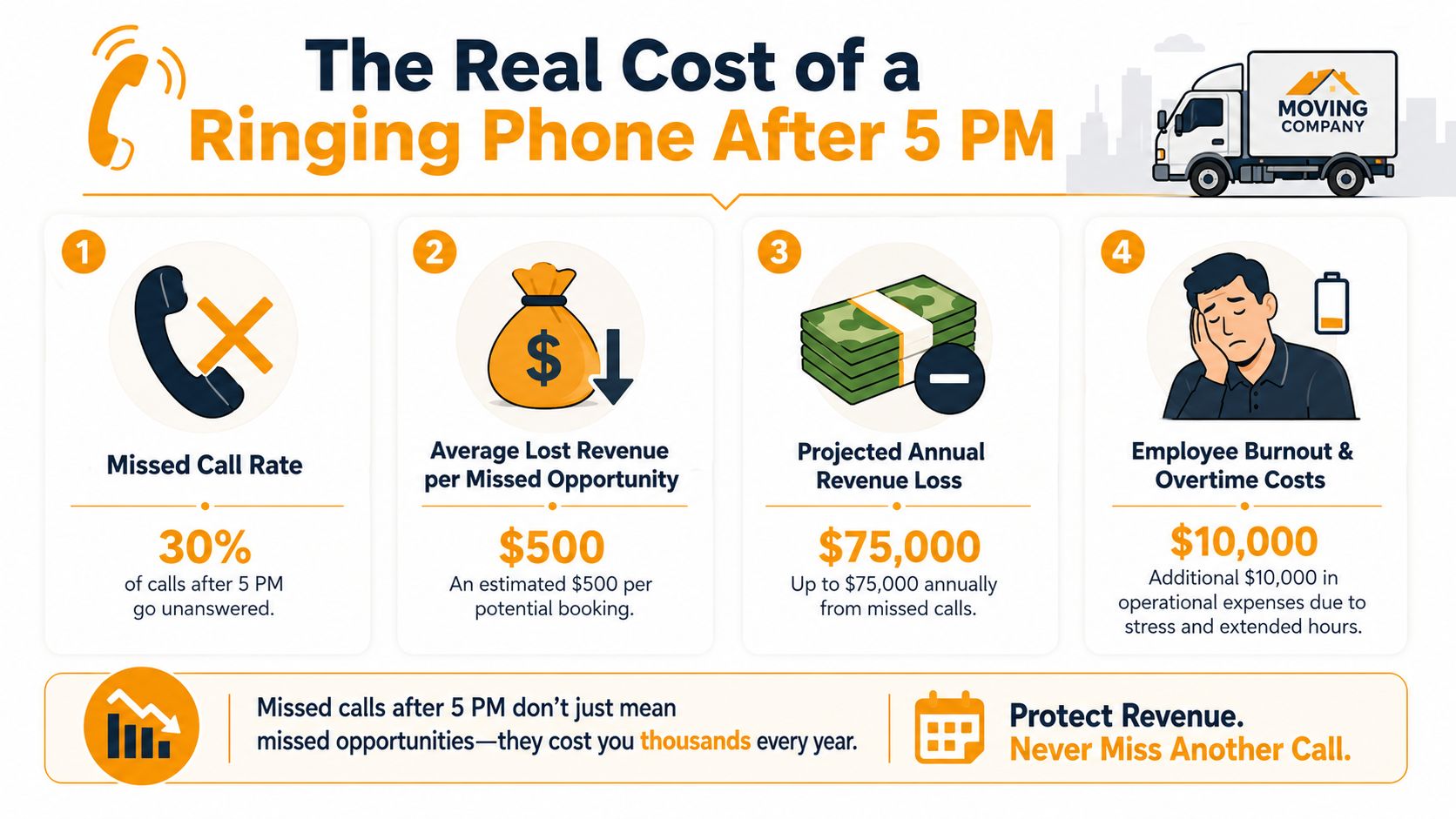
At 7:40 PM, a prospect is finally free to call three movers. One line goes to voicemail. One service takes a message. One company gets the caller to the next step. That third company has the best chance of winning the job, even before price becomes the deciding factor.
Why missed calls hit sales first
Too many owners still treat evening call volume as an office coverage issue. In practice, it shows up on the sales board. If the phone is one of your primary ways to generate estimates, every unanswered quote call creates a gap between marketing spend and booked revenue.
Analysts at PCN found that small and mid-sized businesses miss a meaningful share of inbound calls. For movers, that risk usually spikes during peak season, on weekends, and on days when the coordinator is tied up with dispatch problems, changes, and customer questions.
Davinci Virtual’s review of missed-call revenue impact makes the financial side plain. Unanswered calls can turn into major annual revenue loss for small and midsize companies. In moving, the full cost can run even higher because one booked job often leads to packing, storage, a second move, or referrals from the same household.
If you want a mover-specific breakdown, review this analysis of missed call revenue for moving companies.
Use a simple revenue leak formula
You do not need a complicated model to spot the problem. Start with this:
Missed Quote Calls x Average Job Value x Typical Close Rate
That formula is simple on purpose. It keeps your team focused on booked work, not phone activity.
The bigger mistake is counting every answered call as a save. A service that only collects a name and number has not protected the sale. It has delayed the estimate. That distinction matters after hours, because a caller who is ready to book will often keep dialing until someone can answer basic questions, qualify the move, and tell them what happens next.
A good after-hours setup also depends on how well it understands real conversation. That is where Natural Language Processing matters. If the system cannot reliably catch move dates, inventory details, origin and destination, or intent signals like urgency and budget sensitivity, it will struggle to quote accurately or route the lead correctly.
Here is the practical in-house audit I recommend:
- Pull 30 days of call logs: Separate after-hours calls from business-hours traffic.
- Isolate quote intent: Remove vendor calls, claims, existing customer support, and spam.
- Check outcome, not just pickup rate: Did the caller get an estimate, a follow-up scheduled, or nothing useful?
- Compare callback timing to booking results: Next-morning follow-up sounds reasonable, but many ready-to-buy callers are gone by then.
Owners usually discover the same thing. The loss is not just the calls you never answered. It is the jobs you never had a fair chance to close because your after-hours process stopped at message-taking instead of booking.
Human vs AI Comparing After-Hours Answering Solutions
Most moving companies evaluating an after hours answering service for a moving company end up looking at three options. A traditional human answering service. A generic AI voicebot. Or automation built specifically for moving workflows.
They are not equal, and they fail in different places.
What human answering services do well
A human answering service can give you live coverage. That matters because callers prefer a live response over voicemail, and a live operator can calm down a frustrated customer better than a static recording.
Human services also help when your office team is overloaded. They can gather names, phone numbers, move dates, and basic notes. For some operators, that alone feels like progress because at least the lead didn’t disappear completely.
The problem is that most of these services stop at message-taking.
A human operator who doesn’t know your rate card, your travel charge rules, your service area, your minimums, or your calendar can’t really sell the job. They can only hold it for later. In moving, “we’ll have someone call you tomorrow” is often another way of saying “we let a ready-to-buy customer keep shopping.”
Where generic AI breaks down for movers
Generic AI sounds attractive because it’s available around the clock and doesn’t need shift coverage. But moving companies run into a specific problem fast. Generic tools don’t understand the quoting logic that determines whether an estimate sounds accurate or clueless.
That issue has been called out directly in Nextiva’s write-up on after-hours answering service limitations, which notes the flaw in generic AI voice tools that lack industry-specific quoting logic. In moving, terms such as “2-bedroom walkups” and “hourly vs. flat-rate pricing” can change the quote and the customer’s trust immediately.
If you want a plain-English explainer on the technology behind better voice conversations, this overview of Natural Language Processing is useful. The key takeaway for movers is simple. Voice tech only helps if it understands the language and decision rules of your business.
Generic voice tools can capture words. They often can’t interpret moving context well enough to price work correctly.
That’s where many operators get burned. The bot sounds polished, but it mishandles a long carry, misses a stair charge, confuses local and long-distance logic, or fails to ask about specialty items. Then your office has to clean up the quote the next day, and the caller no longer trusts it.
For operators comparing systems, this overview of AI call answering for movers can help clarify the difference between simple call pickup and real front-end automation.
What industry-specific automation changes
The right moving-specific system doesn’t just answer. It qualifies, quotes, and books using the business rules you already use.
That means it can ask the questions a trained estimator would ask, apply your own rate card, and push the result into the workflow your team already manages.
Here’s the side-by-side view that matters:
| Feature | Human Answering Service | Generic AI Voicebot | Industry-Specific AI (e.g., MoveJoy) |
|---|---|---|---|
| Live after-hours response | Yes | Yes | Yes |
| Takes basic caller details | Yes | Yes | Yes |
| Understands moving terminology | Limited | Limited | Yes |
| Applies moving-specific quoting logic | No | Usually no | Yes |
| Uses your own rate card | No | Limited | Yes |
| Handles stair carries, special items, access issues | Rarely | Inconsistently | Yes |
| Books directly into CRM or calendar | Sometimes limited | Sometimes | Yes |
| Best use case | Overflow and message-taking | Basic intake | Quote and booking automation |
This marks a key dividing line in the market. One category captures a lead. The other closes work.
The Critical Difference Between Capturing a Lead and Closing a Job
At 9:12 PM, a prospect calls after getting three estimates online. They want a price, want to know whether you can handle a piano and a third-floor walk-up, and want to make a decision tonight. If your system only takes a message, your office inherits a callback list in the morning and that caller keeps shopping.

Lead capture sounds good until callbacks pile up
Message-taking has a place. It can cover overflow, catch low-priority inquiries, and keep the phone from ringing into the void. But for booked-move intent, it leaves too much revenue on the table.
By the next morning, your coordinator is calling back people who were ready to buy the night before. Some pick up. Some are at work. Some already booked with the company that gave them a usable quote and a clear next step on the first call.
That's why the strongest effective lead generation techniques depend on conversion after the inquiry comes in. Movers do not lose these jobs because the phone was answered poorly. They lose them because the buying process stalled.
What has to happen on the first call
Closing an after-hours lead takes more than a name and phone number. The caller needs a credible quote or a defined booking path while urgency is still high.
As noted in AgentZap's moving-industry guidance, a strong moving intake process captures more than a dozen move-specific details in one conversation. That matters because a usable quote depends on operational details such as:
- Origin and destination: Local work, intrastate moves, and long-distance jobs follow different pricing rules.
- Home size and inventory: Crew size, truck count, and time window depend on volume.
- Access issues: Stairs, elevators, long carries, and parking restrictions affect labor and risk.
- Special handling: Pianos, safes, antiques, and gym equipment require different pricing and planning.
- Service type: Packing, storage, shuttle needs, and labor-only requests change the scope.
If your after-hours setup cannot gather those details accurately, it pushes closing work into tomorrow and lowers your odds of winning the job.
The best operators optimize for giving the caller an accurate next step during that first conversation. Sometimes that means a quote. Sometimes it means a deposit request. Sometimes it means a booked on-site estimate for a complex move. The point is speed with enough accuracy to keep trust intact.
That is the gap between capturing interest and turning it into revenue. One system creates a callback task. The other helps your business secure work while the customer is still ready to commit.
Making It Work How to Integrate Automation With Your Operations
The good news is that this doesn't require a complicated rebuild of your office. Most moving companies already have the core ingredients. They just haven't connected them.
Start with your rate card, not the software
If your pricing still lives partly in your owner's head, partly in dispatcher notes, and partly on an old PDF, fix that first.
Your rate card should clearly define your hourly rates or flat-rate logic, travel charges, stair fees, long-carry rules, minimums, specialty item charges, service area rules, and date-based pricing differences if you use them. It doesn't need to look fancy. It needs to be usable and consistent.
Without that, any quoting process breaks down, whether a human estimator is taking the call or a system is handling intake. The issue isn't automation. The issue is unclear pricing operations.
Connect it to the systems your team already uses
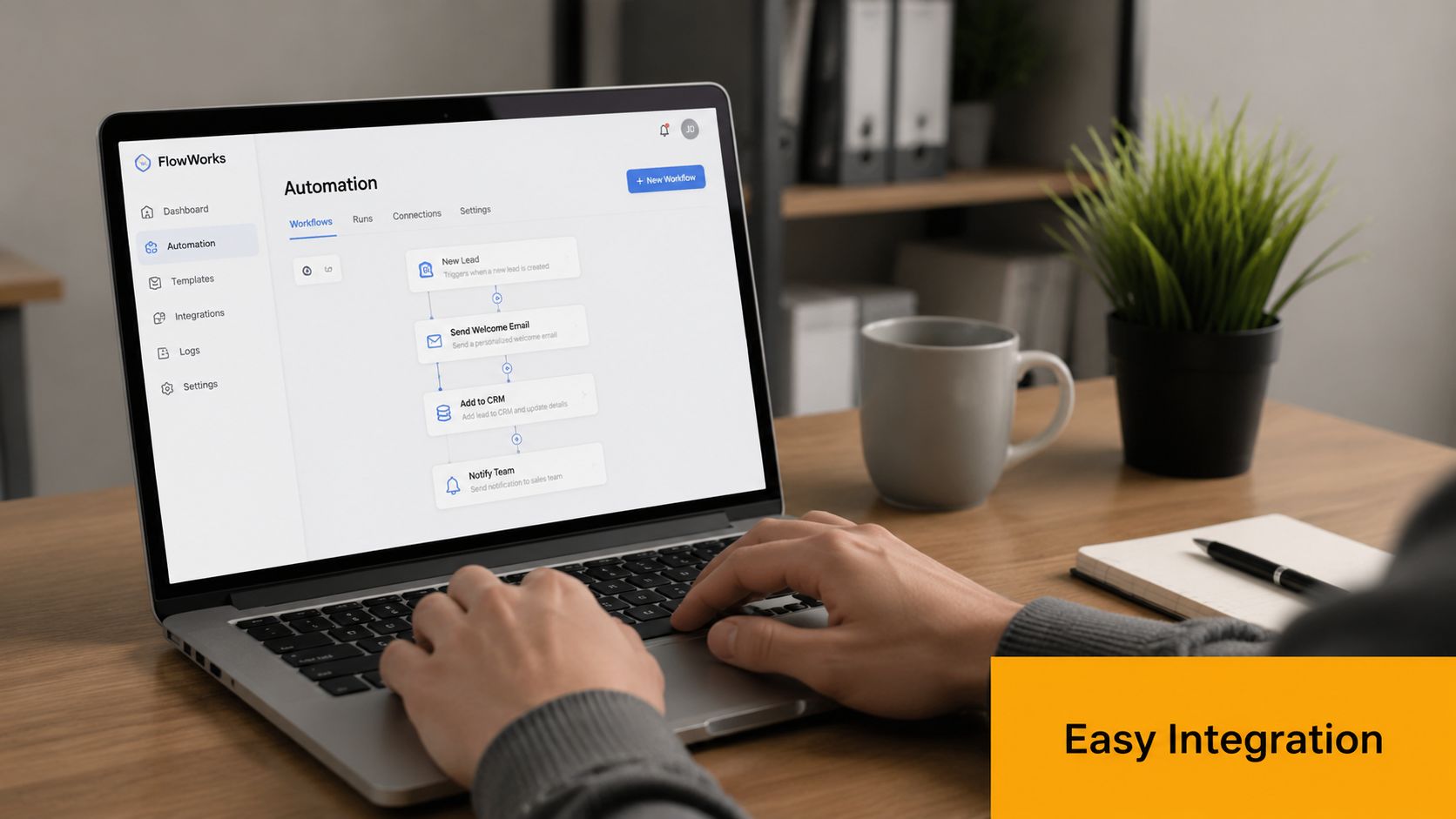
Once your rate logic is organized, connect the quoting flow to where jobs get managed. For movers, that usually means SmartMoving, Supermove, MoveitPro, or a shared calendar if the office is still simple.
The practical goal is straightforward. When a qualified after-hours caller is ready to move forward, the job information shouldn't sit in a text thread waiting for someone to re-enter it manually. It should land where dispatch, sales, and operations can act on it.
If your team still struggles with duplicate bookings or scattered calendars, this guide on how to synchronize events across platforms is a useful primer. Cleaner calendar coordination removes a lot of front-office friction before you automate anything else.
The best automation doesn't create another inbox to check. It places the job where your team already works.
A practical rollout checklist
Use this checklist before you turn on any after-hours booking workflow:
Clean up your service rules
Define what you will and won't quote automatically. Set clear boundaries for local moves, long-distance jobs, storage, junk removal add-ons, and specialty-item exceptions.Standardize your intake questions
Make sure every estimate path asks for the same essential details. If your office staff ask different questions depending on who's on shift, your quote quality will stay inconsistent.Pick one booking destination
Don't split new jobs between email, paper notes, and a CRM. Choose the single system of record.Build an exception path
Some calls still need manual review. Complex commercial work, unusual inventory, or edge-case access constraints should route cleanly to your team.Test with real scenarios
Run sample calls for a local apartment move, a long-distance household move, a labor-only job, and a junk removal inquiry. Listen for where confusion happens.
This is what operators really need. Not more software. A front-end process that works the same way every time.
The Simple ROI of Automation and Your Next Steps
At 9:15 PM, a prospect calls after getting two voicemail boxes from other movers. If your system can quote the job, collect the right details, and hold the booking, that call still has value. If it only takes a message, you are back in line with everyone else at 8 AM.
That is the ROI question for a 5 to 20 truck operation. How many bookable calls are hitting after hours, and how many of them are slipping into tomorrow's callback pile.
Operators often make this harder than it needs to be. You do not need a spreadsheet with twelve tabs. You need a simple threshold. If one recovered move pays for the monthly tool, the decision is already close. If it recovers several jobs during peak season, it usually pays for itself fast.
The bigger mistake is treating every missed call like a lead capture problem. It is a sales conversion problem. A generic answering service can log a name and number. It usually cannot qualify the move, apply your rate logic, handle service-area rules, and ask for the booking. That gap is where revenue leaks out.
For a clear pricing breakdown, review this guide to after-hours answering service cost for movers. Instead of asking what the system costs, ask what one missed booking costs, especially in summer when one truck day can cover a lot of overhead.
What to do next
Set the standard around booked jobs, not answered calls.
- Answer every after-hours inbound call
- Collect the job details your team needs
- Quote using your real pricing rules and service limits
- Write the booking into the system your office already uses
- Trigger follow-up for callers who need time to decide
That setup gives you a cleaner handoff in the morning. Your office sees booked work, pending follow-ups, and flagged exceptions instead of a stack of messages with missing details.
If you are still relying on voicemail and next-day callbacks, start with one service line, one rate card, and one booking workflow. Test it for 30 days. Measure booked jobs, not just answered calls.
If you want to see what that looks like in practice, MoveJoy is built specifically for independent movers that need more than a message-taking service. It helps capture inbound calls, generate accurate quotes using your own rate card, and book jobs directly into the systems your team already runs, so after-hours demand turns into booked revenue instead of tomorrow's callback list.