Stop Letting Voicemail Steal Your Best Moving Leads

As a moving company owner, you know the drill. You’re on-site, managing a crew, and your phone’s blowing up. By the time you get a free minute, you see a missed call. You call back. Crickets. That customer already booked with the company that answered first.
This isn’t just a missed call—it’s a lost job. And when the average move is worth over $1,000, that’s real money walking out the door. An after-hours answering service for your small business isn’t about convenience; it’s about stopping that revenue leak for good.
How Voicemail Is Quietly Costing Your Moving Business
We’ve all been there. You’re leading a crew on a tricky third-floor walk-up, your hands are full, and your phone is buzzing in your pocket. By the time you get a moment to breathe, you see the missed call. You listen to the voicemail—if they even bothered to leave one—and call back.
Crickets.
That potential customer already booked with the moving company that picked up the phone first.
That wasn't just a missed call; it was a lost job. With an average move value floating around $1,000+, that single moment of being unavailable cost you real money. Multiply that by a few times a week, and you’re staring at a serious leak in your bottom line. This is the painful reality for countless moving companies still relying on voicemail.

The Hard Numbers Behind Missed Calls
Let's get down to brass tacks. We've worked with hundreds of movers, and the data is consistent: small moving companies miss between 15-25% of their incoming calls just because they're on a job or it's after 5 PM. When you run the numbers, this easily balloons into $50,000 to $150,000 in lost annual revenue.
That’s not a rounding error. That’s the cost of a new truck. That’s a key new hire.
Here’s why it’s so damaging to your business:
- Urgency is Everything: When someone needs a mover, they’re usually on a tight deadline. They aren't going to sit around and wait for a callback. They're dialing the next name on their list.
- Voicemail is a Dead End: It’s a hard truth, but most callers won't call back if you don't answer the first time. Even worse, many won’t even leave a message.
- After Hours is Prime Time: A huge chunk of moving inquiries—around 35-40%—happen in the evenings and on weekends. These are motivated customers planning their move when they're finally off work. If your phone isn't being answered, you're invisible to a massive piece of your market.
The modern customer expects an immediate response. Voicemail sends a clear message: "We're too busy for you right now." In the moving business, that’s a message that sends them straight to your competition.
The financial bleed from missed calls is almost always bigger than owners realize. We actually broke down the real cost of missing just four calls a week, and the numbers are absolutely eye-opening.
An after-hours answering service for a small business isn’t a luxury; it’s a fundamental tool for revenue recovery. It plugs the leak, making sure every single lead gets the immediate, professional attention it takes to turn them into a booked job.
Figure Out What You're Really Missing After Hours
Before you can plug a leak, you have to know how big it is. It's one thing to feel like you're missing calls after 5 PM, but it's another thing entirely to see the hard numbers. This is the first step to shifting from being overwhelmed to actually taking control of your revenue.
The truth is, a huge chunk of your most motivated customers are looking for movers while you're off the clock. Industry data shows that 35-40% of all moving inquiries happen outside of typical 9-to-5 business hours. These aren't just casual browsers; these are people who just got home from work and are ready to book a move now.

Run a Simple One-Week Call Audit
You don't need some fancy, expensive software to get started. Just commit to tracking your phone and web activity for seven days. This simple exercise will give you a powerful snapshot of what you're actually leaving on the table.
Here’s a straightforward way to do it:
- Check Your Phone Logs: At the end of each day, go through your business line’s call history. Tally up every single call that came in after 5 PM and on the weekends.
- Don't Forget Web Forms: Online leads count, too. Note any contact forms or quote requests that were submitted during those same after-hours periods.
- Listen to Voicemails (If You Get Any): Most people just hang up and call the next company, but a few will leave a message. Pay attention to the urgency in their voice and the kind of move they're asking about.
After just one week, you’ll have a clear, data-backed picture of reality. You might be shocked to find that your busiest time for new leads is 7 PM on a Wednesday or all day Saturday. This isn't just trivia; it's the kind of operational intelligence that helps you grow.
Do the Math: The Real Cost of a Missed Call
Now, let's put a dollar amount on that data. This is where the impact really hits home for a small moving business.
Take the number of after-hours inquiries you logged. If you missed, say, 10 calls over the week, and your typical booking rate is 25%, that’s two or three jobs you almost certainly lost. With an average job value of $1,000+, you’re looking at $2,000 to $3,000 in revenue that just vanished.
Think about that on an annual scale. Losing just two jobs a week adds up to over $100,000 per year. That’s the true cost of being unavailable, and it’s why a reliable after-hours answering service for your small business isn’t an expense—it’s a direct investment in revenue recovery.
This little audit isn't about making you feel bad about what you've missed. It’s about arming you with the real numbers so you can make a smart, ROI-driven decision. Once you know exactly when your calls are coming in and what they're worth, you can finally build a system to capture every single one of them.
Picking the Right Answering Service for Your Moving Company
Let’s get one thing straight: not all answering services are the same. This is especially true when you’re in the moving business.
A generic service that takes messages for a dentist on Monday and a plumber on Tuesday isn’t going to know the difference between a studio apartment move and a three-bedroom house. They won’t know the right questions to ask, which means your team ends up wasting precious time on follow-up calls that go nowhere.
Choosing the right partner here is everything. You’re not just looking for someone to pick up the phone; you’re looking for a genuine extension of your sales team. This is about finding an after-hours answering service for a small business that actively helps you book more jobs and grow your bottom line.
Industry Knowledge Is a Deal-Breaker
The single biggest mistake I see moving company owners make is hiring a standard, one-size-fits-all call center. They look cheap on paper, but they cost you a fortune in lost opportunities.
Why? Because they don’t speak our language. They can take a name and number, sure, but they can’t handle a real moving inquiry.
- Lead Qualification: Do they know to ask about stairs, elevators, or long carries? Do they know if the customer needs packing services or has specialty items?
- Booking Power: A generic service just passes along a cold message. A moving-specific service like MoveJoy can actually capture the details needed to give a real quote and even book the job directly on your calendar.
- Customer Confidence: A caller who gets vague, unsure answers will hang up and dial the next mover on their list. Confidence is what books jobs.
Think about it from the customer's perspective. When they call you at 8 PM on a Tuesday, they're ready to solve their moving problem now. A service that says, "Someone will call you back tomorrow," is basically giving that customer a permission slip to call your competitor.
Generic Call Center vs. Moving-Specific Service
To see just how different these two options are, let's put them side-by-side. One is a passive message-taker that leaks revenue, while the other is an active revenue generator.
Answering Service Comparison for Movers
| Feature | Generic Answering Service | Moving-Specific Service |
|---|---|---|
| Industry Knowledge | Minimal. Agents follow a generic script for all clients. | Deep. Trained on moving terminology, job types, and common customer questions. |
| Lead Qualification | Basic name and number capture. No ability to qualify leads. | Advanced. Asks key questions (move size, locations, access) to pre-qualify leads. |
| Booking Capability | None. Forwards messages for your team to handle later. | Direct. Can provide estimates and book jobs directly into your calendar. |
| Outcome for You | A list of cold leads to call back, many of whom have already booked elsewhere. | Confirmed, high-value jobs on your schedule, captured 24/7 without you lifting a finger. |
| Pricing Model | Usually per-minute, which penalizes you for longer, more valuable calls. | Often performance-based or a flat fee, focused on delivering booked jobs. |
At the end of the day, you can see the gap is massive. A moving-specific service is built to understand the nuances that turn a simple inquiry into a booked move.
The goal isn't just to answer every call. The goal is to book every possible job. A generic service simply can't do that.
It all comes down to ROI. A cheap per-minute service that loses you just one $1,000 job a month is far more expensive than a specialized partner that books three extra jobs for you. Focus on the outcome—booked revenue—not just the upfront cost.
A Practical Guide to Setting Up Your Service for Success
You’ve done the hard work of picking a partner. Now comes the most important part: making sure the handoff is seamless so you can start seeing a return on your investment from day one.
A sloppy setup process is a recipe for disaster. It leads to confused agents, frustrated customers, and lost leads right out of the gate.
Getting your new after-hours answering service for your small business up and running shouldn't be complicated. The whole point is to give them just enough information to sound like you, qualify the call, and grab the details your team needs to provide an accurate quote and book the job. It's a simple transfer of knowledge that makes all the difference.
This graphic lays out the simple, effective process we've seen work for countless moving companies just like yours.
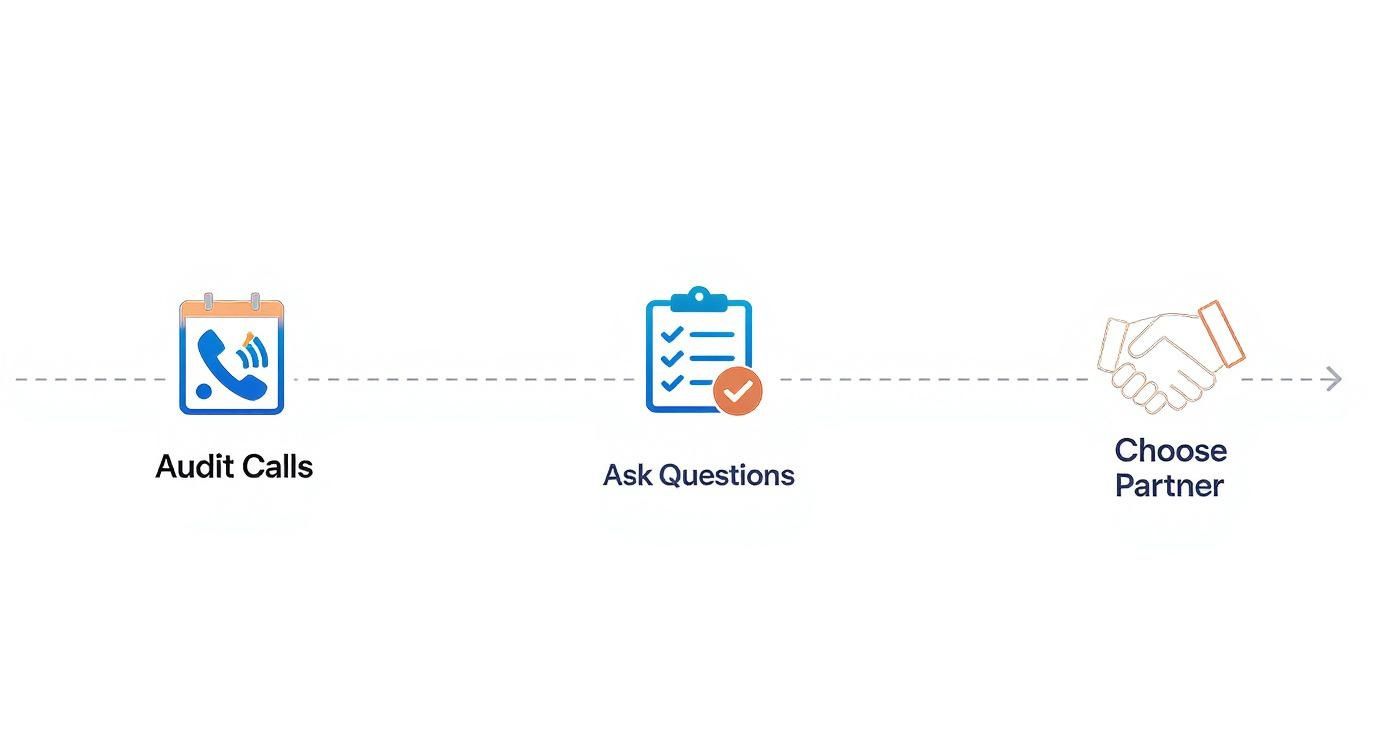
It breaks down the journey into a clear, actionable path, showing that success starts with truly understanding your needs before you choose a solution.
Crafting a Call Script That Books Jobs
The script is the playbook for your answering service. It needs to be simple, effective, and focused on gathering the essential information without sounding robotic. A good script is less about reading lines and more about guiding a natural conversation.
Your primary goal is to qualify the lead. Is this a job you actually want?
- Move Details: Start with the basics. Where are they moving from and to? What’s the desired move date?
- Home Size: Is it a 1-bedroom apartment or a 4-bedroom house? This gives you an immediate sense of job size and value.
- Key Logistics: Don’t forget crucial details like stairs, elevators, or tricky access points that impact the job.
- Contact Info: Always, always get a name, phone number, and email address for follow-up.
Remember, the person answering the phone is representing your company. The script should empower them to be helpful and professional, making the caller feel confident they’ve reached the right movers.
For a deeper dive, our guide on how to stop losing after-hours leads without working 24/7 is extremely helpful.
Making the Technical Handoff Seamless
The technical side of things is usually the easiest part. Your service provider should walk you through it, but it typically just involves setting up call forwarding from your business line.
You can usually choose when calls are forwarded—for example, only after 5 PM, on weekends, or when your main line is busy.
This ensures a smooth transition between your team and your answering service, so there are no dropped calls or dead air. The customer experience remains unbroken, which is key to capturing those high-value leads worth $1,000+ each. A flawless setup means you start recovering that $50K-$150K in potential annual losses immediately.
Is Your Answering Service Actually Making You Money?
You hired a service to stop the bleeding from missed calls. Great. But is it a revenue engine or just another line item on your P&L? This isn't about fuzzy feelings; it's about hard numbers.
Forget vanity metrics like call duration or how many messages they took. That stuff is noise. We’re talking about the numbers that directly impact your bank account.
The Only Metrics That Matter
For a moving company, only a few Key Performance Indicators (KPIs) truly tell you if the service is working. Watch these like a hawk.
- Lead-to-Booking Rate: This is the big one. What percentage of qualified leads from the service are turning into actual, paying jobs? If they send you 20 solid leads and you book 5 of them, your booking rate is 25%. Simple as that.
- Cost Per Booked Job: This tells you exactly what you're paying to acquire a customer. Just divide your monthly bill by the number of jobs the service booked. Pay $500 a month and book 4 jobs? Your Cost Per Booked Job is $125.
- Recovered Revenue: Here's where you see the magic. Multiply the number of jobs booked by your average job value. If that $500/month service books three jobs worth $1,200 each, that’s $3,600 in revenue you otherwise would have missed.
Your answering service isn't an expense; it should be a profitable part of your sales team. When a $125 acquisition cost brings in a $1,200 job, the ROI is a no-brainer. That’s how you turn a simple service into a growth machine.
Fine-Tuning for Better Performance
Measuring performance isn’t a one-and-done task. It’s an ongoing conversation with your service provider, aimed at one thing: turning more after-hours calls into confirmed moves.
You have to give them feedback. If you notice lead quality dipping or that agents are fumbling certain questions, tell them. A good partner will take that feedback, adjust their scripts, and retrain their team.
This is the difference between a basic message-taker and a true partner invested in your growth.
Wondering how these numbers stack up for your business? We built a straightforward moving company ROI calculator to take the guesswork out of it. Plug in your own figures and see exactly how much revenue you can recover. It’s time to stop guessing and start knowing.
Ready to Stop Missing Calls?
If you're tired of seeing great leads slip through your fingers after hours, let's talk. We've helped hundreds of moving companies just like yours turn missed calls into booked jobs. We can walk you through what's working right now and see if there's a fit for your business. No pressure, just a real conversation about recovering lost revenue.