
You know the call. You're on-site, a crew member has a question, dispatch is texting, and your phone lights up with a new lead asking for a quote. You grab a pen, write half the details on a box or invoice, and tell the customer you'll call back.
By the time you do, they've already spoken with two other movers.
That isn't just a busy-day annoyance. It's a front-office problem that leaks revenue. For small and mid-sized moving companies, quoting speed often decides who gets the job, especially when customers are shopping multiple companies at once. If you want to know how to send moving quotes faster, the answer isn't just "buy software." The companies that improve this consistently build a full quoting engine: intake, pricing rules, communication, follow-up, and automation working together.
Slow quotes usually come from the same places. Intake is inconsistent. Pricing lives in the owner's head. Sales reps write every email from scratch. After-hours calls go to voicemail. Nobody measures response time until bookings fall off.
Fix those bottlenecks, and you don't just send estimates faster. You protect margin, reduce errors, and book more jobs without adding chaos to your office.
Why Your Quoting Speed Determines Your Booking Rate
A lot of movers still treat quoting like an administrative task. It isn't. It's a sales race.
When a customer needs to move, they rarely contact one company and wait patiently. They want answers now. They want a real number, a clear scope, and confidence that your company knows what it's doing. If your process depends on somebody being available later, you're giving faster competitors room to win.
What happens in the real world
A typical lead comes in while your office is already stretched. The person taking the call asks a few questions, misses key details, promises a callback, then hands the note to someone else. That person has to decipher handwriting, call back for missing information, check rates, and build a quote manually.
The customer experiences that as uncertainty.
The business impact is direct. Responding to moving leads within 5 minutes increases qualification chances by 21 times compared to 30 minutes, according to Elromco's summary of InsideSales research. That same source notes why speed matters so much: the first credible estimate often becomes the customer's mental benchmark.
The first company that gives a clear, believable quote often controls the conversation from that point forward.
That doesn't mean the cheapest mover always wins. It means the mover who replies first with a professional estimate earns trust first.
Why speed affects more than sales
Fast quoting does three things at once:
- It improves lead conversion: You reach the customer while they're still actively making decisions.
- It reduces office drag: Your team spends less time chasing incomplete information.
- It improves customer confidence: A clean, fast estimate signals that operations are organized.
For smaller operators, this matters even more. If you're still handling calls yourself between jobs, every delay compounds. A missed lead doesn't just disappear. It often turns into an empty slot on the calendar a few weeks later.
One practical way to think about this is first-call resolution. If your team can gather the right information and move the customer toward a quote in the first interaction, your booking odds improve and your office stops drowning in callbacks. This makes improving first call resolution for inbound leads a revenue issue, not just a service metric.
Streamline Your Intake Process for Faster Data Capture
Most slow quotes start with bad intake.
If the first conversation doesn't capture the right details, your team ends up doing the same work twice. They call back for missing addresses. They ask again about stairs. They realize later the customer needs packing, storage, or help with a specialty item. That back-and-forth kills momentum.
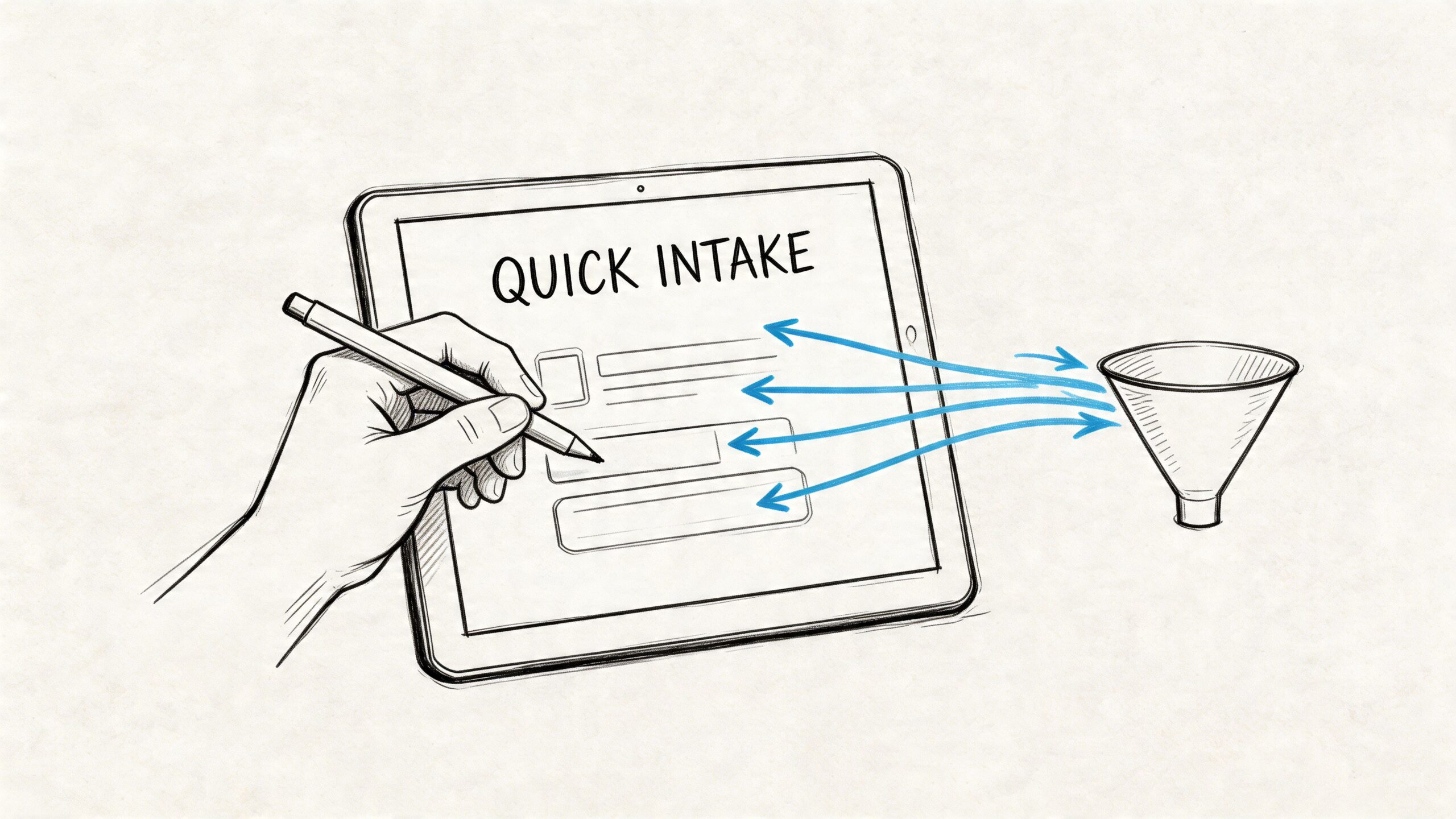
Structured data capture removes the biggest source of delay. According to VelocityOS, standardized intake forms that collect origin, destination, home size, access challenges, inventory estimate, and move date eliminate re-entry and clarification loops, which account for 70-80% of quoting delays.
Build one intake standard for every channel
Your phone script, web form, and text workflow should all collect the same core information. If each channel gathers different details, you create holes that sales and dispatch have to patch later.
At minimum, every quote request should capture:
- Move locations: Full origin and destination addresses, not just city names.
- Home size: Bedrooms, apartment type, office size, or a practical volume estimate.
- Access conditions: Stairs, elevators, long carries, loading dock issues, restricted parking.
- Move date: Exact date if known, or a target date range.
- Service needs: Full-service move, labor-only, packing, unpacking, storage, junk removal.
- Special items: Pianos, safes, treadmills, oversized furniture, fragile pieces.
- Contact details: Name, phone, email, and preferred communication method.
What a good intake call sounds like
Good intake doesn't sound robotic. It sounds controlled.
Your rep shouldn't ask random questions as they think of them. They should move through a fixed sequence that mirrors how the job will be priced and scheduled. That's how you keep calls short without missing anything.
A practical intake flow looks like this:
Confirm the move type
Local, long distance, apartment, home, office, internal move, labor-only.Lock down locations and timing
Exact addresses, desired move date, preferred arrival window if relevant.Size the move quickly
Bedrooms, major furniture count, or business inventory type.Identify access and complexity
Flights of stairs, elevator reservation, long walk, shuttle need, special handling.Add service options
Packing, supplies, storage, assembly, disassembly.Confirm best contact route
Email for the written quote, phone for questions, text if they prefer speed.
Practical rule: If a missing detail could change labor time, truck size, or crew requirements, collect it before the quote goes out.
Tighten your forms without making them painful
A lot of website forms fail because they ask too little or too much.
If you only ask for name, phone, and date, your office has to do intake later. If you ask for a room-by-room inventory on the first click, people abandon the form. The right approach is to collect enough detail to generate a credible first estimate, then fill in edge cases if needed.
Use required fields for the essentials. Keep dropdowns simple. Add checkboxes for common access issues and services. Let customers self-identify obvious variables instead of forcing staff to interpret vague notes.
If your office gets buried in spam, vendor calls, and non-lead inquiries, it also helps to clean up the front door before the intake process starts. A tighter call flow and smarter phone call screening process can keep sales attention on actual revenue opportunities.
Build a Standardized Rate Card and Pricing Rules
Once intake is clean, the next bottleneck is pricing.
A lot of moving companies still quote from memory. The owner knows what a two-bedroom walkup usually costs. The senior rep knows when to add travel time. Somebody else handles long carries differently. That may work when one person controls every estimate. It breaks as soon as volume rises or another team member starts quoting.
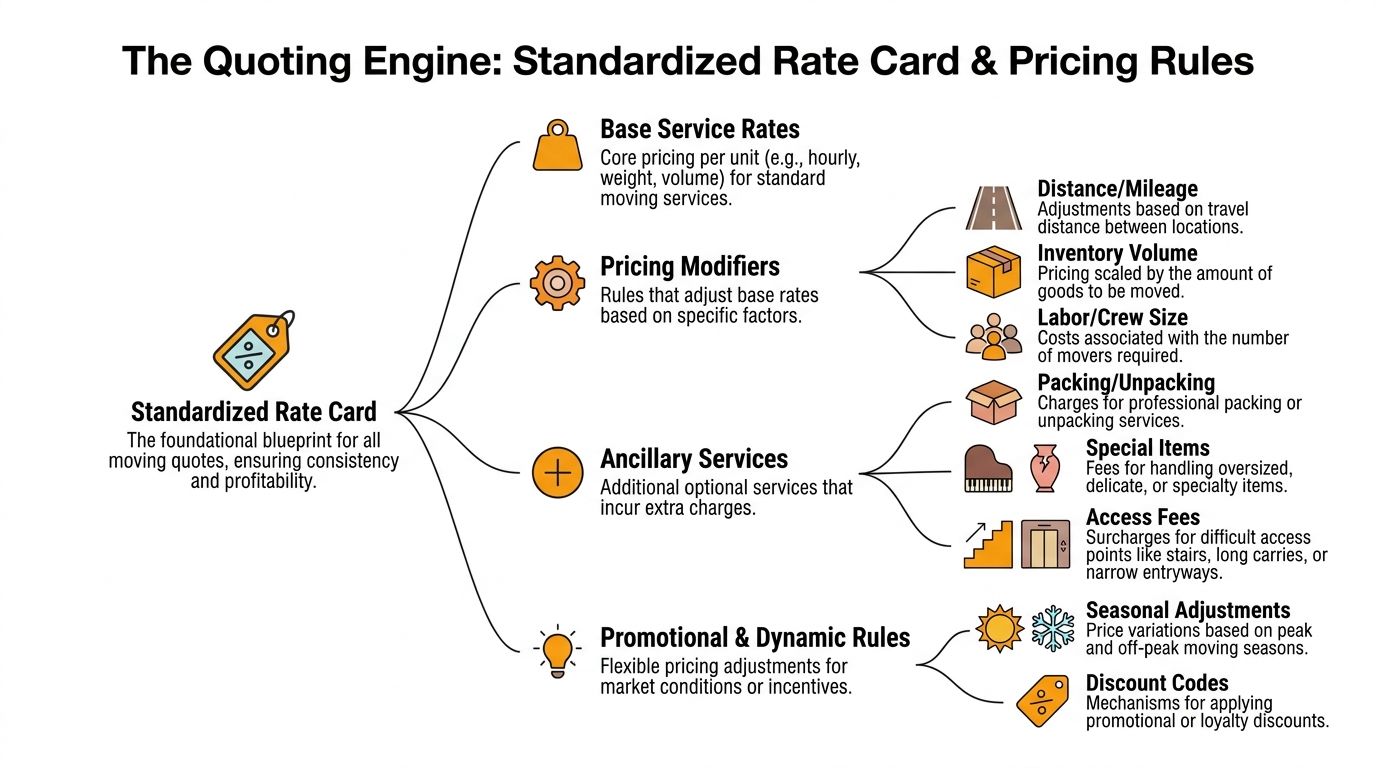
Fast quotes only work when pricing is standardized. According to SmartMoving, top U.S. movers get quotes out in under 5 minutes, compared with an industry average of 20 minutes per quote, by treating moves as structured records with pre-set rates for size, distance, and services such as stair charges.
Move pricing out of people's heads
Your rate card should answer the common quoting questions before a rep ever asks a manager.
That means defining:
- Base service pricing: Hourly, flat-rate, minimums, travel charges.
- Crew logic: When a job needs two movers, three movers, or more.
- Truck logic: What move sizes fit in which truck setup.
- Accessorial charges: Stairs, elevator delays, long carries, shuttle scenarios, specialty handling.
- Packing and material rules: How packing labor and supplies are added.
- Date-related adjustments: Peak periods, limited availability, preferred dates.
The point isn't to create a fancy spreadsheet. The point is to make pricing predictable.
What belongs in a usable rate card
A useful rate card is specific enough to quote from, but simple enough that your team will use it.
Here's a practical structure:
| Pricing component | What to define |
|---|---|
| Base labor | Hourly rate or flat-rate logic by crew size |
| Travel | How you charge drive time, dispatch fee, or mileage |
| Size rules | How bedrooms, inventory, or office scope map to labor and truck needs |
| Access fees | Stair rules, elevator constraints, long carry policy |
| Specialty items | When extra labor, equipment, or handling fees apply |
| Add-on services | Packing, unpacking, storage, materials, assembly |
| Approval rules | Which quotes reps can send immediately and which need manager review |
Set rules for edge cases before they happen
Most companies slow down, not on standard apartment moves, but on the weird jobs.
If your team has to ask every time a lead mentions a steep driveway, split pickup, storage stop, or fragile item, your system isn't finished. Build decision rules now. They don't need to cover every rare scenario perfectly. They need to cover your common exceptions consistently.
A slow quote usually isn't caused by the base rate. It's caused by uncertainty around the extras.
That consistency matters internally and externally. Internally, it prevents underquoting and endless manager interruptions. Externally, it makes your estimates look deliberate instead of improvised.
Protect margin while staying fast
Some owners worry that faster quoting means sloppier quoting. That's only true when the process is rushed without rules.
A standardized pricing system does the opposite. It helps your company quote faster and protects margin because everyone applies the same pricing logic. If a customer asks why the estimate includes a carry fee or a larger crew, your rep can explain it clearly. That transparency builds trust.
If you're still refining the pricing side of your process, it's worth reviewing a practical framework for estimating moving costs in a way that sales staff can apply consistently.
Use Scripts and Templates for Consistent Communication
Even when a company has decent intake and decent pricing, quotes still get delayed because every rep writes from scratch.
That wastes time and creates inconsistency. One prospect gets a clean estimate with clear next steps. Another gets a vague email with a number and no explanation. Customers notice the difference.
Use a phone script that guides the call
Your phone script shouldn't sound stiff. It should make the rep faster.
A good script keeps the call moving, prevents missed questions, and helps newer staff sound experienced. It also reduces the temptation to "wing it," which is where incomplete files usually start.
A simple opening script:
Thanks for calling [Company Name]. I can help with a quote. I need a few details so I can get you an accurate estimate. What address are we moving from, where are we moving to, and what size home are we working with?
That opening does two things well. It sets expectations and starts collecting quote-critical information immediately.
If the caller is in a hurry, your rep can shorten the path:
- For apartment leads: Ask bedrooms, floor, elevator, and move date early.
- For house moves: Ask size, packing needs, and whether there are garage or outdoor items.
- For office moves: Ask business type, furniture count, equipment, and access restrictions.
Standardize the written quote
Your quote email should follow the same structure every time.
It should include:
- Customer summary: Move date, origin, destination, move size.
- Scope of work: Labor, truck, packing, materials, special handling.
- Pricing summary: Clear estimate and what assumptions it's based on.
- What is included: Loading, transport, unloading, basic protection, standard equipment.
- What may change pricing: Extra inventory, added stops, access issues not disclosed.
- Next step: Booking link, reply instructions, or call-to-confirm process.
A simple quote template:
Subject: Your Moving Quote from [Company Name]
Hi [First Name],
Based on the information you provided, we've prepared your estimate for the move from [Origin] to [Destination] on [Date].
Estimated services included: [Crew size], [truck/service type], [packing or add-ons if applicable].
Estimated price: [Quote amount or pricing format based on your process].
This estimate is based on the details shared during intake, including [home size/access notes/special items]. If any of those details change, we'll update the quote before booking.
To reserve your move, reply to this email or use this booking link: [Insert link].
Questions are welcome. We're happy to help.
[Company Name]
[Phone]
[Email]
Add SMS without replacing the full quote
Text is useful for speed, but don't force the entire estimate into an SMS.
Use text to confirm that the quote is ready, remind the customer to review it, or give them a booking path. Keep the detailed scope in email where it can be read clearly and forwarded to a spouse, office manager, or decision-maker.
The companies that quote fastest usually don't write better prose. They just stop reinventing the same communication on every lead.
Implement Automation for 24/7 Live Quoting and Booking
Once intake, pricing, and communication are standardized, automation starts to make real sense.
Without that foundation, automation just speeds up bad process. With it, automation turns a manual office workflow into a quoting engine that runs all day, every day.

The difference between lead capture and job closing
Many movers often buy the wrong tool.
A basic answering service can take a message. A generic AI voice tool can gather contact details. A CRM can store the lead after someone enters it. But none of those tools solves the urgent business problem if the customer still has to wait for a human to price the move.
For this part of the workflow, speed matters at the moment of inquiry. According to a video reference on automated CRM orchestration for moving quote delivery, teams can auto-create contacts on inquiry, route leads to reps or AI, and generate quotes in under 60 seconds using templates. The same source states that contacting leads in under 5 minutes yields 21x higher conversions, and that CRM automation can recover 30-50% of lost bookings from after-hours calls, equating to $50K+ annual gains for 1-20 truck fleets.
That gap is why many operators feel like they already have software but are still losing jobs. The software records work. It doesn't always do the work.
What useful automation actually does
The best workflow automation for movers handles the front-office chain end to end:
- It captures the inquiry immediately: Call, form, or text.
- It asks the right intake questions: The same ones your best rep would ask.
- It applies your pricing rules: Not generic assumptions.
- It sends a professional quote fast: Without manual rewriting.
- It starts follow-up automatically: So leads don't go cold overnight.
- It books the job into your system: CRM or calendar, without duplicate entry.
That last piece matters more than most owners realize. Booking friction kills momentum too. If the customer says yes but still has to wait for somebody to call back Monday morning, you've created another leak.
Why after-hours quoting changes the economics
A lot of independent movers lose business outside normal office hours. Not because demand disappears, but because their quoting system does.
Evening calls, weekend web forms, and overflow calls during peak season are often high-intent inquiries. They don't need a receptionist. They need a real quote and a path to book.
If you're evaluating what's possible beyond basic call handling, it can help to leverage an Artificial Intelligence Automation agency as a planning resource for how automation workflows get mapped, deployed, and maintained across operational tasks. The key is making sure any system you choose can handle moving-specific logic, not just generic conversation.
If your tool can answer the phone but can't quote the move, your office still owns the bottleneck.
For movers, that's the difference between automation as a convenience and automation as a revenue engine.
Train Your Team and Measure What Matters
A quoting system only works if people use it the same way every time.
That means training can't be casual. If one rep follows the intake checklist, another skips access questions, and a third rewrites every quote email, your process breaks before the software ever gets blamed.
Train around scenarios, not theory
Don't train your team by handing them a document and hoping they absorb it.
Run common lead scenarios:
- Standard local apartment move
- House move with packing
- Office move with access restrictions
- After-hours inquiry that needs next-step follow-up
- Lead with missing information that must be completed before pricing
Listen for where reps hesitate. Those pauses usually reveal gaps in either the rate card or the intake script.
If your team is comparing newer tools for call handling and front-office automation, resources on AI voice agents can help frame the broader category. For movers, the key question isn't whether a system can talk. It's whether your workflow still needs a human to finish the quote and booking.
Track the three metrics that expose quoting problems
You don't need a giant dashboard. You need a few operational numbers you review consistently.
Focus on these three:
| KPI | What it tells you | Why it matters |
|---|---|---|
| Speed-to-Quote | Minutes from first contact to quote sent | Shows whether your process is actually fast |
| Quote-to-Booking Rate | How many sent quotes turn into jobs | Reveals whether speed and presentation are converting |
| Quote Accuracy | How often estimates need correction | Protects margin and customer trust |
What to do with the numbers
If speed-to-quote is slow, start at intake. Missing data is usually the culprit.
If quotes go out quickly but booking rate is weak, the problem may be communication, unclear scope, or poor follow-up.
If quote accuracy is inconsistent, revisit the rate card. That's often a rules problem, not a people problem.
Field note: The best operators review quote quality the same way they review crew performance. Sales process is operations.
Small companies often skip measurement because it feels corporate. That's a mistake. You don't need enterprise reporting. You need enough visibility to see where money is slipping through the cracks.
Stop Quoting Manually, Start Closing Automatically
The fastest-moving companies don't win because they hustle harder. They win because their front office stops improvising.
When you standardize intake, lock down pricing rules, use reusable communication, and automate the handoff from inquiry to quote to booking, quoting stops being a bottleneck. It becomes a system.
That's the answer to how to send moving quotes faster. Not one tool. Not one script. A complete operating model that removes delay at every step.
You can start today with the manual pieces. Tighten your intake form. Clean up your rate card. Build one quote template your team uses. Measure speed-to-quote this week, not next quarter.
Then decide how much longer you want your staff handling repetitive quoting work by hand while leads come in at night, on weekends, and during peak-season overload.
If you're ready to turn missed calls and delayed estimates into booked jobs, take a look at MoveJoy. It’s built for moving companies that want accurate quotes using their own rate card, automatic follow-up, and direct booking into the tools they already use.