
You’re loading a truck, your phone buzzes, and you see a missed call from a number you don’t recognize.
By the time you call back, they’ve already spoken to another mover.
That’s the part most owners feel in their gut. The missed opportunity. The empty slot that could’ve been filled. The crew hours you still have to cover. The marketing dollars you already spent to make that phone ring in the first place.
For a small moving company, that’s not just a communication problem. It’s a revenue leak.
Many owners think the fix is simple. Answer more calls. Hire office help. Return messages faster. Those things matter, but they don’t solve the whole problem. If the person answering the phone can’t give a reliable quote, explain the pricing clearly, and move that lead toward a booking, you haven’t closed the gap. You’ve just delayed the loss.
The practical difference is this. Capturing a lead is not the same as closing a job.
A consumer-facing moving calculator might help a shopper ballpark a price. An effective moving company cost estimator does something very different. It turns your pricing rules, labor assumptions, accessorials, and job requirements into a quote that protects margin and helps your team book faster.
Owners with 1 to 20 trucks feel this more than anyone. You’re balancing sales, dispatch, crew issues, and customer calls at the same time. During busy season, that pressure gets worse. If your quoting process lives in one person’s head, or in a spreadsheet only one office staffer understands, your sales process is fragile.
The companies that grow out of that trap build a system. Not just for answering. For estimating, quoting, and booking.
Introduction Beyond the Voicemail Box
The most expensive voicemail in a moving company sounds harmless.
A customer says they need a quote for a local move, maybe this weekend, maybe next week. They’re calling a few companies. They ask for a callback. That lead might still be warm when you hear it, but often it’s already gone.

This is often the case in owner-operated moving businesses. You’re not sitting at a desk waiting for the phone. You’re walking a job, solving a payroll issue, checking on a late truck, or helping a crew that got stuck on a stair carry they didn’t expect.
The mistake is thinking the problem starts and ends with the call itself.
A missed call becomes a pricing problem fast
If you call back later and say, “I’ll need to get some details and send something over,” you’ve added friction. The customer has to wait. Your team has to follow up. Another mover who gave a clear quote on the first interaction now has the advantage.
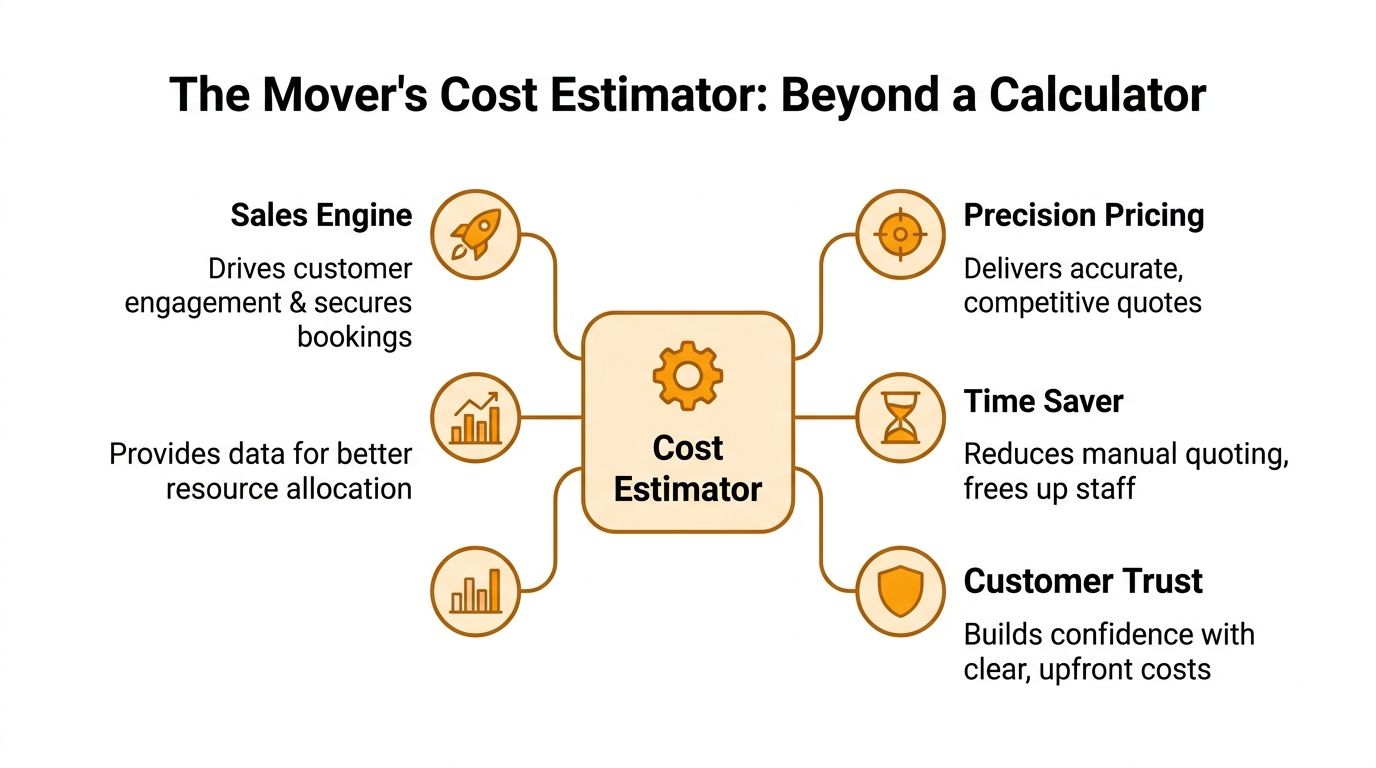
That’s why I don’t look at a moving company cost estimator as a calculator anymore. I look at it as part of the front-end sales engine.
A good estimator does three things at once:
- Protects your margins by pricing the move correctly
- Improves trust by giving the customer a clear explanation of what’s included
- Shortens the sales cycle by getting the lead closer to a yes on the first call
If your process only collects contact info and promises a callback, you’re still making the customer do more waiting than they want.
The goal is booking, not just responding
Many moving companies patch the problem with message-taking, generic intake forms, or a rep who’s good on the phone but inconsistent on pricing.
That works until volume picks up.
Then you start seeing the same symptoms. Quotes go out late. Add-ons get missed. Two people price the same move differently. Crews show up to jobs that were sold too cheap. Customers argue because what they were told on the phone doesn’t match what the job requires.
An effective estimator fixes that by turning your pricing into a repeatable process.
Not a guess. Not a rough range. A system your business can run on.
What Is a Moving Company Cost Estimator Really
Many people hear “estimator” and think of the simple online tools customers use to compare movers.
That’s not what matters inside a moving business.
For an owner, a moving company cost estimator is the mechanism that translates operations into sellable pricing. It’s the difference between “I think this is a three-hour job” and “this quote reflects our truck, labor, travel, stairs, carry distance, and margin requirements.”
Your rate card is the foundation
Every estimator starts with the same thing. Your rate card.
That’s the pricing DNA of your company. It includes your local hourly structure, flat-rate rules if you use them, minimums, travel time, packing charges, long carry fees, stair fees, specialty item handling, and anything else that changes labor or truck time.
If the rate card is vague, the estimator will be vague.
If the rate card is incomplete, the estimator will create underpriced jobs.
That’s why owners get in trouble when they rely on “what we usually charge.” That kind of pricing works when the owner handles every quote personally. It breaks as soon as office staff, dispatch, or outside help starts quoting on your behalf.
The inputs decide whether the quote reflects reality
The second piece is intake.
The estimator only works if it asks the right questions in the right order. Basic inputs include move size, addresses, dates, access conditions, and requested services. Strong estimators go deeper and ask the questions that change cost.
Those are the details that separate profitable jobs from cleanup jobs later:
- Access conditions such as stairs, elevator reservations, and long carries
- Service scope like packing, unpacking, disassembly, and reassembly
- Inventory signals that indicate truck space, labor intensity, or specialty handling
- Timing variables that affect route planning and crew utilization
Logic matters more than the software
Owners sometimes over-focus on the tool itself. Spreadsheet, CRM module, custom form, AI intake, it doesn’t matter if the logic is weak.
The “brain” of the estimator should apply your company rules consistently. Same move profile, same pricing logic, every time.
Here’s what a working estimator should do inside a moving business:
| Function | What it should accomplish |
|---|---|
| Standardize pricing | Keep quotes consistent across office staff, owner calls, and after-hours intake |
| Reduce guesswork | Remove gut-feel pricing that changes by who answered the phone |
| Protect profit | Catch add-ons and operational factors before the crew is dispatched |
| Speed up sales | Make it easier to quote while the customer is still engaged |
| Create accountability | Let you compare estimated scope against job performance |
Practical rule: If two people in your company would quote the same move differently, you do not have an effective estimator yet.
A system beats a talented individual
Many moving companies depend on one experienced person who “just knows” how to quote.
That works until that person is off, busy, or leaves.
A business-grade estimator gives newer staff a framework they can follow. It also gives owners something to audit. You can review the quote, inspect the assumptions, and see where jobs were sold too cheaply or padded too heavily.
That’s why the estimator isn’t just a pricing tool. It’s a training tool, a quality-control tool, and a booking tool.
If it’s built correctly, it helps you win jobs without giving away margin.
The Core Drivers of Accurate Moving Quotes
A quote usually breaks long before the crew arrives.
It breaks on the call, when the office misses one detail that adds labor, time, or a second truck. Then the job gets sold at a number that looked fine in the moment and turns thin or ugly in the field. Owners feel that twice. First in reduced margin, then in callbacks, bill disputes, and crews saying the office sold another bad one.
Accurate quoting starts with scope capture. If the intake is weak, the math does not matter.
Good estimates are built on labor reality
Every move has a few cost drivers that carry most of the job. Local work usually comes down to crew hours, truck count, travel time, and how efficiently the crew can load and unload. Long-distance work adds another layer because pricing may be based on weight, cubic space, linehaul, or a flat operational model your company has chosen.
The point is simple. Your estimator has to match how your company produces the move.
A lot of underpricing starts when office staff treat all inventory as equal. It is not. A first-floor apartment with clean access is one job. The same furniture on a third-floor walk-up with a long carry and no legal truck parking is a different job, even if the customer says, "It’s just a one-bedroom."
Access kills margin faster than inventory count
Owners often focus on what is being moved. The bigger pricing risk is often how the crew has to move it.
Stairs, elevator reservations, long carries, shuttle requirements, tight driveways, building certificate rules, and restricted loading windows all change production speed. If those details stay in the rep’s notes instead of feeding the quote logic, the estimator is only doing half the job.
These are the items that need a pricing rule attached to them:
- Stairs and walk-ups that increase labor time and fatigue
- Long carries that turn a normal loadout into repeated extra trips
- Elevator and building delays that create paid downtime
- Shuttles or access constraints that require smaller vehicles or extra handling
- Disassembly and reassembly for items that slow the crew before the truck is even loaded
- Specialty pieces such as safes, pianos, glass tops, gun safes, and fitness equipment
- Packing labor and materials that can add hours, not minutes
- Waiting time caused by keys, closings, or customer readiness problems
Those charges should not live in a dispatcher’s memory. They should live in the estimator so the first quote has a chance of being profitable.
The jobs that look easy on the phone are often the ones that bleed margin.
Inventory matters, but only if it changes the plan
Counting furniture is useful when it affects labor, truck space, or handling method. It is less useful when the estimator collects a long room-by-room list and never turns that list into operational decisions.
That is where I see a lot of wasted effort. The office spends ten minutes gathering detail, then still prices the move off a rough guess.
A better approach is to connect inventory inputs to decisions:
- Does this change crew size?
- Does this change truck size or truck count?
- Does this create a specialty handling charge?
- Does this increase packing time or required materials?
- Does this raise the risk of overages, damage, or a return trip?
If the answer is no, that input may be nice to have but it is not driving the quote.
Bad jobs show you exactly what your estimator is missing
The fastest way to improve accuracy is to review completed jobs that went wrong. Pull moves with poor gross margin, overtime you did not expect, customer pushback on extra charges, or crew notes that say the scope was misrepresented.
Then isolate the miss.
Usually it is one of four problems:
- The office never asked the question
- The office asked it in a vague way
- The answer never changed the quoted price
- The final estimate left too much open to interpretation
That review process matters because it turns quoting from opinion into a system. You stop arguing about who gave the estimate and start fixing the intake rule, pricing trigger, or workflow step that caused the miss.
Accuracy depends on connection to dispatch
A quote is only accurate if operations can run the job the way it was sold.
If your estimator says two movers and one truck, but dispatch knows the building needs a shuttle and a third man for the safe, the quote is already broken. The office sold one version of the move and the field has to deliver another. That gap is where revenue leaks out.
This is why the strongest estimators are tied to the same operational logic your team uses in SmartMoving, Supermove, or your dispatch workflow. Crew count, truck assignment, accessorials, packing, and valuation should not be floating in separate systems or buried in someone’s notes. They should flow through one quoting process that sales, dispatch, and the owner can all inspect.
A quick audit for owners
Look at your current estimator and answer these questions plainly:
- Does it separate local, intrastate, and long-distance quote logic?
- Does every recurring access problem trigger a price change or labor change?
- Can a newer rep build the same quote an experienced rep would build?
- Can dispatch see the assumptions behind the number?
- Can you compare estimated scope to actual job performance after the move?
If the answer is no on any of those, the issue is not quote speed. The issue is revenue control.
A moving company cost estimator earns its keep when it prices the move the way the job will run. That is how you protect margin, cut down on billing surprises, and close more work without training customers to expect bad numbers.
Hourly Rates Vs Flat-Rate Pricing Which is Better
A customer calls at 4:45 p.m. wanting to book for Saturday. Your rep can either give a number that feels clear and closes the job, or give a range that invites shopping and a callback that never comes. That decision affects revenue more than owners like to admit.

Hourly and flat-rate pricing can both work. I have seen both produce healthy margins, and I have seen both create chargebacks, blown crews, and jobs that should never have been sold. The better model is the one your estimator can support consistently inside the way your office already runs jobs.
Hourly pricing gives flexibility, but it can weaken the sale
Hourly pricing fits local work because it tracks labor and time in a way the office and the field both understand. If access changes, inventory was understated, or the elevator booking falls apart, the price can still move with the work.
That protects you operationally. It does not always help you close.
Customers hear "hourly" and start doing math in their heads. They worry about delays, padding, slow crews, and a final bill that drifts above what they expected. Even honest companies lose bookings here, because the customer compares your estimate to a competitor's flat number and treats certainty as value.
Hourly pricing works best when your estimator sets realistic time expectations, explains what changes the clock, and gives the rep language that reduces friction on the first call.
Flat-rate pricing sells better, but mistakes come out of your pocket
Flat-rate pricing is easier for a customer to approve because it removes uncertainty. For sales, that matters. A clear number gets more deposits than a vague range.
For owners, flat-rate can also improve margin control if the quote is built on real operating assumptions. The office can price labor, truck time, travel, packing, materials, and accessorials into one job value instead of hoping the clock covers everything later.
The risk is simple. If the estimator misses the scope, your company funds the mistake.
Miss a long carry, a shuttle requirement, extra packing, or a fourth-floor walk-up, and the job can go bad fast. The crew feels it first. Payroll still goes out, the truck still burns the day, and your margin disappears on work you already promised at the wrong number.
Side-by-side, the trade-off looks like this
| Pricing model | Where it helps | Where it can hurt |
|---|---|---|
| Hourly | Handles local jobs with uncertain conditions and changing scope | Creates customer hesitation and post-move billing arguments |
| Flat-rate | Closes faster when scope is defined clearly | Turns bad intake into underpriced jobs |
A practical rule applies here. Flat-rate pricing rewards disciplined intake. Hourly pricing tolerates uncertainty better, but it often lowers close rates if the rep cannot control the conversation.
Which model fits your company
The answer usually comes from your workflow, not your preference.
Hourly fits companies that run a high volume of local moves, deal with frequent building surprises, and need newer sales staff to quote safely without underbidding. It also fits teams that want dispatch flexibility when same-day details change.
Flat-rate fits companies that have standardized intake, documented pricing rules, and enough quote discipline to sell the full scope before move day. It is often the better revenue model when you want cleaner approvals, fewer pricing objections, and more predictable job values on the board.
Owners who are reworking their structure can borrow ideas from outside the industry. Studying understanding various pricing models helps clarify the same issue service businesses all face. Price has to match delivery, or margin leaks out later.
Your estimator decides which model makes money
This is the part many operators skip. Pricing model is not just a sales choice. It is a systems choice.
If your estimator feeds SmartMoving, Supermove, or your dispatch process with clean assumptions, flat-rate becomes much safer and much easier to defend. If your estimator is loose, inconsistent, or dependent on one veteran rep's judgment, hourly pricing gives you more room to recover from bad intake.
Neither model fixes weak quoting. A strong estimator does.
The companies that book more work at better margins usually end up using both. They run hourly where uncertainty is real, flat-rate where scope can be defined, and they build rules so reps know which path protects revenue before they promise a number.
Building and Validating Your Own Cost Estimator
A lot of owners build their estimator the same way they built their first price sheet. Fast, from memory, and under pressure. Then the problems show up later. Sales quotes one number, dispatch sees a different scope, and the crew finds the primary money leak on move day.
A profitable estimator starts from operations, not from a form.
The goal is simple. Give the office a quoting system that protects margin, fits how your team already works, and feeds clean information into SmartMoving, Supermove, or whatever process runs your board today. If the estimator cannot survive handoff from sales to dispatch to crew, it is not a business asset yet.
Build from job economics, not guesswork
Start with what each job has to produce after payroll, truck costs, fuel, claims exposure, materials, and office overhead. Then add the ugly parts owners know are real but sales teams often skip. Travel time that never gets billed cleanly. Jobs that tie up a truck for half a day. Crews sitting because the customer understated access conditions.
Those are not small misses. They are margin killers.
Set your pricing rules around the work you perform and the job types you want more of. A two-bedroom apartment with elevator access should not be evaluated the same way as a packed four-bedroom house with a long carry and partial packing.
Write the pricing rules first
Many companies build intake in the wrong order. They start with customer questions, then try to decide later what those answers should do to price.
Reverse it.
Write the rate card in plain language first so a rep, dispatcher, or owner can read it and make the same call. Then build the estimator around those rules. If you need a clean starting format, this moving company estimate template helps organize the fields before you automate them.
A useful framework includes:
Base quote logic
Define how local, intrastate, and long-distance jobs are priced in your company.Add-on charges
Spell out when stairs, long carries, shuttle service, packing labor, bulky items, or storage handling change the quote.Minimums and exclusions
Document trip minimums, travel policies, material charges, and what is excluded unless a rep adds it.Manual-review triggers
Flag the jobs your estimator should not price instantly, such as uncertain inventory, commercial work, hoisting, or high-value specialty items.
That last point matters. Every estimator needs a stop sign. Instant quotes on the wrong jobs do more damage than a delayed quote on a complicated one.
Make the intake flow usable in real conversations
A profitable estimator has to work on a busy Monday morning, with a newer sales rep, while phones are ringing.
That means the question flow should follow how customers describe a move, while still collecting the details operations needs to execute it. Group questions into move basics, access conditions, inventory, added services, and risk flags. Keep the wording consistent so answers can map cleanly into your CRM and dispatch system.
Good intake does two things at once. It keeps the call moving, and it protects revenue.
Validate against closed jobs, not opinions
Validate against closed jobs, not opinions. Here, owners discover whether their estimator is helping or hurting.
Pull past jobs by type. Run them back through the estimator using only the information sales had at booking. Then compare that quote to what happened in the field. Look at crew hours, truck count, add-ons discovered later, and final ticket value. Do this by category, not just one file at a time, so patterns become obvious.
The point is not perfect forecasting. The point is finding where your system underprices the same conditions over and over.
In practice, the misses are usually predictable. Apartment jobs with difficult access run longer than the intake assumed. Packing gets quoted too loosely. Inventory categories are too broad to reflect real labor. Reps use soft language, so customers do not understand which details change price.
Fix the parts that keep giving money away
After validation, tighten the rules that show repeated leakage:
- Labor assumptions for walk-ups, elevators, downtown parking, and oversized homes
- Accessorial capture for long carries, stair charges, shuttle conditions, and materials
- Inventory definitions so sales, dispatch, and crews mean the same thing when they read the order
- Quote language so customers know what the price includes and what changes it
Small rule changes can have a big effect when they are applied on every call.
A strong estimator does not need custom software on day one. It needs consistent inputs, documented pricing logic, and regular back-testing against real jobs. Once that discipline is in place, automation starts making money because it is running rules you trust, not guesses that only one experienced rep can interpret.
The Automation Advantage Closing Jobs on the First Call
A prospect calls at 7:40 p.m. They want a local move for Friday, need packing for the kitchen, and ask the question that decides whether you get the job. “Can you give me a price now?”
If that call hits voicemail, or lands with a service that only takes a message, the job usually keeps shopping. By the time your office calls back, another mover has already quoted it, booked it, and filled a truck slot you could have sold.

Availability drives revenue
A well-built estimator still leaves money on the table if it only works when your best salesperson is free.
That is a significant operating problem for many movers. The pricing logic may be sound. The rate card may be dialed in. Your office may know how to qualify a move properly. None of that helps when calls come in after hours, during dispatch chaos, or while the owner is on another estimate.
The revenue leak is not just bad pricing. It is slow response at the exact moment the customer is ready to buy.
Automation has to quote, not just answer
Owners do not need another tool that captures a name, phone number, and “moving from a 2-bedroom apartment.”
They need automation that follows the same rules a trained rep would use. It should collect the details that change labor and price, calculate from the company’s rate card, and move the lead toward a booked job without waiting for a callback.
Useful automation should be able to:
- Quote from your pricing structure instead of generic market ranges
- Ask the questions that affect margin such as stairs, long carries, elevators, packing, and specialty items
- Follow the right pricing method for hourly, flat-rate, or other quote types you already use
- Create or update the job record inside SmartMoving, Supermove, MoveitPro, or your scheduling workflow
- Continue follow-up automatically when the customer needs time before booking
That is what turns an estimator into a sales tool.
If the system cannot quote the move the way your company quotes it, it will create more office work and more pricing mistakes.
Generic bots do not solve the sales problem
Plenty of owners try broad chat tools, AI receptionists, or outsourced answering services first. I understand why. They are easier to buy than a quoting workflow that matches moving operations.
The problem is simple. Reception is not the same as closing.
Many business owners have seen how lead generation chatbots can help qualify interest online. That model works for many industries. Moving is tighter. The conversation has to capture inventory, access conditions, service add-ons, and timing well enough to produce a usable quote. If it stops at “someone will contact you,” the customer still has to wait, and waiting kills close rate.
Integration is where automation starts paying for itself
The gain shows up when the quote lands where your team already works.
If the intake creates a record in SmartMoving or Supermove, the office does not have to retype notes from a voicemail or paste details from a text thread. Sales sees the same scope dispatch sees. Crews are less likely to show up to a job that was sold one way and entered another. That saves labor on the back end and protects close rate on the front end.
This is also why language handling matters. Customers do not describe moves in neat database fields. They ramble, change direction, forget details, and mention the piano at the end. Owners who want to understand how systems interpret normal conversation can get a plain-English overview in this guide to how natural language processing works.
First-call quoting changes how you fill the board
When quotes happen on the first interaction, more leads become booked jobs before they drift to a competitor.
That changes the math of the whole week. More trucks get assigned faster. Dead calendar gaps shrink. Office staff spend less time chasing callbacks and more time working live opportunities. The estimator stops being a calculator your team uses occasionally and starts acting like a revenue asset that protects margin while helping you close on the spot.
For a moving company owner, that is the point of automation. It should not just make the phone ring easier to manage. It should help sell the job while the customer is still on the line.
Evaluating an Automated Quoting Solution
Most owners don’t need another dashboard.
They need a tool that fits the way their company already sells and books work. That’s why the evaluation process should stay focused on outcomes, not feature lists.
Start with the rate card question
The first thing to ask is simple.
Can the system quote from your rate card, or is it built around generic moving averages?
If it can’t reflect your own hourly structure, flat-rate rules, packing charges, and accessorials, it won’t be trustworthy enough to put in front of leads. That’s the dividing line between an effective quoting tool and a dressed-up intake assistant.
Check the workflow, not just the conversation
A quoting system is only useful if the job moves somewhere after the quote.
Ask what happens next. Does the estimate land in SmartMoving, Supermove, MoveitPro, or your calendar? Does the office have to re-enter details? Can dispatch see the same scope that sales captured?
Those workflow questions matter more than clever call scripts.
Use this checklist when vetting any platform:
Rate card fidelity
Can it support your pricing structure and not just broad categories?Scenario handling
Does it deal with stairs, long carries, packing, specialty items, and exceptions cleanly?Booking outcome
Can it move from quote to booked job, not just lead capture?CRM and calendar integration
Will it fit into the systems your team already uses?Setup and validation process
Is there a clear method for testing the estimator against real jobs before relying on it fully?
Ask how exceptions are handled
No estimator should auto-price every lead blindly.
Some jobs should be flagged for review. Large homes, unusual specialty items, incomplete inventory, difficult access, and mixed-service requests can all require a manual touch. A good system knows when to continue and when to escalate.
The best quoting tools don’t pretend every move is simple. They know when to stop guessing.
Judge the tool by operational trust
Owners should be able to answer one final question with confidence.
Would you be comfortable letting this system handle inbound opportunities while you’re on a job or away from the phone?
If the answer is no, the issue isn’t “AI.” It’s one of three things. Weak rate card support, shallow move logic, or poor workflow integration.
If you’re comparing options, this overview of moving company estimate software is useful because it frames the category around quoting and booking workflows instead of generic office software.
The right system should feel like a dependable extension of your sales process, not another tool your staff has to babysit.
Conclusion From Calculator to Revenue Engine
A moving company cost estimator should do more than produce a number.
It should protect margin, keep quotes consistent, reduce disputes, and help your company book work faster. When that estimator is tied to real intake logic and connected to your workflow, it becomes a business asset. When it’s available around the clock, it becomes a competitive edge.
Owners don’t need more software for the sake of software. They need fewer revenue leaks.
If you want to see how MoveJoy helps independent movers turn missed calls into accurate quotes and booked jobs using their own rate card, it’s worth a look. The strongest operators don’t win because they answer every call themselves. They win because their sales process still works when they can’t.