Best Estimating Software for Movers: Your 2026 Guide

For moving company owners, the quote is where the job is won or lost. Estimating software for movers is the technology that turns your company's unique rate card into fast, accurate, and profitable quotes. It’s the difference between booking a profitable job on the first call and telling a customer, "Let me get back to you," only to find out they already booked with your competitor.
In a world where customers expect instant answers, relying on spreadsheets, calculators, and voicemail is a recipe for lost revenue.
Why Your Old Quoting Process Is Costing You Jobs
Let’s be honest—every missed call or slow quote is a job your competitor just booked. For a moving company owner with 1 to 20 trucks, that "leaky bucket" of lost revenue isn't an abstract metaphor. It's a daily reality that hits your bank account, hard, especially during seasonal spikes when you're already stretched thin.
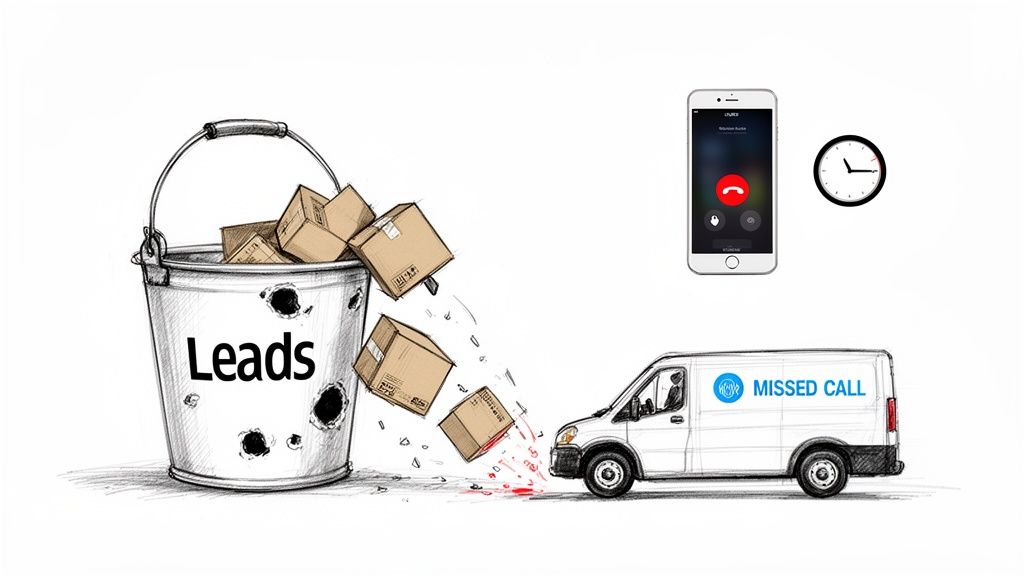
Think about the chaos of a typical week. A motivated customer calls at 6 PM, but your office is closed. Another one calls during the morning dispatch frenzy while you're just trying to get crews out the door. These aren't just missed opportunities; they are thousands of dollars in lost income, every single month. Studies show that a typical mover loses 3-7 jobs per month from missed calls alone.
The True Cost of Manual Quoting vs. Automated Estimating
The financial drain of slow, manual quoting is staggering. Let's break down exactly what sticking with the old way costs you versus what you gain by automating the process. The numbers might surprise you.
| Metric | Manual Quoting (The Old Way) | Automated Estimating (The New Way) |
|---|---|---|
| Quote Speed | 10-15 minutes per quote | Instant (under 60 seconds) |
| Lead Capture | Missed calls, voicemail tag | 24/7 capture, even after hours |
| Annual Lost Revenue | $50,000 – $150,000 (from missed calls alone) | Recovers 3-7+ jobs per month |
| Booking Rate | Lower; 30-40% of callers hang up | Higher; captures leads on first contact |
| Quote Accuracy | Prone to human error (under/overbidding) | Consistent and profitable every time |
| Staff Focus | Tied up with manual data entry | Focused on operations & customer service |
Sticking with spreadsheets and calculators isn’t just inefficient; it’s a direct drain on your revenue. In a market as competitive as the U.S. moving industry—which hit $21.3 billion in 2023—automating your estimates isn't a luxury. It's how you stop the bleeding and start growing again.
The core issue isn't just answering the call. It's the inability to provide an immediate, accurate quote that closes the job right then and there. Speed determines who wins the business, every single time.
This constant revenue leak is precisely why so many moving businesses feel stuck. You're losing 3 to 7 jobs per month not because your crews are bad, but because your front-office operations can't keep up with how customers buy today.
Closing the Gap Between a Lead and a Booking
The space between a potential lead and a booked job is where your profit is made or lost. A customer with a simple two-bedroom apartment move doesn't want to wait for a callback. They want a price now. If your system relies on voicemails, spreadsheets, and frantic manual calculations, you are personally handing jobs to your faster competitors.
This isn't about working harder. It’s about finally closing the operational gaps that let motivated customers slip right through your fingers. To get a deeper dive on building perfect quotes, you might find our guide on how to estimate moving costs helpful. But the real, long-term fix lies in automation that turns every single inquiry into a revenue opportunity, 24/7.
What Is Estimating Software for Movers?
Imagine your best salesperson. Now imagine they work 24/7, never make a math mistake, and know every single one of your pricing rules by heart. That’s estimating software for movers. It’s a system built to ditch the back-of-the-napkin math that bleeds your company dry and instead produce instant, accurate quotes based on your specific rules.
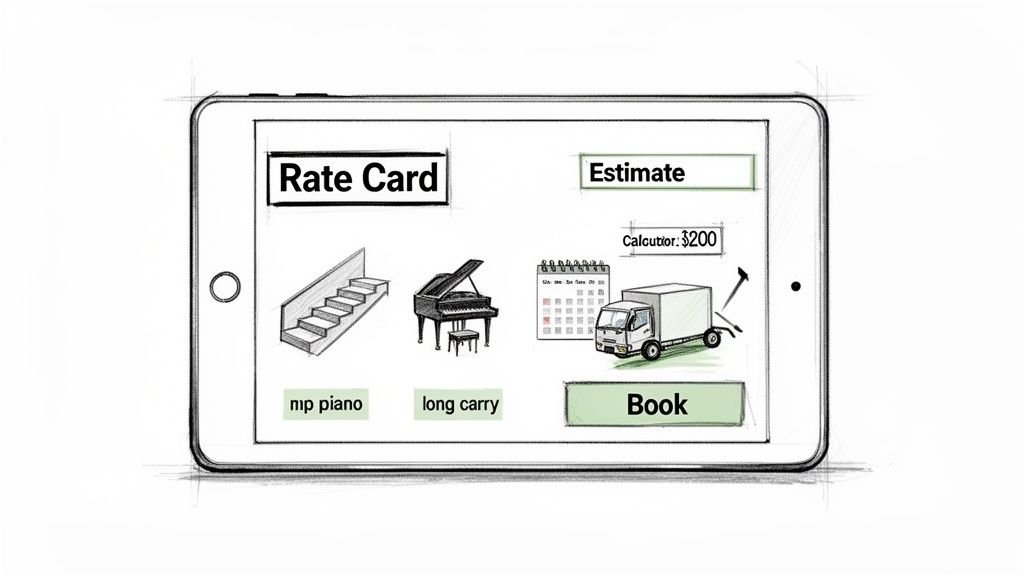
At the end of the day, this software is about one thing: creating a single source of truth for your pricing. It turns messy, complex rules into simple, profitable quotes using dynamic moving service quote templates that capture everything you need to know. It’s how you protect your margins on every single job.
The DNA of Your Moving Business: Your Rate Card
Your rate card is the heart of your operation. It holds all the pricing logic that makes your business yours. Good estimating software takes this business "DNA" and digitizes it, turning your hard-earned knowledge into a powerful, automated engine.
This is where all your specific pricing rules live:
- Hourly Rates: Your standard pricing for a two-man, three-man, or four-man crew and a truck.
- Travel and Fuel Surcharges: Automatically calculated based on distance or pre-set zones.
- Truck Fees: The fixed cost for using a specific vehicle for any given job.
- Packing Materials: Itemized costs for every box, roll of tape, and piece of packing paper.
When you program these rules directly into the software, you take human error out of the picture for good. No more forgetting to add the fuel surcharge. No more misquoting the rate for a bigger crew. The software gets it right, every single time.
We see it all the time with smaller moving companies: inconsistent quoting. The owner quotes a job one way in the morning and another way in the afternoon, all depending on how slammed he is. Software enforces consistency, making sure every customer gets a fair price that’s actually profitable for you.
Quoting Styles: Inventory vs. Room-Based Estimates
Modern software is flexible, letting you handle quotes based on the customer and the size of the job. The two most common ways to do this are with inventory-based and room-based estimates.
An inventory-based estimate is for the detail-oriented jobs. The customer—or your sales team—lists every single thing being moved, from the living room sofa down to the last box of books. This gives you laser-like accuracy, which is non-negotiable for large or complex moves.
A room-based estimate is the faster, more convenient path for smaller jobs, like a one or two-bedroom apartment. Instead of listing every item, the software uses smart templates (like a "standard 2-bedroom apartment") to spit out a reliable quote in seconds. This speed is what wins you the lead who just wants a price now without the work of a full inventory.
Handling the Variables That Kill Your Profit
Here’s where estimating software really earns its keep. It effortlessly accounts for all the tricky little details that are so easy to forget on a busy phone call—the same details that silently kill your profit margins.
A good system automatically adds charges for the real-world stuff, like:
- Flights of Stairs: Applying your per-flight fee for those lovely walk-up buildings.
- Long Carries: Adding cost when the truck has to park a mile away from the front door.
- Specialty Items: Factoring in the extra time, muscle, and equipment for pianos, gun safes, or fragile artwork.
- Disassembly/Reassembly: Including the labor for breaking down that giant IKEA wardrobe and putting it back together.
By automating all these little calculations, the software acts as your financial safety net. It makes sure the price you quote is a price you can actually stand behind, protecting your bottom line and building real trust with your customers. It’s the engine that guarantees every single quote is both competitive and profitable.
From Lead Capture to Booked Job: Choosing the Right Automation
When you’re drowning in calls and manual quotes, "automation" sounds like a lifesaver. But many movers have learned the hard way that not all automation solves the real problem. It's easy to end up paying for a tool that just creates more work.
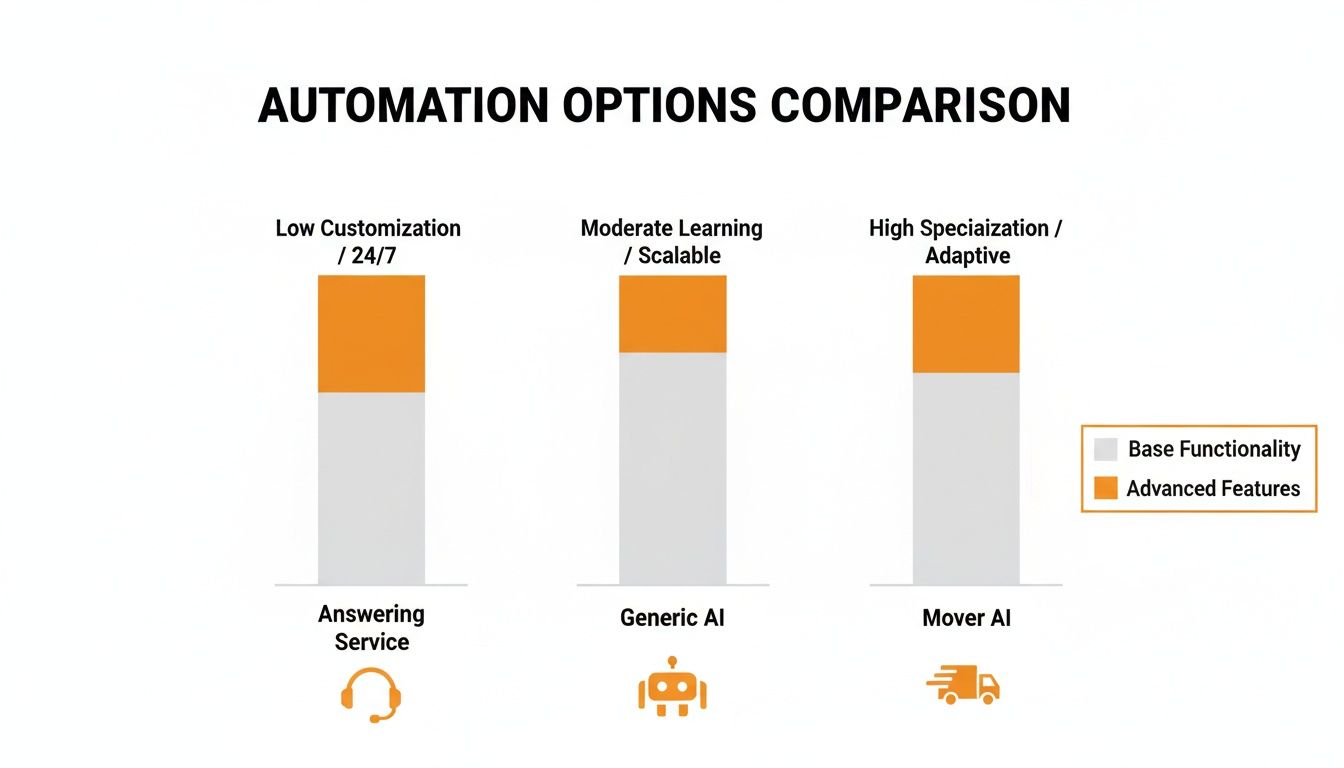
The market is flooded with options, but they really boil down to three types. Knowing the difference is the key to spending money on a system that actually books jobs, not just adds another line item to your credit card statement.
1. Traditional Human Answering Services
For years, this was the only alternative to voicemail. You get a real person answering your calls, which feels professional. But in practice, they function as expensive message-takers. An agent takes down the caller's info and promises someone will call them back. That’s it.
The problem? They can't give a quote because they don't have your rates, and they lack the industry know-how to ask the right questions. You're still stuck playing phone tag, racing the clock before that lead calls the next mover on their list. They answer the call, but they can't book the job.
2. Generic AI Voice Tools
These are the general-purpose AI phone bots you hear about on tech podcasts. They're programmed to do one thing: answer a call, follow a simple script, and maybe grab a name and phone number. Then, they shoot you an email with the lead's info.
They don't speak "moving."
- They have no idea what to do when a customer mentions a "three-story walk-up."
- They can't tell the difference between a studio apartment and a four-bedroom house.
- They can't look at your rate card and give a price.
A generic AI captures a lead, but it can’t qualify it or price the job. You’re still stuck having to call the customer back to do the real work—the exact delay that sends them straight to your competitor. It answers the phone but completely fails to book the move.
3. Purpose-Built AI Quoting & Booking Automation for Movers
This is where things get interesting. A purpose-built tool isn't just a voice on the phone; it’s an intelligent system designed from the ground up for the moving industry. It doesn't just answer the call—it handles the entire booking process from start to finish.
Here’s what sets it apart:
- It Knows Your Business: This kind of AI is trained on moving terminology. It integrates directly with your rate card and understands all your specific rules, from hourly minimums to fees for stairs and specialty items.
- It Quotes and Books: It can have a full conversation, qualify a lead, generate a 100% accurate quote, and then book the job directly into your CRM like SmartMoving, Supermove, or MoveitPro—or even just a shared Google Calendar.
- It Works 24/7: It’s your best employee. It captures and closes jobs after hours, on weekends, and during your busiest moments, turning what would have been a missed call into booked revenue.
The takeaway is simple. You have to decide if you want a tool that just captures a lead or a system that actually closes a job. One creates more work for you. The other makes you money while you sleep. For a small or mid-sized moving company, that difference is everything.
Calculating the ROI for Your Moving Company
Let's talk money. As a moving company owner, you know that any new expense has to earn its keep. Estimating software isn't just another line item on your P&L—it’s a revenue engine that plugs the leaks in your sales process. The return isn't some fuzzy, abstract idea; it's cold, hard cash from booked jobs you would have otherwise lost.
To get a real handle on this, you need to know how to calculate return on investment. The concept is simple: does the software bring in more money than it costs? For movers, the answer is almost always a resounding yes.
ROI for a 3-Truck Operation
Picture your three-truck company. It's Tuesday morning, the crews are heading out, and the phone is ringing off the hook. Or it's 7 PM and you're finally home, but a lead is calling for a quote. You miss just a couple of those calls a day, and you're not just missing calls—you're missing jobs.
Let’s run the numbers, and we'll be conservative:
- Average Job Value: Let's say $850 for a standard local move.
- Recovered Jobs: Automation helps you book just two extra jobs per month that would have gone to voicemail or a competitor.
That’s an extra $1,700 in monthly revenue ($850 x 2). A good automation tool often costs less than one of those jobs. The moment it books that first move for you, it has paid for itself. Every single job after that is pure profit.
ROI for a 15-Truck Operation During Peak Season
Now, let's scale that up. You're running a 15-truck operation, and it's May. The phone never stops. You know you’re missing calls, but you have no idea how many. Manually trying to catch every lead is like trying to catch rain in a thimble—you’re losing dozens of good leads to your competitors who are faster.
It’s a brutal fact: independent moving companies often miss 60-70% of after-hours calls. For a growing business, this can mean a loss of $50K-$150K every single year. A specialized tool can easily recover over 100 jobs during your busy season, for a monthly cost that’s covered by the very first booking it makes. The 2026 moving industry outlook shows labor costs are up 15-20% and insurance premiums have jumped 25%. Efficiency isn't a luxury anymore.
The question isn't whether you can afford automated estimating software. It’s whether you can afford to keep losing jobs to competitors who are faster and more responsive.
For that 15-truck operation, capturing just 10 extra jobs a month during peak season—at an average of $1,200 a pop—adds up to $12,000 in recovered monthly revenue. The software doesn't just pay for itself; it becomes a growth engine, turning missed opportunities into a steady stream of booked moves.
Curious what your specific return could be? Plug your own numbers into our free ROI calculator for moving companies.
How to Get Started with Estimating Software (And Not Get Burned)
Bringing new software into your moving company sounds like a massive headache, right? You’re picturing weeks of training, confusing settings, and endless tech support calls. But here’s the truth: getting modern estimating software running is easier than you think.
You don’t need to be a tech wizard. All you need is a simple plan to get the system dialed in. This isn’t about rebuilding your business from the ground up—it’s a small, manageable change that starts paying for itself almost immediately by turning missed calls into booked jobs.
Your Quick-Start Checklist
Getting set up isn't some month-long ordeal. You can knock this out in an afternoon and be ready to roll. Seriously.
Map Out Your Rate Card: Grab a legal pad or open a doc and just write down your pricing. Don't overthink it. What are your current rates for a 2-man crew? A 3-man crew? What’s your standard travel or truck fee? This is the core "DNA" the software needs to quote accurately.
List Your Special Charges: Now, think about all the little things that trip up quotes. Flights of stairs, long carries from the truck, that awkward piano in the basement, or the client with a massive gun safe. Give each one a clear rule or a specific price.
Check for Must-Have Integrations: Your new tool is useless if it doesn't talk to the systems you already rely on. Make sure it connects to your calendar (like Google Calendar) or your main moving CRM, whether that’s SmartMoving, Supermove, or MoveitPro. This is the magic step that makes automation actually work without forcing you to copy and paste job details all day.
Run a Few Test Drives: Before you flip the switch, run some test quotes yourself. Try a simple one-bedroom apartment first. Then, do a more complex four-bedroom house with a piano and a long carry. Once you see the numbers line up with what you’d quote manually, you’re good to go.
Red Flags to Watch For When Picking a Tool
Not all software is created equal. Choosing the wrong tool can be even more frustrating—and costly—than sticking with pen and paper. As you look at your options, keep an eye out for these massive red flags.
The biggest mistake I see movers make is picking a generic quoting tool that doesn't get the moving business. A system that can’t tell the difference between a long carry and a flight of stairs isn’t a solution—it’s just another problem you have to manage.
Watch out for these warning signs:
- Generic "One-Size-Fits-All" Software: If the tool wasn't built from the ground up for movers, run. It won't understand your language or your quoting logic. The second a customer mentions "shuttle service" or "hoisting," it will completely fall apart.
- No CRM or Calendar Integrations: A standalone quoting tool that doesn’t automatically push booked jobs into your dispatch calendar or CRM is a dead end. You’ll be stuck in data-entry hell, defeating the whole purpose of having the software in the first place.
- Complicated or Hidden Pricing: The company selling you the software should be as transparent with their pricing as you are with your customers. Avoid vendors with confusing, usage-based models that make it impossible to know what your bill will be at the end of the month.
The right choice comes down to picking a system designed for your world. To help you sort through the options, our guide to the best software for moving companies breaks down what separates the great tools from the generic ones. This upgrade should give you confidence, knowing every quote that goes out is spot-on and every job you book is profitable.
Frequently Asked Questions About Estimating Software
Thinking about new software probably gives you a headache. You're busy. You have crews to manage and trucks on the road. The last thing you need is a complicated tech project that takes weeks to figure out.
You have real questions about how this stuff actually works in a moving business. Will it be a pain to set up? Will it mess with my pricing? Will it actually help my team, or just add another thing for them to learn?
Here are the straight, no-BS answers to the questions we hear from owners just like you.
How Long Does It Take to Get Set Up?
This is always the first question, and the answer is probably faster than you think: less than a day. Seriously. Modern estimating software isn't some clunky program from 10 years ago. It’s built for people who run moving companies, not IT departments.
The whole setup is just you plugging in the rates you already use. Your hourly for a 2-man crew, your 3-man rate, your truck fee, travel charges—whatever is on your current price sheet. Once that’s in, you’re live. The best tools are intuitive; they’re designed to follow the same logic you use when you give a quote over the phone.
Will Automated Quotes Hurt My Profit Margins?
No, they'll save them. This is one of the biggest misconceptions. Manual quoting is where profits go to die. It’s where your dispatcher, in a rush on a Monday morning, forgets to add the stair fee. It’s where you accidentally underbid a job because you misjudged the time.
Automation is your safety net. It uses your exact rate card, every single time. It doesn’t forget things. It doesn’t have a bad day. It makes sure every quote is consistent, accurate, and profitable, protecting your margin on every single job.
How Does the Software Handle Unique or Complex Jobs?
This is where tools built specifically for movers blow generic software out of the water. They’re designed for the messy reality of moving, not simple A-to-B tasks. You can set up your own rules to automatically handle the tricky stuff:
- Specialty Items: Add your standard fee for pianos, gun safes, or that weirdly-shaped piece of art.
- Access Challenges: Factor in costs for a 150-foot long carry, a shuttle truck for a tight driveway, or three flights of stairs.
- Multi-Stop Moves: Easily build a quote that includes a stop at a storage unit or a second drop-off location.
It doesn't just work for the easy jobs. It gives you the confidence to accurately price the complex ones that usually turn into money-losers when quoted by hand.
Does This Replace My Office Staff?
Not at all—it makes them better at their jobs. Think about all the time your team wastes on stuff that doesn’t make you money. Manually typing lead info into a spreadsheet. Playing phone tag. Double-checking their own math on a quote.
This software automates all that low-value grunt work. This frees up your office staff to focus on what actually grows your business: talking to high-value customers, managing dispatch, and closing the jobs that the software has already qualified. It turns them from quote-takers into problem-solvers and job-closers.
Ready to stop losing jobs to your voicemail and start capturing revenue 24/7? See how MoveJoy can turn every call into a booked job with accurate, instant quotes using your own rate card. Book your free demo today at getmovejoy.com.