Moving company quoting software: what to look for and what to avoid
When you hear "quoting software," what comes to mind? Probably a glorified web form that grabs a name and number, right? Something that creates another task for your sales team to follow up on—another lead to chase.
That’s not what we’re talking about here. The right quoting software isn’t just another lead-capture tool. It’s an engine that instantly generates accurate quotes based on your specific rate card and books the job directly into your CRM. Forget generic AI and rigid logic. This is about building a tireless salesperson that closes jobs for you 24/7, even when your office is closed.
Your Best Salesperson Isn't a Person

Imagine your top salesperson. They never miss a call. They quote every job with 100% accuracy, day or night, using your exact rates. They instantly follow up with every single lead. This isn't a person—it's what modern quoting software should be doing for your moving business.
For too long, moving company owners have viewed software as a back-office expense. It’s time to flip that thinking. The right tool isn't a cost center; it's your #1 revenue engine.
The Gap Where Your Profit Bleeds Out
Every moving company owner knows that critical gap between a customer’s first call and getting a solid quote into their hands. That delay? That's where your profit bleeds away.
This industry is won on speed. The first company to deliver a trustworthy quote is almost always the one that books the job. Every minute you delay is another minute a potential customer has to call your competitor down the street. This problem explodes during the busy season, which hammers movers from March to September. When your phones are ringing off the hook, every missed call or slow quote is a job handed to someone else. For a small or mid-sized moving company, that easily adds up to $50,000 to $150,000 in lost jobs every single year.
The real problem isn't just answering the phone. It's closing the job on that first touch. Answering services and generic AI voice tools can take a message, but they can't quote the move using your rates. That single failure leaves a mountain of money on the table.
How to Turn Missed Calls into Booked Jobs
A well-built quoting tool does more than just give customers slick online forms that convert. Its real job is turning a website visit or a phone call into an instant, bookable job on your calendar. This is the difference between simply capturing a lead and actually closing a job.
Think about this all-too-common scenario for a 5-truck operation:
- A motivated customer calls you on a Saturday morning. Your office is closed.
- Your answering service takes a message and promises someone will call back Monday.
- By the time Monday rolls around, that customer has already booked with another company that gave them an instant price online over the weekend.
The right software is your tireless salesperson, closing that gap. It works around the clock, turning those after-hours and weekend inquiries into confirmed jobs that pop up on your dispatch board. It completely changes the game, turning a potential revenue leak into a powerful asset that ensures you never miss another chance to book a move.
Not all quoting software is created equal. Picking the wrong tool can feel like you’re running in quicksand, while the right one can completely change the game for your business.
For a small or mid-sized moving company, the features you need aren't just bells and whistles. They're about survival and growth.
Let's cut through the sales pitches and talk about the practical, non-negotiable features your quoting software absolutely must have. This isn't some generic checklist. This is what a company with 1–20 trucks actually needs to stop losing jobs and start building a more profitable, streamlined operation.
Dynamic and Configurable Rate Cards
Your pricing isn't one-size-fits-all, so your software can't be either. The foundation of any good quoting tool is its ability to perfectly mirror your company's unique pricing. Generic software that forces you into a rigid model will either underprice your jobs—killing your margins—or price you right out of the market.
You need a system that lets you easily configure:
- Hourly Rates: Set different rates based on the number of movers and trucks for a job.
- Flat-Rate Pricing: Create rules for fixed-price moves, perfect for smaller jobs or specific routes you run all the time.
- Zone-Based Pricing: Define geographic zones with custom travel fees or rate adjustments. This is critical for managing drive time and ensuring profitability on every job, no matter the distance.
- Seasonal Adjustments: Apply peak season surcharges with a few clicks, ensuring you capitalize when demand is highest without manual recalculations.
Without this level of flexibility, you'll spend more time creating manual workarounds than you save. Your rate card is your business's DNA; your software must be able to read it perfectly.
Essential vs. Outdated Quoting Software Features
It's easy to get bogged down in feature lists, but what really matters for a moving business? This table breaks down what separates modern, effective software from the tools that hold you back. Think of it as a quick cheat sheet to see where your current process might be falling short.
| Feature | Modern Software (What to Look For) | Outdated/Generic Software (What to Avoid) |
|---|---|---|
| Rate Card | Fully configurable to your specific pricing (hourly, flat-rate, zones, seasonal). | Rigid, template-based pricing that forces you into a pre-set model. |
| Move Complexity Logic | Automatically accounts for stairs, long carries, elevators, and specialty items in the quote. | Manual calculations are required for anything beyond basic move details. |
| Quoting Speed | Instantly generates and sends a complete quote on the call, 24/7. | Requires a sales rep to manually build and send the quote, often with a delay of hours or days. |
| Follow-Ups | Automated email and SMS sequences to nurture unbooked estimates. | No follow-up system; leads go cold unless your team chases them down manually. |
| CRM Integration | Seamlessly syncs with popular moving CRMs like SmartMoving, Supermove, and MoveitPro. | Operates as a standalone tool, creating data silos and requiring manual data entry. |
| Customer Experience | Provides an interactive, self-serve quoting experience that customers can use anytime. | Relies on static web forms that offer no immediate feedback or pricing. |
At the end of the day, modern software is built to automate the tedious work and capture revenue you’d otherwise miss. Outdated tools simply create more manual tasks for you and your team, defeating the whole purpose.
Granular Move Logic for Pinpoint Accuracy
The difference between a profitable move and a money-loser often comes down to the details. A customer might forget to mention the 150-foot walk from the truck to their third-floor apartment door, or the antique piano hiding in the basement. Your quoting software can't afford to forget.
The most common source of revenue leakage isn't just missed calls—it's inaccurate quotes. A system that can't account for job complexity forces your team to either guess or manually recalculate, introducing errors that kill your margins.
Your software must have granular logic to accurately price these common variables:
- Stairs and Elevators: Automatically add time or fees for flights of stairs or reserved elevator usage.
- Long Carries: Factor in the extra time and labor for those long walks from the truck to the front door.
- Specialty Items: Apply specific charges for heavy or delicate items like pianos, gun safes, or oversized artwork.
- Packing and Materials: Accurately estimate the cost of boxes, tape, and packing services based on the home size or inventory list.
To get even better, some software supports modern inventory methods like the use of QR coded moving boxes, which helps both your crew and the customer keep track of everything and reduces chaos on move day.
Instantaneous Quoting Speed
In the moving business, speed wins. Today’s customers expect answers now. If you make them wait, they won't. They’ll just hang up and call the next company on their list.
A top-tier system doesn't just capture a lead; it calculates and delivers a complete, professional quote in real time. This is a game-changer for calls that come in after hours or on weekends when your office is closed. An AI-powered tool that can answer a call, run the numbers through your rate card, and send a quote instantly is no longer a futuristic nice-to-have—it's a competitive necessity.
Automated Follow-Up Sequences
Did you know that a huge percentage of booked jobs come from follow-ups? Most moving company owners are too busy putting out fires to manually chase every single lead. This is where automation becomes your secret weapon for recovering revenue.
Your quoting software should automatically trigger a sequence of emails and text messages to nurture leads that haven't booked yet. This keeps your company top-of-mind without you lifting a finger. A good follow-up sequence can:
- Remind the customer of their quote.
- Highlight what makes your company the best choice.
- Create a sense of urgency to lock in their move date.
This single feature can dramatically boost your booking rate, turning those "I'll think about it" estimates into confirmed jobs on your calendar. If you want to see what a polished final quote should look like, you can download a moving company estimate template here. The right software builds these professional documents for you, automatically.
Integration Isn't a Feature, It's the Whole Point
A quoting tool that doesn’t talk to your other systems is just a fancy calculator. It creates more work, not less.
If your team is constantly copying and pasting information from your quoting tool into your CRM and then again into your calendar, you don’t have a system. You have a recipe for disaster. Names get misspelled, addresses get entered wrong, and special instructions get missed.
Integration isn't a luxury; it's the difference between a smooth, profitable operation and a chaotic back office that’s always putting out fires. Your quoting software absolutely must connect directly with the two most important parts of your business: your moving CRM (like SmartMoving, Supermove, or MoveitPro) and your dispatch calendar. Anything less is just another broken process.
This is what a modern, truly connected quoting process should look like.
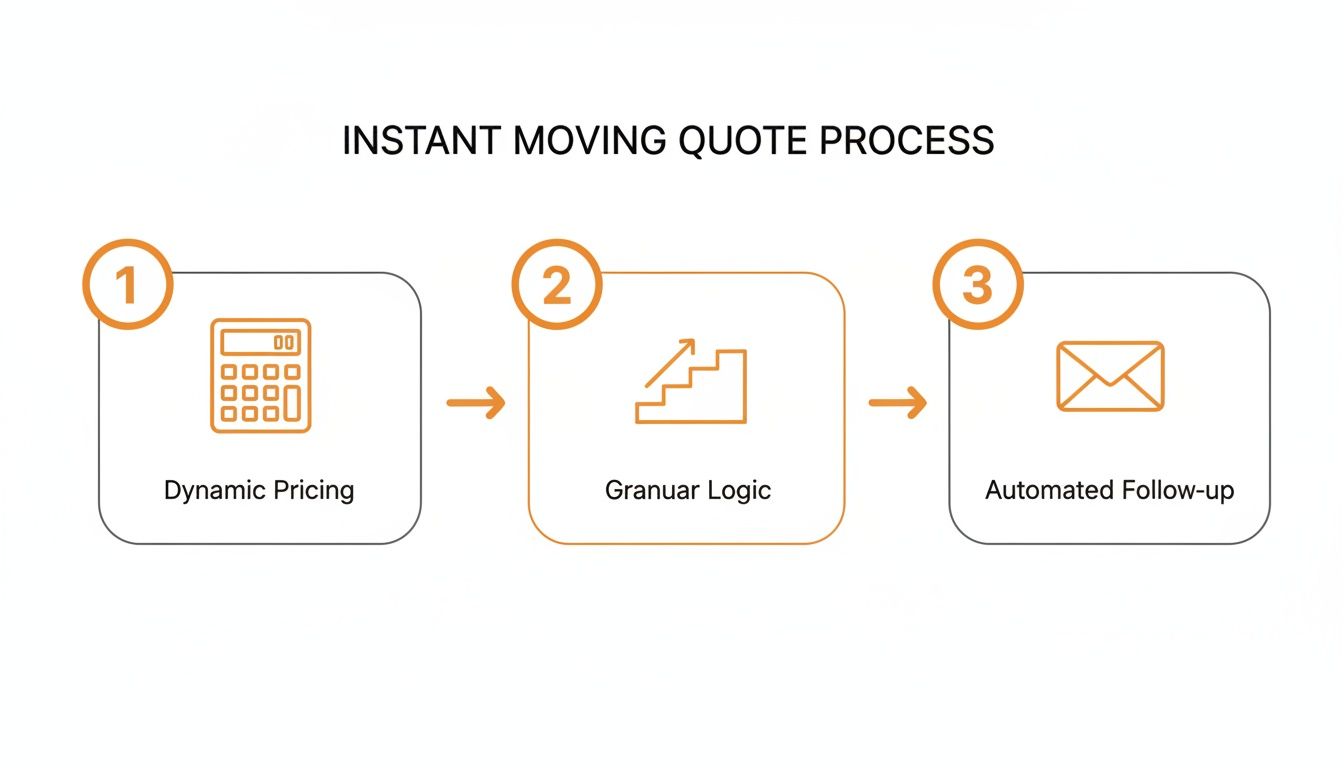
As you can see, the flow is automatic. From the initial call to the final booking, the data moves from one step to the next without anyone having to lift a finger. That’s the goal.
The Perfect Workflow: First Call to Booked Job
Let's walk through how this should work in the real world. Imagine a potential customer calls you at 9 PM on a Tuesday. Your office is closed, but instead of hitting voicemail, an AI-powered system answers.
Here’s what happens next, with zero human effort:
- Lead Captured & Quoted: The system asks all the right questions to gather the move details. It then instantly generates an accurate quote based on your company’s specific rates, including all the tricky stuff like stair fees, long carries, and travel time.
- Customer Approves: The customer gets a professional-looking quote by text or email and approves it with a single click.
- Job Instantly Booked: The system automatically creates the job on your dispatch calendar, whether you use Google Calendar or something else.
- CRM Profile Created: At the exact same time, a new customer profile and job record are created in your CRM—be it SmartMoving, Supermove, or MoveitPro.
This isn't science fiction; this is what modern automation actually does. This kind of closed-loop system eliminates double-entry, saves your office staff from hours of mind-numbing admin work, and most importantly, ensures your crews show up on move day with the right information. Our guide on choosing a CRM for a service business goes way deeper on why this is so critical.
The Chaos of Disconnected Systems
Now, let's contrast that with the nightmare you might be living right now. A lead calls and leaves a message. Your office manager listens to it the next morning, calls the customer back, and scribbles down some notes. They punch the details into a spreadsheet to figure out a price, then type that all up in an email.
If the customer actually books, that same information has to be manually typed again into the calendar and again into the CRM. This is where things fall apart. During the busy season, these "small" mistakes snowball into massive scheduling headaches, angry customers, and jobs that lose you money.
A disconnected system means your team is constantly playing catch-up, reacting to problems instead of proactively booking jobs. Every minute spent on manual data entry is a minute not spent on customer service or growth.
The global moving company software market is on track to hit $38.11 billion by 2035, and 70% of movers are already shifting to cloud-based tools to get more efficient. For independent movers, the key is finding tools built specifically for our industry.
Generic voice tools or basic quoting forms just can't handle the logic. They fumble our terminology, can't calculate rates properly, and lose you leads. You need a specialized AI solution that’s been trained on moving language, can generate a perfect quote from your rate card, and books the job directly into SmartMoving or Supermove. You can dig into more of these trends in this detailed business report.
Red Flags to Avoid in a Quoting Solution
Picking the wrong quoting software is often worse than having no software at all. A bad investment won’t just burn a hole in your budget; it can actively torch your reputation, bleed your profits, and create total chaos for your team.
It’s easy to get wowed by a slick sales demo, but spotting a bad fit before you sign on the dotted line is everything. The real problems are almost always hiding in the details—or the lack thereof.
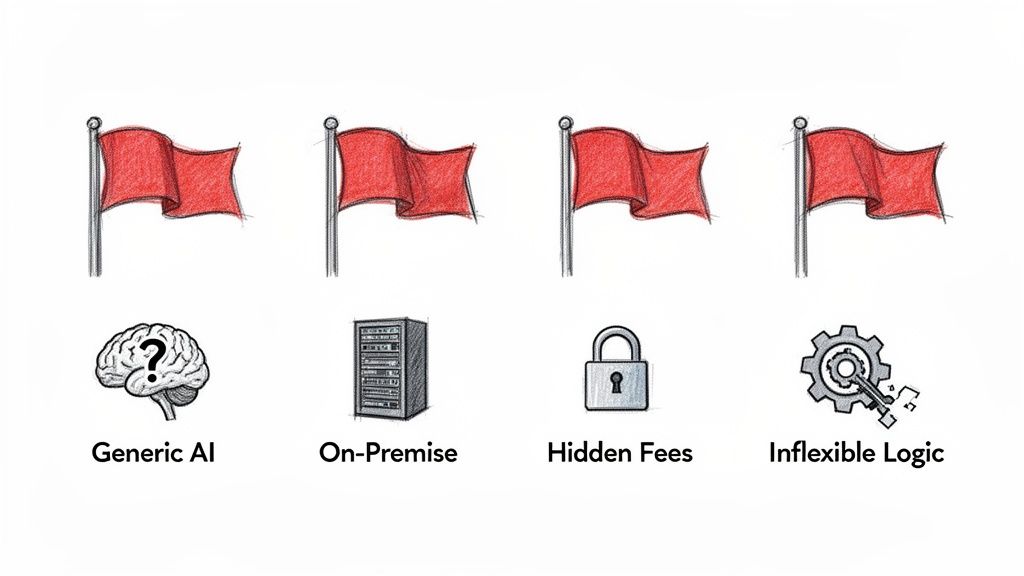
Generic Platforms That Don't Speak "Moving"
This is the single biggest red flag, and it's a deal-breaker. Generic AI voice tools or chatbots are built to serve every industry under the sun, which means they don't truly understand any of them. They aren't trained on the specific language and logic that runs a moving business.
The result is a complete disaster. These tools can't tell the difference between a "long carry" and "long distance." A customer might mention a "third-floor walk-up," and the AI has no clue that this detail just blew up the time and labor estimate for the job.
Using a generic AI tool for moving quotes is like asking your accountant to patch a hole in your truck's tire. They might know the word "tire," but they lack the fundamental understanding to do the job right. You end up with wildly inaccurate quotes and jobs that lose you money.
Inflexible Quoting Logic
You’ve spent years dialing in your pricing. A quoting solution that shoehorns you into a rigid, one-size-fits-all model is a step backward. If the software can’t bend to your rules, it’s not a solution.
Get nervous if a vendor can't give you a straight answer on how their system handles your specific logic:
- Hourly vs. flat-rate rules: Can it flip between pricing models based on the job type or even what the customer wants?
- Travel time calculations: Does it accurately apply your specific travel zones and fees, or is it just pulling a generic number from Google Maps?
- Complex service charges: How does it deal with multi-stop moves, storage-in-transit (SIT), or seasonal surcharges?
If you find yourself having to create manual workarounds to make the software fit your business, you're not buying a solution—you're buying a new set of expensive problems.
A classic mistake is buying software that promises "customization," but what they really mean is you'll be paying for expensive developer hours for every tiny change. True flexibility means you can tweak your own rates, rules, and services without having to call tech support.
Lack of Specialization
Be very skeptical of any software that claims it’s the perfect fit for movers, plumbers, electricians, and dog walkers all at once. The challenges of a moving company—seasonal demand spikes, complex crew logistics, and the need for razor-sharp quoting accuracy—are completely unique.
A platform built specifically for movers understands this. It’s designed from the ground up to solve moving-specific problems. A generic tool, on the other hand, will always feel clunky and incomplete because it was never really made for you. These "jack-of-all-trades" solutions are masters of absolutely none.
On-Premise or Clunky Software
In this day and age, there is simply no good reason to use quoting software that isn't cloud-based. If a vendor tries to sell you a system that has to be installed on a specific computer in your office, run for the hills.
On-premise software is a dinosaur, and it comes with some serious baggage:
- No remote access: Your team can't give quotes or manage leads unless they are physically sitting at that one desk in the office.
- Manual updates: You’re on the hook for installing every update and security patch, which is both a security risk and a massive time-suck.
- Data silos: All your information is trapped on one machine, making it impossible to connect with other essential tools like your moving company CRM.
Your software should work for you anytime, anywhere, and on any device. Anything less puts you at a huge disadvantage.
Hidden Fees and Long-Term Contracts
Transparent pricing is a sign of a vendor who is confident in their product. If a company is cagey about all the potential costs, it’s a massive red flag. Keep an eye out for sneaky fees that can quickly double your bill.
Always ask directly about:
- Implementation or setup fees
- Charges for training and support
- Fees per user or even per quote
- Costs for integrating with your CRM
On the same note, be very wary of vendors pushing you into long-term, iron-clad contracts. A company that actually believes in its product should be willing to earn your business month after month. A 12-month or 24-month contract can trap you with a subpar tool, forcing you to keep paying for something that's actively hurting your business. Look for providers that offer flexible, month-to-month terms.
How to Calculate the ROI of Your Quoting Software
It’s easy to get hung up on the monthly price tag of new software. But when it comes to a quoting solution, you have to stop thinking of it as a cost. It’s an investment. The right tool isn’t another line item on your expense report; it's a machine that generates revenue.
Figuring out the Return on Investment (ROI) is way simpler than you think, and it shows you just how fast the right tool pays for itself. You don't need some complex financial model. The real ROI comes from one place: recovering the jobs you’re already losing.
The Simple Math for Recovered Jobs
Every missed call, every lead that goes cold waiting for a quote—that's cash walking out the door. An automated quoting tool is your 24/7 salesperson, catching those opportunities before they disappear.
Here’s how you can put a dollar value on that.
Just use this straightforward formula:
(Average Job Value) x (Number of Missed Calls Per Week) x (Booking Rate for Recovered Leads) = Monthly Recovered Revenue
Let’s run the numbers for a typical 5-truck moving company to see how this plays out.
- Average Job Value: Your average local move brings in around $1,500.
- Missed Calls Per Week: Your team misses just 3 calls a week. Maybe they come in after hours, or during the morning rush. That's 12 missed calls a month.
- Booking Rate: Let's be conservative and say you book 25% of these instantly-quoted leads that you would have otherwise missed.
Now, let's do the math. A 25% booking rate on 12 missed calls means you recover 3 jobs.
$1,500 (Avg. Job) x 3 (Recovered Jobs/Month) = $4,500 in Monthly Recovered Revenue
Even if a solution costs you $149–$499 a month, you've made your money back multiple times over from those three jobs. The very first job it books puts you in the black. Everything after that is pure profit.
The Hidden Payback Beyond Booked Jobs
The financial return doesn't stop with just the new jobs you book. There's a "soft" ROI that shows up in other places, cutting costs and making your entire operation run smoother.
Think about these benefits:
- Fewer Wasted Admin Hours: How many hours does your team burn manually punching numbers into a calculator, chasing down leads, and then re-keying all that data into your CRM? Automating that frees them up to focus on things that actually make you money, like talking to high-value clients or managing dispatch.
- No More Costly Quoting Errors: One bad quote on a big job can destroy your profit margin for the week. A single miscalculation—forgetting a flight of stairs or underestimating packing time—can turn a profitable move into a loss. Automation based on your specific rate card eliminates that human error.
- A Better Customer Experience: A fast, professional quote makes a killer first impression. It shows you’re on top of your game. This leads directly to better reviews and more referrals, which strengthens your brand and gives you the power to charge what you're worth.
The 2026 State of Moving Report found that the average time it takes to book a move is a painful 2.5 days. For movers with 1-20 trucks, this delay adds up to a staggering $50K-$150K lost every year from missed calls alone.
In a world where customers expect an answer now, a tool that recovers even one of those lost jobs a month gives you an immediate and massive return.
At the end of the day, doing the ROI math shows that the right quoting software isn’t a nice-to-have. It’s a strategic investment in growth. You can plug in your own numbers and see how this applies to your business with this simple ROI calculator for moving companies.
Your Go-Live Implementation Plan
The best quoting software in the world is junk if you don’t set it up for success. A clumsy rollout leads to frustrated staff, confused customers, and a fast retreat back to the old, inefficient way of doing things. But a smooth launch gets your team on board fast, and you start seeing the payoff immediately.
A good vendor will walk you through the process, but don't just sit back and wait. Being proactive on your end is what guarantees this thing actually works. This isn't about getting tangled in technical weeds; it's about prepping your business to run smarter.
1. Dial In Your Rate Card
This is it. The absolute foundation of your entire setup. Before you touch anything else, you have to get your pricing rules documented and crystal clear. An automated system is only as smart as the information you feed it.
Your rate card needs to cover everything:
- All Services and Fees: Get a clean list of every single thing you charge for, from standard hourly labor to flat-rate packages.
- The Nitty-Gritty Pricing Rules: This is where the magic happens. Document the logic for stair charges, long carries, travel time zones, and those one-off fees for pianos or gun safes.
- Minimums and Surcharges: Make sure you note any hourly minimums for jobs or any surcharges you add during peak season.
Get this right, and your software will spit out accurate, profitable quotes every single time. Get it wrong, and you’re just automating your mistakes.
2. Get Your Team On Board
Your sales and dispatch staff are on the front lines. They need to understand not just how to use the new tool, but why it makes their lives easier. Frame it as a way to kill all the tedious manual work so they can focus on high-value tasks.
Hold a quick training session and walk them through the new flow. Show them how a lead comes in from a call and ends up as a booked job in your CRM or calendar—without them lifting a finger. An automated system that quotes and books jobs on its own should feel like a superpower, not a threat to their job.
3. Test It Until It Breaks
Before you flip the switch, you need to run this system through the wringer. Run dozens of mock quotes. Pressure-test the logic. Make sure every single detail works exactly the way you expect.
Don’t just test the easy jobs. The real test of any moving quoting software is how it handles the messy stuff. A simple studio apartment is one thing; a multi-day job with storage and three different stops is where you’ll see if you bought a tool or a toy.
4. Announce and Launch
Once you’re confident that everything is dialed in, it’s time to go live.
Update your website with your new instant quoting tool. Tweak your call routing to send after-hours or overflow calls to the new system. A real launch isn't just about turning on a piece of tech; it's a commitment to a more efficient, more profitable way of running your business.
It reinforces the one idea that matters most: competitive advantage now comes from automation that actually closes jobs, not just one that answers the phone.
Frequently Asked Questions
If you’re thinking about quoting software, you probably have a few questions. These are the ones I hear most often from moving company owners who are on the fence.
Can AI Quoting Software Really Be As Accurate As a Human?
Let's be blunt: a generic AI chatbot will absolutely fail at this. It doesn't know what a "long carry" is and it definitely doesn't understand your rate card.
But an AI built specifically for moving is a different story. When it's trained on moving lingo and your company's exact rules—for everything from stair fees to travel time—it's not just as accurate as a human. It's often more accurate and consistent. It never miscalculates, never forgets to add a fee, and it quotes every job profitably, 24/7.
Is This Software Too Expensive For My Small Company?
Not at all. In fact, I've found that owners with 1–3 trucks often see the biggest and fastest return. When you’re the one answering phones, driving the truck, and managing the crew, every missed call is a lost job. You’re wearing too many hats.
Modern quoting software is surprisingly affordable, especially when you do the math.
The ROI is almost immediate. If your average move is $1,200, and the software costs a few hundred bucks a month, it only needs to recover one single missed job to pay for itself and turn a profit. It’s the tool that lets you punch above your weight and compete with bigger companies by offering instant, professional service around the clock.
What Is The Difference Between A Quoting Tool And My CRM?
This is a critical distinction, and getting it wrong can cost you. Think of it this way:
Your CRM (like SmartMoving, Supermove, or MoveitPro) is your operational hub. It kicks in after you’ve booked the job to handle dispatch, scheduling, and billing. It runs the back end of your business.
A quoting tool is your sales engine. Its entire job is to capture a lead and convert them into a paying customer before they ever touch your CRM. Its job is to win the business. The best setups integrate the two, so the AI books the job and it appears in your CRM automatically, with zero data entry from you or your team.
How Much Training Does My Team Need To Use This?
If you pick the right tool, almost none. The whole point of this software is to automate the tedious work your team is already doing by hand. It shouldn't feel like learning a complicated new system.
It's less about "training" and more about enjoying a lighter workload. A good provider will walk you through setting up your rate card during onboarding, but the day-to-day use should feel effortless. The goal is to find software that just works, letting your team focus on running the moves, not answering endless calls.
Ready to see how an AI can plug your revenue leaks and start booking jobs for you tonight? MoveJoy is the only AI-powered revenue engine built from the ground up for movers. It answers every call, gives instant quotes from your rate card, and books the job right into your CRM.