Every time your phone rings and you can’t get to it, a potential job—often worth thousands—is already dialing your competitor. For a busy moving company owner, that isn’t just a missed call. It’s revenue you’ve sent directly to voicemail.
An automatic answering service powered by an automatic call system is the modern fix, acting as your digital dispatcher to ensure you never miss another lead, whether you’re out on a job, it’s the middle of the night, or it’s 9 PM on a Saturday. This is the competitive advantage that helps you book more jobs, capture every opportunity, and grow your moving business without working harder.
Stop Sending Thousands in Revenue to Voicemail
If you’re running a moving company with 1–20 trucks, you or a small office team are probably juggling everything: quoting jobs, dispatching crews, and answering the phone. This system works right up until the moment it doesn’t.
During the peak season summer rush, when you’re out on a job or call handling an urgent dispatch issue, the phone inevitably rings. That caller isn’t going to wait around. They’ll hang up and call the next mover on their list. Speed is everything for today’s customer.
This isn’t a small leak in the boat; it’s a huge hole. Losing just a few jobs a month stacks up to tens of thousands of dollars in lost revenue every single year. It’s a direct hit to your bottom line caused by a simple problem: you can’t be in two places at once.

The Real Cost of Unanswered Phones
The damage from a missed call goes way beyond losing one job. It creates a ripple effect that stunts your growth and chips away at your local reputation.
Here’s a breakdown of what’s really at stake:
- Immediate Revenue Loss: A standard local move can easily be worth $1,500 or more. Miss just one of those calls a week, and you’re leaving $6,000 on the table every month.
- Lost Customer Lifetime Value: A happy customer moves again or, more importantly, refers friends and family. That single missed call could have turned into a steady stream of future business.
- Competitive Disadvantage: In a crowded local market, the first mover to respond usually wins the job. If you’re not answering, you’re just handing jobs to your competitors.
The table below breaks down just how quickly the financial damage adds up when calls go unanswered. It’s not just about the one job; it’s about the long-term opportunities that vanish along with it.
The True Cost Of A Missed Call For Your Moving Company
| Scenario | Immediate Revenue Loss (Example) | Long-Term Impact |
|---|---|---|
| Call #1: Local Move | $1,500 | Customer books with a competitor. You lose the job and any chance of a referral. |
| Call #2: Repeat Customer | $1,200 | They needed a small move but couldn’t reach you. They find a new “go-to” mover. |
| Call #3: After-Hours Lead | $2,000 (Larger move) | Called at 8 PM. Went to voicemail. Booked with the first company that answered. |
| Call #4: Referral | $1,800 | A past client’s friend called. Couldn’t get through. The referral opportunity is lost. |
When you add it all up, it becomes clear that missed calls aren’t just an annoyance—they’re a significant drain on your company’s financial health and future growth.
Capturing every ready-to-book client is critical, and the principles in guides like this one on how to get more plumbing leads using SEO and AI apply just as much to movers. The demand for reliable phone service is massive. In 2024 alone, the U.S. telephone answering service industry hit $2.5 billion in sales, driven by businesses that simply can’t afford to let a single opportunity slip by.
Think of an automatic answering service as your frontline defense. It’s a system built to capture every inquiry, qualify leads, and secure bookings 24/7. This technology isn’t just about answering calls; it’s about finally sealing the revenue leaks that are quietly draining your company’s potential. Our guide on after-hours answering services dives even deeper into how to capture these crucial leads.
What Exactly Is an Automatic Answering Service?
Think about the best dispatcher you’ve ever had. You know the one—they knew your business inside and out, never missed a single call, and could talk a stressed-out customer off a ledge in seconds.
Now, what if that person could work 24/7 without ever taking a coffee break, a sick day, or a vacation? That’s the easiest way to understand what a modern automatic answering service really is.
This isn’t just a glorified voicemail or one of those old-school call centers that only takes messages. Today’s systems, powered by smart AI, act like a genuine front-office assistant for your moving business. They are built to do one thing incredibly well: turn every phone call into either a booked job or a qualified lead.
Beyond Answering, It Takes Action
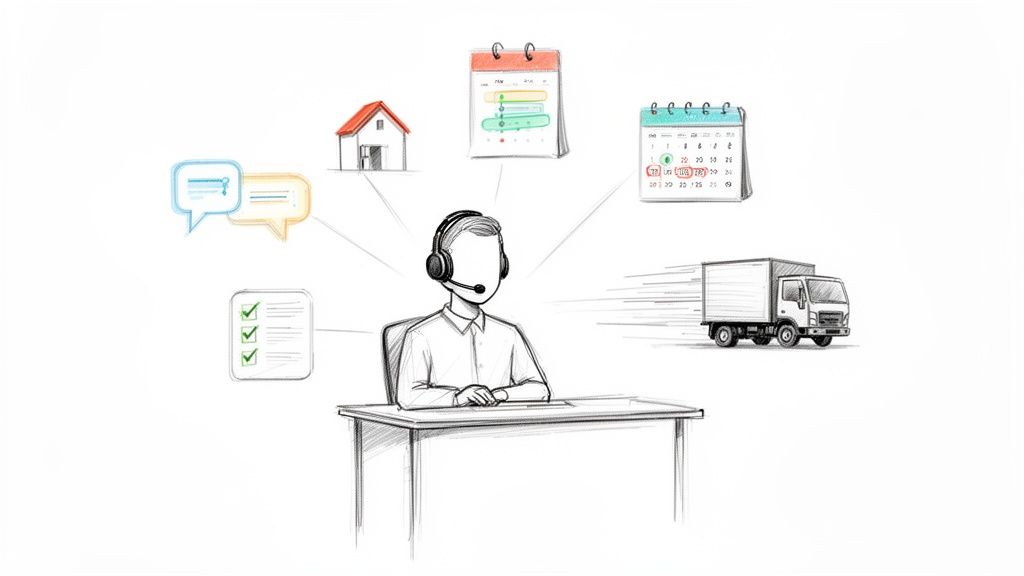
At its core, an automatic answering service does more than just listen; it understands. It’s programmed to recognize the specific language of the moving industry. So when a caller says, “I need a quote for a three-bedroom house move next Saturday,” it knows exactly what to do next.
Instead of just jotting down a message, it takes intelligent, immediate action. Think of it as a digital dispatcher working for your company:
- It Qualifies the Lead Instantly: The system can ask the key questions you’ve programmed it with, like “Are you moving locally?” or “Will you need packing services?” This weeds out the tire-kickers right away.
- It Checks Your Calendar in Real-Time: By connecting directly to your scheduling software, it can see if your crews are actually available on the date the customer wants. No more double-booking or playing phone tag.
- It Sends an Immediate Follow-Up: Based on the conversation, it can automatically text the caller a link to your online booking form or a preliminary quote, capturing their interest while they’re still on the line.
This isn’t some far-off, futuristic concept. It’s a practical tool that frees you and your team from being chained to the phone. You can finally focus on running the moves and delivering five-star service while your AI receptionist makes sure no lead ever gets ignored again.
The Technology Driving This Shift
The tech behind these automatic answering services is getting better and more affordable every day, making it a no-brainer for small moving company owners. The global call center AI market is expected to explode from $3.98 billion in 2025 to $30.69 billion by 2035. That’s a clear signal that businesses are finally embracing automation to handle customer calls because they know speed wins.
This growth is all about efficiency and the simple truth that the first company to answer the phone usually gets the job. You can dig deeper into the numbers by checking out the full call center AI market research.
An automatic answering service doesn’t just answer the phone. It starts the sales process for you, engaging customers in those first critical moments when they are most ready to book a mover.
Essentially, it closes the gap between a customer’s first call and a confirmed booking. A traditional answering service might say, “Someone will call you back.” An automatic answering service says, “I can help with that right now.”
For a local mover, that difference is everything. It’s the competitive edge that helps you book more jobs without having to hire more people.
What to Look for in an Answering Service for Movers
Let’s be clear: not all automatic answering services are built the same. A generic, off-the-shelf solution that just takes a message is basically a more expensive voicemail. For a moving company, where every call is a potential high-value job on the line, you need a system that acts more like a seasoned dispatcher than a passive receptionist.
Think of it this way: you’re hiring a digital employee to be the first point of contact for your business. It needs to handle the fast-paced, high-stakes nature of a customer who wants to book a move right now. Anything less, and you’re just paying to lose leads more slowly.
Here are the non-negotiables.
24/7 Availability
Your potential customers aren’t just looking for movers between 9 AM and 5 PM. They’re planning their lives after work, on weekends, and during holidays. A missed call at 8 PM on a Friday is a hot lead handing a $1,500 job to your competitor who actually picked up the phone.
An answering service that clocks out when you do is solving the wrong problem. You need true 24/7 availability to make sure you’re always “open for business,” ready to capture high-intent leads the moment they decide to call.
This isn’t just a nice-to-have; it’s about matching your customer’s schedule. When a family gets the green light to move, they don’t wait until Monday morning to start their search. Being the first to respond at any hour is a massive competitive advantage.
Real-Time Calendar Integration
“Let me check with the team and call you back.”
That phrase is a death sentence for a lead. In the time it takes you to track down your dispatcher and confirm crew availability, that customer has already called three other companies and gotten a quote. A must-have feature is direct, real-time integration with your scheduling calendar, whether it’s Google Calendar or a dedicated moving CRM.
This connection lets the answering service:
- Instantly see if you’re free: It knows if your crews are booked on a specific day without having to ask anyone.
- Book jobs on the spot: It can grab an open slot and schedule the move right into your calendar.
- Prevent double-booking: It eliminates the human error that leads to those awful scheduling nightmares.
This simple feature turns an inquiry call into a confirmed, booked job on your calendar without you ever touching the phone. It’s the difference between a “maybe” and a deposit.
Automated Quoting and Follow-Up
Speed is everything in this business. A smart automatic answering service should do more than just answer the phone; it needs to get the ball rolling immediately. It should be able to gather the essentials—home size, move distance, special services—and then take action.
The system should instantly send a preliminary quote or a link to your detailed quoting form via text, while the customer is still on the line and engaged. This keeps your company top-of-mind. Better yet, it should also be programmed to send an automated appointment reminder message a day or two later if the customer hasn’t booked, nudging them to make a decision without any manual work from you.
Natural Language Understanding for Movers
A generic AI will get tripped up fast. It won’t know the difference between a “studio apartment” and a “three-bedroom house with a piano.” Your automatic answering service has to be trained on the specific language of the moving industry.
It needs to understand terms like:
- “Packing services”
- “Storage needs”
- “Long-distance move”
- “Specialty items like a safe”
This is what allows the AI to have an intelligent, productive conversation that actually qualifies the lead and gathers the right info. The call should feel natural and helpful, not like a frustrating robotic phone menu. This can even include advanced features like a warm transfer, which our guide explains in detail, to seamlessly hand off a complex call to a live person when it makes sense.
CRM Integration
Finally, all this valuable customer information is useless if it just vanishes after the call. Direct integration with your Customer Relationship Management (CRM) system is non-negotiable.
This ensures every caller’s name, number, move details, and conversation history is automatically logged in their customer profile. No more manual data entry. No more costly errors. It gives your team a complete picture of every lead, making every follow-up call more personal and effective.
How an AI Answering Service Actually Makes You Money
The features are impressive, sure. But let’s get down to what really matters: how does this tech actually put more money in your pocket?
It’s not about having a fancy AI. It’s about plugging the three biggest leaks that sink a moving company’s profits: missed calls, slow response times, and getting buried in administrative work.
This is about turning tech talk into real dollars.
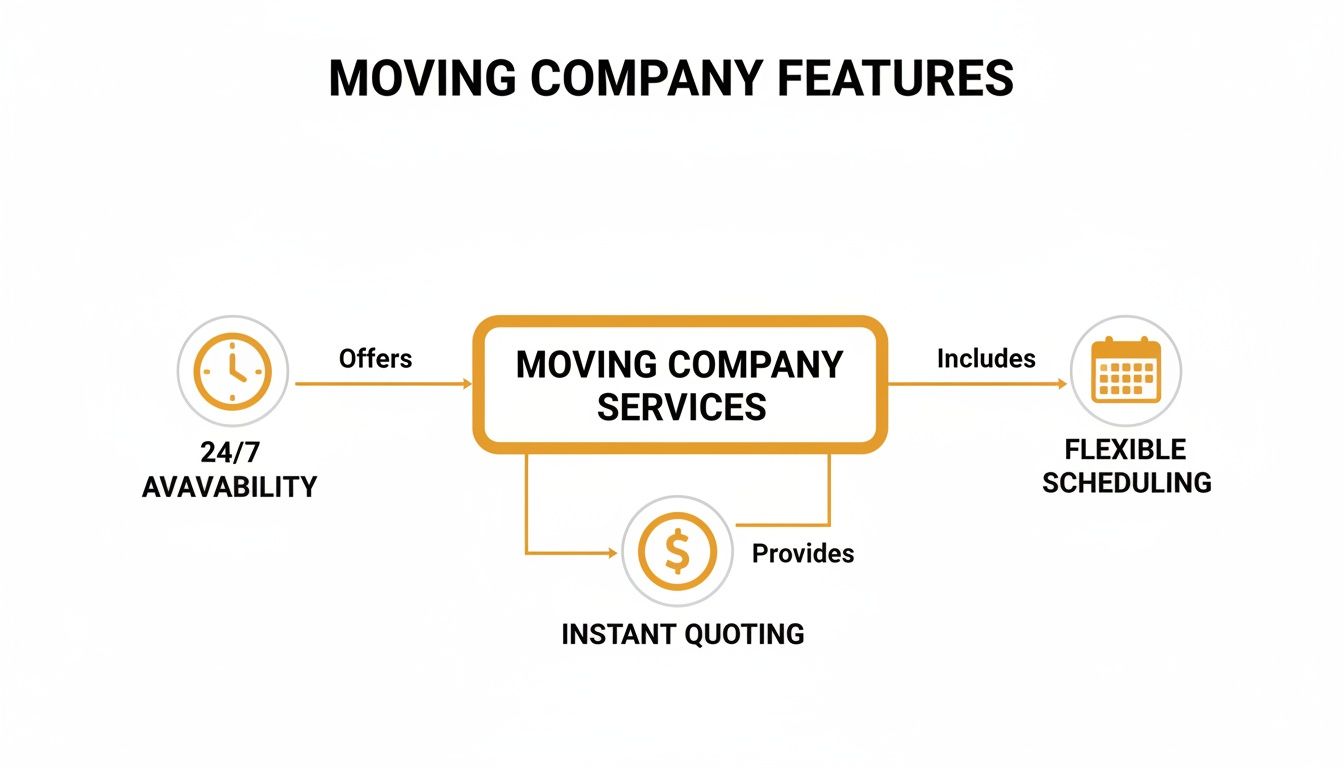
As you can see, it’s a simple formula. When you’re available 24/7 and can give a customer a quote instantly, you book jobs your competitors can’t. You’re capturing leads around the clock, even when you’re on a job or asleep.
Let’s break down how this plays out in the real world for a moving business owner.
Recovering Cash from Missed Calls
Every owner knows the feeling. You’re on a big job, hands full, and your phone buzzes in your pocket. You can’t possibly answer it.
Later, you check the voicemail. It was a hot lead—a three-bedroom move for next month. You call back an hour later, but it’s too late. They already booked with the company that picked up the phone.
That’s a $2,000 job, gone. Forever.
An automatic answering service makes that whole scenario disappear. It answers that call on the first ring, qualifies the customer, and texts them a quote or a booking link right then and there. Even if they don’t book on the spot, you’ve captured their info and made a professional first impression. Your chances of winning that job just went through the roof.
Winning Jobs with Speed
In the local moving game, speed wins. Period. When a customer is ready to book, they’re calling two or three companies, one after the other. The first one to give a confident, professional answer and a clear next step almost always gets the job.
Imagine it’s a Saturday afternoon. A potential customer calls you and your main competitor at the same time. Your competitor’s call goes to voicemail. Yours is answered instantly by an AI that confirms you have their date available and texts them a link to your quoting form.
By the time your competitor finally calls back on Monday morning, that customer is already in your calendar. Your crew is scheduled. That’s the raw power of an immediate, automated response.
Handling the Summer Rush Without Breaking a Sweat
What happens when peak season hits? Call volume doubles overnight and your small office team is completely overwhelmed. Hiring temps is expensive and a hassle. Letting calls go unanswered? That’s just turning away money.
An automatic answering service is built to scale. It can handle one call or one hundred calls at the same time without a single drop in quality. It guarantees every single person who calls during your busiest months gets a professional experience, booking jobs that would have otherwise been lost in the chaos.
This is exactly why the AI answering service market is expected to hit $9 billion by 2033. Owners are figuring out it’s a smarter, more reliable way to grow than just hiring more people, especially since customers are already comfortable talking to assistants. You can dig into the numbers yourself with these AI receptionist statistics and see where things are headed.
To really see the difference, let’s compare the old way of handling leads to the new way.
Manual vs. Automated Lead Management: A Comparison
| Task | Manual Process (The Old Way) | Automated Process (The New Way) | Business Impact |
|---|---|---|---|
| Initial Call | Rings until someone (maybe) answers. Often goes to voicemail. | Answered instantly, 24/7, by an AI assistant. | Zero missed calls. Every lead is captured, day or night. |
| Lead Qualification | Dispatcher asks basic questions, writes notes on a pad. | AI asks structured questions, qualifies the lead based on your rules. | Consistent, error-free lead qualification. Frees up your team. |
| Quoting | Dispatcher calculates a quote, calls or emails the customer back later. | AI provides an instant quote based on your rate card. | Speed wins. You get a quote to the customer before your competitor even calls them back. |
| Booking | Manual calendar entry, sending confirmation emails by hand. | AI books the job directly into your calendar and sends automated confirmations. | Drastically reduces admin work and eliminates double-booking errors. |
| Follow-Up | Relies on someone remembering to call back leads who didn’t book. | AI automatically follows up via text with leads who received a quote. | Recovers jobs you would have lost, increasing your booking rate. |
Looking at it side-by-side, the difference is stark. The manual way is full of holes where money leaks out. The automated way is a system designed to capture every dollar.
The return on investment couldn’t be clearer. For most movers, booking just one extra job a month—a job that would have otherwise gone to voicemail—more than pays for the service. Everything after that is pure profit. You’re turning what used to be a frustrating operational headache into a powerful engine for revenue.
Your Quick-Start Checklist
Bringing on a modern automatic answering service isn’t some massive IT project. It’s designed to be simple and fast, getting you from missing calls to booking jobs in under an hour, without any headaches or downtime.
The whole point is to make the transition painless. Here’s a no-nonsense checklist to get you up and running smoothly.
Step 1: Prep Your Business Info
Before you even sign up, pull together the key details the AI will need to act as your new dispatcher. A few minutes of prep here makes the actual setup ridiculously fast.
Think of it like briefing a new hire. You’ll want to have the answers ready for:
- Your Service Area: What cities, counties, or zip codes do you actually cover?
- Business Hours: When are you officially open? More importantly, when does the AI need to take over?
- Your Core Services: Is it just local moves? Do you do long-distance, packing, storage, or specialty items? Be specific.
- Pricing Basics: What are your hourly rates? Do you have a basic formula for quotes? The AI needs to know this.
- Frequently Asked Questions: What are the top 5 questions every customer asks? Things like, “Are you licensed and insured?” or “What size are your trucks?”
Having this info ready to go turns a long setup process into a quick copy-and-paste job.
Step 2: Get Your System Configured
Once you’ve picked a provider, the actual setup is surprisingly simple and doesn’t require any technical skills. You’re just telling the system how you want your calls handled.
- Forward Your Business Number: This is the easy part. You’ll set your existing business number to forward to the new service number whenever you’re busy or after hours. It’s usually a one-click setting with your phone provider.
- Integrate Your Calendar: This is the most important step. Connect your Google Calendar, CRM, or whatever scheduling tool you use. This is what lets the AI see your crew’s availability in real-time and book jobs without you worrying about double-booking.
- Customize Your Greeting: Write a simple, professional greeting for the AI to use. Something like, “Thanks for calling Mike’s Movers, how can I help you today?” This makes sure the first impression is solid and sounds like your company.
This whole process is built for business owners, not tech wizards. The best platforms make this as easy as filling out a simple form.
Step 3: Test and Go Live
Before you let it run wild, give it a quick test drive. Call your own business number after hours and see how the AI handles it.
Try to get a quote. Ask it a question. Attempt to book a job. Does it give the right answers? Does the appointment actually pop up on your calendar? This little quality check gives you peace of mind that the system is ready for real customers.
Once you’re happy with it, you’re done. You’re live. The system now works quietly in the background, making sure you never miss another lead. From here on out, you just watch your dashboard to see the calls it’s answering, the jobs it’s booking, and the revenue it’s bringing back into your business.
Choosing the Right Answering Service Partner
With so many options out there, picking the right automatic answering service can feel like a chore. But here’s the thing: a generic solution might answer your phone, but it won’t get the unique rhythm of a moving company. The real goal is to find a true partner—one that understands your operations and turns this tech into a money-making machine for you.
You need a service that acts like an extension of your team, not just another piece of software you have to babysit. It has to be built for the fast-paced, high-stakes world of booking moves, where one fumbled call can easily cost you a thousand-dollar job.
Key Questions to Ask Any Vendor
Before you sign on the dotted line, you have to vet these providers. Can they actually handle the specific demands of a moving business? Generic answers won’t cut it. You might also want to explore a review of the best VoIP providers to get a better sense of the overall tech landscape.
Use these questions as your guide:
- Is your AI actually trained on real moving industry conversations? A system has to know the difference between “packing services,” “long-carry fees,” and “storage-in-transit” to have a conversation that leads to a booking.
- How does your system handle complex quotes? Can it factor in variables like distance, home size, and specialty items? Or does it just punt and send a generic link?
- Can your dashboard give me real insights on call volume and booking trends? You need more than just a call log. You need data that shows you when customers are calling and what they’re asking for.
- What’s the calendar and CRM integration process really like? It should be a simple, no-code setup that works with the tools you already use, not a complicated IT project. Our guide on the best answering service for small business shows what a modern, easy integration should look like.
The answers you get will quickly separate the generic call-takers from the specialized solutions built to help movers grow.
Pitfalls to Avoid
Knowing what to look for is only half the battle. You also have to know what to run away from. A lot of services hide their flaws in the fine print, leaving you stuck with a system that doesn’t actually solve your problems.
Be on the lookout for these red flags:
Long-Term Contracts: A provider who’s confident in their service won’t try to lock you into a long, multi-year agreement. Look for flexible, month-to-month options. If it works, you’ll stay.
Hidden Fees: Watch out for sneaky per-minute charges, overage fees, or extra costs for “premium” features that should be standard, like calendar integration. Pricing should be simple and predictable.
Lack of Specialization: If a vendor’s website talks about serving everyone from dentists to law firms but has nothing specific for movers, they probably don’t have the deep industry knowledge you need.
At the end of the day, you’re not just buying software. You’re investing in a system to protect and grow your revenue. Choose a partner who gets that every single call matters.
Common Questions from Moving Company Owners
Bringing on any new tech always comes with questions. I get it. As a moving company owner, you need to be damn sure any tool you bring on board is going to book more jobs and make your life easier, not harder.
Here are the questions that come up most often when I’m talking to movers just like you.
Will an AI Sound Like a Robot to My Customers?
This is the big one. It’s the first thing everyone asks, and it’s a completely fair question. We’ve all been tortured by those clunky, robotic phone menus from the past.
The good news is, we’re worlds away from that now. Modern conversational AI is built to sound natural, professional, and honestly, pretty friendly. The goal is to give your customers a smooth, positive experience that makes them feel confident in your company from the jump. It sounds less like a machine and more like a really well-trained receptionist who never has a bad day.
Can I Still Jump In and Answer Calls Myself?
Absolutely. You’re still in the driver’s seat. The best platforms are built for flexibility, not to take over your business.
You can easily set it up so calls ring to your phone or office first, just like they do now. If you don’t pick up after a few rings, the AI receptionist just seamlessly steps in as your backup. It’s the best of both worlds: you stay connected when you want to, but you have peace of mind knowing you’ll never, ever miss a call again.
How Long Does This Take to Set Up?
This isn’t some massive IT project that’s going to take weeks. Most modern services are designed for guys who run moving companies, not tech companies.
For most movers, you can get the whole thing done—forwarding your number, customizing your greeting—in under an hour. It’s built to get you live and catching leads without derailing your day.
Is This Actually Affordable for a Small Moving Company?
Yes, because it’s not just another expense on your P&L—it’s a tool that generates revenue. The right way to think about the cost is through the ROI.
For the average moving company, booking just one or two extra jobs a month—jobs that would’ve otherwise been lost to voicemail—more than covers the entire monthly cost. Every job it books after that is pure profit hitting your bottom line.
Ready to stop sending revenue to voicemail and see what an AI receptionist can actually do for your business? MoveJoy is a 24/7 automatic answering service built from the ground up just for movers. Learn how MoveJoy can help you book more jobs.