What Is Sales Pipeline Management for Moving Companies? A Guide for Owners
Every time your phone rings and goes to voicemail, or a hot lead suddenly goes cold, it’s not just a missed chance. It's a booked job walking out the door. Sales pipeline management is the system you build to stop that from happening.
For a moving company owner, this isn't corporate jargon. It's a visual roadmap for your entire sales process. It shows you the exact journey every potential customer takes, from the moment they first call for a quote to the day you mark their job as complete and paid. It's how you turn chaos into a predictable flow of revenue.
Your Moving Company's Roadmap From Lead to Revenue
For a busy owner-operator or a growing 5-truck operation, a real pipeline is the difference between guessing and knowing. It replaces a mess of sticky notes and a chaotic inbox with a clear, step-by-step process showing exactly where every lead stands.
Instead of trying to remember who needs a follow-up call, you can see in a glance who's waiting on a quote and who's ready to book. It’s a practical system designed to make sure every single lead gets the attention it needs to become a paying customer. A well-managed pipeline is your best defense against the madness of peak season and the pressure from the moving company down the street.
This system provides a structured way to turn that first phone call into a booked job, getting the most value out of every inquiry you pay for. For a deeper dive into this process, our guide on the journey from prospect to customer breaks it all down.
Why a Pipeline Matters Now More Than Ever
Today's customers shop fast. When they need a mover, they contact multiple companies at once. The first one to provide a professional, timely response often wins the job. A structured pipeline gives you the speed and organization needed to be that first mover.
Waiting just a few hours to respond can mean the difference between booking a profitable job and hearing, "Sorry, we already went with someone else." In a competitive local market, speed isn't just a nice-to-have; it's a weapon. A sales pipeline ensures you're always ready to strike while the iron is hot.
Key Takeaway: A sales pipeline turns a random stream of calls and web forms into a predictable flow of revenue. It’s the difference between reacting to your phone ringing and proactively managing your company's growth.
Handling leads without a real system is a recipe for lost Post-it notes, forgotten callbacks, and customers who book with your competitor because you took too long. A pipeline forces you to see the big picture, preventing leads from falling through the cracks.
Below is a quick comparison of what life looks like with and without a structured pipeline.
The Old Way vs. The Pipeline Way
| Challenge | The Old Way (No Pipeline) | The Pipeline Way (Structured) |
|---|---|---|
| Lead Tracking | Leads are scattered across sticky notes, emails, and memory. | Every lead has a designated place and status. |
| Follow-Up | Relies on remembering to call back; often inconsistent. | Automated reminders ensure no lead is forgotten. |
| Visibility | No clear idea of how many potential jobs are in play. | A visual dashboard shows the health of your business at a glance. |
| Forecasting | Guesswork. Revenue is a surprise each month. | Predictable revenue based on conversion rates and deal stages. |
| Team Hand-offs | A mess. Information gets lost between the office and the crew. | Smooth transitions with all customer details in one place. |
| Customer Experience | Inconsistent and often frustrating for the customer. | Professional and organized, building trust from the first call. |
The difference is night and day. One approach is reactive and stressful; the other is proactive and built for growth.
A Clearer Path to Booking More Jobs
Without a system, it's too easy for good leads to get lost. A customer calls for a quote during a chaotic morning, you promise to call them back, and then another job pulls you away. By the time you remember, they've already booked with someone else. A sales pipeline visualizes this entire process, making it almost impossible to forget a follow-up.
It gives you a clear path from that first phone call all the way to a signed contract and a happy, paying customer. For those looking to really button up how they present information and guide buyers, centralizing communications is a game-changer. This A Guide to Digital Sales Room Software offers some great insights into how to organize content and simplify the journey for your customers.
The 5 Essential Stages of a Mover's Sales Pipeline
A sales pipeline isn't some generic business school template. For a moving company, it has to mirror your real-world operations—turning a random stream of calls and web forms into a predictable flow of booked jobs. Getting these stages defined is the first real step toward getting control over your revenue.
Think of it as the engine for your company's growth. It’s the path every lead takes from the first phone call to the final invoice.
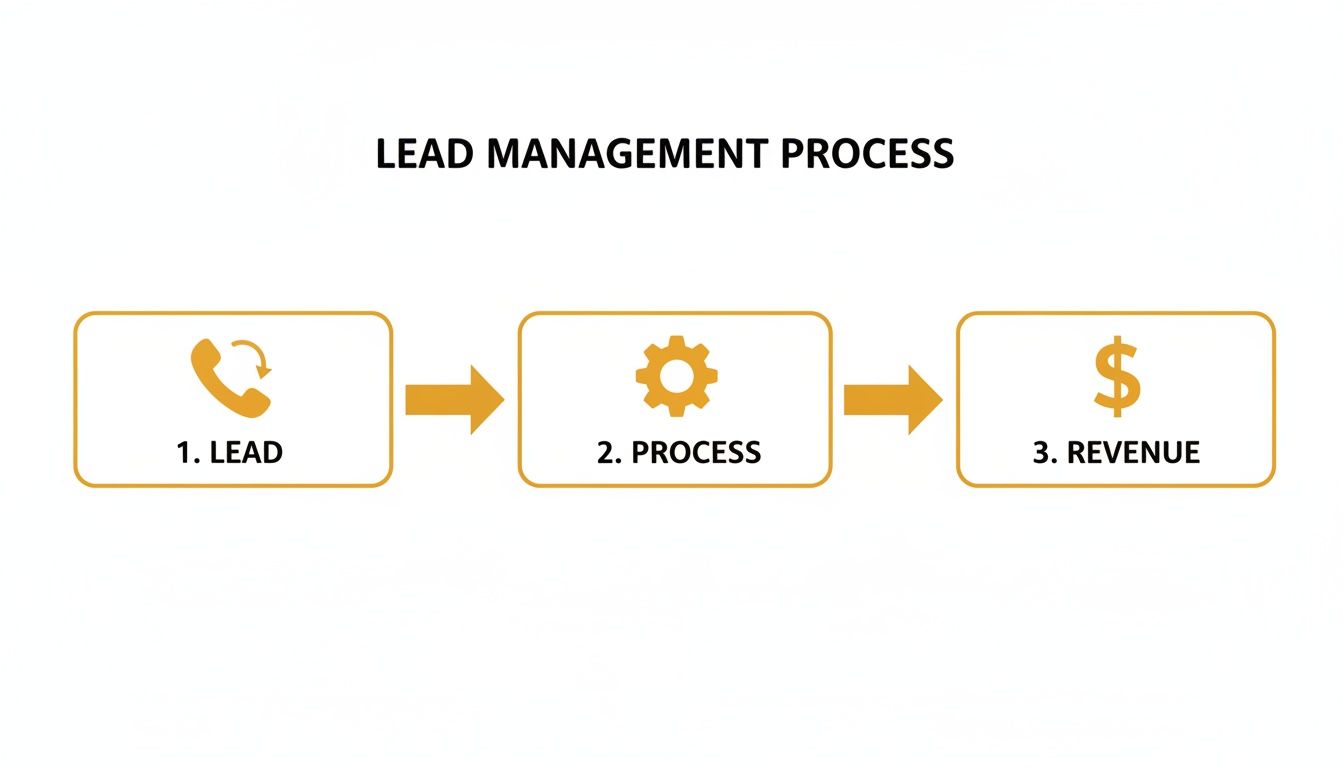
This graphic nails a simple truth for movers: every single lead has to be processed efficiently to make you money. Any breakdown in that process isn't just an inconvenience; it's lost income.
Here are the five essential stages every moving company owner needs to be tracking.
1. Lead Capture
This is ground zero—the moment a potential customer first reaches out. They might call the office, submit a quote request on your site, or shoot you an email. The goal here is simple and brutal: capture their information accurately and immediately.
Missed calls are the biggest profit killer at this stage. You’re on a job, it's after hours, your dispatcher is on another line—it doesn't matter. An unanswered call is a lost opportunity. This is where an AI receptionist or a 24/7 answering service becomes a non-negotiable. It ensures every lead is captured, even when you can't get to the phone.
2. Quoting
Okay, you've got their info. Now you slide them into the quoting stage. This is where you dig in and get the details needed to build an actual estimate: inventory lists, addresses, flights of stairs, that weirdly heavy antique wardrobe.
Speed and accuracy are everything here. The faster you get a professional quote in their hands, the higher your odds of winning the job. This is the exact spot where a lot of movers get beat by a faster competitor.
3. Follow-Up
This is the stage where the money is made or lost. You sent the quote. Now what? The customer is almost certainly getting other estimates. A smart, well-timed follow-up—often just a simple text message—can be the one thing that pushes them over the line.
Most jobs are won right here. You can try to remember to follow up with every single lead yourself, or you can automate it. An automated system sends those perfectly timed messages for you, keeping your name top-of-mind without you having to think about it. For a deeper dive on this, check out our guide on creating a sales process flowchart for movers.
4. Booking Confirmed
Success! The customer accepted your quote and they're ready to book. Now it's time to lock in the date, collect a deposit, and get the job firmly on your dispatch calendar.
This is all about organization. A sloppy booking process is a recipe for disaster. Think double-bookings, forgotten jobs, and a damaged reputation that costs you way more than just one move.
5. Job Completed
This is the final stage. The move is done, the customer's happy, and you've collected the final payment. But it’s not really over. This is your golden opportunity to ask for a review or a referral to fuel the next wave of business.
Just defining these stages puts you miles ahead of the competition. Without a defined process, you're leaving money on the table. With one, you build a repeatable system for booking more jobs.
Key Metrics to Track for a Healthy Pipeline
You can't improve what you don't measure. A healthy sales pipeline gives you the vital signs of your company, showing you exactly where you're strong and where you're leaving money on the table.
Focusing on a few key numbers transforms your pipeline from a simple list of leads into a powerful tool for growth.
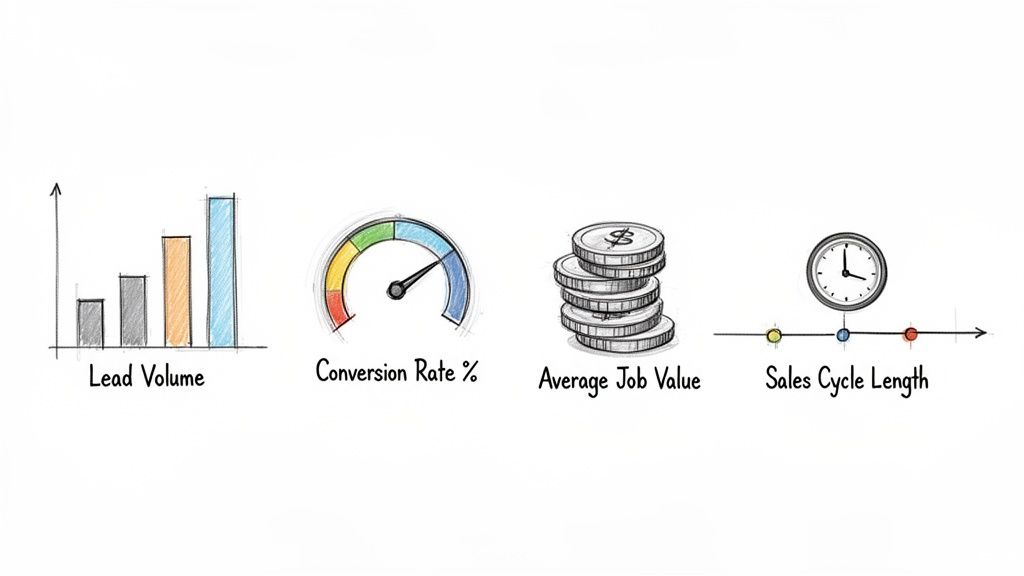
Forget complicated spreadsheets and confusing jargon. Here are the numbers every moving company owner should be watching. They're the difference between guessing and knowing.
Lead Volume
This one's simple: how many new inquiries are you getting each week or month? This is the raw fuel for your business. It's the first number to check to see if your marketing is actually working. A sudden dip in lead volume is an early warning that something’s wrong with your ads, your website, or your reputation.
Tracking this helps you see the obvious impact of seasonality, but also the success of that new Google Ads campaign or the fallout from a bad review. It also sets the stage for figuring out what it really costs you to land a new customer. We break that down in our guide on calculating cost per lead for your moving company.
Conversion Rate
Your conversion rate—or booking rate—is arguably the most important number for your bottom line. It answers a critical question: What percentage of the quotes you send out actually turn into booked jobs? This number tells you the real story about your sales process.
Simple Formula: (Number of Booked Jobs ÷ Number of Quotes Sent) x 100 = Conversion Rate
Let's say you send out 50 quotes in a month and book 15 jobs. Your conversion rate is a solid 30%. But what if you have a ton of leads coming in and that number is closer to 10%? That’s a red flag. It could mean your prices are too high, your follow-up is too slow, or your quotes just don't look professional enough.
Average Job Value
This metric tells you what each booked job is worth on average. It’s how you figure out which types of moves are your bread and butter. Is it the quick local studio apartments or the more complex long-distance 4-bedroom homes?
Knowing your average job value lets you forecast revenue with surprising accuracy. If your average move brings in $1,200 and you consistently book 20 jobs a month, you can reliably plan for $24,000 in revenue. No more guesswork.
Sales Cycle Length
How long does it take for a new lead to become a paying customer? That’s your sales cycle length. In the moving industry, speed is everything. A customer looking for a mover isn't browsing; they're ready to buy now. A shorter sales cycle almost always means a higher booking rate.
- Long Cycle: If it takes you a week to go from initial call to a booked job, you're giving competitors a massive window to swoop in and steal that customer.
- Short Cycle: If you can get them from inquiry to quote to booking in under 24 hours, you're going to win way more business.
This is where things like automated quote follow-ups and 24/7 call answering make a huge difference. They shorten that cycle dramatically by engaging customers the moment their intent to buy is highest.
Common Pipeline Mistakes That Cost Movers Money
Most moving companies leave thousands on the table, not because they aren't getting leads, but because of a few common, fixable pipeline mistakes. A healthy pipeline isn’t just about filling it with new inquiries; it’s about making sure the good ones don't leak out.
Pinpointing these pitfalls is the first step to boosting your booking rate and, ultimately, your bank account.
The single most damaging mistake? Slow or inconsistent follow-up. When a customer fills out your quote form, they're in "buy mode." That means they’re also contacting three of your competitors at the same time. Waiting just a few hours to get back to them is often the difference between winning the job and hearing, "Oh, we already booked with someone else." Speed is your biggest weapon.
Another costly error is a lack of a system for tracking leads. If your "system" is a mix of sticky notes, your own memory, or a chaotic email inbox, you're setting yourself up for failure. Details get lost, callbacks are forgotten, and a hot lead goes cold simply because they fell through the cracks. It makes you look disorganized and costs you booked jobs.
Wasting Time on Unqualified Leads
Just as bad as losing good leads is chasing bad ones. Trying to win over every single person who calls, no matter how bad a fit, is a massive waste of time that your team could be spending on high-value moves. Some people are just kicking tires and shopping for the lowest price. Others are outside your service area or need a specialty service you don’t even offer.
When you don't filter these out early, they clog up your pipeline and steal focus from the customers who are actually ready to book. Your goal isn't just to have a full pipeline; it's to have a pipeline full of customers you actually want.
The Fix in Action: Picture this: a new lead comes in while your entire crew is sweating it out on a job. Instead of that call going to voicemail, an automated system instantly texts them back: "Got your request! We're working on your quote and will have it to you shortly." That one simple action solves the speed problem and keeps you in the game, even when you’re busy hauling furniture.
Key Mistakes to Avoid
- Delayed Responses: Not getting back to new leads within minutes. Every minute you wait, a competitor is talking to your customer.
- No Follow-Up System: Just sending a quote and praying they call back. Without a consistent follow-up plan, you’re gambling with your revenue.
- Poor Lead Tracking: Using notepads, memory, or a messy spreadsheet. It’s a guarantee that good leads will get lost in the shuffle.
- Chasing Every Lead: Burning hours on prospects who were never going to book with you in the first place, while serious customers go ignored.
How Automation Can Unclog Your Sales Pipeline
For a small moving company, managing a sales pipeline by hand is a heavy lift. You’re drowning in repetitive tasks—typing in lead info, sending quotes, and chasing down follow-ups. All that admin work clogs up your day and pulls you away from actually running the business.
This is where technology gives you a serious edge.
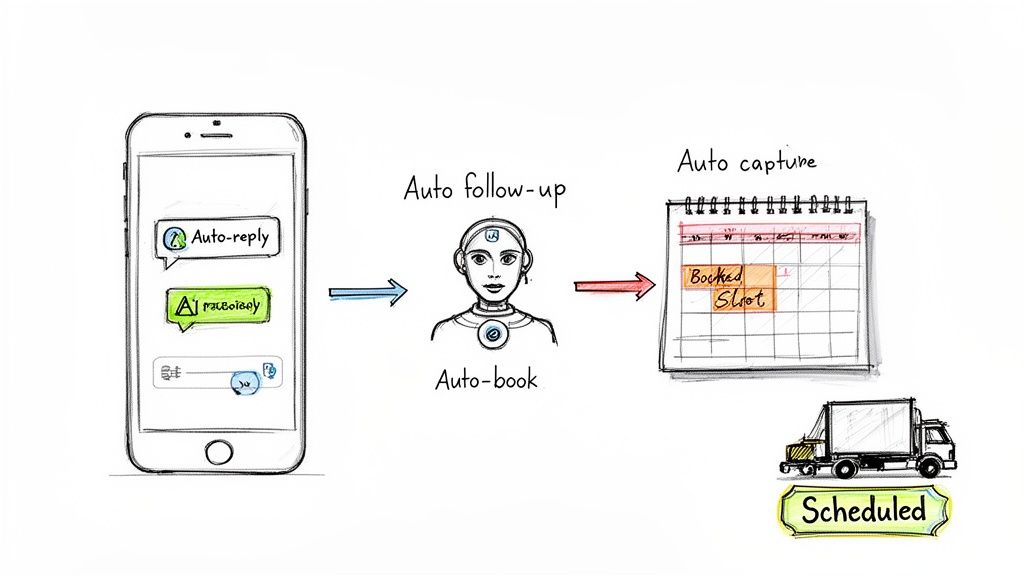
Automation handles the administrative gridlock, letting your pipeline flow smoothly and predictably. It’s not about replacing your team; it’s about freeing them from busywork so they can focus on talking to high-value customers and making sure moves go off without a hitch.
Answering Every Call and Capturing Every Lead
The first stage of any pipeline is getting the lead, and the biggest leak for movers is the missed call. When you’re on a job or it's after hours, every unanswered ring is a potential customer dialing your competitor. Simple as that.
Imagine a system that answers every single call 24/7, like an AI receptionist that never sleeps. This isn't just taking a message. It captures critical job details like addresses, inventory, and move dates, instantly creating a new lead in your pipeline without anyone lifting a finger.
Key Impact: By ensuring 100% call answer rates, automation stops leads from slipping through the cracks at the very top of your pipeline. One booked job from a call you would have otherwise missed often pays for the system itself for months.
This immediately solves the speed problem. Customers who need a mover want answers now. An instant response makes a hell of a first impression and keeps you in the running for their business.
Nurturing Leads with Automated Follow-Ups
Once you send a quote, the real work begins. The follow-up is where most jobs are won or lost. Let’s be honest, manually tracking who to call and when is nearly impossible during the busy season. Things fall through the cracks.
Automation takes this whole burden off your plate. You can set up automated follow-up sequences that nurture leads without any manual effort. These systems send perfectly timed texts or emails to:
- Confirm the quote was received.
- Check in a day later to see if they have questions.
- Send a final reminder before the quote expires.
This consistent, professional communication keeps your company top-of-mind and dramatically increases the odds of turning that quote into a booked job. It makes sure every single lead gets the attention it deserves, even when you're stretched thin.
Streamlining Bookings with Calendar Integration
The final step—getting the job on the calendar—can turn into a frustrating game of phone tag. Automation kills this with direct call-to-calendar integration.
Once a customer is ready to book, an automated system can check your crew’s live availability and let the customer schedule their move right then and there. This removes all the back-and-forth and lets you literally book jobs while you sleep.
If you're looking to explore platforms that can help you get this set up, check out a guide to the best sales automation tools.
Got Questions About Your Sales Pipeline? Good.
Even with a clear plan, a few practical questions always pop up. It's one thing to talk about pipeline management in theory; it's another to actually do it day-to-day. I hear the same smart questions from moving company owners all the time, so let's get right into them.
What’s the Difference Between a Sales Pipeline and a CRM?
This is the big one, and it trips up a lot of people. The difference is simple but super important. Think of it like your moving truck versus your GPS.
- Your Sales Pipeline is the route you take to get paid. It’s the step-by-step journey a lead follows, from the first phone call all the way to a "Job Completed" status. It's your company's specific roadmap to making money.
- Your CRM (Customer Relationship Management) is the GPS that tracks everything along that route. It's the software that holds all the customer info, notes, quotes, and tells you exactly where each job is on the map.
One is the process, the other is the tool. Your pipeline is the what; your CRM is the where. You can't manage a route without a map, and a map is useless if you don't know where you're going. They have to work together. A pipeline without a CRM is just a good idea, and a CRM without a defined pipeline is basically just a very expensive address book.
I Have No System at All. Where Do I Even Start?
First off, don't sweat it. If you're currently running your entire operation off sticky notes, a legal pad, and the back of your hand, you're not alone. The goal here isn't to build some perfect, complicated system overnight. The goal is just to start.
Here’s a dead-simple, two-step plan you can put into action right now:
- Draw It Out: Grab a whiteboard or even just a piece of paper. Write down the five basic stages we talked about: Lead Capture, Quoting, Follow-Up, Booking Confirmed, and Job Completed.
- Use a Simple Tool: You don't need to spend thousands on software to get going. A basic spreadsheet like Google Sheets or a free project management board like Trello is more than enough. Create a column for each stage and just start dragging your leads from left to right as they move forward.
Key Takeaway: The best first step is always a small one. The moment you can actually see where every lead is in your process, you'll stop jobs from falling through the cracks. Don't let perfect be the enemy of good. Just get started.
Can an AI Tool Really Manage My Moving Leads?
The short answer: Yes, but not just any AI. The generic chatbots you see on websites are useless for movers. They can't tell the difference between a studio apartment with a few boxes and a four-bedroom house with a grand piano. They don't get our business.
But AI tools built specifically for the moving industry are a totally different game. These systems are trained on thousands of real calls with real moving customers. They already know the right questions to ask to get an inventory, estimate cubic feet, and give a customer a solid quote right over the phone or text.
An AI receptionist doesn't replace you or your best dispatcher. Think of it as the perfect front-office assistant. It's the one that answers 100% of your calls, 24/7, never messes up a detail, and makes sure you never lose another lead to voicemail again. It handles the boring, repetitive work of capturing leads and giving initial quotes, which frees you up to focus on closing the big, profitable jobs and actually running your crews. This isn't some futuristic fantasy anymore—it's a real tool that gives smaller moving companies a serious edge.
Ready to stop missing calls and start booking more jobs automatically? MoveJoy is the AI-powered assistant built by movers, for movers. It answers 100% of your calls, provides instant quotes, and puts bookings directly on your calendar, so you can focus on running your business. See how it works at https://getmovejoy.com.