A no-show isn't just a scheduling hiccup; it’s a direct hit to your bottom line. For a moving company with 1–20 trucks, a single missed job can throw off the entire day's schedule and torpedo your revenue plan.
The good news is, you can stop no-shows by being proactive. It’s not about one single trick; it’s a combination of smart communication, solid booking policies, and making sure the customer is committed from the moment they book.
The True Cost of No-Show Appointments for Your Moving Business
Picture this: It’s 8 AM on a Saturday during peak season. Your best crew is fueled up, and the truck is ready for a three-bedroom pack-and-move. But the customer isn't answering their phone.
That silence is the sound of money evaporating.
When a customer ghosts you, the costs stack up faster than moving boxes. You’re not just losing the income from that one job. You’re actively burning cash on resources you’ve already committed.
The Immediate Financial Drain
The most obvious losses are the hard costs for a job that never happens:
- Wasted Crew Wages: You're paying your crew for their time, whether they're lifting furniture or waiting by the phone. A two or three-person crew sitting idle for an hour or two can cost you hundreds in wages before you even call it a loss.
- Fuel and Vehicle Expenses: The truck was prepped, fueled, and maybe even driven part-way. Those are sunk costs you can't get back.
- Lost Opportunity Cost: This is the killer. That Saturday morning slot is prime real estate on your calendar, especially during the busy season. Another customer would have gladly taken it, but now that revenue is gone forever.
A single no-show isn't a minor inconvenience; it's a hole in your weekly revenue. Two or three a month can be the difference between a profitable quarter and falling behind.
The Ripple Effect on Operations
The financial damage is just the beginning. No-shows throw a wrench in your entire operation, creating a domino effect that hits morale and efficiency.
You’re left with a demotivated crew, a scrambled dispatch schedule, and the administrative headache of trying to fill that empty slot last-minute. It all adds up to a chaotic day.
Fortunately, this is a solvable problem.
In the moving industry, companies that adopt modern tools like automated reminders and online scheduling have seen a huge impact. Some have achieved up to a 90% reduction in no-show rates. You can find out more about how movers are boosting profitability with these tools.
By understanding the true cost, you can justify putting the right strategies in place to protect your schedule and your bottom line.
Building a Bulletproof Booking and Confirmation Process
The best defense against a no-show is a strong offense, and that starts the second a customer books with you. A single confirmation call the day before isn't going to cut it anymore.
Customers today expect consistent, helpful communication. A scattered approach leaves the door wide open for them to forget, get poached by a competitor, or just change their mind.
To really lock in a job, you need a multi-step communication process that keeps your moving company top-of-mind. This isn't about spamming them; it's about providing value at each step and reinforcing their commitment to you. Your goal is to build a sequence of touchpoints using a mix of channels—email and SMS—to ensure your message gets through and shows you're a professional outfit.
Crafting a Multi-Channel Confirmation Sequence
A well-timed series of reminders transforms a tentative booking into a locked-in job. Each message has a specific purpose, guiding the customer from initial booking excitement to total move-day readiness. Think of it as a checklist for their peace of mind—and yours.
This isn't complicated. Here’s a simple timeline you can put into action today.
- Immediately After Booking (SMS & Email): The instant they book, hit them with an automated text and email. The text should be a quick "Thanks for booking with [Your Company]! Your move on [Date] is confirmed." The email can provide more detail: confirmation number, date, time, and a link to your moving prep guide. This is a key part of lead management.
- 72 Hours Before the Move (Email): This is your logistical check-in. Send a detailed email that goes beyond just confirming the date and time. Remind them of what to expect, share some last-minute packing tips, and ask them to confirm critical details like the final address or any tricky parking situations.
- 24 Hours Before the Move (SMS or Personal Call): This is the final "see you tomorrow" confirmation. An automated SMS is efficient and works great. But for bigger, high-value jobs? A quick personal phone call adds a powerful human touch. It’s your last chance to iron out any questions and prove you're on top of your game.
I put together a sample schedule to show how this looks in practice. It's a simple way to keep customers engaged and drastically reduce the chances of them bailing on you.
Optimal Customer Confirmation Timeline
| Timing | Channel | Purpose of Communication |
|---|---|---|
| Immediately After Booking | SMS & Email | Instant reassurance. Confirms key details (date, time) and sets expectations. |
| 72 Hours Before Move | Logistical check-in. Share packing tips and ask for confirmation on address/parking. | |
| 24 Hours Before Move | SMS or Phone Call | Final confirmation. A quick, friendly "see you tomorrow" to lock it in. |
Following a timeline like this isn't just about preventing no-shows; it’s about creating a better customer experience from start to finish. It shows you’re organized, reliable, and run a professional moving business.
This flowchart breaks down the real costs you're fighting every time a customer flakes.
Each of those boxes—lost crew wages, wasted fuel, missed opportunities—is a direct hit to your bottom line. It’s why a solid confirmation process is non-negotiable.
Scripts That Solidify Commitment
The words you use matter. Your goal is to be friendly yet firm, making the customer feel cared for while subtly reinforcing their obligation.
Pro Tip: Stop asking "Are we still on for tomorrow?" That’s a weak question that’s easy to ignore. Instead, frame your messages to require a specific answer. This forces them to engage and makes the booking feel more concrete in their mind.
Here’s a simple, effective script you can use for that final 24-hour check-in.
Example 24-Hour Confirmation Script (SMS):
"Hi [Customer Name], this is [Your Name] from [Company Name]. Just confirming we're all set for your move tomorrow at 8 AM to [Address]. Our crew is looking forward to it! Can you quickly reply 'CONFIRMED' to lock it in?"
This simple, action-oriented message requires a response, which psychologically boosts their commitment.
Using Deposits and Clear Policies to Secure Commitment
Let's be honest: a booking on your calendar without a financial commitment is just a placeholder. It's a fragile promise that can evaporate with a single unanswered phone call, leaving your crew idle and a prime slot on your schedule empty.
This is where a clear deposit and cancellation policy becomes your best friend. It’s not about penalizing customers. It’s about sending a clear signal that your company’s time, your crew’s schedule, and your resources are valuable.
Serious customers get this. In fact, they expect it. A professional policy actually builds trust and weeds out the tire-kickers who aren't fully committed, protecting your revenue in the process.
Structuring a Fair Deposit Policy
Your deposit policy doesn't need to be a complex legal document. The goal is simple: create just enough "skin in the game" to make sure the customer shows up, without scaring off legitimate clients.
For a typical 1-20 truck operation, here are a couple of practical approaches that work:
- Flat Fee for Local Moves: A simple $50 to $150 deposit is usually perfect for standard local jobs. It’s a reasonable amount that confirms the customer is serious and intends to follow through.
- Percentage for Bigger Jobs: For those multi-day, long-distance, or complex pack-and-move projects, a deposit of 10% of the estimated total is a common industry standard. This protects you against a much larger potential loss if they flake.
The real key here is consistency. Apply the same policy fairly to every new booking. It quickly becomes a standard, professional part of how you do business.
Communicating Your Policies the Right Way
How you talk about your policies is just as important as the policies themselves. You want to frame them as a professional standard, not a punishment. Transparency is everything.
A clear, upfront policy prevents misunderstandings down the road. It shows you run an organized, professional business, and customers who value reliability will see this as a huge positive.
Make your deposit and cancellation terms impossible to miss. They need to be clearly stated in a few key places: on your quote, in your booking confirmation email, and on your website. Be sure to clearly outline the terms for a refund, like for cancellations made more than 48 or 72 hours in advance. This shows you're being fair and reasonable, which builds even more trust.
When a customer pays a deposit, they become mentally and financially invested in the move. That simple step transforms a "maybe" into a definite.
Use Automation to Get Ahead of No-Shows
Let's be real. Manually sending reminders for every single job is a recipe for disaster, especially when you're slammed during peak season. Your team is juggling quotes, dispatching crews, and putting out fires. Who has the time to chase down every customer just to make sure they're still on for Friday? This is exactly where things fall through the cracks.
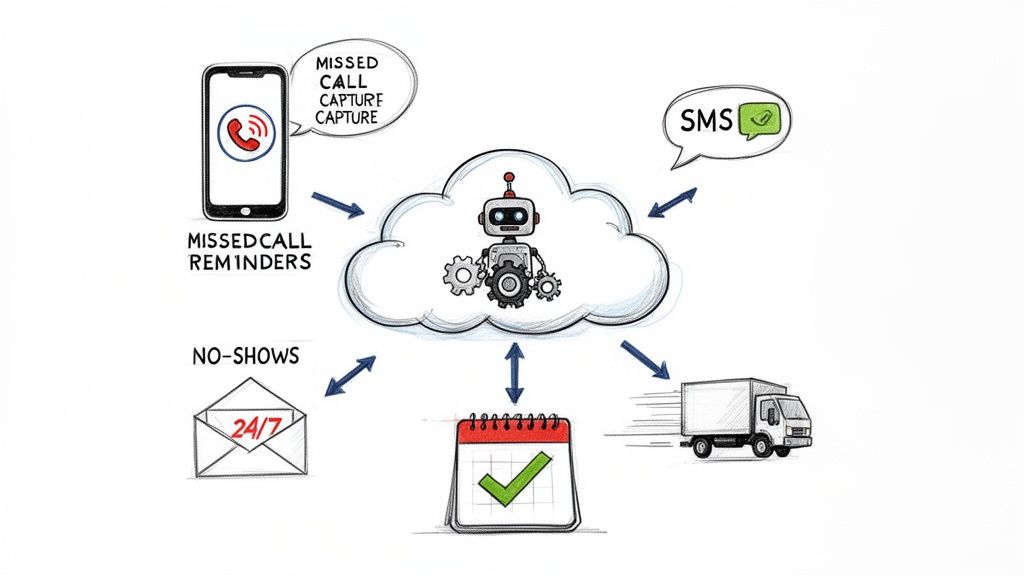
Technology is your best friend here. It’s all about consistency. Automation makes sure that the bulletproof confirmation process you designed actually happens—every single time, without fail. Think of it as your 24/7 operations assistant, making sure no customer ever feels forgotten.
Go from Reactive Follow-Ups to Proactive Confirmations
Imagine this: a job gets booked—doesn't matter if it's from a call at 2 PM or an online form filled out at 2 AM—and a perfectly timed sequence of confirmations and reminders kicks off instantly. This isn't some futuristic dream; it's exactly what modern tools are built to do.
An AI receptionist, for instance, does a lot more than just answer calls you miss. It can capture job details and feed them right into your system, triggering your entire communication workflow without anyone on your team lifting a finger.
- Instant Booking Confirmation: The second a customer commits, an SMS and email go out. Done.
- Scheduled Reminders: A 72-hour pre-move email with helpful tips and a final 24-hour confirmation text are queued up automatically.
- Call → Calendar Integration: The job lands directly on your dispatch calendar, wiping out the chance of manual entry errors.
This kind of automated safety net flips your whole booking process on its head. You go from being reactive and vulnerable to human error to being flawlessly proactive.
By automating your reminder workflow, you're not just saving time. You're building a reliable system that protects your most valuable asset: your schedule. Preventing just one no-show can easily pay for a whole month of the technology.
The Power of an Always-On System
As a moving company owner, you can't be everywhere at once. You're out on a job site, driving a truck, or handling a problem with a crew. While you're busy, calls are hitting voicemail and crucial follow-ups are getting pushed back. This is where automation gives you a massive leg up on the competition.
Making your communication timely and error-free is non-negotiable, and understanding the wider advantages can sharpen your approach. This guide on 9 Key Workflow Automation Benefits digs deeper into that.
A dedicated system ensures every single lead is handled with the speed and professionalism that builds trust from the very first call. When you integrate the right technology, you connect your calls, calendar, and customer communications into one smooth operation. This isn't just about cutting down no-shows; it's about booking more jobs by making sure every customer gets the attention they need, exactly when they need it.
Keep the Fire Lit: Shorten Your Lead Times
This might sound backward, but one of the best ways to kill no-shows has nothing to do with reminder texts or cancellation fees. It's all about one thing: shrinking the gap between the day a customer books and the day your truck shows up.
Think about it. A two-week lead time is a two-week window for your customer to get cold feet. It’s 14 days for them to see a competitor's ad pop up, get a slightly cheaper quote, or just have life get in the way.
That job you celebrated becomes a lukewarm lead, and your odds of a last-minute cancellation—or a complete no-show—go through the roof. Keeping that booking window as tight as possible is a massive competitive advantage. You’re capturing their immediate need and turning it into a confirmed job before they have a chance to cool off.
The Psychology of "I Need This Done Now"
When a customer calls your moving company, they have a problem right now. They're actively trying to solve an urgent headache. The faster you can provide that solution, the more likely you are to lock in the job for good.
A customer who books a move for this Saturday is a world away from one who books for three weeks from now. Shorter lead times build momentum. They just don't leave room for second-guessing.
This requires a more aggressive approach to managing your schedule. Instead of just slotting jobs in order, you need to be actively hunting for ways to fill your calendar and offer those sooner move dates.
This is where a smart scheduling system becomes your secret weapon. An AI-powered assistant, for example, can instantly scan your live calendar for the very next opening. Your team—or the system itself—can then offer that prime slot on the spot, capitalizing on the customer's sense of urgency.
Turn Empty Calendar Slots into Cash
Shortening lead times isn't just a defensive move against no-shows. It's an offensive strategy to maximize your revenue per truck. Every empty slot on your calendar is money left on the table.
Here’s how to put this into practice today:
- Offer the Soonest Date First: When a new lead calls, don't ask, "When would you like to move?" Instead, say, "Great, we have an opening this Friday at 9 AM. Does that work for you?" Lead with the solution.
- Start a Waitlist: Keep a running list of customers with flexible schedules. The second you get a cancellation, you have a hot lead ready to fill that spot immediately.
- Embrace Smart Scheduling: Use tools that give you a crystal-clear, real-time view of your crew and truck availability. No more guesswork.
This isn't just a moving industry trick; it’s a proven tactic across all service businesses. Research shows that just reducing the wait time is one of the most effective ways to keep appointments locked in. In fact, a 2025 study found that 73% of businesses that successfully slashed their no-show rates pointed to shorter booking windows as a key reason for their success. You can dig into some of the data behind these scheduling strategies here.
By focusing on shrinking that lead time, you keep your schedule packed, your crews hustling, and your customers fully committed.
Tying It All Together: Your No-Show Proof Game Plan
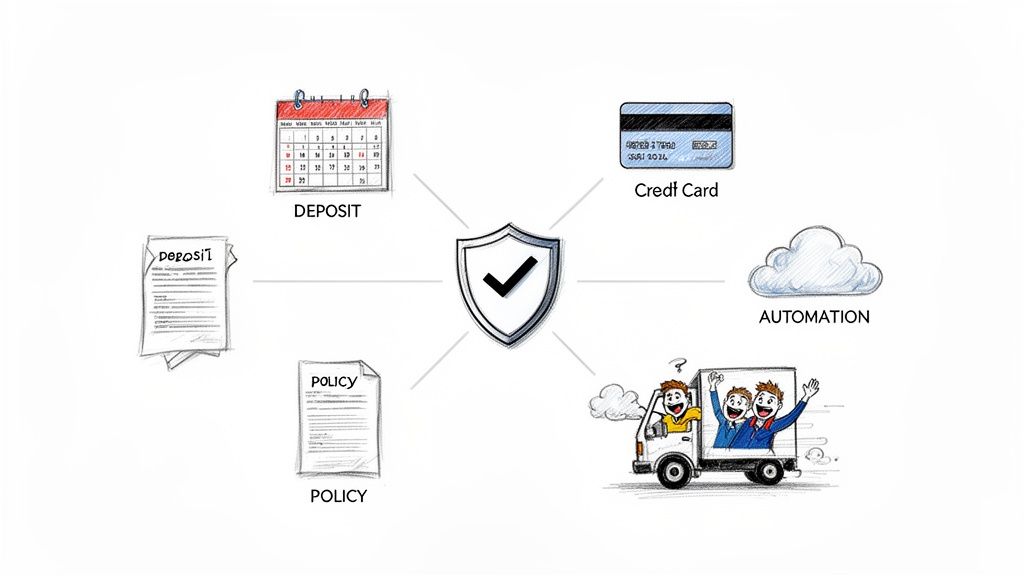
Alright, let's bring this all home. The goal here is to turn those frustrating, costly no-shows from a regular headache into a rare blip on the radar. You do that by layering a solid confirmation process, clear-cut financial policies, smart automation, and strategic scheduling.
These are practical, field-tested steps that protect your revenue, stop wasting your crew's time, and build a more reliable, profitable moving business. Think of each piece as a gear in a machine—when they all work together, your operation runs smoothly and your trucks stay on the road.
Here's the bottom line: You are in control of your schedule. You don't have to be at the mercy of flaky customers. Putting even one or two of these strategies into play will have an immediate, noticeable impact.
And the best part? You don’t have to drown in manual work to make it happen. The logical next step is to let automation do the heavy lifting for you.
Tools that plug directly into your calendar are the bedrock of a predictable operation. To see what that looks like in practice, you can dig into what the right crew schedule software can do for your business. By automating the reminders and locking in confirmations, you ensure every single job is solid. This frees up your team to focus on what they do best—delivering great service—instead of chasing down customers. It’s how you turn a chaotic calendar into a predictable stream of revenue.
Got Questions? We've Got Answers
Here are some of the most common questions moving company owners ask when we talk about stopping no-shows and protecting their schedule.
How Much Should I Ask for as a Deposit?
For local moves, a flat fee of $50 to $200 is pretty standard and gets the job done. For bigger, long-distance jobs, asking for about 10% of the estimated total is a solid industry benchmark.
The trick is how you frame it. This isn't just a fee; it's their commitment. Explain that the deposit officially reserves their crew and truck for that specific day, taking those resources off the market. Serious customers get it and respect that you're running a serious business.
How Many Reminders Is Too Many?
You're aiming for the sweet spot, which is usually three well-timed, genuinely helpful touchpoints. Anything more and you risk being annoying.
Here’s a sequence that works wonders:
- An immediate booking confirmation (email/SMS).
- A detailed reminder 3-5 days out.
- A final check-in 24 hours before the truck arrives.
The goal is to sound like a helpful coordinator, not a nagging machine. A simple message like, "Hey, just confirming all the details for Saturday to make sure your move is smooth and stress-free," works perfectly. Mix up the channels—using both SMS and email—to make sure your message lands without feeling repetitive.
Can a Small Moving Company Really Afford Automation Tools?
Absolutely. Many owners find that automation pays for itself almost instantly.
Just do the math. If an automated system saves you from just one or two no-show jobs a month, it’s likely already covered its own cost. Think about the revenue from a single lost job—it’s almost always more than the monthly fee for a service that can give you 24/7 call answering, automated follow-ups, and booking confirmations.
It’s not about being fancy. It’s about giving a small crew the efficiency and reliability of a much larger operation, protecting your schedule and making sure you get paid for the work you book.
Ready to stop losing revenue to no-shows and missed calls? MoveJoy acts as your 24/7 sales and scheduling assistant, answering every call, sending automated confirmations, and booking jobs directly into your calendar.