A Mover’s Guide to Diverting Calls to Another Number

Diverting calls to another number is a simple operational tweak, but it’s one of the most powerful things you can do to make sure you never miss a lead.
For a moving company, this just means redirecting incoming calls from your main office line to a cell phone, an answering service, or an automated system. It’s how you capture every single opportunity, even when you're out on a job or it's 9 PM on a Saturday. This isn't just a tech feature; it's a core strategy for protecting your revenue.
Why Every Missed Call Is a Lost Moving Job
Picture this: It's a Tuesday morning, right in the middle of your busy season. Both of your crews are out on jobs, your dispatcher is juggling logistics, and a homeowner with a high-value, four-bedroom move calls for a quote.
The phone rings four times, then goes to voicemail. What do you think happens next?
That homeowner doesn't leave a message. They hang up and call your competitor, who picks up on the second ring.
Just like that, a potential $3,000 job is gone.
For most moving companies with 1–20 trucks, this isn’t a hypothetical. It’s a daily reality. A missed call isn't a small slip-up; it's a direct, immediate loss of revenue. Today’s customers expect answers instantly. If you don't provide one, they'll find someone who will in minutes. Speed to lead is everything in this business.
The True Cost of Voicemail
Letting calls go to voicemail is the same as leaving cash on the table. It's not just about one lost job, either. It’s a domino effect that impacts your entire moving business.
- Lost Immediate Revenue: The most obvious hit is the booking you didn't get. One missed call can cost you a $1,500 to $5,000 job.
- Lost Future Business: A happy customer becomes a repeat customer. They refer friends and family. That one missed call could have turned into a steady stream of future income.
- Lost Online Reviews: The five-star review you never earned could have been the deciding factor for dozens of other people looking for local movers.
It all adds up way faster than you’d think. Missing just a few calls a week can easily translate into tens of thousands of dollars in lost revenue over a year. If you want to see the hard numbers, check out the real cost of missing just 4 calls per week.
Voicemail is where profitable leads go to die. In a competitive local market, the moving company that answers the phone first almost always wins the job.
This is why setting up call forwarding isn't just a technical task—it's a critical business strategy. It’s about building a reliable system so that every single lead gets a prompt, professional response. Whether you forward calls to your personal cell after hours or to an AI receptionist that can answer 24/7, the goal is the same: close the gap between a customer's inquiry and your response.
Your Options for Diverting Calls Explained
Figuring out how to divert calls doesn't have to be a headache. For a moving company owner, knowing your options is the first real step toward building a system that actually captures every lead you pay for, whether you're a one-truck operation or running a full-scale fleet.
Each method has its place, but let's be honest—they aren't all created equal for a growing moving business.
The decision really boils down to a simple truth: when your phone rings, it's either a job won or an opportunity handed to a competitor. This flowchart says it all.
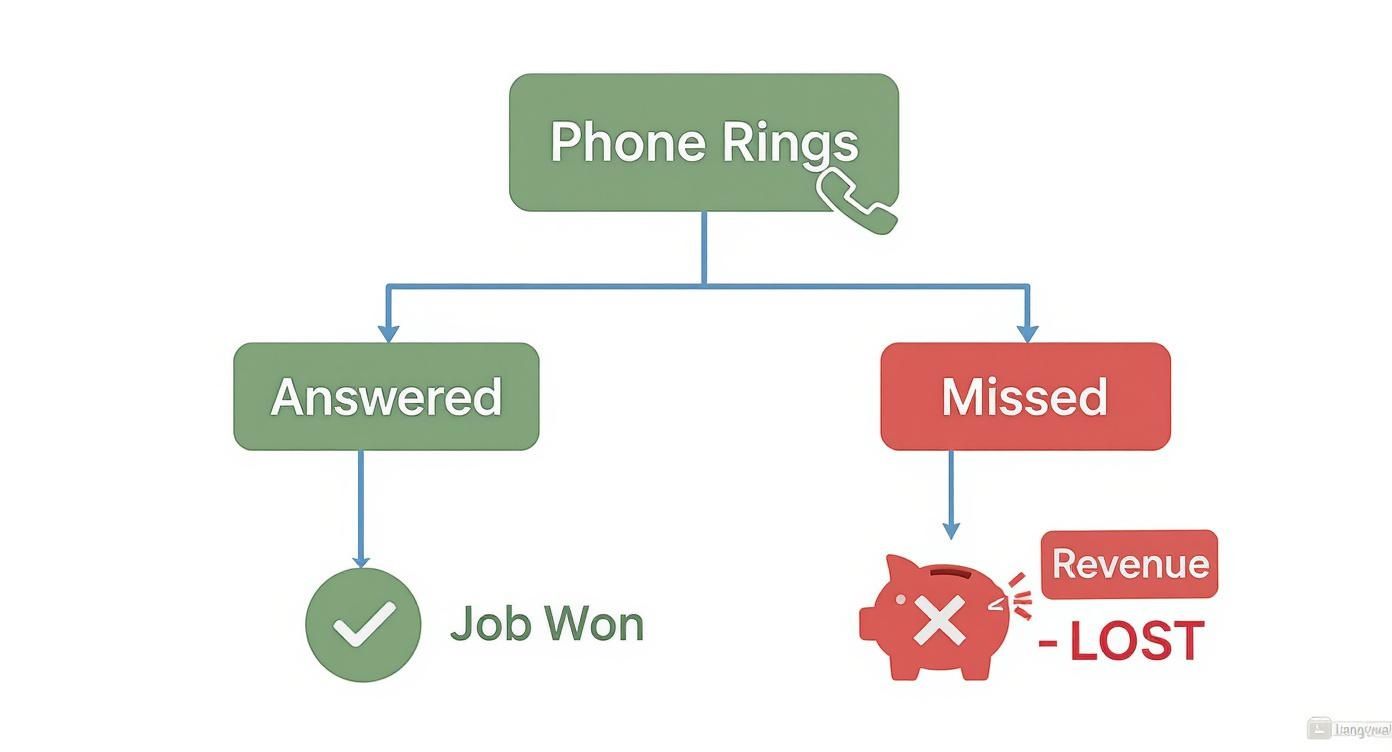
As you can see, the path to revenue starts with one thing: answering the call. Sending a potential customer to voicemail is a direct line to a lost sale.
Manual Call Forwarding from Your Carrier
This is the most basic option out there. You use special codes (like *72 on many landlines) or dig into your smartphone’s settings to manually send all incoming calls from your office line to your cell.
It’s a quick fix, no doubt. If you know you'll be on-site all afternoon, you can flip it on and take calls from the truck. But that simplicity is also its biggest flaw. You have to remember to turn it on and off, and it has zero intelligence. Every single call—from a hot lead to a telemarketer—goes straight to your personal phone.
I’ve seen this countless times: the owner forwards the office line to their cell for the weekend. Sure, it stops you from missing leads, but it also turns you into a 24/7 receptionist. Burnout is pretty much guaranteed.
Using VoIP or PBX System Features
If you’ve invested in a Voice over Internet Protocol (VoIP) service or a modern PBX phone system, you probably have more advanced call routing features already available. These systems let you create simple rules, like forwarding calls to different people in a specific order ("ringdown") or sending calls to voicemail after a few rings.
This is definitely a step up from basic carrier forwarding. It feels more professional and can handle slightly more complex setups, like routing a call to your dispatcher first, then to your cell if they don’t pick up. The catch is that these systems can be rigid and often require someone on your team to be technically comfortable enough to configure the rules correctly.
Automated Call Answering and AI Assistants
This is where the game changes for small and mid-sized movers. The most effective modern solution isn't just about sending a ringing phone to another person; it’s about sending it to an intelligent system built to handle the entire lead capture process from start to finish.
An AI receptionist answers instantly, 24/7, greets the customer professionally, and gathers all the job details you need. It can even provide an instant quote via text and integrate with your calendar to book the job right on the spot. This isn't just forwarding a call; it's automating the first, most critical sales conversation.
This kind of tech is no longer just for big corporations. Today's systems are crucial for hitting high First Call Resolution rates—benchmarked at over 80%—because customers want answers on the first try. You can dig into more call center statistics to see how top-performing teams operate.
The real game-changer here is scalability. During the summer rush, an automated system handles an unlimited number of calls without getting overwhelmed, making sure every single lead is captured and quoted flawlessly.
Call Forwarding Methods for Moving Companies
Choosing the right call forwarding method depends on where your business is today and where you want it to go. Each option serves a different purpose, fitting various operational needs, budgets, and technical comfort levels.
Here’s a quick breakdown to help you compare your options at a glance.
| Method | Best For | Pros | Cons |
|---|---|---|---|
| Manual Carrier Forwarding | One-truck operators or very small teams needing a simple, temporary fix. | Easy to set up; no extra cost. | Manual on/off; no flexibility; leads to owner burnout. |
| VoIP/PBX System Routing | Companies with 3-10 trucks and an established office phone system. | More professional; allows for basic routing rules. | Can be complex to configure; lacks 24/7 coverage unless staffed. |
| Automated AI Assistant | Any mover who wants to maximize lead capture and slash administrative work. | Answers 24/7; captures details perfectly; books jobs automatically. | Requires a subscription service. |
Ultimately, the best method is the one that stops leads from slipping through the cracks without adding more stress to your plate. While manual forwarding works in a pinch, scaling your moving business requires a system that works for you, not the other way around.
How to Set Up Call Forwarding on Different Devices
Ready to stop missing calls? Diverting your business line to another number is a simple fix you can set up today. Whether you're a one-truck operation or juggling multiple crews, the basic process is pretty similar across all the devices your company probably uses.
Here’s a straightforward guide to getting your calls routed where they need to go, making sure a potential customer always gets an answer.
Forwarding Your Business Landline
For a lot of moving companies, the old-school office landline is still the main point of contact. If you need to head out for a site survey or manage a job, you can quickly forward that line to your cell.
The quickest way is usually with star codes.
- Grab the handset and wait for the dial tone.
- Dial *72.
- When you hear the next tone, punch in the full 10-digit phone number you want calls sent to (like your mobile).
- Listen for a confirmation tone or message, then hang up. That’s it.
When you're back in the office and ready to take calls there again, just dial *73 to turn it off. Keep in mind these codes can sometimes differ between providers like Verizon or AT&T, so it never hurts to double-check with them first.
Setting Up Call Forwarding on Smartphones
When you're constantly on the move, your smartphone is your lifeline. Both iPhones and Androids have call forwarding built right in, which is perfect if you have one person covering the phones for the day.
For iPhones:
- Head to Settings → Phone.
- Tap on Call Forwarding.
- Flip the switch on and type in the number where you want calls to go.
For Androids (steps can vary a bit by phone model):
- Open up your Phone app.
- Tap the three-dot menu icon, then find Settings → Calling accounts (or it might be called Supplementary services).
- Choose Call forwarding and pick your condition, like "Always forward" or "When busy."
- Enter the number and hit save.
Pro Tip: While this is easy, relying on your personal cell as the main backup can lead to serious burnout. It mixes high-value business leads with your personal calls, making it impossible to switch off and tough to give every caller a professional greeting.
Configuring Basic VoIP or PBX Systems
If your moving business is on a VoIP system, you've got way more flexibility than a simple landline offers. Most VoIP dashboards let you manage forwarding rules right from a web portal, giving you control without needing to punch in codes.
Just log into your provider's online account and look for a "Call Routing" or "Forwarding" menu. From there, you can point your number to any phone you want. This is also where you can start setting up smarter rules like conditional routing, which we'll dive into next. Getting this basic setup right is the first step toward building a system that reliably captures every single lead.
Using Conditional and Timed Call Routing
Basic call forwarding is a decent start, but if you want to grow your moving company, smart call routing is an absolute game-changer. This is where you move beyond just sending all calls to one number and start building an intelligent system that diverts calls based on specific rules you set.
This isn't about getting tangled up in complicated tech. It’s about making your phone system work smarter, not harder, so you never miss a chance to book another job.
What Is Conditional Forwarding?
Conditional forwarding only sends a call to another line if certain conditions are met. Think about it: you're on the phone quoting a big job, and another potential customer calls. Instead of them getting a busy signal or being dumped into voicemail, the call automatically routes to someone or something else that can help them.
For movers, this is essential. Here are a few real-world scenarios:
- When Busy: Your main line is tied up. The call instantly bounces to your dispatcher’s cell or, even better, an AI receptionist. The lead gets an immediate response.
- When Unanswered: The phone rings three times and nobody in the office picks up. Instead of going to a generic voicemail box, the call is sent to a backup number.
- When Unreachable: Your internet goes down, knocking your VoIP system offline. Calls are automatically rerouted to a designated mobile number so business doesn't stop.
This simple logic makes sure that even when you're slammed, every single lead gets a chance to be answered. You maximize your opportunity to book every job you paid to generate.
Why Time-Based Routing Is a Must
Time-based routing is exactly what it sounds like: it sends calls to different places depending on the time of day or day of the week. For any moving company, this solves the massive headache of handling after-hours and weekend leads.
A customer looking for a mover on a Sunday evening isn't going to wait until Monday morning for a callback. They'll book with the first company that answers the phone. Time-based routing makes sure you're that company.
With a time-based setup, your phone system can automatically switch from your office line to another number at 5 PM sharp. You could send those calls to your personal cell, sure. But a much more powerful move is to route them to an AI receptionist.
An AI system can capture lead details overnight, provide instant quotes based on your rate card, and have the job ready for confirmation when your team walks in the next morning. You can dig deeper into how to handle after-hours leads without working 24/7 in our guide.
This kind of setup turns your phone line into a 24/7 booking machine. By combining conditional rules with timed routing, you create a system that intelligently manages every single call, protecting your revenue around the clock.
The Most Profitable Place to Send Your Calls
You’ve figured out how to forward calls, but the million-dollar question is still on the table: where should those calls actually go?
Diverting your phone line is only half the battle. Choosing the right destination is what separates a missed opportunity from a booked job that pays the bills.
Sending every call straight to your personal cell might seem like the simplest fix, but trust me, it’s a fast track to burnout. You can't give every caller a professional, energetic greeting when you're in the middle of a job, driving a truck, or just trying to eat dinner with your family. Your personal voicemail is no place for a high-value lead to die.

Breaking Down Your Destination Options
Let’s get real about the common choices and their hidden costs for a moving business.
-
Your Personal Cell Phone: This is the default for most owner-operators. While it feels like you'll never miss a ring, it completely erases the line between work and life. More importantly, it chains you to the front desk forever, making it impossible to scale your business.
-
A Team Member's Phone: Routing calls to a dispatcher or sales manager is a definite step up. But this strategy is still leaky. What happens when they’re on another call, out to lunch, or on vacation? You’re right back where you started, with good leads hitting a dead end at voicemail.
-
Traditional Answering Services: For decades, this was the go-to for after-hours coverage. The problem is, these services are often expensive and painfully impersonal. The operators just read from a generic script and have zero industry knowledge to answer specific questions, which can easily turn off a customer who is ready to book.
The Smartest, Most Scalable Solution
Instead of just passing a ringing phone around, the smartest play is to route calls to a modern, automated system built specifically for the moving industry. An AI-powered receptionist brings a level of efficiency and professionalism that a human team just can't match 24/7.
This isn't about replacing your people; it's about making them superhuman. An automated system can:
- Deliver a professional, branded greeting every single time. No exceptions.
- Capture all the critical job details—addresses, inventory lists, move dates.
- Instantly text accurate quotes to callers based on your company's own rates.
- Sync confirmed bookings directly into your calendar or dispatch software.
By diverting calls to an AI assistant, you transform your phone line from a simple communication tool into an automated sales engine. It ensures every lead is captured and nurtured, even at 2 AM on a Sunday.
This frees you and your team to focus on what humans do best—closing complex deals, managing on-the-ground logistics, and providing the kind of customer service that earns five-star reviews. Automation isn't just a perk anymore; it's a competitive advantage that lets you operate with the power of a much larger company. You can see exactly how this works with specialized moving company software.
Your Top Questions About Call Forwarding, Answered
Even with a solid plan, you probably have a few practical questions. I get it. Here are the most common things moving company owners ask before they start forwarding calls, so you can move forward with confidence.
Will My Customers Even Know Their Call Was Diverted?
Nope. In almost every case, the customer has no idea.
The transition is instant and totally seamless. Someone dials your main business number, and the call just rings at the new destination—your cell, a dispatcher's phone, or an AI receptionist. There's no weird delay, no "please wait while we transfer your call" message. Nothing.
From their perspective, it feels exactly like calling you directly. The only thing they’ll notice is that their call got answered quickly and professionally, which is exactly the kind of first impression that wins the job.
What’s This Actually Going to Cost Me?
The cost to divert calls is all over the map, but it's almost always a drop in the bucket compared to what one lost job costs you.
- Carrier Forwarding: Your basic call forwarding through a landline or mobile provider is often baked into your plan already. If not, it's usually just a few bucks a month.
- VoIP Systems: If you're using a VoIP service like RingCentral or Dialpad, call routing features are pretty much always a standard part of your subscription.
- AI Answering: Using an AI receptionist is a monthly subscription, but the ROI is where it really shines. Just one booked job that you would have otherwise missed usually pays for the entire month of service, with plenty left over.
Think of it less as an operating expense and more as an investment in not letting perfectly good leads slip through your fingers.
Let's reframe the question. It's not "What does call forwarding cost?" It's "What does a missed call cost?" For a mover, that's easily $1,500 to $3,000 walking out the door every single time.
How Does This Help During the Summer Rush?
Peak season is exactly when smart call routing goes from a "nice-to-have" to an absolute necessity.
When call volume goes through the roof, you can't afford to let good leads hit a busy signal or get dumped into voicemail. That’s just throwing marketing dollars away.
By setting up conditional forwarding, you create an overflow safety net. If your main line is tied up, the next call automatically routes to a second destination. That could be your dispatcher, another team member, or—for maximum horsepower—an automated system that can handle an unlimited number of calls at once.
It ensures you capture every single inquiry and quote every lead, letting you capitalize on that seasonal demand without burning out your entire team.
Ready to stop sending leads to voicemail and start booking more jobs automatically? MoveJoy is the AI receptionist built for movers. It answers every call 24/7, provides instant quotes, and books jobs directly into your calendar, ensuring you never miss a revenue opportunity again. See how it works at https://getmovejoy.com.