Missed Call Moving Company Revenue: Your Guide to Recovery

It’s July. Crews are out. Your dispatcher is juggling schedule changes. Your sales rep is already on a quote call. A homeowner calls during lunch to ask about a move two weeks out, gets voicemail, and books the next mover who answers live.
That’s the missed call moving company revenue problem in its real form. Not a phone issue. Not an admin issue. A booked-job issue.
Owners running 5 to 20 trucks feel this most during busy season because demand doesn’t show up neatly between 9 and 5. It comes in bursts, after hours, on weekends, and while your office team is already buried. The result is predictable. Calls slip. Follow-up slows down. Good leads go cold before anyone prices the job.
Table of Contents
- The Unseen Leak in Your Moving Company’s Bottom Line
- How to Calculate Your Lost Revenue from Missed Calls
- Why Calls Get Missed and When It Hurts the Most
- Three Strategies to Recover Your Lost Revenue
- Modeling the ROI of a 24/7 Automated Booking Solution
- Your Action Plan to Stop Leaking Revenue Today
The Unseen Leak in Your Moving Company’s Bottom Line

A missed call in a moving company usually isn’t just someone checking hours. It’s often a family with a short decision window, a property manager pricing a vacancy turn, or a customer calling three movers in a row and hiring the first one that sounds organized.
That’s why owners who say, “We probably lose a few jobs to voicemail,” are usually understating the problem. In moving, speed and confidence matter. If the caller can’t get a human or a useful answer, they keep dialing.
What one missed ring usually means
Research indicates that small service businesses, including moving companies, typically miss between 20% and 40% of inbound calls during business hours, and 85% of callers who reach voicemail never call back, which turns missed calls directly into lost leads and revenue, according to Davinci Virtual’s missed-call revenue analysis.
That lines up with what shows up in real moving operations. The owner is on a walkthrough. The office manager is handling a reschedule. The sales line rolls to voicemail for fifteen minutes. That short gap is enough to lose a ready-to-book customer.
Practical rule: If your phone process depends on someone becoming free later, you’re already giving high-intent leads a chance to buy somewhere else.
Why this hits mid-sized movers hardest
The pressure is different for a company running multiple crews. You’ve got enough marketing working to generate demand, but not enough front-office coverage to absorb every spike cleanly. That creates a leak between lead generation and booked jobs.
A lot of operators focus on revenue loss as a marketing problem. It often isn’t. It’s a capture problem on the front end. If you want to see how that leak forms between inbound calls and unbooked work, this breakdown on moving company revenue leak patterns is worth reviewing.
Here’s the blunt version. Most local movers don’t need more phone ringing. They need fewer good calls dying before they become quotes.
How to Calculate Your Lost Revenue from Missed Calls
The fastest way to get serious about this problem is to stop talking about it in general terms. Put a number on it.
A simple model works well for most moving companies:
Weekly Missed Calls × 50 Weeks × Booking Rate × Average Job Value = Annual Revenue Leak
That formula isn’t perfect, but it’s practical. It gets you close enough to make better staffing and automation decisions.
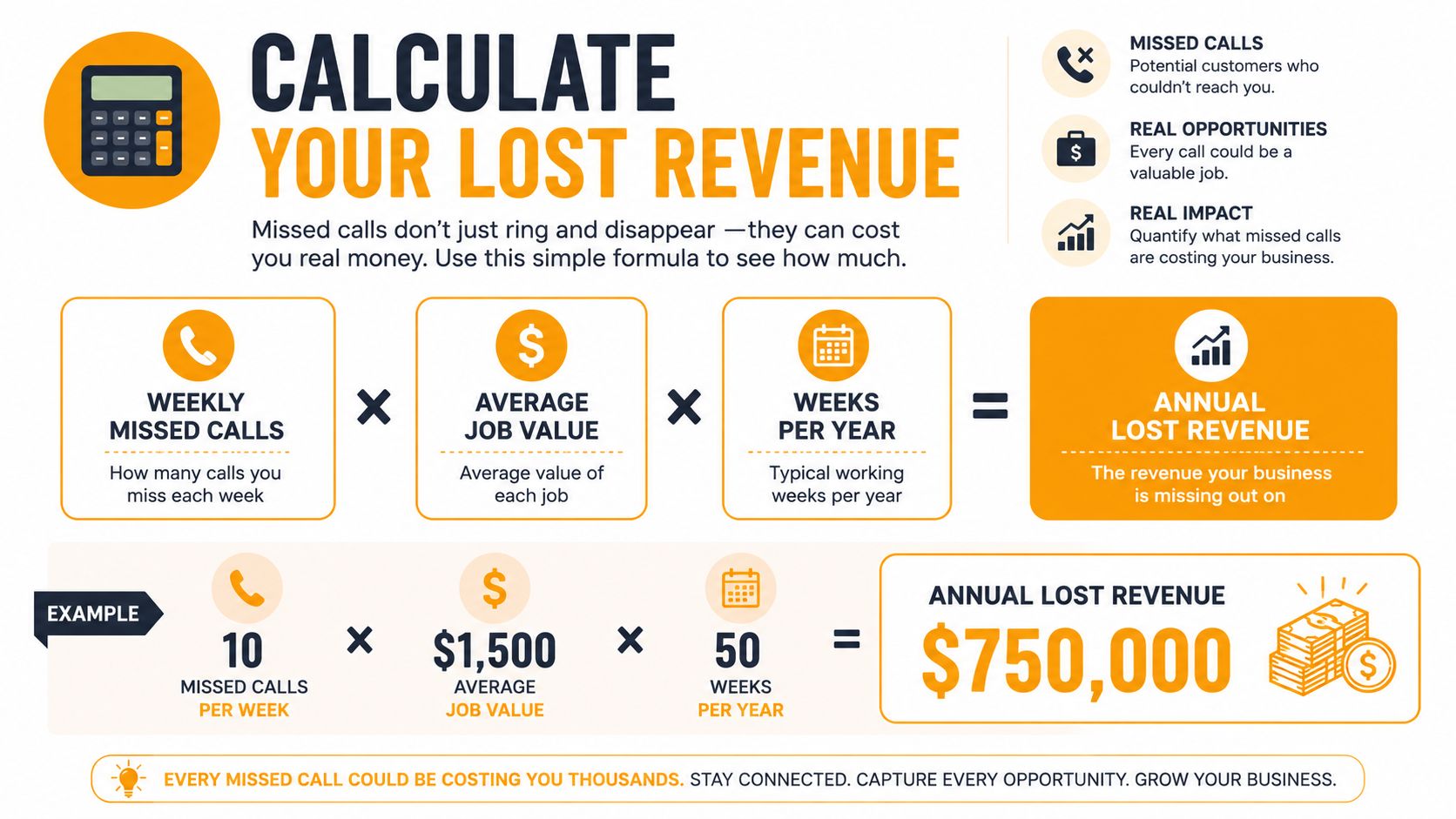
Use a simple revenue leak formula
One verified benchmark makes the point clearly. Using the formula Missed Calls × Conversion Rate × Average Job Value, even a conservative estimate of 30 missed calls per month can translate into annual revenue leakage of $25,000 to $75,000 or more for an independent moving company, based on PCN Answers’ missed-call revenue study.
The reason this formula works is that it forces you to tie operations to outcomes:
- Missed calls shows whether coverage is the issue.
- Booking rate shows whether your team converts the leads it reaches.
- Average job value keeps the model grounded in your market and mix.
- Annualized view shows why “just a few missed calls” isn’t small.
A conservative example for a typical mover
Let’s keep this practical and avoid inflated assumptions.
Say your company misses a handful of calls each week. Some are low quality. Some are duplicate shoppers. Some would never book. Fine. You still don’t need a dramatic close rate for the leak to matter. If your team normally turns a portion of qualified inbound calls into jobs, every missed call has recoverable value.
Use your own numbers in this order:
- Pull one week of phone records. Count calls that rang out, went to voicemail, or were returned late enough that the lead likely cooled off.
- Estimate your real booking rate. Use booked jobs divided by qualified inbound leads, not all inquiries.
- Use actual average job value. Separate local residential work from larger flat-rate or long-distance work if needed.
- Multiply across 50 weeks. Busy season and slower months balance out better than one short snapshot.
Start with conservative assumptions. If the number still bothers you, the real problem is probably larger.
What to track this week
If you don’t have a clean reporting process yet, start with a manual audit. One week is enough to expose the pattern.
| What to track | Why it matters | What to look for |
|---|---|---|
| Missed inbound calls | Shows the raw leak | Calls by day, hour, and call source |
| Time to callback | Reveals response lag | Same-hour vs next-day response |
| Quote issued or not | Separates contact from conversion | Calls that ended without pricing |
| Booked job outcome | Finds true recovery value | Jobs won after live answer vs delayed follow-up |
Most movers are surprised by one thing. The issue usually isn’t only the calls that were fully missed. It’s also the calls that were answered, but not quoted or advanced quickly enough.
If you want a cleaner worksheet than a scratch pad and call log, use a dedicated moving revenue calculator and run your own estimate with your actual booking rate and average job value.
Why Calls Get Missed and When It Hurts the Most
The root problem usually isn’t laziness or bad effort. It’s structure.
A moving company can be busy and under-covered at the same time. In fact, those two conditions usually show up together. The more successful your lead flow gets, the easier it becomes for calls to stack up right when your team is least able to answer them.
The real operational bottlenecks
In a typical 5 to 20 truck operation, missed calls happen for familiar reasons:
- Crews are active. Owners and managers are in the field, not at a desk.
- Office staff are single-threaded. One dispatcher or coordinator can only handle one live conversation at a time.
- Quote calls run long. Good sales calls take time, especially when inventory, stairs, long carries, or timing issues are involved.
- Admin work blocks the phones. Claims, reschedules, payroll questions, and truck coordination all compete with new lead intake.
None of that is unusual. It’s how many local movers operate.
The worst windows are usually the most valuable
The painful part is timing. The highest-intent customers often call when your team has the least capacity to respond well. Evenings, weekends, lunch breaks, crew load-out windows, and peak-season surges all create the same result. Delayed contact when the buyer wants immediate clarity.
For moving companies with 5 to 20 trucks, high-volume periods like March through September create staffing gaps where even a 30% missed call rate on 100 weekly calls can lead to revenue exposure in the tens of thousands annually, based on a $1,500 average job value, according to Revmo’s analysis of missed calls in service businesses.
When call volume spikes, the bottleneck usually isn’t trucks first. It’s intake, quoting, and response speed.
That’s why adding more marketing alone often disappoints operators. More leads don’t help if your front office can’t absorb demand during the exact windows when buyers are shopping.
Three Strategies to Recover Your Lost Revenue
There are three realistic ways to tackle missed call moving company revenue loss. Each has trade-offs. Some improve contact rate. Only one consistently improves close rate at the same time.
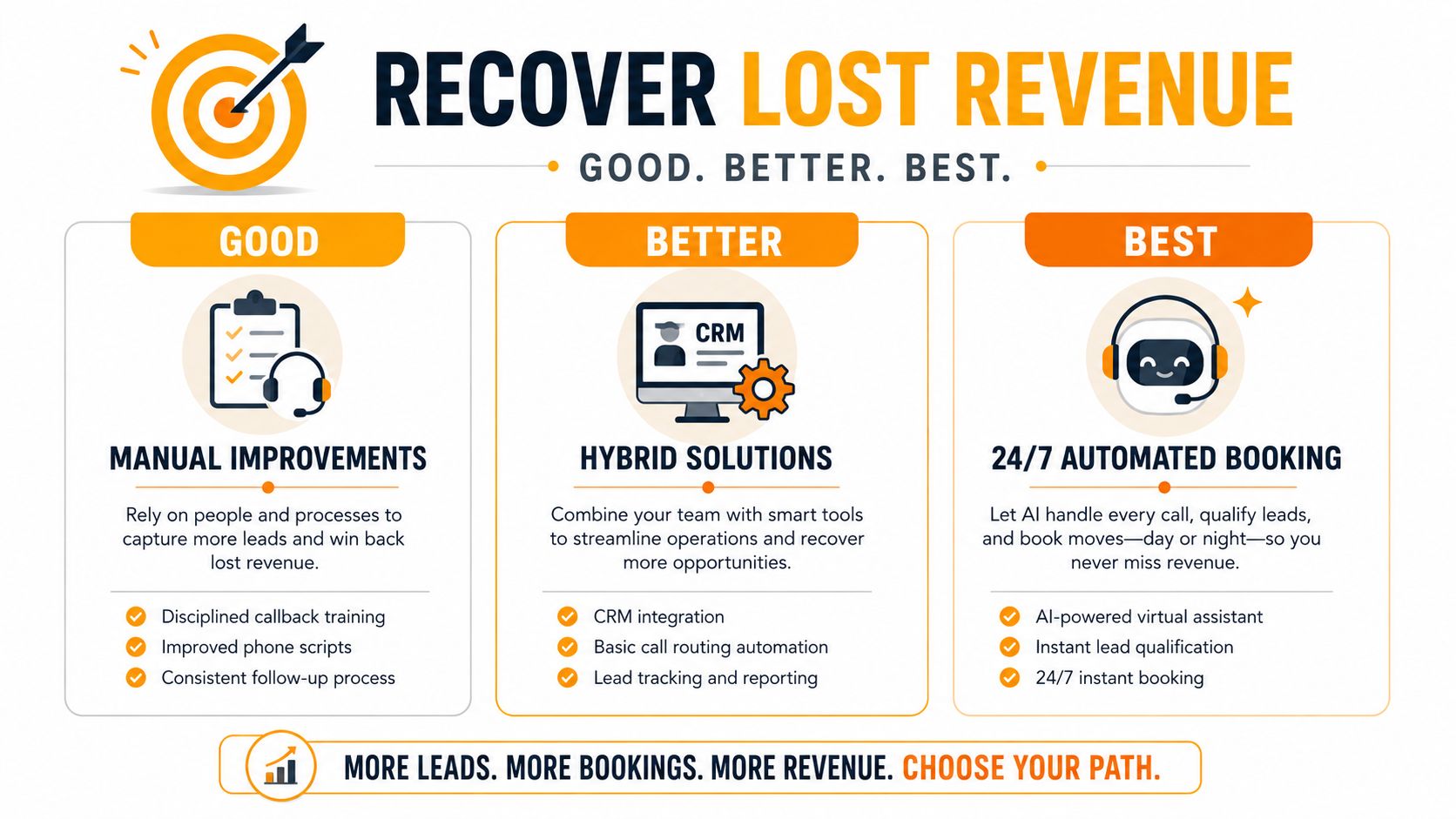
Good manual discipline
Manual improvement is the first move because it costs the least to try.
You can tighten callback rules, assign clear phone ownership, improve scripts, and review missed-call logs daily. For some operators, that alone will recover business.
A few practices usually help:
- Set a callback standard. Every missed lead gets returned quickly, not “when things calm down.”
- Separate service calls from sales calls. Claims and schedule issues shouldn’t crowd out new quote inquiries.
- Create a weekend and evening plan. Someone must own inbound demand outside normal office hours.
- Review unquoted calls. Answering the phone without giving a useful next step still loses jobs.
The weakness is obvious. Manual systems work until the office gets slammed.
Better lead capture
The next step is using an answering service, call routing tool, or a generic AI voice platform to make sure someone or something responds.
That’s better than voicemail. It preserves the lead and reduces the number of total losses. Some operators also look outside their industry for service models that handle high-stakes phone intake well. A good example is this guide to virtual receptionists for law firms and agents, which shows how businesses with urgent calls think about responsiveness, screening, and handoff quality.
But this middle tier has a major limitation in moving. It often captures the lead without closing the job. The caller gives their name, maybe a move date, and then waits for your team to call back later with a quote. That delay is where a lot of good demand still dies.
Best quote and book on the call
The strongest setup for a mover is one that handles the full front-end workflow:
| Approach | What it solves | Where it falls short |
|---|---|---|
| Manual callbacks | Low upfront cost | Breaks during spikes and after hours |
| Answering service or generic AI | Captures contact info | Usually can't price accurately or book |
| Automated quote and booking workflow | Responds, quotes, and books | Requires setup around your rate card and systems |
This is the gap many operators miss. Actual value isn’t answering every ring. It’s giving the customer an accurate next step while they’re still on the phone.
That’s where purpose-built tools fit better than generic ones. For example, MoveJoy is designed to answer inbound calls, generate an accurate moving quote using the company’s own rate card, and book directly into systems like SmartMoving, Supermove, MoveitPro, or Google Calendar. That matters because local movers don’t win by taking messages. They win by pricing correctly and moving the customer to a booked job before the shopper drifts away.
Operator mindset: If your system only captures the lead, your sales process still starts late.
Modeling the ROI of a 24/7 Automated Booking Solution
Most owners ask the wrong first question. They ask what the tool costs.
The better question is what it replaces. If the current system leaks booked jobs during nights, weekends, and peak-day bursts, then the benchmark isn’t the price of software. The benchmark is the value of work you were already paying to generate but failed to convert.
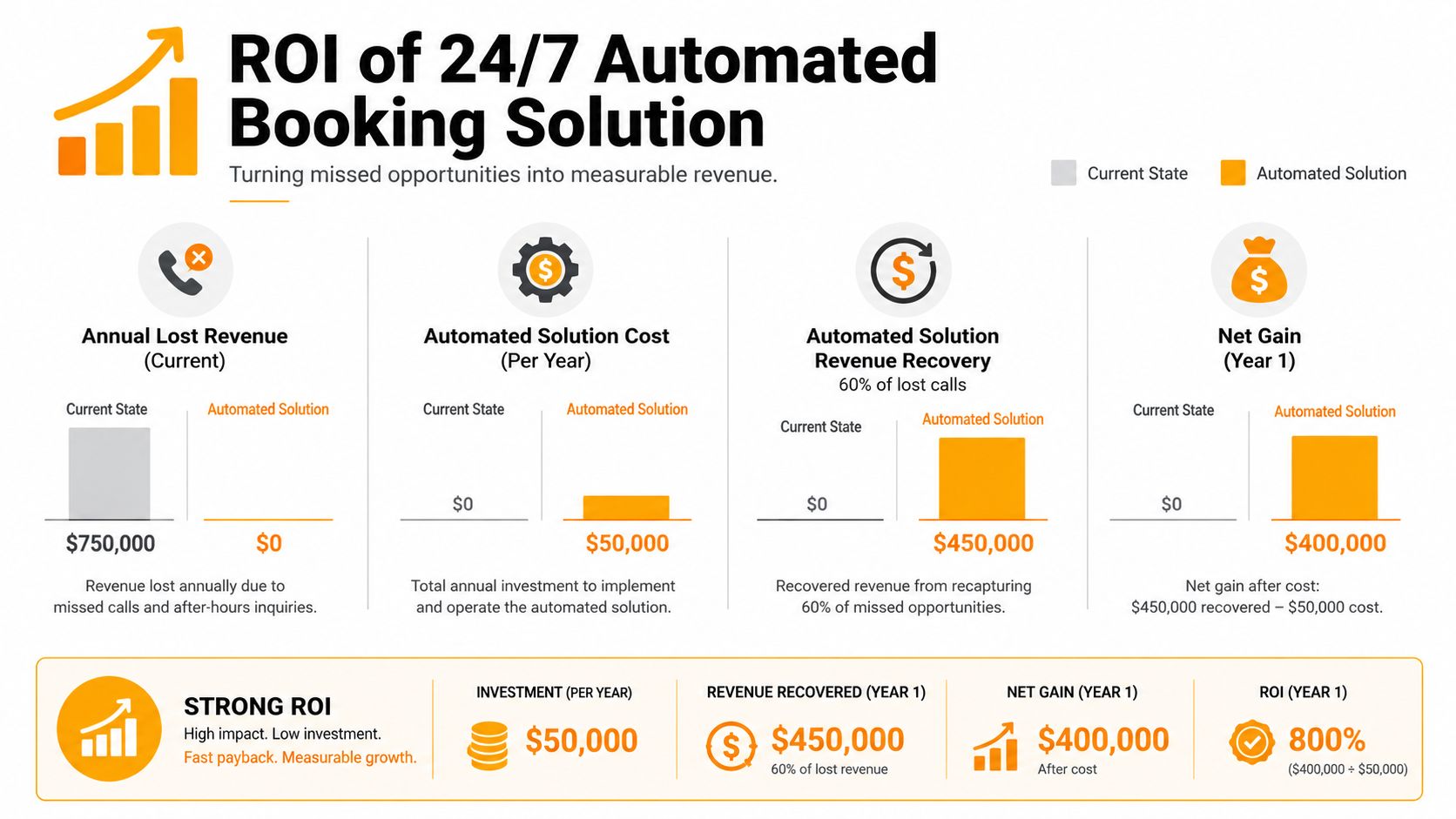
Revenue recovery is only part of the picture
A lot of missed-call content stops at gross revenue. That’s useful, but it’s incomplete.
A more nuanced perspective for operators is modeling recovered-call profit after direct costs such as labor and fuel, not just headline revenue, and while many movers close 39% of leads, the primary goal is to translate recovered calls into net operating impact, as discussed in Supermove’s analysis of missed-call recovery and profitability.
That changes the conversation in a good way. You stop asking, “Can this answer more calls?” and start asking, “Will this recover profitable jobs we currently lose?”
How to think about profit instead of headline revenue
Not every recovered booking has the same value. Some jobs are high margin. Some are awkward calendar fillers. Some involve longer carries, tougher labor, or tighter scheduling. That’s normal.
Use a simple review process:
- Look at variable costs first. Crew labor, fuel, and truck time determine whether a recovered job is attractive.
- Separate easy-fit work from hard-fit work. The best recovered calls often fill capacity you already have.
- Check quote quality. If the system can’t quote accurately from your own rate card, you may create downstream problems for ops.
- Measure booked jobs, not answered calls. A cheap system that takes messages can still be expensive if the customer keeps shopping.
For owners who want a general framework before building an internal spreadsheet, these ROI measurement tools are a useful starting point for comparing recovered revenue against operating cost.
A practical ROI test
You don’t need a complicated finance model to decide whether automation is worth exploring.
Ask three questions:
- How many good calls are missed after hours or during overload periods?
- How many of those could be quoted accurately on first contact?
- Would recovering a small number of those bookings justify the system?
That third question matters most. In moving, one recovered job can go a long way toward paying for better front-end coverage, especially if the alternative is leaking demand you already earned. If you’re comparing the economics of manual coverage against a system that handles nights and weekends, this breakdown of after-hours answering service cost for movers helps frame the trade-off in operational terms.
Cost of inaction is easy to miss because it never shows up as a bill. It shows up as silence in the schedule where booked work should have been.
Your Action Plan to Stop Leaking Revenue Today
You don’t need a full tech overhaul to start fixing this. You need a tighter process and a hard look at where calls die.
A simple three-step checklist
- Calculate the leak. Use your own missed calls, booking rate, and average job value. Don’t guess from memory.
- Track one full week by time block. Break out business hours, lunch, evenings, and weekends. The pattern usually jumps out fast.
- Audit what happens after a missed call. Does the lead get a fast callback, a quote, a booking option, or just a message and delay?
If you do only that much, you’ll know whether your problem is coverage, quoting, follow-up, or all three.
Why fixing this now pays beyond the first job
Plugging the missed-call leak has a compounding effect beyond the first booking. A professional, instant first-contact experience strongly correlates with higher review ratings and repeat or referral bookings, which amplifies customer lifetime value, according to OnCall Clerk’s analysis of missed-call impact on referrals and repeat business.
That’s why this isn’t just about stopping loss. It’s about building a front end that helps you book more moving jobs, protect busy-season demand, and run a cleaner operation without adding more manual chaos.
If you want to see what a fully automated quote-and-book workflow looks like for local movers, visit MoveJoy. It’s built around the part most tools miss: turning inbound calls into accurate quotes and booked jobs, not just captured messages.