Moving Company Missed Calls: Solutions to Boost Revenue
If you run a moving company, you already know the scene. Your dispatcher is juggling schedule changes. A sales rep is trying to finish a quote. Someone in the field needs an answer right now. Meanwhile the phone rings, then rings again, then stops. By the time anyone calls back, that prospect has usually moved on.
That’s why moving company missed calls aren’t really a phone problem. They’re a booking problem. More specifically, they’re a front-end revenue leak that hits hardest when your business is busiest, when customers are calling multiple movers, and when your office team doesn’t have time to gather the details needed to quote on the spot.
Table of Contents
- The True Cost of a Ringing Phone You Cannot Answer
- Why Your Moving Company Misses Calls And Why It Is Normal
- Comparing Common Fixes Human Answering vs Generic AI
- The Modern Solution From Answering Calls to Booking Jobs
- Calculating the ROI of an Automated Booking System
- A 5 Step Checklist to Implement Your Revenue Recovery Engine
- Turn Your Ringing Phone into Your Best Salesperson
The True Cost of a Ringing Phone You Cannot Answer
The easiest mistake owners make is treating a missed call like a minor service issue. It isn’t. In moving, an unanswered inquiry can be the difference between an open truck and a full route.
A neutral industry estimate says a missed moving call can mean losing a job worth $1,500 to $4,000 for a typical local move, and 85% of missed callers never call back according to missed business call statistics for service companies. That means the revenue often disappears almost immediately.
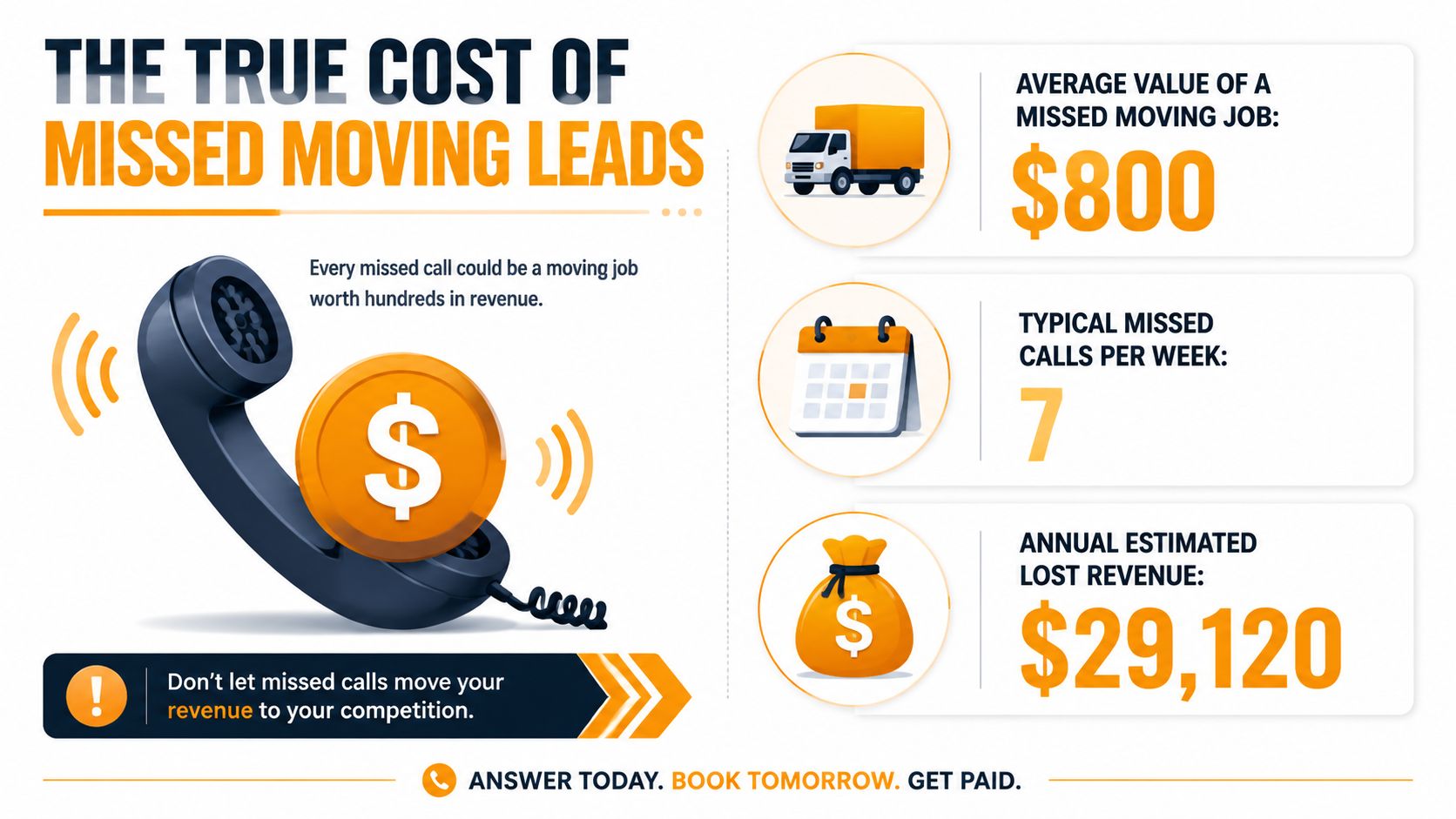
What one missed call is really worth
Take a conservative view. Don’t assume every missed caller would have booked. Assume only that each missed call was a real chance to quote and win a job. In this business, that chance has value because the job sizes are meaningful.
If your office misses even a small number of qualified calls each week, you’re not just losing conversations. You’re losing shots at local jobs worth $1,500 to $4,000, and sometimes larger relocations that can exceed $10,000 as noted in this breakdown of missed-call losses for small businesses.
Practical rule: If a lead had enough intent to call, you should treat that ring like a live sales opportunity, not admin.
Here’s the operational reality. You already paid for the branding, referrals, SEO, lead source, truck wraps, or ad spend that made that phone ring. Once the call is missed, part of that acquisition cost gets wasted too.
Why lead generation gets wasted
Owners often focus on buying more leads before fixing call capture. That’s backwards. If you want a better feel for acquisition channels, this guide on where to get moving leads is useful, but none of those channels matter much if inbound calls still fall into voicemail or delayed callbacks.
A missed call hits three parts of the business at once:
- Lost immediate revenue: You may have just missed a move worth $1,500 to $4,000.
- Lost marketing efficiency: The dollars spent to make the phone ring produce less return.
- Lost scheduling control: An open date that could have been booked now has to be filled later, often under more pressure.
That’s why the best operators don’t look at missed calls as a phone metric. They look at them as an unbooked-job metric. That framing changes the urgency fast.
Why Your Moving Company Misses Calls And Why It Is Normal
Most moving companies don’t miss calls because they don’t care. They miss calls because the business is built around motion. Your best people aren’t sitting in a call center waiting for the phone. They’re quoting, dispatching, solving crew issues, handling claims, or physically on a truck.
That’s especially true once you grow past a tiny shop but haven’t built a fully staffed front office. In a 5 to 20 truck operation, the phones usually compete with everything else.
The owner is wearing three jobs at once
A lot of owners still act as sales manager, operations manager, and problem escalator. That works until it doesn’t. One damaged-item complaint, one truck delay, or one no-show issue can eat the next hour of your day.
Then the calls stack up.
I’ve seen this pattern over and over. The team isn’t lazy. The process is overloaded. A moving office can look fully staffed on paper and still miss calls because everyone available is already handling something that feels more urgent in the moment.
A moving company can be busy and still leak revenue at the same time. Those two things often happen together.
Peak season breaks old phone processes
The risk gets worse when call demand spikes. For moving companies, missed-call exposure is concentrated in the busiest periods of the year, and one study notes that 30 missed calls per month can create about $25,000 to $75,000+ in annual revenue exposure according to this missed-call revenue study.
That number rings true operationally because moving demand doesn’t arrive evenly. It clumps. You get bursts before work, at lunch, late afternoon, evenings, weekends, and during weather or schedule shifts. The old playbook of “we’ll call them back when things calm down” usually fails because things don’t calm down until the lead is gone.
Common reasons missed calls happen in healthy growing moving companies:
- Field-first operations: Owners and managers are on trucks, at surveys, or handling day-of-service issues.
- After-hours demand: Prospects call when they get off work, not only when your office is staffed.
- Seasonal overload: From busy-season volume to weekend surges, demand outpaces office coverage.
- Split attention: The same person answering phones is often dispatching, collecting deposits, and fixing service issues.
If that sounds familiar, good. It means the problem is structural, not personal. Once you see that clearly, you stop trying to fix it with hustle alone.
Comparing Common Fixes Human Answering vs Generic AI
Most owners try to patch the problem with whatever seems fastest. That usually means voicemail, a traditional answering service, or a generic AI tool. Each option sounds reasonable at first. Each one solves only part of the problem.
In moving, partial solutions still lose jobs because the lead window is short. Customers typically contact 3–4 movers in quick succession, and a missed call can cost you the customer within minutes according to this moving-call discussion on response speed.
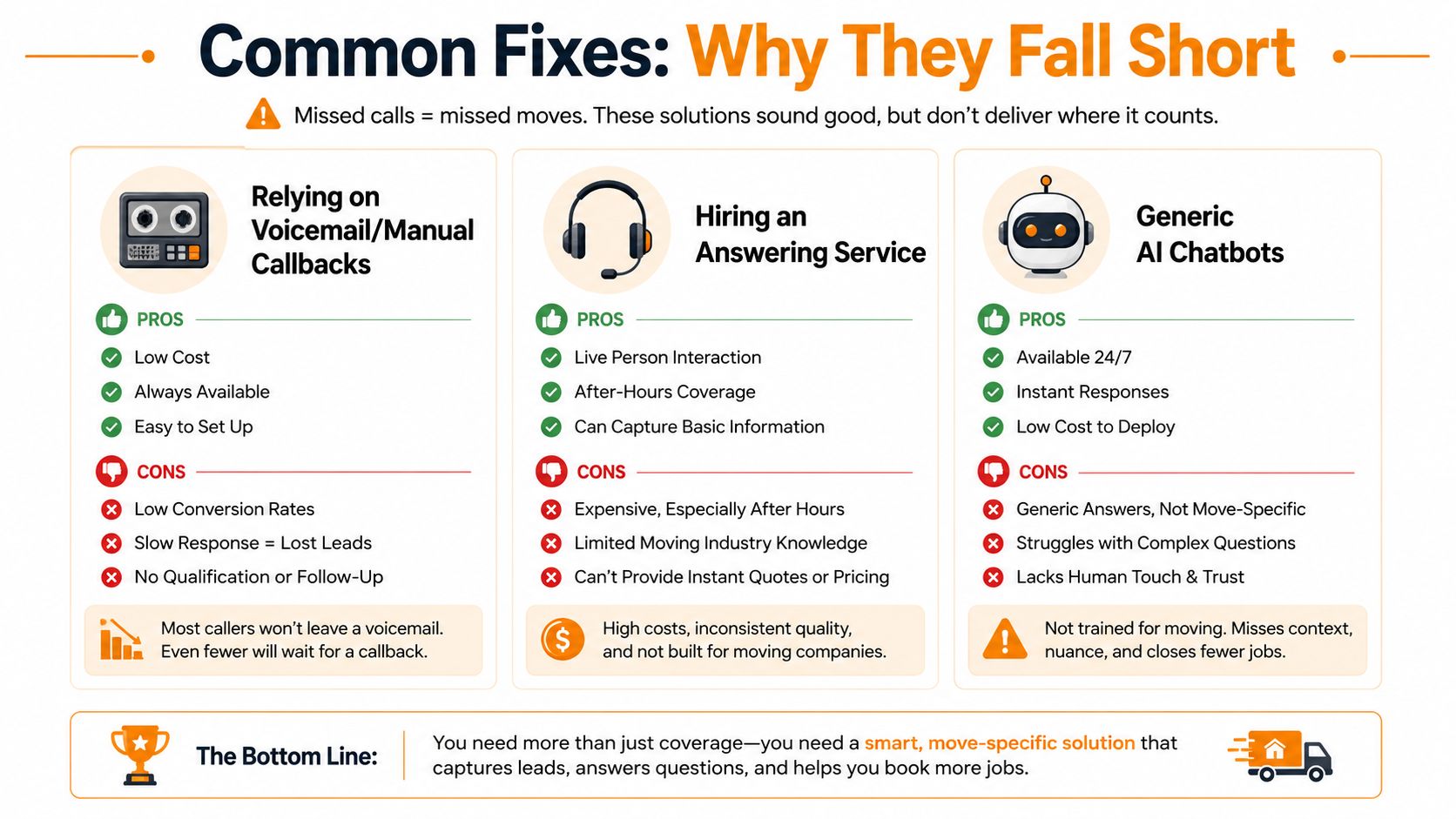
Voicemail and manual callbacks
Voicemail is cheap. That’s the main advantage.
The problem is that voicemail doesn’t move the sale forward. It asks a motivated buyer to do more work while they’re already shopping. In moving, that’s usually the wrong bet. By the time your team returns the message, another company may already have quoted or booked the job.
Manual callbacks fail for a second reason. They depend on office discipline during the exact periods when your office is most overloaded.
Human answering services
A human answering service usually improves coverage. That can help if your only goal is making sure every caller reaches a live person.
But most services stop at message taking. They can collect a name, phone number, and maybe a basic note. They usually can’t handle moving-specific pricing logic, qualify the job properly, or book into your systems with confidence.
That creates a hidden delay. The caller feels heard, but the sale still waits on your team.
| Option | What it does well | Where it breaks |
|---|---|---|
| Voicemail | Always available | No qualification, no quote, no booking |
| Human answering service | Live human pickup | Usually takes messages instead of closing jobs |
| Generic AI tool | Fast response, basic intake | Often weak on moving-specific quote logic |
Generic AI tools
Generic AI platforms are better than dead air. They can answer, capture basic information, and keep a lead from vanishing outright. For many service businesses, that’s progress.
For movers, though, generic systems often fall apart once the conversation gets specific. They don’t reliably handle stair carries, elevator access, long carries, packing services, storage timing, or the difference between hourly and flat-rate quoting. If the tool can’t price with your rules, it still leaves the hard part unresolved.
If you want a closer look at where automated phone systems fit, this page on AI call answering for service businesses is a useful reference point. The key distinction is simple. Answering a call is not the same as advancing a sale.
The Modern Solution From Answering Calls to Booking Jobs
The right target isn’t a prettier call log. It’s more booked jobs from the calls you already earn.
That changes what you should look for. A strong system for movers has to do more than pick up. It has to qualify the lead, gather the right move details, generate a usable quote, and move the caller toward a real booking decision while the prospect is still on the line.
What real intake looks like in moving
A missed call isn’t only a lost chance to talk. It’s a lost chance to collect the information needed to price correctly. Good intake requires details like bedrooms, stairs, long carries, and packing services, and if intake is incomplete, the booking can fail or become unprofitable according to moving-specific answering service guidance.
That point matters more than most owners realize. Some companies answer plenty of calls and still lose money because the intake is shallow. The quote goes out too fast, with too little detail, and then one of two things happens:
- The prospect doesn’t trust the estimate
- The company wins the job but at the wrong price
The real gap in moving is between contact and commitment. If you can’t qualify and quote cleanly, “answered” calls still leak revenue.
If you want broader context on how these systems are being designed, this guide to AI lead qualification agents is helpful. The lesson for movers is that generic intake isn’t enough. The system has to follow your operating rules.
What booking systems need to do
For a mover, a useful booking workflow should handle the basics without forcing your office to rework everything later. That means:
- Collecting the right fields: Name, contact info, move date, origin, destination, home size, access constraints, and requested services.
- Applying your pricing logic: Hourly versus flat-rate, travel charges, stair considerations, packing, special items, and scheduling rules.
- Creating a clean handoff or direct booking: Into the calendar or software your team already uses.
The companies getting the best results are focused on a revenue outcome, not a tech outcome. They want a system that can quote with confidence and move the customer into a real next step. If it can’t do that, it’s still acting like a receptionist instead of a booking engine.
That’s also why tight integration matters. A booking system only helps if it can push the job where your team operates. For a look at what that kind of workflow can resemble, review an appointment booking system built around direct scheduling.
Calculating the ROI of an Automated Booking System
Owners often overcomplicate this decision. You don’t need a big spreadsheet. You need a short formula and honest assumptions.
One industry source notes that moving companies that improve close rate from 39% to 50% can achieve a 28% revenue lift without adding new leads according to this article on improving moving close rates. That tells you where the main impact is. It’s in conversion, not just volume.
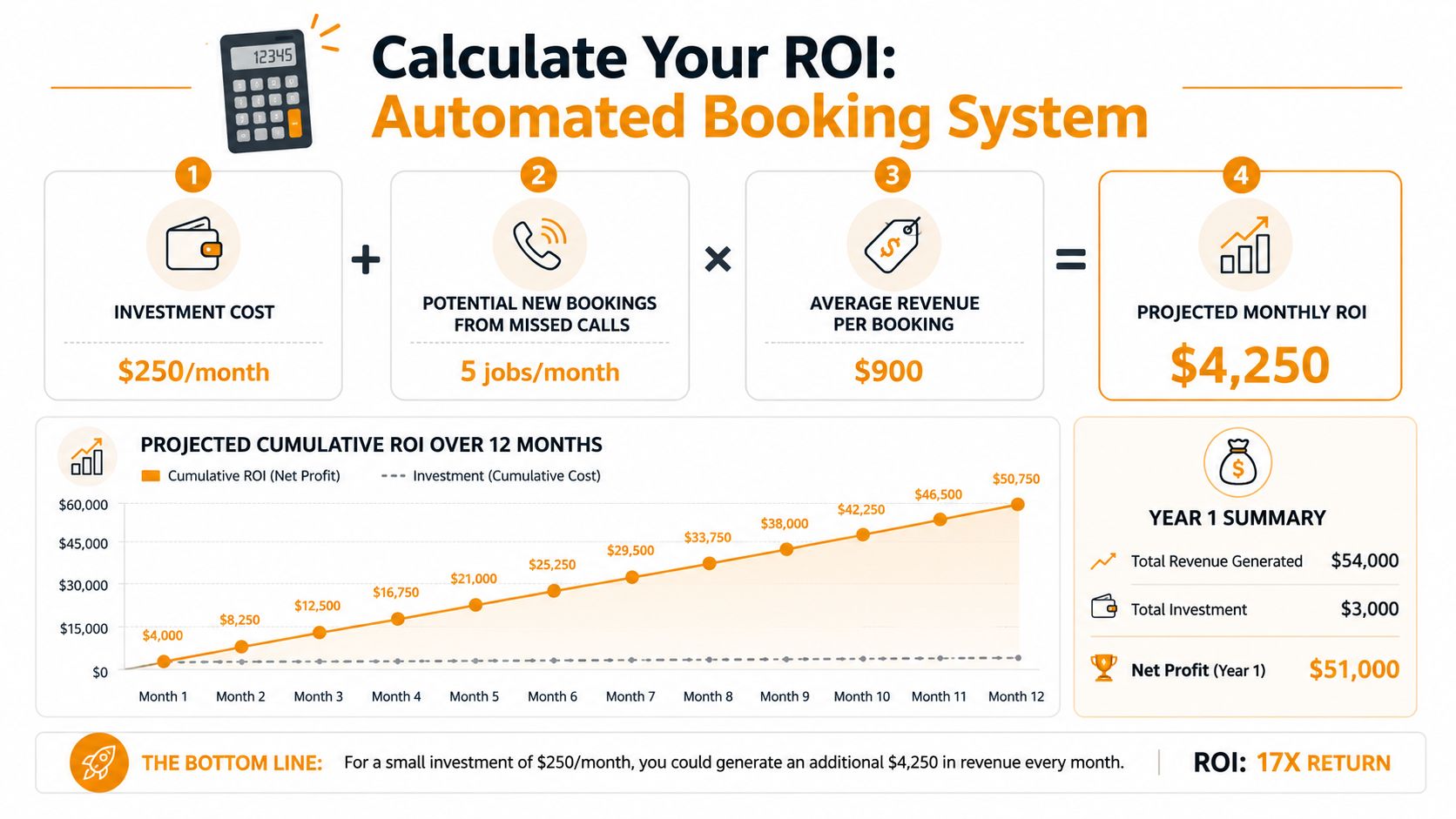
A simple back of the napkin formula
Use this:
Estimated missed calls per month × estimated value of a qualified booked job × your likely close rate on qualified calls = monthly revenue at risk
You already know the inputs better than anyone else:
- Missed calls per month: Pull this from your phone logs.
- Average job value: Use your own numbers by service type.
- Likely close rate: Don’t use your overall lead-to-book rate if half your leads are junk. Use your close rate on real, qualified phone opportunities.
This won’t be perfect, but it will be directionally useful. And that’s enough to make a good operating decision.
What to count and what to ignore
Don’t inflate the math. Be conservative. If your team tends to win a solid share of live inbound calls, use that rate. If many calls are low quality, adjust down.
What matters is seeing the pattern. If better call handling recovers even a small number of good opportunities, the return can be meaningful because each move is worth real money. In practical terms, the system doesn’t need to be magical. It just needs to help you convert more of the demand you already have.
A 5 Step Checklist to Implement Your Revenue Recovery Engine
Most owners stall here because they think setup will be messy. It doesn’t have to be. If you break it into a few operational steps, it becomes manageable.
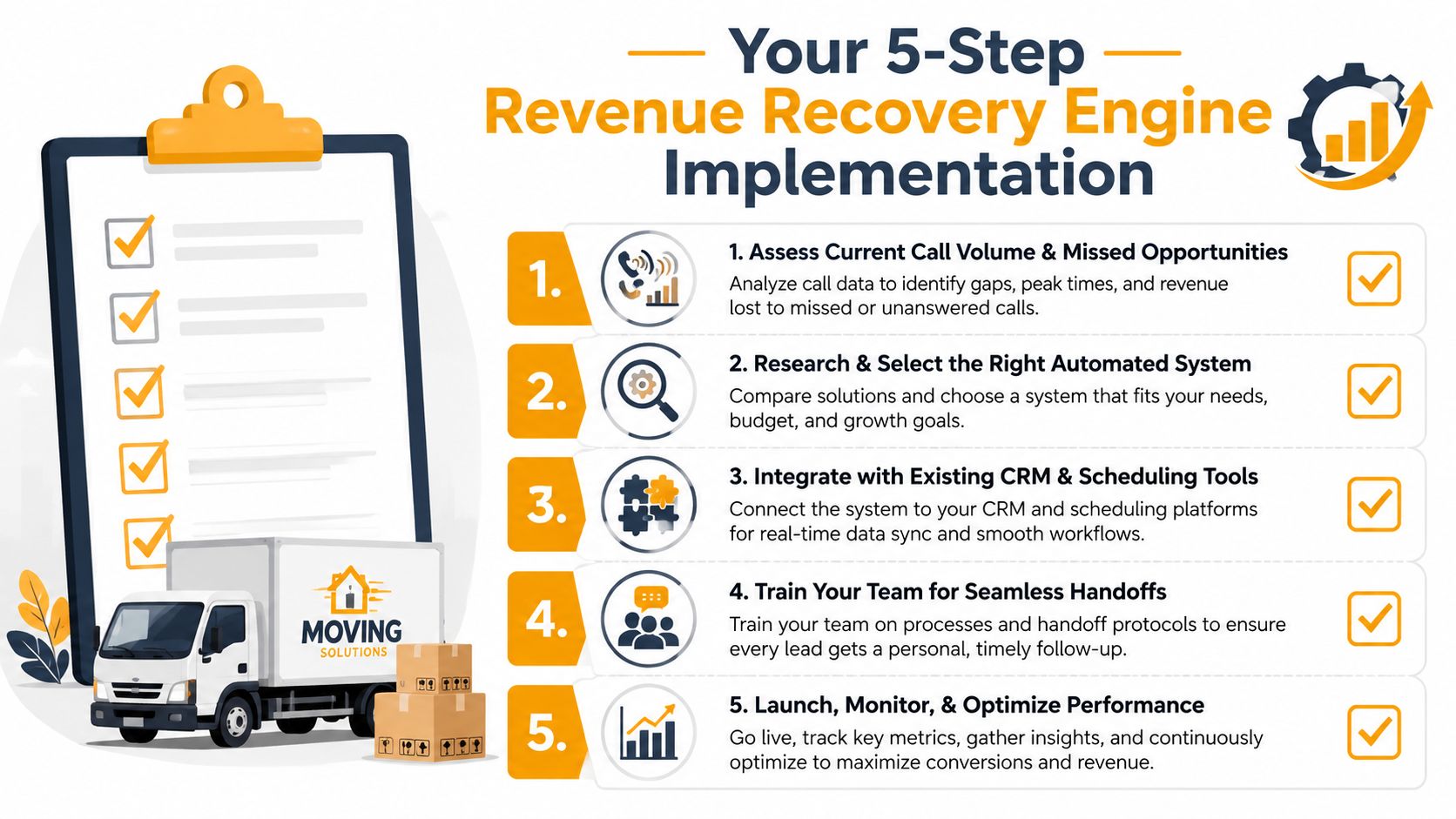
Step 1 and Step 2
Audit your current call flow
Check when calls are missed, who is supposed to answer them, and what happens next. Look closely at evenings, lunch periods, weekends, and peak moving dates. You’re trying to find patterns, not assign blame.Write down your quoting rules
Often, projects stall at this stage. Put your logic in plain English. Hourly or flat rate. Travel time. Minimums. Stair charges. Long carries. Packing. Specialty items. Date restrictions. If your best estimator knows it in their head, document it.
“If your quote process lives only in one rep’s brain, you don’t have a process. You have a dependency.”
Step 3 through Step 5
Choose a mover-specific booking workflow
Avoid systems that only capture contact details. You need one that can qualify, follow your pricing logic, and support actual booking steps. If it can’t handle moving language and quoting rules, your office will still end up cleaning up the mess.Connect it to the tools you already use
This part should be boring. That’s a good thing. The best setups drop data where your team already works, whether that’s SmartMoving, Supermove, MoveitPro, or Google Calendar. No separate black box. No duplicate entry.Test before you trust it
Run sample calls. Try common scenarios. Include awkward ones. Third-floor walk-up, flexible date, packing add-on, storage in the middle, small move that still has access complications. Make sure the handoff, quote logic, and booking steps work the way your office expects.
A few things that do work:
- Clear ownership: One person should own setup and review.
- Recorded test scenarios: Use real call examples from your business.
- Weekly review in the first month: Listen for missed details, pricing confusion, or bad handoffs.
A few things that don’t:
- Winging the rate card
- Leaving dispatch out of setup
- Assuming “live answer” automatically means “booked job”
Turn Your Ringing Phone into Your Best Salesperson
The core issue with moving company missed calls isn’t that the phone rang and nobody picked up. The actual problem is that a customer raised their hand, and your business didn’t move that person toward a booked job.
That’s why voicemail, message taking, and generic intake only solve part of the problem. They may reduce silence, but they don’t necessarily improve booked revenue. In moving, the winning system is the one that can handle the whole front end cleanly. Qualify the lead. Gather the right details. Quote accurately. Get the next commitment while the customer is still ready to act.
Owners don’t need more software tabs. They need fewer leaks. They need a process that works when the office is busy, when the trucks are out, and when calls come in after hours.
If you fix that gap, your ringing phone stops being a source of stress and starts acting more like your best salesperson.
If you want to see what that looks like in practice, MoveJoy is built for exactly this gap. It helps moving companies turn inbound calls into qualified quotes and booked jobs using their own rate card, with direct booking into the tools they already use.