How to Answer Calls Moving Company: Book More Jobs

Most moving company owners don't lose jobs because their crews can't move furniture. They lose jobs because nobody handled the first phone call like a sales event.
The pattern is familiar. The owner is on-site. Dispatch is juggling reschedules. The office line rings during a carry, after dinner, or on a Saturday. The call goes to voicemail, or someone answers with a flat “hello,” takes a name, and promises a callback later. By then, the customer has already called the next mover.
That is why learning how to answer calls moving company style isn't a front-desk issue. It's a revenue issue. In one industry discussion, movers note that most customers contact 3–4 moving companies, and missing even 1–2 calls can mean roughly $800–$1,000 in lost revenue per missed opportunity. The point is simple: the first responder usually wins, and every inbound call has to be treated like booked revenue trying to get in the door (industry discussion on missed-call revenue loss).
Table of Contents
- The First 15 Seconds Opening Scripts That Win the Job
- From Hello to Qualified Lead The Essential Question Playbook
- Quoting on the Call Hourly vs Flat Rate Quick Checks
- Handling Objections and Scheduling the Job
- Solving After-Hours and Overflow Call Problems
- Building Your Revenue Engine Training and Tools
The First 15 Seconds Opening Scripts That Win the Job
Why the opening matters more than most owners think
Most movers answer the phone like they're interrupting work. Customers hear that immediately.
A strong opening does three things fast. It tells the caller they reached a real company, it creates confidence that you do this all day, and it moves the conversation toward booking instead of price shopping. If your first line sounds casual, distracted, or rushed, the caller assumes the rest of the job will feel the same way.
Practical rule: The opening should sound like a company that runs trucks, schedules crews, and solves problems, not a guy grabbing his phone between stops.
The mistake is thinking the opener needs personality. It doesn't. It needs control.
Good opening:
- Company first: “Thanks for calling ABC Moving, this is Sarah. Are you planning a local move or a long-distance move?”
- Professional and directional: “ABC Moving, this is Mike. I can help you with pricing and availability. What's your move date?”
- Confident triage: “Thanks for calling ABC Moving. This is Jen. Let me get a few details so I can tell you the best next step.”
Bad opening:
- Too casual: “Hello?”
- Too vague: “Moving company.”
- Too passive: “Can I take a message and have someone call you back?”
That last one is especially expensive because it pushes the lead back into shopping mode. If you don't sound ready to help right now, the caller keeps dialing.
Say this not that
Owners often ask for a perfect script. You don't need perfect. You need consistent.
Use this simple structure in the first few seconds:
| Opening step | What to say |
|---|---|
| Identify the business | “Thanks for calling ABC Moving” |
| Identify the speaker | “This is Chris” |
| Signal competence | “I can help with pricing and availability” |
| Take control | “What's your move date?” |
That sequence works because it removes uncertainty. The caller knows who you are, who they're talking to, and what happens next.
A few practical swaps make a big difference:
- Instead of “How can I help you?” say “What's your move date and where are you moving from?”
- Instead of “We'd need to see” say “I can get you a ballpark now and tell you if we need a walkthrough.”
- Instead of “Someone will call you” say “Let's get the key details while I have you.”
If your team struggles with this, standardize the greeting and post it at every desk. A cleaner business telephone greeting matters because it sets the tone before pricing ever comes up. This guide on business telephone greeting best practices for movers is worth reviewing with anyone who answers inbound calls.
From Hello to Qualified Lead The Essential Question Playbook
A lead goes cold when the conversation feels random. The caller starts with “I just need a quote,” and your rep jumps from address to bedrooms to stairs to packing to storage. That doesn't sound organized. It sounds like you're building the plane in flight.
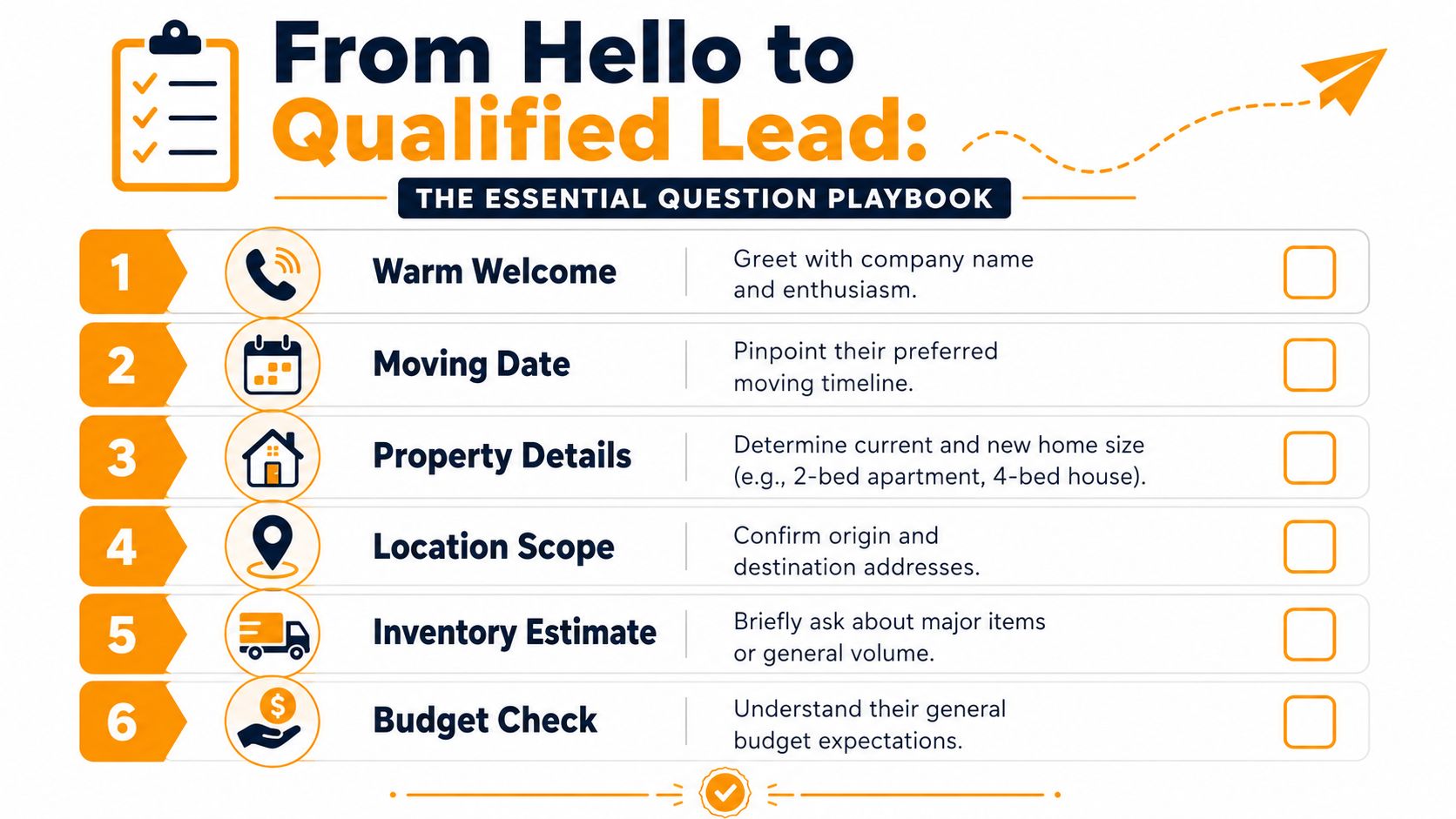
High-performing moving intake follows a structured sequence: identify the caller, confirm move date flexibility, capture origin and destination, then move into quote details or a scheduled walkthrough. Operators who use that order waste less time on weak inquiries, and callers who can't provide dates or addresses are often not serious leads (structured moving call intake guidance).
Use a sequence not a scattershot script
The fastest way to qualify a moving lead is to ask in layers.
Start with identity and contact details
Get the caller's name, best phone number, and email early. If the call drops, you still own the lead.Pin down the timing
Ask for the move date first, then ask if that date is firm or flexible. A flexible date gives your scheduler room and tells you the caller may be workable even if the preferred slot is full.Lock in origin and destination
You need actual addresses or at least enough detail to determine service area, travel considerations, and crew planning. Serious buyers usually have this ready.
If a caller can't give you a move date or basic addresses, don't spend ten minutes building a quote around a job that may not exist.
The questions that protect quote accuracy
After the basics, move into the details that make or break margins.
- Current home size: Ask whether it's an apartment, condo, or house, then ask for bedroom count or overall size. This gives you a first-pass volume estimate.
- Destination details: The new place matters as much as the old one. A ground-floor pickup into a third-floor walk-up is not the same job as first-floor to first-floor.
- Access issues: Stairs, elevators, long carries, tight hallways, loading dock limits, and truck access all affect labor time and risk.
- Special items: Pianos, safes, treadmills, glass tops, large sectionals, and fragile pieces need to be called out during intake, not discovered by the crew.
- Add-on services: Packing, unpacking, materials, disassembly, reassembly, and storage change both price and scheduling.
Modern call intake for movers has become much more structured for exactly this reason. Live workflows are now built to capture origin, destination, home size, special items, move-date flexibility, and access issues during the call, then sync those details into systems such as MoveitPro or SmartMoving so quoting and scheduling can happen without rekeying the same information later (moving call intake workflow overview).
A strong rep doesn't interrogate. They guide.
Try wording like this:
- “I'll ask a few quick questions so I can give you the right pricing.”
- “Any stairs, elevator reservations, or long walks from the truck to the door?”
- “Are there any heavy or high-value items I should account for now?”
If your staff needs a cleaner qualification framework, this checklist on how to qualify moving leads is useful for scripting and training.
Quoting on the Call Hourly vs Flat Rate Quick Checks
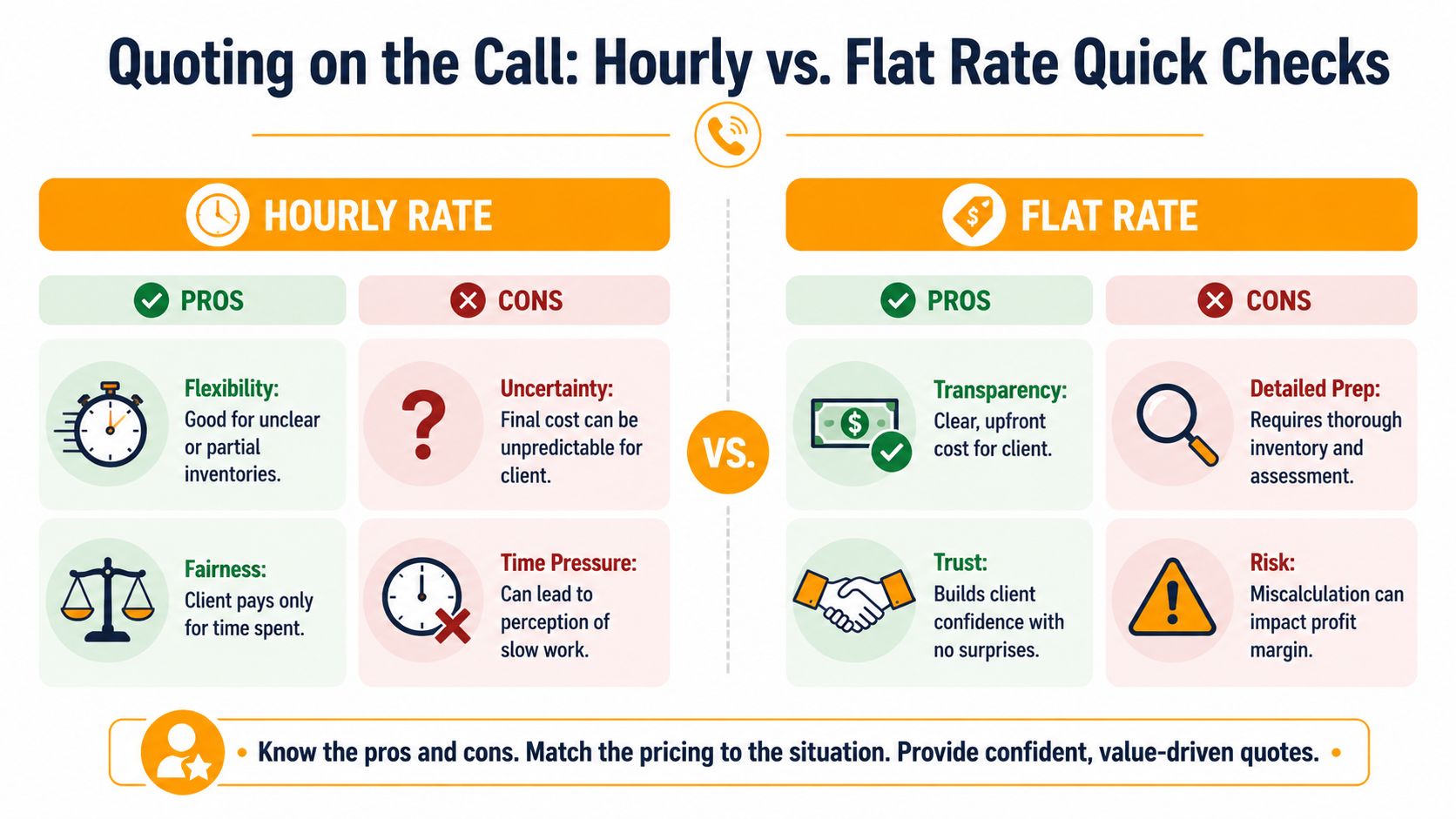
The quote is where confidence shows up. If your rep gets to pricing and starts stalling, the lead feels it. “We'll have someone review it and call you back” often sounds like “we don't know our own numbers.”
Most moving companies don't need a full survey for every call. They need a quick-check method based on their own rate card, service area, minimums, and known add-ons.
When hourly works better
Hourly pricing usually works best when the move is local and the inventory is still somewhat loose.
Use it when:
- The job is nearby and travel policy is straightforward.
- The inventory is incomplete but the home size and access details are clear enough to set expectations.
- The caller wants speed and mainly needs a realistic range to decide whether to move forward.
The trade-off is predictability. Hourly can feel fair because the customer pays for time used, but it can also create anxiety if you don't explain what may extend the clock.
When flat rate works better
Flat-rate pricing is stronger when the move is more defined and the risk of scope drift is lower.
It makes sense when:
- Inventory has been properly qualified
- Travel and logistics are clear
- The move has complexity that you want to account for upfront rather than debate later
A lot of owners in service trades struggle with this same pricing tension. Some of the best thinking on job pricing comes from adjacent home-service operators who obsess over margin discipline. If you like owner-level operational advice, this resource on coaching for tradie business growth is worth a read because the pricing and staffing trade-offs are very similar.
How to present extras without sounding slippery
What loses trust isn't charging for extras. It's surprising the customer later.
Use plain language:
- Packing materials: “If you want us to bring materials, I'll note that separately so there are no surprises.”
- Stairs or long carries: “If there's a long walk from truck to door or multiple flights, that affects labor time, so I want to account for it now.”
- Special handling: “For items like pianos or safes, we price that separately because it requires different planning.”
The best phone quotes don't promise the lowest number. They make the final invoice feel consistent with what the caller was told.
If you want your quoting process to be tighter and more consistent, review these practical tips for accurate moving quotes over the phone. The main objective is simple: give a usable number now, explain the assumptions, and define what would change it.
Handling Objections and Scheduling the Job
Most objections aren't rejections. They're signs that the caller still has unanswered risk in their head.
When someone says, “That's more than I expected,” they usually aren't asking for a cheaper truck. They're asking why your company is worth trusting with the move. If your rep hears every objection as a price complaint, they'll discount too early and still fail to close.
Objections are usually requests for confidence
Use responses that reframe around planning, execution, and clarity.
If the caller says the quote feels high:
- Anchor to scope: “That number includes the crew and the job conditions you described, especially the stairs and larger items.”
- Anchor to certainty: “I'd rather give you a realistic quote now than a low number that changes on move day.”
- Anchor to professionalism: “The goal is a smooth move with the right crew and no surprises.”
If the caller indicates they need time to decide:
- Lower pressure, keep momentum: “Of course. Before we hang up, let me reserve the details and send everything over so you have it in writing.”
- Ask one more useful question: “Is there anything specific you're comparing, price, timing, or service?”
A hesitation is often the right time to tighten the process, not loosen it.
The close should happen on the same call
Once the lead is qualified and the quote is accepted, move directly into scheduling. Don't create a second gap where the customer can keep shopping.
Use a booking workflow like this:
- Confirm the service date and arrival window
- Repeat the addresses and key job conditions
- Verify special items and add-on services
- Collect the best mobile number and email
- Send written confirmation immediately
The follow-up discipline matters even when the caller doesn't book on the spot. One mover-focused process recommends an automated acknowledgment within 5 minutes, a personal phone call within 1 hour, a second attempt the next day at a different time, then additional touches on days 3, 5, 10, and 30, using SMS and email because many customers ignore voicemail (structured follow-up process for movers).
That means voicemail alone is weak. A missed inbound call should become a tracked lead with a sequence attached to it.
A simple follow-up stack works well:
| Lead status | Best next action |
|---|---|
| Missed inbound call | Send acknowledgment fast, then call back |
| Quote sent, no response | Text and email, not voicemail only |
| “Need to think about it” lead | Schedule next follow-up before hanging up |
| Warm lead gone quiet | Retry at a different time of day |
Owners who tighten this process usually find the same thing. They didn't have a lead problem. They had a follow-up problem.
Solving After-Hours and Overflow Call Problems
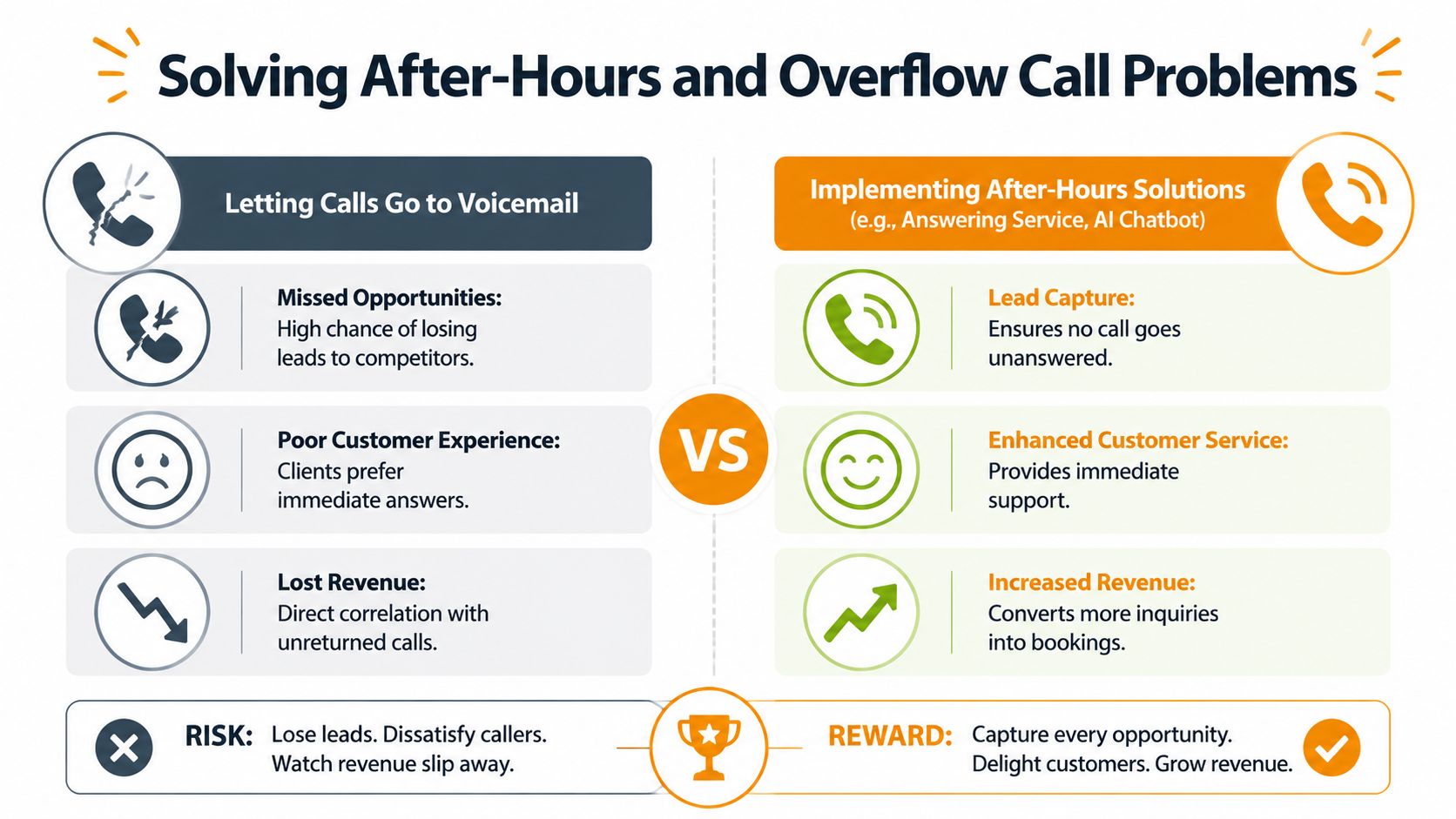
The calls you miss at night, on weekends, and during peak-season chaos are often the easiest jobs to lose. That's when the owner is driving, the office is closed, and everyone tells themselves they'll call back later.
Later is too late if another mover qualified the lead while you were unloading.
Three options and only one protects revenue well
Most moving companies rely on one of three after-hours setups.
Voicemail
This is the weakest option. It creates delay, loses context, and depends on the customer caring enough to wait. Many won't.
Human answering service
Better than voicemail because at least the call gets picked up. The problem is that message-taking is not the same as qualification, quoting, or booking. You captured a lead, but you didn't close anything.
Automated intake and quoting workflows
This is the strongest operational model because it preserves the actual sales process. The system doesn't just answer. It follows your qualification logic, gathers usable details, and keeps lead tracking intact.
What small operators need during peak pressure
The after-hours problem gets worse during busy season because the same people handling sales are often also running jobs. The core issue isn't just call coverage. It's protecting quote quality and lead tracking when nobody has time to stop and think. Broader guidance for movers points to automation, remote access to customer data, and CRM integration as the fix under peak-season pressure (after-hours call handling for moving companies).
For a practical side view outside moving, this guide on how to automate support and delight customers is useful because it shows the broader principle well: fast response helps, but consistent process is what protects the customer experience.
Use this test on your current setup:
- Can it collect full move details? Names and phone numbers aren't enough.
- Can it follow your quote rules? If not, your team still has to rebuild the lead manually.
- Can it update your system of record? If details live in texts, sticky notes, and missed-call logs, jobs will fall through cracks.
- Can it book while you're asleep or on a truck? If not, it isn't solving the actual problem.
The best after-hours system acts like your best trained inside sales rep, not like a digital voicemail box.
Building Your Revenue Engine Training and Tools
A missed process on the phone costs money twice. First when the rep fails to book the job, then again when operations has to clean up a bad intake, a vague quote, or a schedule conflict. Owners feel this every day. The phone is not a front-desk task. It is the front end of revenue.
Train for consistency not personality
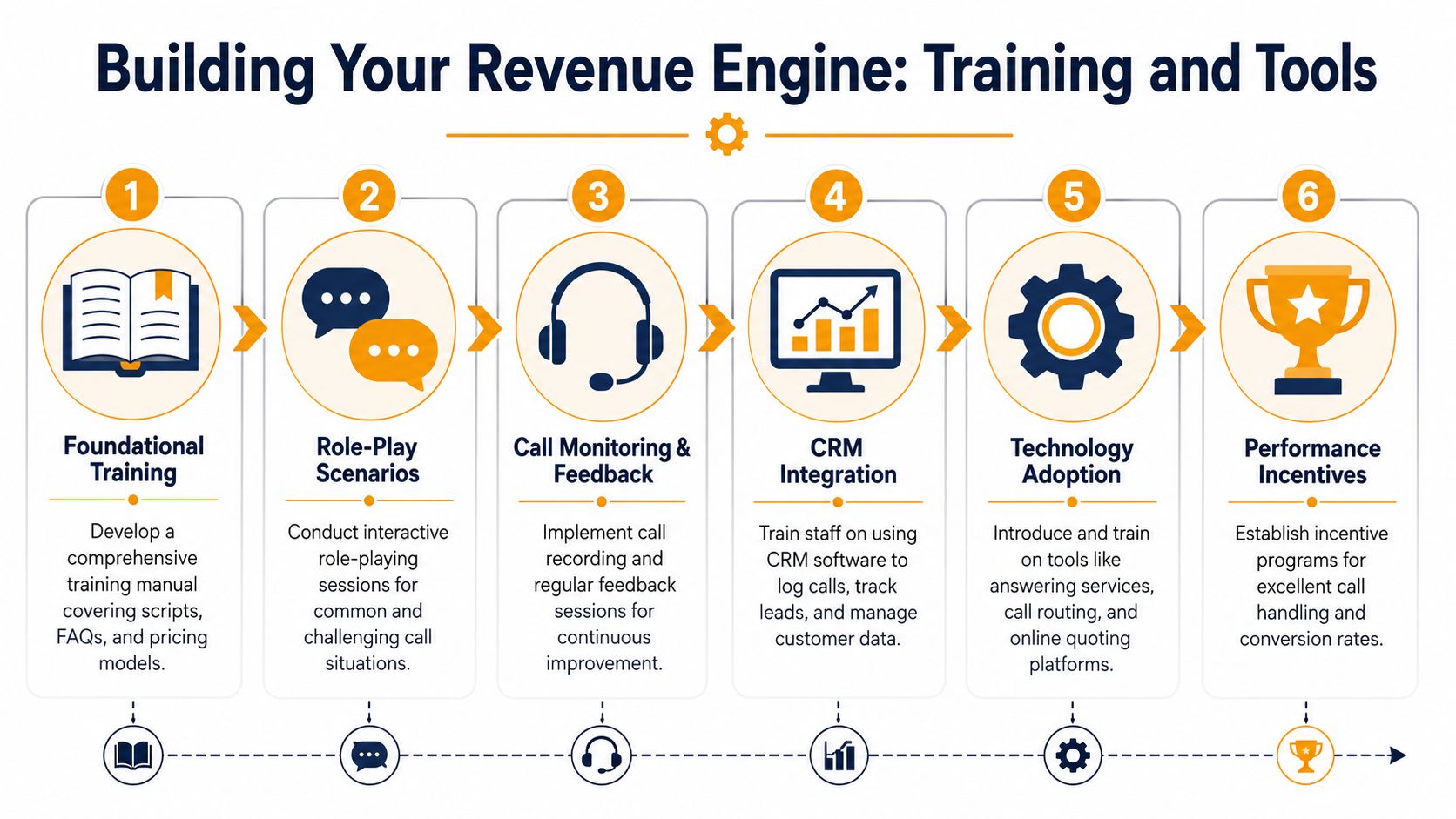
A friendly rep who skips key questions will still lose jobs. A tougher rep with a clear process will usually produce better quotes, cleaner schedules, and more booked revenue.
Train around the actual sales path your team must execute on every call:
- Opening: Greeting, control of the conversation, and a clear next step
- Qualification: Required details gathered in the same order every time
- Quote delivery: How to explain hourly work, flat-rate work, travel time, minimums, and assumptions
- Objection handling: Approved responses to price pushback, shopping behavior, and "I need to think about it"
- Close and confirmation: Deposit, date hold, written confirmation, and handoff into operations
Role-play short, ugly calls. Not perfect ones. Have office staff practice late callers, rushed customers, partial information, and shoppers comparing three movers at once. That is where revenue leaks.
Then score calls against a checklist. Did the rep collect the move date, addresses, inventory, access constraints, and decision timeline? Did they ask for the booking before ending the call? If not, coaching stays vague and nothing changes.
If you record calls for coaching or quality control, document that process carefully. This guide to secure business communication is a useful reference for call recording, storage, and oversight.
Connect the phone to the rest of the operation
Call handling breaks down when sales, dispatch, and follow-up live in separate places. The rep answers the phone in one system, writes notes somewhere else, builds a quote later, and hopes nothing gets lost. That setup creates bad estimates and missed follow-up.
Use tools that push call details straight into your operating system. The ideal workflow is simple. The rep captures the move details once, sees calendar availability while the caller is still engaged, sends the quote fast, and updates lead status without duplicate entry. Software directories such as Capterra's moving software category are useful for comparing platforms that support quoting, scheduling, and CRM tracking.
A setup that protects revenue usually includes:
- CRM sync: Lead details land in SmartMoving, Supermove, MoveitPro, or your system of record without retyping
- Live schedule visibility: The rep can offer real dates and time windows on the call
- Automatic follow-up: Quote emails, confirmations, and reminders go out on schedule
- Lead-stage tracking: New lead, quoted, pending follow-up, booked, and lost
- Call review tools: Managers can audit real calls and coach to script compliance, close rate, and quote accuracy
The call answering process determines whether small operators gain or lose margin. If the phone process is tight, dispatch gets usable information, crews arrive with fewer surprises, and fewer leads die in a notebook or missed-call log. If the process is loose, the owner ends up being the human integration between sales and operations.
The best companies train the phone like a sales function and build the tools around that standard. That is how a moving company turns inbound calls into booked jobs instead of admin work.
If your company is losing jobs to missed calls, slow callbacks, or inconsistent quoting, MoveJoy is worth a look. It's built for movers to qualify leads, generate accurate quotes using your rate card, and book jobs directly into your CRM or calendar, so the phone does what it should do: bring revenue in.