What is First Call Resolution? A Mover’s Guide to Booking More Jobs
Let's cut to the chase. For a moving company owner, First Call Resolution (FCR) means one thing: booking the job on the first call. It’s not about answering a question. It’s about turning a random phone call from a potential customer into a confirmed move on your calendar, right then and there.
This is the difference between a one-touch sale and a lead that goes cold while you’re out on a job site. It’s the key to stopping revenue leakage.
What First Call Resolution Means for Your Moving Business
Think of FCR as the ultimate report card for your sales process. When a potential customer calls for a quote, a high FCR means your people, pricing, and process are so dialed in that you can give them a firm price and get them on the calendar immediately.
No more phone tag. No more callbacks that go straight to voicemail. And definitely no more lost leads who just call your competitor next.
In our industry, speed is everything. A customer looking for a mover is ready to buy now. They'll almost always book with the first company that gives them a confident, professional answer and a clear price.
For an owner-operator with a few trucks, a high FCR is like a perfect pack-and-move day—everything gets handled in one seamless trip. A low FCR is like making two trips because you forgot something critical. It just wastes time, fuel, and money.
Understanding the FCR Metric
FCR is a standard way to measure how many customer inquiries get completely resolved in the first interaction. Across most service industries, a good FCR rate falls between 70% and 79%. This means the vast majority of issues are handled without any need for follow-up.
The calculation is simple: just divide the number of calls resolved on the first try by the total number of calls you received. You can learn more about these customer experience benchmarks and how they're calculated.
This infographic breaks down what you're tracking.
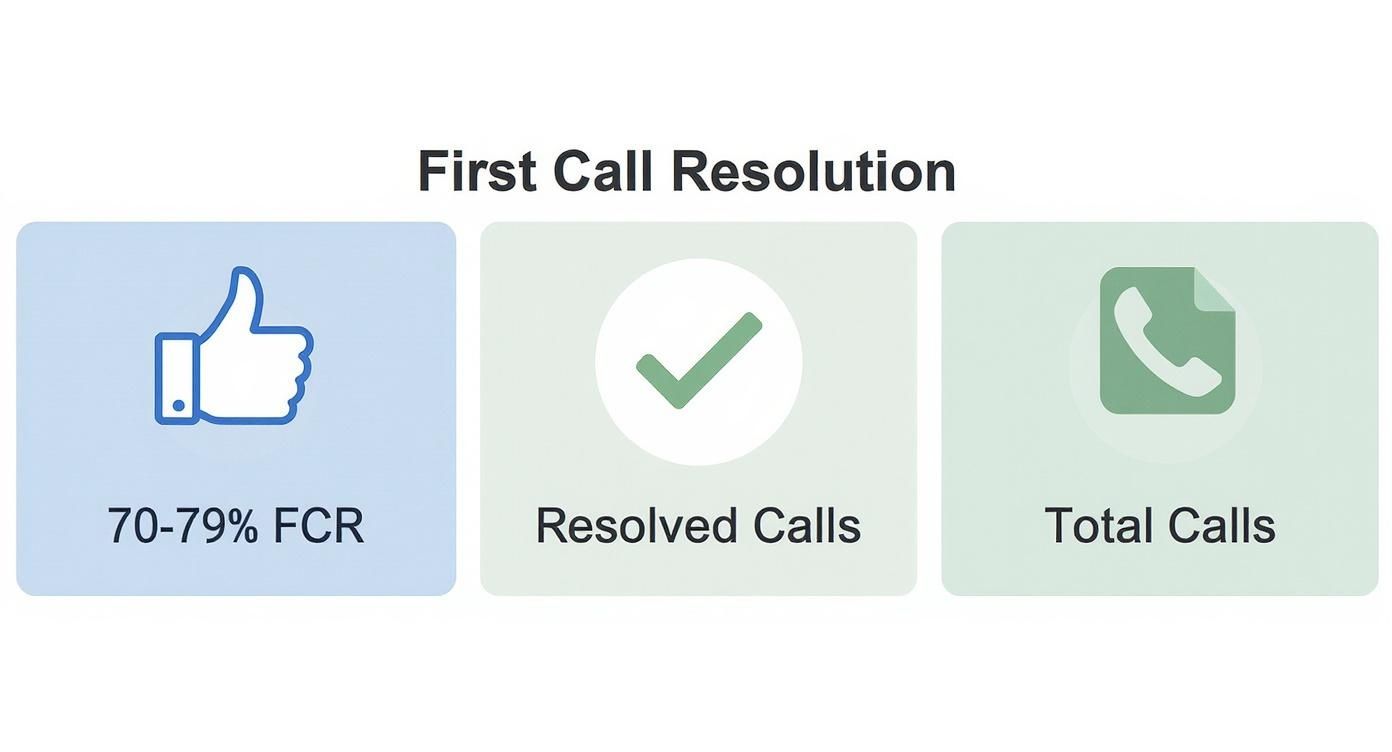
This really just highlights one simple goal: turning the majority of your incoming calls into booked jobs on the first attempt.
The difference between a high and low FCR isn't just a number on a spreadsheet; it's the difference between a chaotic, leaky sales funnel and a smooth, profitable operation.
How High FCR vs Low FCR Impacts Your Moving Business
| Metric | High FCR Moving Company | Low FCR Moving Company |
|---|---|---|
| Booking Rate | Consistently high. Most qualified leads are booked on the initial call, maximizing the return on marketing spend. | Erratic and low. Leads are lost to competitors during the callback lag. You're paying for leads that your competitors are closing. |
| Operational Costs | Lower. Less time is wasted on phone tag and follow-ups. Staff can focus on dispatch, crew management, and other core tasks. | Higher. Staff spend hours chasing leads, leaving messages, and re-explaining quotes, driving up labor costs for each booked job. |
| Customer Experience | Excellent. Customers feel heard, get quick answers, and are impressed by the professionalism. This leads to better reviews. | Poor. Customers get frustrated by delays, unreturned calls, and having to repeat information, often leading to negative online reviews. |
| Revenue & Growth | Predictable and strong. A steady stream of efficiently booked jobs fuels growth, allowing for investment in new trucks and crew. | Stagnant. Lost jobs and high operational costs eat into profits, making it difficult to scale the business. |
As you can see, a high FCR isn't just about efficiency—it directly impacts your bottom line, your reputation, and your ability to grow. It’s the engine that powers a healthy moving business.
The Real Cost of a Low Booking Rate
Every call you don't book on the spot isn't just a missed opportunity—it's thousands in lost revenue slipping right through your fingers. Let's be blunt and just do the math. When the average moving job is worth over $1,000, failing to book just one or two leads a week adds up, fast.
For a small moving company, this isn't pocket change. We're talking about $50,000 to $150,000 in lost annual income. That’s a new truck. That’s better pay for your crew. That's the marketing budget you need to finally dominate your service area. This is the real, painful drain caused by a low First Call Resolution rate.

Uncovering the Hidden Costs
The financial damage goes way beyond just the value of the lost job. A low booking rate creates a ripple effect of inefficiency that costs you in other ways, bleeding your business dry without you even noticing.
Think about these hidden operational expenses:
-
Wasted Labor Hours: Your time, or your office manager's time, is valuable. Every minute spent chasing down a lead with follow-up calls and voicemails is time that could have been spent on dispatching, managing crews, or actually planning for growth.
-
Burned Marketing Dollars: You paid good money for that lead. Whether it came from Google Ads, Yelp, or a local mailer, every lead that doesn't convert is like setting a pile of cash on fire. You're essentially paying to generate business for your competitors who did answer the phone.
-
Damaged Reputation: Customers who have to chase you for a quote don't feel valued. They get frustrated and are far more likely to leave a negative review, even if they do eventually book with you.
Why This Problem Is Bigger Than You Think
Now, let's connect this back to the reality of running a moving company. The data we see from operators just like you paints a clear, painful picture of just how much revenue is leaking out.
Consider this: 15-25% of all calls to moving companies are missed entirely. On top of that, another 35-40% of inquiries come in after hours or on weekends when no one is in the office.
When you add those numbers up, it's easy to see how a few missed calls a day become a massive financial problem over the course of a year. It’s not a small leak; it's a busted pipe.
If you want a more detailed breakdown, you can learn about the real cost of missing just 4 calls per week in our other guide. This is the core issue that a strong focus on First Call Resolution aims to solve—plugging the leak and turning every single inquiry into a potential booked job.
Why Your First Calls Aren’t Turning into Booked Moves
So, you’re getting calls, but they aren’t becoming jobs. What gives?
From our experience talking with hundreds of moving company owners, it’s rarely one big thing. It’s usually a handful of small, predictable breakdowns in your process that add up to a serious amount of lost money.
Think of this as a quick diagnostic check for your business. Let’s walk through the usual suspects we see every day that are killing your First Call Resolution rate and costing you moves. This isn't about pointing fingers; it’s about finding the exact spots where cash is leaking out of your company.
Busy Season Chaos
The busy season should be your most profitable time of year. For many, it’s just the most chaotic.
The phone is ringing off the hook, but you and your crew are out on a job. Every one of those calls you can’t get to is a potential $1,000+ move that probably just went to the next mover on the Google search list.
When a customer is ready to book, they don't want to leave a voicemail. They want answers now. If you can’t give them that, they’ll find someone who can in a matter of minutes.
The After-Hours Black Hole
Here’s a hard truth: 35-40% of moving inquiries come in after 5 PM and on weekends. If your “office” closes when your trucks stop running for the day, you're missing a massive piece of the pie.
A generic voicemail asking customers to call back during business hours is the same as telling them to call your competitor.
These after-hours leads are often the most motivated and ready to make a decision. Failing to connect with them immediately is one of the biggest—and most avoidable—reasons for a low booking rate.
Inconsistent Quoting and Untrained Staff
Another common killer is inconsistency. Maybe you’ve got a new person answering the phone who doesn’t know how to price a three-bedroom house with stairs. They promise to call back with a quote, but by then, the lead has already gone cold.
Or maybe you give one price, and another crew member gives a totally different one. This kind of confusion creates doubt and makes a customer think twice about booking with you. Without a standardized, quick quoting process that anyone on your team can follow, you’ll never nail First Call Resolution.
The industry is waking up to this. Before 2018, only about half of service teams even bothered to track FCR. By 2024, that number jumped to 80%. Still, even with a typical call center hitting a 70-79% FCR rate, a lot of customers still need callbacks—which shows just how tough it is to get this right. You can dig into more of these customer service trends on Salesforce.com.
Practical Ways to Boost Your Booking Rate
Improving your First Call Resolution rate doesn’t mean you have to buy a whole new software suite or double your sales team. It's really about making smart, practical tweaks to what you're already doing.
These are the kinds of low-cost, high-impact changes you can make today to book more jobs and stop leaving money on the table. Let’s break it down into simple strategies that make a real difference to your bottom line.

Standardize Your Quoting Process
The number one reason calls don't convert? The person answering the phone can't give a confident quote on the spot. You need a system that anyone—you, your office manager, or a new hire—can use to give a consistent, accurate price every single time.
Create a simple pricing sheet or a cheat sheet that covers all your core services.
-
Hourly Rates: Have clear rates listed for a 2-man, 3-man, and 4-man crew. No hesitation.
-
Travel Fees: Define your service area and know exactly what you charge for jobs outside that radius.
-
Specialty Items: Note any flat fees for things like pianos, safes, or that ridiculously heavy armoire.
-
Packing Supplies: Keep prices handy for boxes, tape, and packing paper.
When your team has this information at their fingertips, they can stop saying, "Let me call you back," and start saying, "Great, we can get you on the schedule for Tuesday."
Develop Simple Qualifying Scripts
Let's be honest: not every call is a good fit for your company. To improve your booking rate, you need to quickly identify the serious, qualified leads from the tire-kickers.
A short script helps your team gather the essential details in the first 60 seconds of the call. This lets you decide right away if it's a job worth pursuing. For more on this, check out our guide on how to get moving leads that actually turn into jobs.
Every 1% improvement in FCR can reduce your operational costs by 1%. It’s simple: fewer repeat calls mean less wasted time and better efficiency. While the global benchmark for a good FCR is around 70%, hitting an elite 80% rate is something only about 5% of companies manage to pull off. You can dive deeper into these first call resolution benchmarks on Talkdesk.com.
Establish a Clear After-Hours Plan
With 35-40% of leads coming in after business hours, your voicemail just isn't cutting it anymore. You need a dedicated system to handle these calls professionally.
This doesn't mean you have to be awake 24/7. It just means having a process to make sure every single lead gets a prompt, professional response.
This could be a dedicated answering service or a solution like MoveJoy that can qualify leads and give instant estimates anytime, day or night. The goal is to engage every potential customer the moment they reach out—not hours later, when they've already booked a job with the first company that picked up the phone.
Let’s get real for a second.
Picture a 10-truck moving company down in Texas. It's the spring busy season. The phone is ringing off the hook, but the owner is out on a job, and his dispatcher is already on another line. Every missed call is a lost opportunity. That company is easily losing $15,000 a month in moves they could have booked.
This isn't some made-up scenario; it’s the daily reality for so many movers. Your marketing is working. You're generating leads. But the revenue just leaks right out because you can't physically get to every single call.
A potential customer who calls at 9 PM on a Saturday isn't going to wait around until Monday morning for you to call them back. They're going to call the next company on their list.
This is exactly the problem we built MoveJoy to solve. We provide the 24/7 coverage that acts as your always-on booking coordinator. The goal isn't just to answer the phone—it's to handle every inquiry professionally, with the single-minded purpose of booking that job on the first call.
From Missed Opportunities to Confirmed Moves
Think about how many chances slip through the cracks. A missed call during the day while your team is swamped, a lead that comes in while you’re driving between job sites, or an after-hours inquiry that goes to a generic voicemail—these are all open doors for your competitors.
And trust me, they are more than happy to take the job you couldn't answer.
By putting a system in place that ensures every call gets answered and every lead is qualified instantly, that Texas moving company could turn those missed opportunities into booked moves. This is how you stop the bleeding and start converting the leads you're already paying good money for.
The big idea here is to shift from a reactive, "we'll call them back" mindset to a proactive, "we booked them now" strategy. This simple change transforms your front desk from a cost center into a powerful revenue engine.
This is what a high First Call Resolution rate looks like in the real world. It's not about complicated tech or confusing buzzwords. It's about having a reliable system that makes it dead simple for a customer who wants to hire you to actually do it—right away.
You need a solution that understands the moving business, can give an accurate estimate based on your specific rates, and can lock in the booking without you having to lift a finger. It's about turning every single phone call into a job on your calendar, no matter what time of day it is.
Stop Missing Calls and Start Booking More Moves
We’ve covered a lot of ground. You now know what First Call Resolution is, why it's a massive deal for your bottom line, and how to spot the operational leaks that are costing you jobs.
The biggest takeaway is this: every single time your phone rings and you don't answer, you've essentially just held the door open for your competition. Mastering that first conversation—turning a simple inquiry into a booked move right then and there—is how you slam that door shut.

Don't let another busy season bleed revenue. The slow drain from missed calls, voicemail tag, and delayed quotes really adds up, especially when a huge chunk of your best leads call after hours. If you're looking for a game plan, our guide on how to stop losing after-hours leads without working 24/7 digs into the specifics.
If you’re ready to see what a higher booking rate actually looks like for your business, let's talk. We're here to help you capture every lead, starting today.
Frequently Asked Questions
Let's tackle some of the most common questions moving company owners have when they start digging into their booking process and First Call Resolution. We'll keep it simple and focus on what actually moves the needle for your business.
How Can I Measure My Company's First Call Resolution Rate?
Honestly, it's simpler than you might think. You don't need a fancy CRM or analytics software just to get a baseline.
Just track your calls for one week. On a simple notepad or spreadsheet, keep a running total of all new customer inquiries. In a separate column, make a tally mark every time one of those calls ends with a booked job or a scheduled in-home estimate during that very first conversation. No callbacks, no "let me check and get back to you."
To get your FCR, just divide the number of "resolved" calls by the total number of new inquiries, then multiply by 100. If you got 50 calls and booked 15 of them on the spot, your FCR is 30%. That number is your starting point—a clear, no-fluff baseline you can start improving tomorrow.
What Is the Biggest Reason Movers Have a Low FCR?
From all the moving company owners we’ve worked with, the number one reason is painfully simple: not being able to answer the phone live.
It's a classic scenario. You're out on a job, driving a truck, or it's after 5 PM. A potential customer calls, but it goes straight to voicemail. The problem is, by the time you get a free moment to call them back, they've already called two other movers.
In the moving business, the customer almost always books with the first company that answers the phone and gives them a confident quote. Availability isn't just part of the game; it's the biggest hurdle to a high First Call Resolution rate.
How Can a Small Operator Improve FCR Without Hiring Office Staff?
This is the classic dilemma for any 1-20 truck operation. You need the booking power of a full-time office manager, but you can't justify the salary, benefits, and headache that come with hiring another person.
The most practical solution is to find a service that can act as your dedicated front office. Instead of bringing on a full-time employee, a specialized answering service built specifically for movers can handle your calls 24/7.
These systems aren't just taking messages. They can qualify your leads, provide instant estimates based on your exact pricing, and book jobs directly into your calendar. It gives you the power of a full office staff for a fraction of the cost, directly boosting your FCR and pulling back revenue that would otherwise be lost to voicemail.
Ready to stop losing leads and start booking more jobs? MoveJoy acts as your 24/7 booking coordinator, ensuring every call is answered and every lead gets a chance to book. Let's show you how it works: https://getmovejoy.com