Warm Transfer Meaning: A Mover’s Guide to Booking More Jobs
Let's get right to it. A warm transfer is when you hand off a customer call to another team member with a full briefing, so the customer never has to repeat themselves.
It’s the difference between a new hire showing up to a job site clueless versus a foreman who already knows the inventory, the destination, and the client's biggest concerns. For a moving company owner, this is the secret to a killer first impression—the kind that wins the job before your competitor even calls back.
What Is a Warm Transfer and Why Movers Should Care
Imagine a potential customer calls your office during the busy season. Instead of getting dumped into a voicemail box or blindly sent to a busy crew member, they’re greeted, their key details are noted, and they’re smoothly handed off to the right person who already has all the context. That seamless handoff is a warm transfer.
For moving companies, where over 75% of moves are local jobs that demand quick quotes and calendar checks, this isn't a luxury. It's a critical operational step. The person answering shares key context like their name, move date, and any special requirements while keeping the customer on the line.
This small step immediately tells the customer you're competent and you respect their time—two huge factors in how customers select their moving service.
Call Transfer Types For Moving Companies
Not all call transfers are created equal. The way you hand off a call has a massive impact on whether that caller becomes a booked job or a frustrated lead who calls your competitor. Here's a quick breakdown for moving business operations:
| Transfer Type | How It Works | Customer Experience Example |
|---|---|---|
| Warm Transfer | The initial agent speaks with the caller, gathers key info, puts them on a brief hold, briefs the next agent, and then introduces them. | "Hi Jane, I have Mike on the line who can give you a precise quote for his 2-bedroom move on the 15th. He knows you're moving from downtown to the suburbs and have a piano. I'll connect you now." |
| Cold Transfer | The initial agent transfers the call directly to another person or department without any introduction or context. The caller starts from scratch. | "You need a quote? Let me transfer you." (New agent picks up) "Hello, this is dispatch, how can I help you?" (Customer sighs and repeats everything.) |
| Blind Transfer | The agent transfers the call to a line or person without even knowing if they are available. It often goes straight to voicemail. | "One moment." (Customer is sent directly to a ringing phone that goes to voicemail.) "Hi, you've reached Bill. I'm on a job site, please leave a message…" (Customer hangs up and calls the next mover on their list.) |
As you can see, only a warm transfer treats the customer like a priority. The other methods create friction and make your company feel disorganized, costing you leads you paid good money to get. Missed calls and bad handoffs are missed revenue, plain and simple.
The On-the-Job Analogy
Think of it like this: a warm transfer is the office equivalent of a well-briefed moving crew. You'd never send your team to a job without knowing the address, what they’re moving, or if there are three flights of stairs. A warm transfer just applies that same professional prep to your phone calls.
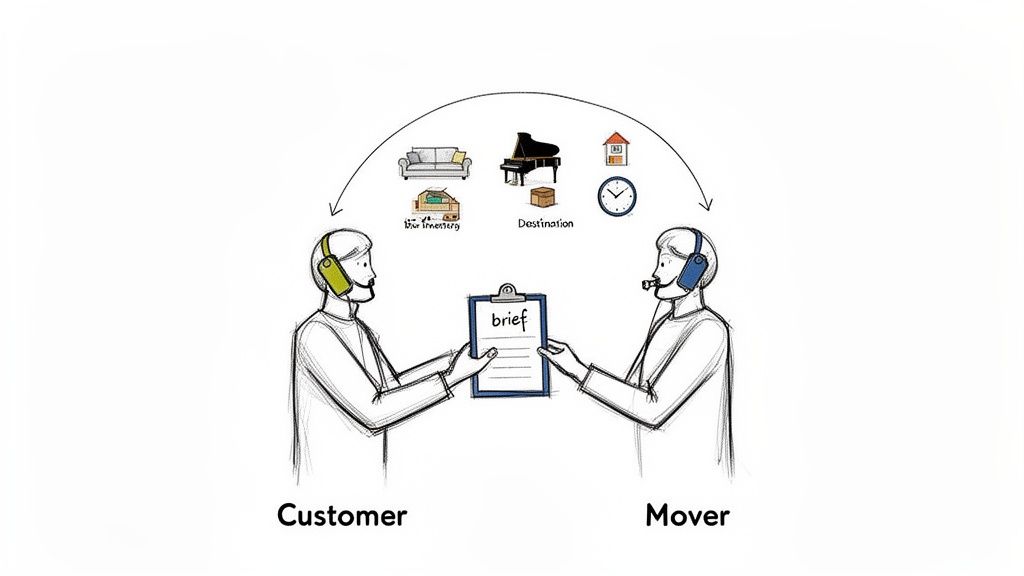
The person who answers first gathers the essential intel:
- Customer's name and move-from/move-to locations.
- Desired move date and flexibility.
- Size of the move (e.g., 2-bedroom apartment).
- Any special items like a piano or hot tub.
This simple process prevents that sinking feeling of frustration that sends potential customers straight to your competitors. It also builds the foundation for more efficient operations—something that any modern moving company software should support. When you treat every call with this level of detail, you stop losing leads to missed calls and chaotic follow-ups.
The True Cost Of A Single Mishandled Call
Let's get real for a minute. A cold transfer isn't just an awkward handoff; it’s a direct punch to your bottom line. In the moving business, speed is everything. One clumsy call experience is all it takes for a customer to hang up and dial your competitor. Speed determines who wins the job.
Picture this: It's a busy Saturday, and a high-value lead calls. They've got a grand piano and need to know if you can store it. Your new office assistant has no clue, so they panic and blindly forward the call to your lead mover. Problem is, he's in the middle of a job, wrestling a sofa down three flights of stairs. He can't answer. The customer, now annoyed, hangs up and immediately calls the next mover on their list.
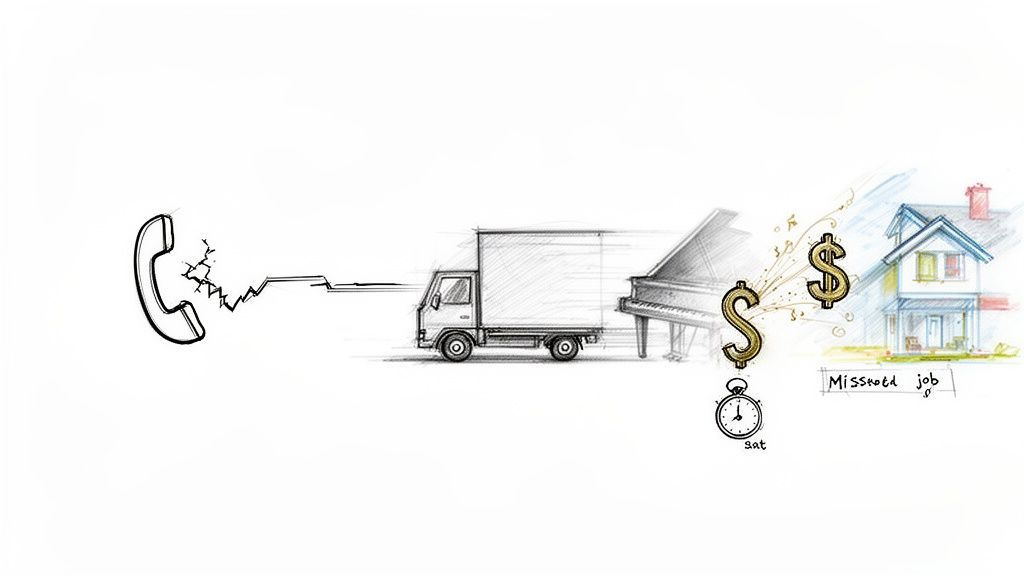
That wasn't just a dropped call. That was a multi-thousand-dollar job you just lost. And worse, that single fumble creates a terrible first impression that can poison your reputation in a tight local market.
The Ripple Effect of One Bad Call
This isn't a rare occurrence; scenarios like this play out every single day for local movers. A single botched call doesn't just vaporize one opportunity. It kicks off a ripple effect that hurts your business in ways you might not even see at first.
- Immediate Revenue Loss: This is the most obvious hit. You just lost a booked job, which for a mover can be worth anything from $800 to over $5,000. Gone.
- Wasted Marketing Spend: You paid good money for that lead. Whether it came from Google Ads, SEO, or a referral, a mishandled call turns that investment into a complete waste.
- Damaged Reputation: Frustrated people talk. That bad first impression can easily turn into negative word-of-mouth, making it harder to land future jobs from referrals.
Understanding the importance of First Call Resolution in customer service really drives home why you have to get it right the first time. Every call you fail to convert is a job you're gift-wrapping for your competition.
Curious how fast these losses pile up? Check out the real cost of missing just 4 calls per week—it's probably a lot more than you think.
How Warm Transfers Fuel Revenue and Efficiency
Ditching cold, impersonal handoffs for a thoughtful warm transfer is one of the fastest ways to make your moving company more profitable. This isn't just about fluffy "customer service"—it's a direct lever you can pull to grow revenue and clean up the chaos in your front office.
When your team gets this right, the benefits start stacking up immediately. You'll book more moving jobs from the calls you're already getting, earn the kind of five-star reviews that bring in new business, and make your entire operation run smoother.
From Chaos to Control
Picture this: your dispatcher gets a call, but all the critical details are already on their screen. Instead of spending ten minutes pulling basic info, they’re handed a lead who has already confirmed their move size, mentioned the piano, and warned about the tight stairwell.
This lets your dispatcher jump straight to what matters, delivering a confident, accurate quote in minutes, not hours.
A seamless warm transfer tells the customer you're a professional, trustworthy company from the very first call. It lays the groundwork for scaling your business without the usual headaches of missed calls and frantic follow-ups.
Turning Voicemails Into Booked Jobs
In a sales-heavy business like moving, a warm transfer is gold. Passing a qualified lead with full context can turn a potential voicemail into a booked job. This is absolutely critical right now. Even with a slight dip in how many people are moving—only 12.1% of Americans moved in 2023—the industry still pulled in over $19 billion. You can dig into more of these moving trends here to see why every single lead counts. Grabbing your slice of that pie comes down to how well you handle every inquiry.
The core benefits for your moving business are simple and powerful:
- Higher Booking Rates: When a customer feels like you've actually listened to them, they’re far more likely to book on the spot. No need to shop around.
- Better Quoting Accuracy: With all the key details upfront, your quotes are tighter. This prevents those costly surprises that tick off customers and wreck your margins.
- Less Wasted Time: Your team spends less time chasing down information and more time booking jobs and managing logistics.
At the end of the day, a solid warm transfer system means more money in your pocket from the leads you’re already paying for. It's about maximizing every opportunity, especially during seasonal spikes.
Your Blueprint for a Warm Transfer Process
Alright, you get the theory. But how do you actually put a warm transfer process into practice in your moving company? The good news is you don't need a bunch of expensive new software. You just need a clear, repeatable playbook.
This is your step-by-step guide to handling calls better, starting today. It doesn’t matter if it's your dispatcher, an office manager, or even an outside answering service picking up the phone. A solid process means every single caller gets the same professional, reassuring experience—turning more of those calls into booked jobs.
It all starts with deciding who answers the phone and what they need to get done on every call.
Step 1: Define Who Answers and What to Ask
First thing's first: assign a primary point of contact for all new calls. Think of this person as the gatekeeper for new business. Their job isn't to know the answer to every single question. It's to qualify the lead efficiently and set them up for a perfect handoff to the person who can give them a quote.
To pull this off, they need a simple script and a non-negotiable checklist for every call.
The Essential Information Checklist:
- Caller's Full Name: Get the spelling right. It sounds small, but it shows you're paying attention.
- Best Callback Number: Absolutely critical in case the call drops during the transfer. Don't skip this.
- Desired Move Date: This is the most important piece of the puzzle. It determines availability right away.
- Move Size & Scope: Keep it simple. "2-bedroom apartment" or "4-bedroom house" is all you need for now.
- Key Challenges: Ask if they have any special items (a piano, a safe) or tricky access (lots of stairs, a long carry from the truck).
This quick checklist makes sure you grab the most important details upfront. It makes the next step a whole lot smoother and helps you book more moving jobs.
Step 2: Set Clear Rules for Transfers
Not every call needs a live transfer. Your front-line person needs to know exactly when to hand off a call and when to just take a detailed message for a callback.
Pro-Tip: A great rule of thumb is to only attempt a warm transfer when you know for a fact a sales manager or the owner is free. Blindly transferring a call to a mover who’s out on a job is a surefire way to lose the lead.
Train your team on how to professionally brief the next person before patching the customer through. A quick, internal heads-up makes all the difference in the world.
Something simple like: "Hey Bill, I've got Sarah on the line for a 3-bedroom move on the 25th. She's got a piano on the second floor. You free to give her a quote now?"
This simple process, as you can see below, is a direct line to more bookings, better reviews, and a much more efficient operation.
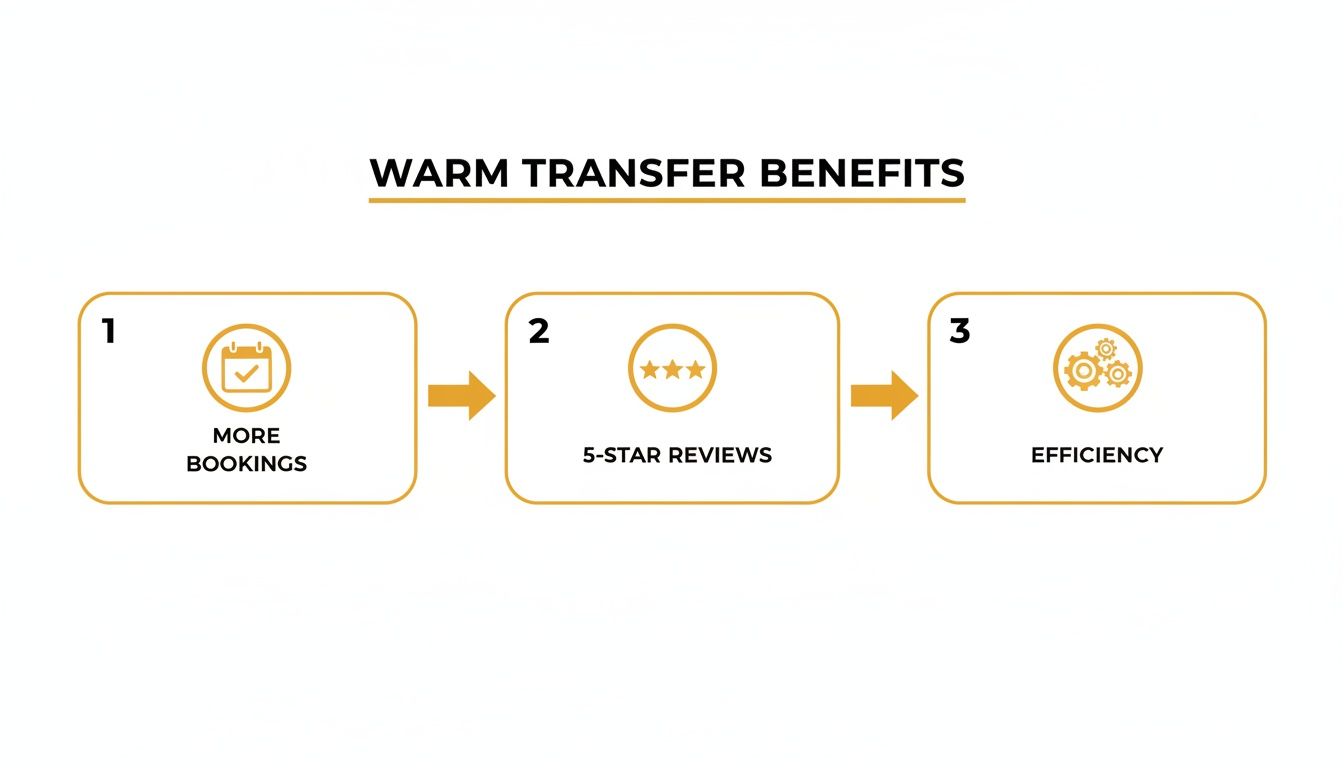
When you get right down to it, mastering this handoff is what separates a chaotic front office from a professional, revenue-generating machine.
From Manual Handoffs To AI Automation
A manual warm transfer is a fantastic way to handle leads, but it’s got one major flaw: it depends on a human being available to make the handoff.
What happens when a motivated customer calls at 8 PM on a Friday? Or during the Saturday morning rush when your entire team is out on a job? If no one’s there to pick up the phone and do that crucial introduction, that lead is gone. They're not leaving a voicemail; they're calling the next mover on their list. Missed calls equal lost revenue.
This is where technology steps in, taking the principle of a warm transfer and making it work 24/7. This is the competitive advantage successful movers are adopting.
The AI Receptionist Takes Over
Imagine having an AI-powered receptionist working for your moving company around the clock. It’s the ultimate first point of contact, answering every single call instantly, without fail. This isn't just about killing your voicemail box; it's about executing a perfect warm transfer of information every time someone calls.
The tech has come a long way. Warm transfers went from clunky 1990s call center systems to the AI-human bridges we see today, drastically cutting down on errors and wait times in fast-paced industries like moving. As you can discover in more detail from moving industry trends, this evolution means AI can now handle the entire front-end of the conversation. It answers the call, qualifies the lead by asking the important questions—like "is it a 2-bedroom with stairs?"—and then gets a fully briefed lead over to your team.
But instead of a live call handoff, an AI receptionist can do all this in just a couple of minutes:
- Gather all the critical job details (move size, date, tricky items).
- Check your calendar for real-time availability.
- Instantly text the customer an accurate quote based on your rates.
This whole process delivers a fully qualified, pre-quoted lead right into your booking calendar or CRM. It's the scalable, reliable way to stop missing calls and capture every dollar, especially if you're looking for an after-hours answering service for your small business.
The result is the same as a perfect warm transfer—a happy, informed customer ready to book. It just happens instantly, without a single employee needing to pick up the phone.
Got Questions About Warm Transfers? We've Got Answers.
Getting your call handling right is the difference between booking a job and losing a lead to the next company on Google. Here are the straight-up answers to the questions I hear most often from moving company owners about warm transfers.
"I Run a Small Operation. Are Warm Transfers Really Necessary?"
Yes. Absolutely. When you’re a smaller company with 1-5 trucks, every single call is a high-value job you can't afford to lose. It's not an extra; it's survival.
A solid warm transfer process means that even if you're out on a job, the person answering your phone isn't just taking a message. They're professionally capturing key details and smoothly handing off the caller. It stops you from losing a booking to a competitor just because you couldn’t answer, and frankly, it makes your small operation look a hell of a lot more organized and trustworthy.
"What's the Most Important Info to Collect on the First Call?"
Get this right and you'll save yourself a ton of headaches. While all the details matter, the two most critical pieces of information are the customer's move size (like a '3-bedroom house') and any major obstacles ('they're on a narrow street with no parking').
Why? Because that context immediately lets you or your sales manager frame the quote and the solution accurately. No more playing 20 questions. It saves time, impresses the customer, and helps you give a more profitable estimate right from the start.
"How Can AI Replace a Warm Transfer Without a Human?"
This is where things get interesting. An AI receptionist achieves the ultimate goal of a warm transfer—moving a fully-informed lead to the next stage without any friction—but it does it differently.
Instead of a human receptionist gathering details and then trying to track down a busy manager for a live handoff, the AI gathers all the same information. But instead of transferring the call, it transfers the complete data directly into your systems.
It can text the customer an instant quote, slap the appointment on your calendar, and create a new lead in your CRM. The outcome is exactly what you wanted: a booked job from a perfectly handled inquiry. The only difference is it happens instantly, 24/7, without interrupting anyone's day.
Stop losing jobs to voicemail and missed calls. MoveJoy answers every call, provides instant quotes, and books jobs directly into your calendar, turning every lead into revenue. See how MoveJoy can help you book more moves.